Chapter 25: Glycogen Synthesis
 Call Kai
 Learn
 Practice Test
 Spaced Repetition
 Match
 Flashcards
 Knowt Play
1/35

There's no tags or description
Looks like no tags are added yet.
36 Terms
uridine diphosphate glucose (UDP-glucose)
formed from glucose 1-phosphate and UTP
activated form of glucose → used in glycogen synthesis
what enzyme catalyzes UDP-glucose formation
UDP-glucose (UDPG) pyrophosphorylase: takes in UTP and G1P → liberates outer 2 phosphoryl of UTP as pyrophosphate; makes UDP-glucose
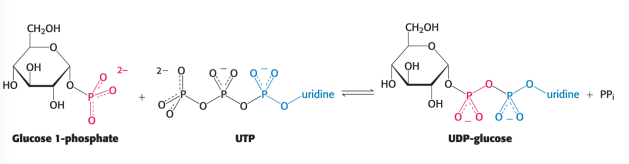
spontaneity of UDP-glucose synthesis
pyrophosphate quickly undegoes highly exergonic hydrolysis by pyrophosphotase
while G1P + UTP → UDPG + PPi is reversible, PPi hydrolysis makes it overall irreversible
*the 2 rxns are not mechanistically coupled though

glycogen synthesis formula

glycogen synthase
key regulator of glycogen synthesis → exists in a and b form
transfers glucose from UDP-glucose to non reducing (OH) end of glycogen via α-1,4-glycosidic linkage
only add glucosyl rediues to chain of 4 or more glucose → needs a primer
glycogen synthase: a and b form
a → mostly active, nonphosphorylated
b → mostly inactive, phosphorylated
opposite convention of glycogen breakdown (glycogen phosphorylase)
”phosphorylase is activated by phosphorylation”
glycogenin
Mn 2+-requiring glycosyltransferase
has 2 identical subunits that autoglycosylate
glycogenin autoglycosylation
each of its subunits forms α-1,4-glucose polymers (10-20 long) on the partner subunit
add glucose from UDP-glucose on to tyrosine residue of each subunit
what makes the branches of glycogen
branching enzyme → breaks a-1,4 link and forms a-1,6 link
from chain of at least 11 glucose, branching enzyme steals 7 residues (with non reducing end) and forms a-1,6 branch at least 4 away from another branch
importance of glycogen branching
incleases soluability
lots of terminal residues fo glycogen phosphorylase and synthase to work on → increases rate of synthesis and degradation
glycogen synthase regulation
like phosphorylase, regulated by covalent modification for fine tuning
allosteric reg of phosphorylated form (synthase b) is the key means
what activates glycogen synthase
glucose 6 phosphate → stabilizes R state of glycogen synthase b
glycogen synthase regulation: covalent modification
phosphrylated at multple sites, notably by glycogen synthase kinase (GSK) and PKA
GSK is controlled by insulin
how is UTP regenerated
nucleoside diphosphate kinase → uses ATP to regenerate UTP from UDP
whats the cost of glycogen synthesis
2 ATP get hydrolyzed but glycogen derive glucose generates 31 ATP → oveall very efficient
link between glycogen breakdown and synthesis
reciprocally regulated → glucagon and epi-triggered cascades that activate breakdown deactivate synthesis
linked through PKA
how is glycogen synthesis turned on
protein phosphotase 1 shuts down glycogen phorylase a and phosphorylase kinase via desphosphorylation → glycogenolysis off
PP1 dephosphorylates glycogen synthase b (converts to a form) → glycogen synthesis on
(edit card from 24 abt regulation to add insulin)
regulation of protein phosphotase 1 (PP1)
activated by insulin, inhibited by glucagon and epinephrine
PP1 structure
catalytic subunit is single-domain
catalytic subunit bound to 1 regulatory subunit: GM in muscle or GL in liver
PP1 structure: regulatory subunit function
regulatory subunits have mutiple domains; interact with glycogen, the catalytic subunit, and target enzymes → scaffolds that bring PP1 and substrates together
how is PP1 inhibited
epi and glucagon release → PKA activation
PKA phosphorylates GM regulatory subunit in muscle, releasing the catalytic subunit → desphosphorylation reduced
PKA phosphorylates and activates inhibitors of PP1 → phosphorylase stays active (a) and synthase stays inactive (b)
phosphorylase and acetylation
acetylation stimulated by glucose and insulin, inhibited by glucagon
acetylation inhibits phosphorylase and enhances dephosphorylation (interacts with PP1)
how is glycogen sythesis stimulated
high [glucose] in blood → insulin stilumates glycogen synthesis
insulin causes glucose uptake (GLUT4) → G6P activates glycogen synthase b
insulin leads to inactivation of glycogen synthase kinase
insulin leads to PP1 activation → dephosphorylates synthase b into a
what is the glucose sensor of liver cells
phosphorylase a → activity drops significantly when glucose infuses in the blood
effects of [glucose] on glycogen metabolism
high glucose → degradation inhibited and synthesis stimulated
inhibits phosphorylase directly
activates synthase indirectyl
glucose effect on phosphorylase a
inactive PP1 binds to phosphorylase a when in phosphorylase a in R state
glucose binds and stabilizes T state → serine 14 phosphoryl group becomes a exposed for PP1 → PP1 dissociates and dephosphorylates a into b form
only liver; muscle phosphorylase a unaffected by [glucose]
glucose effect on glycogen synthase
phosphorylase b doesn’t bind PP1
++glucose → conversion of phosphorylase a into T state → releases PP1 → PP1 inactivates phosphorylase (a to b), then activates glycogen synthase (b to a)
why is there a lag between glycogen degradation and synthesis
~10 phosphorylase a per PP1 → almost all phosphorylase a has to become T before PP1 can be active, then PP1 deactivates phosphorylase a to b, then finally activates synthase b to a

diabetes mellitus
glucose is overproduced by the liver and underutilized by other organs → glucose accumulates in blood and excreted in urine
diabetes insipidus
impaired renal reabsorption of water
types of diabetes mellitus
type 1 → no/low insulin
type 2 → insulin resistance
types of diabetes mellitus: type 1
aka insulin-dependent diabetes
arises early in life (before 20)
autoimmune attack on β cells in the pancreas → insufficient insulin production → lots of glucagon
types of diabetes mellitus: type 1, why isnt glucose absorbed
no insulin to signal uptake → high glucose content in the blood
types of diabetes mellitus: type 1, how is gluconeogensis stimulated
high glucagon (starve state)
decreases F-2,6-BP in liver → glycolysis (PFK) inhibited and gluconeogensis (FBPase) favoured
glycogenolysis promoted
lypolysis and ketogenesis (fat utilization): liver makes FA and converts to ketone bodies → ketoacidosis
types of diabetes mellitus: type 1, phsyical manifestation
high glucose content of urine → high water content of urine → abnormal hunger and thirst
acetone ketone bodies → fruity breath
types of diabetes mellitus: type 2
normal insulin levels (insulin still inhibits lipase), but insulin resistant
genetic but obesity is a factor too
signaling path overwhelmed
impaired glucose uptake
but lipase still inhibited → less FA release from adipose than type 1