All of Biochem Mid2 minus krebs i made new cards
 Call Kai
 Learn
 Practice Test
 Spaced Repetition
 Match
 Flashcards
 Knowt Play
1/52

There's no tags or description
Looks like no tags are added yet.
53 Terms
chemical formula for monosaccharide
(CH2O)n
How to determine D or L if multiple chiral carbon?
Look at the chiral carbon furthest from the carbonyl, and look at its functional group (-OH)
Ketones (in ketoses) react with an alcohol to form a ____
hemiketal
Haworth projection vs Fischer projection (they’re just images)
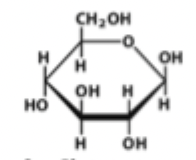
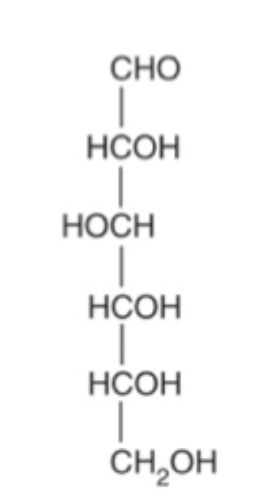
In Haworth projection, alpha anomer means (up/down) and beta anomer means (up/down)
down, up

diastereomer vs enantiomer vs anomer. there’s a picture

Hint: enANTIomer so opposite of you. diSastereomer so you but mutilated, anomeric so anomer
Monosaccharides become cyclic structures by…
the sugar’s carbonyl carbon reacting with the furthest chiral carbon to create an anomeric carbon (hemiacetal reaction)

pyranose vs furanose
six membered ring = pyranose
five membered ring = furanose (remember O is a member too)

Hint: 6 is beautiful # aka Egyption aka pyramid, Furious 5
Which sugars prefer being in cyclic form?
Sugars w/ 5 or more C’s
Glucose can turn into how many isomers? (HARD) Name the isomers
5 isomers
⍺-D-glucopyranose
β-D-glucopyranose (weirdly most common)
linear D-glucose (~0.02%)
⍺-D-glucofuranose (furanose is rare)
β-D-glucofuranose
spontaneous mutarotation
the process of switching isomers of glucose by linearizing and recyclizing
(HARD) 3 ways glucose can be oxidized, becoming new compounds called…
aldonic/gluconic acid: when 1st C (aldehyde) gets oxidized
uronic/glucuronic acid: 6th C (the non chiral one) oxidized
aldaric/glucaric acid: both 1C and 6C gets oxidized
Hint: WAldo has a dih that looks like =o, Moronic to oxidize an achiral Carbon, All da Carbons got oxidized ric
Glycosidic formation
reaction that forms disaccharide and 1 H2O, reduces one of the sugars.

reducing vs non-reducing end
If the sugar’s anomeric carbon has an OH group, reducing end
Otherwise, non-reducing end

Write the notation for a glycosidic bond btwn ⍺-glucose’s C1 and β-fructose’s C2. Hint there’s 2 ways.
Fru(2β ↔ ⍺1)Glc
OR
⍺(1→2)
Don’t know why β is omitted in 2nd name or why letters switch places in 1st name
Ways you can categorize polysaccharides
Homopolysaccharide: one typa sugar
Heteropolysaccharide: 2+ typa sugars
Branched vs unbranched
Oligosaccharides: very few units (<10 monosacchs)
Peptidoglycans: sugars linked to short peptides
Amylose vs amylopectin vs glycogen. Also note their glycosidic bonds
Amylose: unbranched, made of ⍺(1→4) and is helical
Amylopectin: branched, both ⍺(1→4) and ⍺(1→6)
Glycogen: branched, even more a(1→6) than amylopectin
Cellulose properties. Also note their glycodic bonds
Very planar structure due to β(1→4) linkage, making strong structural layers
Which 3 amino acids can glucose bind to
O-linked: link to O of Serine or Threonine
N-linked: link to N of Asparagine
lectin
A protein, not peptidoglycan, that recognize and bind to specific sugars on cells
How does the influence virus infect cells? How does Tamiflu stop the influenza?
The virus’s lectin binds to a cell, enters the cell, and cuts down the lectin so new viruses don’t stick. Tamiflu inhibits the cutting enzyme, bad for virus because newly made viruses stick to the lectin and can’t escape.
metabolite
an intermediate product in a metabolic pathway, not final product
kinds of metabolic pathways
linear, branched converging, branched diverging, cyclic, spiral
Catabolism (breaks/forms) biomolecules, basically (oxidizing/reducing) which leads to (oxidized/reduced) cofactors NADH, NADPH, or ATP.
breaks, oxidizing, reduced
Hint: makes sense since oxidizing is burning smth
inorganic phosphate
Pi, a product formed from

pyrophosphate
PPi, a product formed from

Based on oxid#, the most reduced Carbon molecule is ___, and the most oxidized is ___
CH4, CO2
Rank the SPONCH atoms based on electronegativity and thus who oxidizes who
O > N > S > C > P > H
If bonded to a more EN atom, (add/subtract) to the Oxid#. If bonded to a less EN atom, (add/subtract) to the Oxid#.
add, subtract (remember double bonds and identical EN!)
Dehydrogenase always does a ____ reaction.
Redox, since the molecule gets oxidized (2H 2e- out)
State if it’s reduced or oxidized form: NAD+, NAD, NADH
NAD+ oxidized
NAD is the name for either NAD+ or NADH
NADH reduced
Difference btwn FAD and NAD
NAD must get 2e- whereas FAD can get 1e- first and 1e- later.
Also FAD is usually found bound to an enzyme
State if it’s reduced or oxidized form: FAD, FADH+, FADH2
FAD oxidized
FADH+ reduced by radical (or semiquinone)
FADH2 fully reduced
Acyl vs acetyl group

acyl has any R group, acetyl has specifically methyl CH3
(HARD) What makes ATP so energetic?
The products ADP and Pi are more stable since more resonance structures formed
Having three PO3- is unfavourable because of repulsion of negative O’s
The products ADP and Pi are more easily solvated
Obvious increase in disorder because 2 molecules made from 1
What does the ‘ mean in ∆Go’?
Biochemically standard state:
All substances at 1 M
pH = 7
Relationship between ∆Go’ and K’eq

Allegedly, this shows that ∆Go’ can be calculated at any temperature, but K’eq is calculated at 25 degrees C (SATP)
Relationship of ∆G and ∆Go’, as in ∆G in non-equilibrium concentrations

Will a coupling reaction work if the anabolic step is the first step?
YES, since the catabolic step consumes all the products of the 1st step, shifting the Q toward making more products.
Very exammable Q: Find the Keq when given

Add up the ∆G’s, ∆Go’net = -14.6 kJ/mol
Plug it into ∆Go’net = -RTlnKeq
R = -8.315 J/mol so you must convert kJ/mol to J/mol
If Keq = 400, how many times more products than reactants at equilibrium?
400, as long as its first order aka Keq = [Prod] / [React]
To summarize glycolysis, the end products are…
2 pyruvate, 2 ATP (after investment), 2 NADH
Reaction 1 of glycolysis is aka the:
first priming reaction. It starts glycolysis and prevents glucose’s escape by negatively charging it
What reactions allowed glucose to end up symmetrical so we could cut it into 2 similar isomers?
#2 isomerizing into a ketose, #1 & 3 adding one phosphate each
Which reactions are investment phase and which are payoff phase
#1-5 investment (up until & including DHAP → G3P)
#6-10 payoff
(HARD) Name all the enzymes used in order in all 10 glycolysis rxns, maybe even their catalyst friends
hexokinase, Mg2+
phosphohexose isomerase, Mg2+
phosphofructokinase-1, Mg2+
aldolase
triose phosphate isomerase
glyceraldehyde 3-phosphate dehydrogenase
phosphoglycerate kinase, Mg2+
phosphoglycerate mutase, Mg2+
enolase
pyruvate kinase, Mg2+, K+ (K not important)
substrate level phosphorylation
the act of producing ATP by ripping a phosphate group from a substrate. Unlike oxidative phosphorylation (in ETC)
Which glycolysis steps are extremely exergonic / irreversible?
#1 Adding phosphate to glucose
#3 Adding phosphate to fructose 6-phosphate
#7 is exergonic but pretty reversible
#10 Generating ATP by removing phosphate
Reverse of glycolysis is called
Gluconeogenesis
Enzymes used in anaerobic reactions
Lactate dehydrogenase
Pyruvate decarboxylase + Alcohol dehydrogenase
EZ names bc they are both redox rxns (NADH → NAD+)
Name Enzymes used in 3 bypass rxns
Pyruvate carboxylase (biotin), PEP carboxykinase
Fructose bisphosphate bisphosphatase
Glucose-6-phosphatase
In bypass #1, pyruvate carboxylase requires 1 ___ and PEP carboxykinase requires 1 ___
ATP, GTP
ATP is a strong (activator/inhibitor) and AMP is a strong (activator/inhibitor) of PFK-1
inhibitor, activator