Ochem Ch. 7 Pt. 2 - EXAM 3
 Call Kai
 Learn
 Practice Test
 Spaced Repetition
 Match
 Flashcards
 Knowt Play
1/65

Earn XP
Description and Tags
Eliminations
66 Terms
What do eliminations form?
Alkenes. (and forms a double bond).
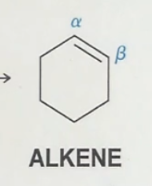

How is Y:- different in substitution reactions and elimination reactions?
In substitution, Y:- is a Nucleophile (attacks E+). In elimination, Y:- is a base (Uses its lone pairs to attack H+).
How does nomenclature of Alkenes different than Alkanes?
Ethane (C2H6) → Ethene (C2H4). Propane → Propene. (A→E)

What is the procedure for naming Alkenes?
1.) Find the longest continuous carbon chain that CONTAINS the C=C double bond.
2.) Number the chain such that the functional group (priority is ALWAYS the C=C, ignore substituents) gets the lowest possible numbers.
3.) Alkyl substituents are cited before the parent name (same as alkanes).

What is the name of this alkene?
but-2-ene or 2-butene

What is the name of this alkene?
5-methylhept-3-ene or 5-methyl-3-heptene

What is the name of this alkene?
Hexa-2,4-diene or 2,4-Hexadiene
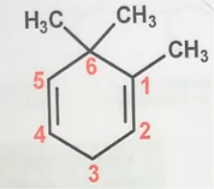
What is the name of this cycloalkene?
1,6,6-trimethylcyclohexa-1,4-diene

What is the name of this cycloalkene?
1-methylcyclopentane (Cycloalkenes are assumed to have a double bond bwtn carbon atoms 1 and 2, so if there aren’t any other double bonds, no need to specify).
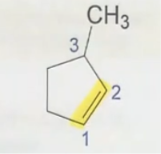
What is the name of this cycloalkene?
3-methylcyclopentene (Cycloalkenes are assumed to have a double bond bwtn carbon atoms 1 and 2, so if there aren’t any other double bonds, no need to specify).

What is the name of this cycloalkene?
cycloheptatriene (Moving double bond doesn’t change the structure, so just label di- or tri- ene for the number of double bonds).
How do you know when an alkene is cis or trans? What do you look at? What is the one exception for using E/Z when you also could use cis/trans?
Label a molecule cis/trans only when you have Hydrogens to compare. Do not label as cis/trans even if you have H to compare IF there’s more than one double bond → use E/Z notation.

Name these alkenes.
cis-pent-2-ene and trans-pent-2-ene
When is E-Z Nomenclature needed?
For geometric Isomers. Assign priorities for each vinyl carbon (carbons in double bonds) as higher and lower, then figure out if you label whole thing as Z (ze same side) or E (epart).
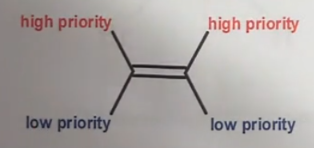
Z or E?
Z.

Z or E?
E.
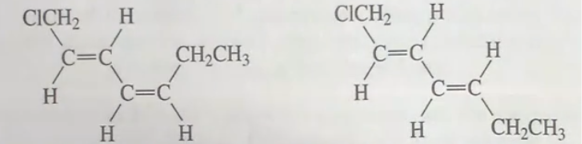
Name these geometric isomers.
Answer in pic.

Alkenes are _____ (more/less) stable when more highly substituted.
more
What is Zaitsev’s Rule?
Alkenes are more stable when more highly substituted.
“Typical multiple choice Exam Q…” We can compare the stabilities of alkenes by putting them through _____. What does this mean?
Hydrogenation. If you take an alkene and through hydrogen gas (H2) at it, NOTHING HAPPENS. If you also throw in a transition metal catalyst (nickel, platinum, plamadium), the pi bond in your starting alkene will break and you form two new sigma bonds in its place to HYDROGEN atoms!! This is why its called hydrogenation! :)
The alkene that released more energy had more energy in the first place. More energy = less stable. In the pic, the trans- one is MORE stable cuz lower energy.
Differences in delta H values = differences in stabilities.
Energy is obvi released (exothermic) cuz we’re breaking pi to from sigma. Takes to break frees to form.

Is cis or trans more stable? Why?
Trans is MORE stable than cis because cis has steric interactions.

Alkyl groups attached to the vinylic carbon atoms stabilize the alkene. Why?
Sterics!! The isomer with the more substituted double bond has a larger angular separation between the bulky alkyl groups.
For cycloalkenes, ring strain is due to a smaller ring. How many carbons in a ring do you need until there’s no angle strain?
5 → cyclopentane.
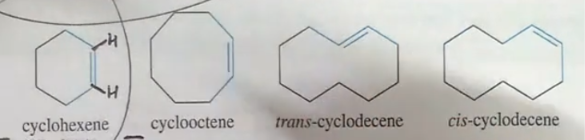
Cycloalkenes are assumed to be ____(cis/trans) unless otherwise specifically trans.
cis!
Trans cycloalkenes are NOT stable unless ring has at least ____ carbons.
Eight.
In an elimination, what 2 things do you eliminate?
An H+ from the Beta Carbon and the halogen on the alpha carbon.

This is dehydrohalogenation. What does that mean?
Elimination of HX, where H is hydrogen and X is a halide. The opposite process is called hydrohalogenation.
True or False: E2 is a concerted process.
True! E2 is a concerted process.
What do the parts of “E”2” stand for?
E = Elimination. 2 = bimolecular, 2 things involved in the rate determining step - 2 things bump (the substrate and a strong base). Similar to SN2. Overall rate order is 2.
What is the rate law of an E2 process?
Rate = k[Alkyl halide][strong base] (1+1=2 molecularity).
The E2 process goes through a ______(transition/intermediate) state.
Transition!! Just like SN2!! Be sure to add partial charges!
“When Given on an exam…” What does NaOEt mean? Strong/Weak base?
NaOCH2CH3. Strong base. The Na has the + and the O has the -. Na+ is an NPC, don’t do anything with it!
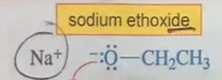
Since most strong nucleophiles are also strong bases, how can you tell that once will happen over the other?
E2 normally results when a strong base/nucleophile is used on a POOR SN2 substrate (tertiary).

Will an E2 process happen most readily with a primary, secondary, or tertiary alkyl halide?
Tertiary!
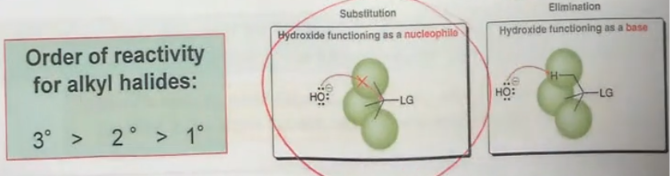

Explain why the top is major and bottom is minor.
More substituted double bond = more stable = major product. (Zaitsev’s rule!!)
What is Zaitsev’s Rule?
In elimination reactions, the major product of the reaction is the more substituted (more stable) double bond.

Label the products as either Zaitsev or Hofmann.
Left is Zaitsev (more stable) and Right is Hofmann (less stable).
What is the Hoffman product?
The less stable product made in the E2 process.
What happens when a small vs bulky base are involved in an E2 process?
The small base will attack the more substituted beta carbon, favoring forming a more substituted Zaitsev Product.
The big base will attack the less substituted beta carbon (STERICS), favoring forming a less substituted Hofmann product.
“For an Exam Q…” What is the most important BULKY strong base that you need to remember?
Potassium tert-butoxide (t-BuOK)

True or False: E2 reactions are stereospecific.
True, but they can also be stereoselective.
What is the stereochemistry of an E2 process?
Stereospecific (most of the time) and anti-coplanar H and X. Must be in the same plane (COplanar). Syn-coplanar (H and X on same side) is very disfavored due to sterics and will not occur.
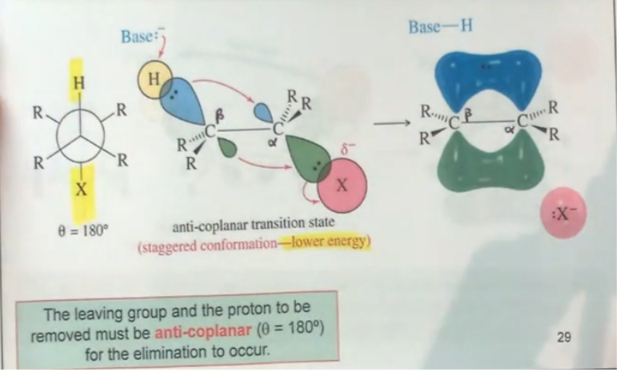
Strong Base = E1 or E2?
E2.
What special case would cause an E2 process to be stereoselective?
If the substrate has 2 identical Beta C-Hs (on the Same Beta C-Alpha C), E2 will be stereoselective (NOT stereospecific.)
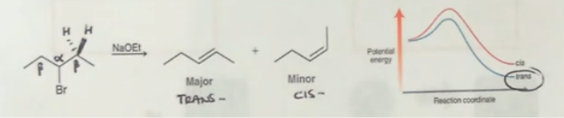
Stereoselective vs Stereospecific
Stereoselective = will form more than one stereoisomer but one is more favored than the other.
Stereospecific = will only form one stereoisomer.
In an E2 process in a cyclohexane, if you are given a chair diagram, why might you need to do a chair-chair interconversion before going through the elimination?
The Halogen X and Hydrogen H need to be anti-coplanar!!! This is only be possible in the axial positions!!!

E1 is ______(concerted/stepwise).
E1 is a stepwise process.
E1 requires a _____(strong/weak) base.
WEAK base!
What are the 2 steps in an E1 Reaction Mechanism?
1.) Leaving Group Leaves to form a carbocation (SLOW, RDS).
2.) WEAK Base (often solvent ex. H2O) takes an H from Beta carbon and forms alkene (FAST). - Even a weak base will be attracted to the positively charged Carbon.
What is the rate law of an E1 process?
(E1) Rate = k[alkyl halide]
What does “E”1” stand for?
E = Elimination.
1 = Only one molecule involved in the rate determining step - alkyl halide. 1 thing falls apart, then everything else.
E1 is only ever ______ (stereospecific/stereoselective). Why?
Stereoselective towards the more stable trans alkene. It’s not stereospecific because AC and BC bond in the carbocation can rotate, giving cis and trans products).

E1 has _____ (transition/intermediate) stages.
Carbocation Intermediate
E2 is the Zaitsev and Hoffman as E1 is to _______(Zaitsev/Hoffman) only.
For E2, we can direct the regiochemistry, we can get a less substituted product if we use a bulky base (Zaitsev vs Hoffman). In E2, there’s no steric interactions so it’s always the Zaitsev Product. If multiple H, choose the H that gives you the most stable product.
The most reactive substrate for both E1 and SN1 is primary, secondary, or tertiary carbocations?
Tertiary = Most stable! Want low energy intermediate(?).
“You will see a carbocation rearrangement in an Exam.” True or False: Like SN1, E1 can also have carbocation rearrangements?
True. they both can.
An alcohol (R-O-H) is a _____(strong/weak) base and nucleophile. It’s just like water!
Weak.
If you have a weak Base/Nucleophile, what does it wait on before doing anything?
Rizzy Carbocation. → LG leaves.

“EXAM” Look at the 4 ways a carbocation can do in reactions and understand them.

Under what conditions would you need to start an E1 process with a proton transfer?
If the substrate is an alcohol, then the OH group must be protonated before it can leave. (ADD H+ to create positive charge).
List the 4 possible steps of an E1 reaction.
proton transfer (ADD H+) → Loss of LG → Carbocation rearrangement → proton transfer (REMOVE H+).
Does E2 have more than 1 step? (extra steps).
NO!! Everything happens at the same time and not typically accompanied by anything else.
If you could put a number to it: Basicity is based on _______ (Keq) and Nucleophilicity is based on ______ (kr).
Thermodynamics; Kinetics.
Lower pKa corresponds to a stronger or weaker acid?
Stronger. Kw=KaKb.
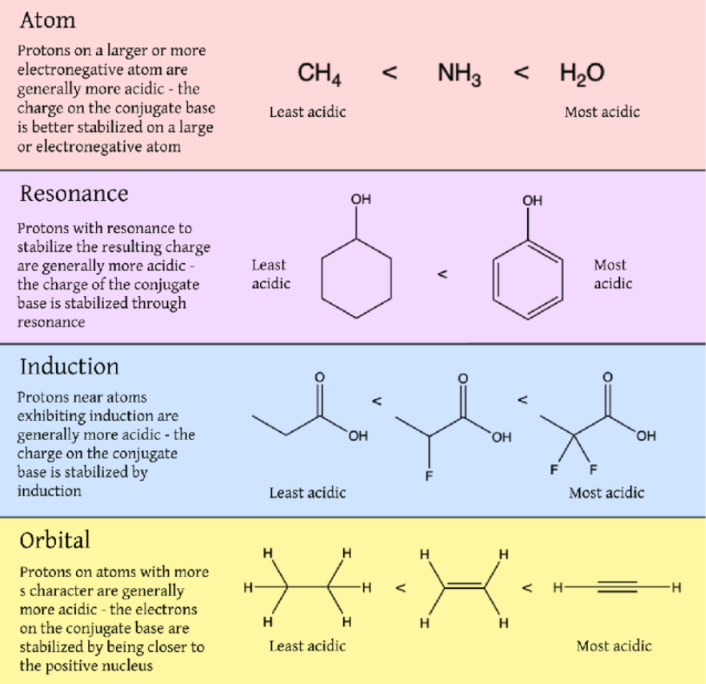
More stable the conjugate base, _____ the acid in the first place.
stronger.
Understand ARIO for comparing strengths of bases.
…