Master flashcards (Prof mentioned)
 Call Kai
 Learn
 Practice Test
 Spaced Repetition
 Match
 Flashcards
 Knowt Play
1/20

There's no tags or description
Looks like no tags are added yet.
21 Terms
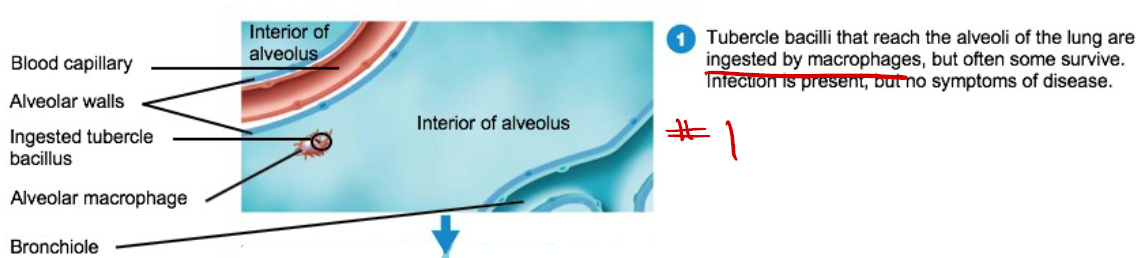
TB pathogenesis step 1: what happens to the inhaled bacteria?
Phagocytized by alveolar macrophages
Multiply inside the macrophages
Cause an inflammatory response
TB pathogenesis step 2: what do the recruited macrophages do, and what forms?
They surround and isolate the bacteria inside a tubercle, and tubercle lesions form.

What is a tubercle lesion?
A collection (aggregation) of activated macrophages with the bacteria multiplying inside.

TB pathogenesis step 3: what happens to the macrophages?
They die and release the bacteria.

After the bacteria are released, what are the 2 possible outcomes?
The bacteria do NOT grow or multiply → the tubercle is NOT ruptured → the bacteria do NOT spread. (Dormant/latent)
The bacteria grow and multiply → the tubercle ruptures → the bacteria spread.

What is latent TB?
The tubercle is NOT ruptured, the lesions heal and calcify, and the bacteria stay dormant.

When the tubercle ruptures, where can the pathogen spread?
To other parts of the lung, circulatory and lymphatic system… to other areas of the body.

When TB spreads through the bloodstream, what type of infection is it, and which organs does it reach?
A systemic infection, reaching the bone, brain, and liver.
- Systemic = miliary TB
Is TB a local or a systemic infection?
Local: the tubercle is NOT ruptured, so the infection stays in the lung.
Systemic: the tubercle ruptures, so the pathogen spreads through the bloodstream.
What is miliary tuberculosis?
TB that spreads from the primary lesion (alveolus) to other areas: the liver, nervous system, and bone. It indicates a systemic infection.
What does a bloody cough indicate in TB?
Alveolar damage.
What are the 3 steps for diagnosing TB, in order?
Tuberculin skin test (Mantoux test).
Chest X-ray (or CT scan).
Acid-fast staining.
How is the tuberculin skin test (Mantoux test) done?
Tuberculin protein is injected under the skin (subdermal). Then you check for induration (a bump or hardness) 48–72 hours later.
Why does the skin test take 48–72 hours, and which cells react?
It’s a delayed immune reaction. TD cells react to the tuberculin protein.
What does a positive skin test mean? A negative one?
Positive (induration): a current or previous infection.
Negative (no induration): no TB infection.
On a chest X-ray, what indicates TB, and what does a positive X-ray mean?
White spots indicate tubercle formation (black = air). A positive X-ray means a current or previous infection.

How is acid-fast staining done for TB, and what do you look for?
Culture a sputum sample from the lung, stain it (slide prep), and look for pink acid-fast bacilli (rods).
On an acid-fast stain, what color is Mycobacterium vs
non-Mycobacterium?
Mycobacterium (acid-fast) stains pink rods.
Non-acid-fast organisms stain blue.

Which 2 TB tests can’t tell a current infection from a past one?
The skin test and the chest X-ray.
A positive result on either means a current OR previous infection.
If a chest X-ray shows lung lesions, how do you know it’s NOT TB (for example, Histoplasmosis)?
A negative TB skin test and a negative acid-fast stain.

summary
