Path: Exam 4: Chapter 14 - Neuro pt 2: Disorders
 Call Kai
 Learn
 Practice Test
 Spaced Repetition
 Match
 Flashcards
 Knowt Play
1/70

There's no tags or description
Looks like no tags are added yet.
71 Terms
meningitis
inflammation of the meninges in the brain, early detection is crucial
meningitis risk factors
people living in close quarters (dorms, military)
meningitis symptoms
rapid onset
sever headache
photophobia (light sensitivity)
nuchal rigidity (neck stiffness)
kernig sign
brudinski sign
worst menegeitis prognosis (bacterial or viral)
bacterial d/t puss and increased ICP
brain abscess
infection that spreads from organisms in ear, throat, sinuses, or lung
brain abscess treatment
surgical drainage and antimicrobials
Encephalitis
inflammation of the brain or spinal cord
Encephalitis causes
vectors (mosquitos, ticks, etc)
encephalitis presentation
Severe headache, stiff neck, lethargy, vomiting, seizures, fever
rabies
a viral infection transmitted by a bite of a rabid animal (bats)
rabies presentation
seizures, hydrophobia (fear of fluids)
rabies prognosis
high fatality rate
rabies treatment
antibodies and vaccines
tetanus
caused by spores in environment
tetanus presentation
tonic muscle spasms
jaw stiffness
tetanus treatment
vaccine prevention
polio
attacks motor neurons of the spinal cord and medulla
polio causes
direct contact with fecal or oral droplets
polio presentation
flaccid paralysis
polio treatment
vaccine prevention
Herpes zoster (shingles)
Caused by varicella-zoster virus in adults
- Can occur years after primary infection of varicella (chickenpox)
herpes zoster presentation
-painful affects on dermatome
- unilateral pain, paresthesia, and vesicular (blisters) rash
concussion (head injury)
caused by a mild blow to the head
concussion prognosis
reversible damage (non permanent). recovery in 24 hours
contusion (head injury)
brain bruise
contusion cause
blunt blow to the head
possible residual damage
closed head injury
skull not fractured
open head injury
fracture of penetration of the brain
depressed skull fractures (head injury)
Involve displacement of a piece of bone below the level of the skull
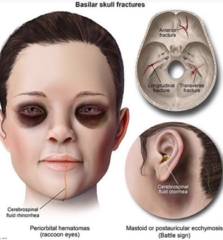
basilar fractures (head injury)
fracture at base of the skull
basilar fractures presentation
leakage of CSF through nose and ears, raccoon eyes, "halo sign" on napkin
countrecoup injury
injury of the brain contralateral to the site of direct damage. brain bounces off skull
Ex: car accident

intracerebral hematoma
Results from contusions or shearing injuries
epidural hematoma
bleeding between dura and skull. arterial bleed (fatal)
subarachnoid hemmorage (hematoma)
Occurs in space between arachnoid and pia (subarachnoid space)
subdural hematoma
Develops between dura and arachnoid
"Below the dura"
hematoma presentation
symptoms of ICP
laceration (spinal cord injury)
causes permanent loss of conduction
Complete transsection or crushing of cord (spinal cord injury)
causes irreversible loss
Partial transection or crushing (spinal cord injury)
may allow recovery
brusing (spinal cord injury)
reversible damage
prolonged ishchemia and necrosis (spinal cord injury)
permanent damage
assessment of spinal cord injury
dermatome map assess for paralysis in affected area
why does outcomes of spinal injuries take awhile to be known
may be spinal shock (inflammation) and not paralysis
spinal shock
Initial period after injury where ANS(involuntary) reflexes are absent
tetra of quadriplegic
paralysis of all 4 extremities
paraplegia
paralysis of the lower part of the trunk and legs
ipsilateral paralysis
paralysis on the same side of the body as the injury
contralateral paralysis
Paralysis occurs on opposite body side from damage.
Gullian-Barre Syndrome
temporary demylanation causes impaired nerve conditions
Gullian-Barre Syndrome presentation
ascending symmetrical paralysis
Multiple Sclerosis (MS)
Loss of myelin interferes with conduction of impulses in affected fibers
Multiple Sclerosis (MS) prognosis
Repeated recurrence causes degeneration to become irreversible
Multiple Sclerosis (MS) cause
unknown
Multiple Sclerosis (MS) presentation
Exacerbations and remissions - eventually doesn't get better
1st sign - blurred vision
Parkinson's Disease (PD)
progressive degenerative disorder in dopamine
Parkinson's Disease (PD) presentation
T - Tremors (resting)
R - Rigidity (stiff limbs
A -Akinesia (difficulty initiating movement)
P - Postural instability
Amyotrophic Lateral Sclerosis (ALS)
"Lue Gehrigs Disease" Progressive degenerative disease affecting upper motor neurons & lower motor neurons
ALS presentation
Progressive muscle weakness and loss of fine motor coordination. Cognition unimpaired
ALS cause
cause is idiopathic (unknown)
ALS prognosis
Death occurs because of respiratory failure. (No tx)
Myasthenia Gravis
destroys receptor sites causing prevention of muscle stimulation
Myasthenia Gravis presentation
skeletal muscle weakness (in voluntary muscle groups),
dysphagia, aspiration (serious problems)
Myasthenia Gravis causes
autoimmune disorder
Myasthenia Gravis treatment
steroids, immunosupressents
dementia
a slowly progressive chronic disease causing decline in mental abilities, including memory, thinking, and judgment, that is often accompanied by personality changes
causes of dementia
vascular disease (stroke)
infections (aids, syphilis)
genetic disorders
old age
Alzheimer's disease
most common cause of dementia causing progressive cortical atrophy
Alzheimer's disease testing
no definite testing available
Alzheimers/dementia presentation
slow onset - symptoms worsen
1st loss of short term memory
poor judgment, decrease cognition, decreased appetite, forgetting family and memories
Alzheimers/dementia prognosis
no treatment available