Greece and Rome (700 BCE - CE 300)
 Call Kai
 Learn
Learn Practice Test
 Spaced Repetition
 Match
Match Flashcards
 Knowt Play
1/7

There's no tags or description
Looks like no tags are added yet.
Name | Mastery | Learn | Test | Matching | Spaced | Call with Kai | Chat |
|---|
No analytics yet
Send a link to your students to track their progress
8 Terms

What: Exekias’ Kylix (Kylix is wide, shallow bowl only suitable to drink from while lying down)
Where: Made in Athens, unearth in Vulci, Italy
Materials: Earthenware clay, with decoration painted with slip. Fired at relatively low temperature, regulation of oxygen during firing creates red and black colors
Function: Used for alcohol during symposium - male drinking party and core of Greek political life. The shape is flat and unwieldy so one cannot walk around or drink quickly - shape necessitates a type of behavior. Inside shows imagery of Dionysus turning sailors into dolphins - cautionary tale about respecting power of drink. Outside turns into a ridiculous mask when tilted too high, keeps people from chugging.
Themes:
shape of object determines function
design interacts with usage (turns into mask if tipped too high)
Feasting is a site of social performance

What: Mantiklos “Apollo” offering with dedicatory inscription in Boetian script
Where: Thebes, Greece, Late Geometric or early Orientalizing period, 700-675 BCE
Materials: Solid lost wax cast figure. Pierced hand appears to have held something, maybe a bow (attribute of Apollo) which may have been made of an organic material that decomposed
Function: Offering to god Apollo. Inscription speaks as the figure on behalf of it’s offerer, asking for good fortune in exchange for the offering. Negotiates a relationship between mortal and gods. The inscription goes up and down the thighs, so to read the object, one would have to rotate it, thus animating its body.
Themes:
miniaturization
inscription speaking for object
movement of object animates it
form creates specific usage
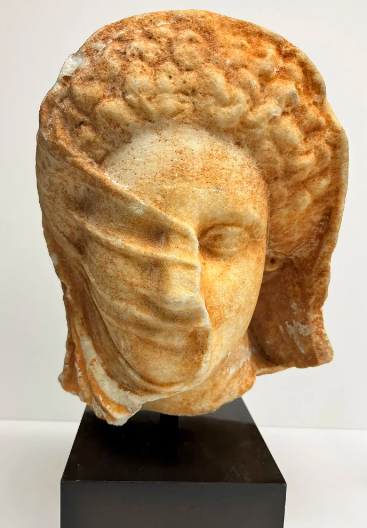
What: Marble head of veiled woman
Where: Cyrene (modern Libya) 350 BCE
Materials: Marble with traces of soil
Function: Likely taken from a full life statue votive dedication or a grave relief
Themes:
Concealment/revealing
naturalism
class conveyed through dress (?)

What: Clepsydra ceramic pot with two horizontal handles
Where: Athenian Agora, 400 BC
Materials: Ceramic, interior is coated with brown slip for water proofing
Function: Like a water clock / hour glass. Used in Athenian low courts to time court proceedings. Experimental replica showed that it took exactly 6 minutes to empty. Small hope at top stops it from being overfilled. Courts were central to Athenian democracy. Plato recounts Socrates’ conversation about philosophers being separated from culture because they had the leisure of time.
Themes:
Containment of water / of time - abstract, measurable
Different spheres of life can have different temporal conventions
Time’s relation to power
Shape of object with direct connection to function

What: Alexander mosaic, showing combat between Alexander the Great and Darius III of Persia at a battle in 4th century BCE (333 or 331)
Where: Pompeii, late 2nd century BCE
Materials: Stone tesserae (tiles). Four color technique (black, white, red, yellow)
Function: Copy of a painting commissioned by a General probably to commemorate their own participation in battle. Shows cultural difference with Persian dress (necklace and mustache). Shows older Darius III and youthful Alexander with large eyes.
Themes:
interaction with foreign culture
depiction of war (naturalism in contrast to the schematic style of King Tut’s chest for example)
Similarity of building structure across Mediterranean(? not sure ?)

What: Glass flask with engraved scenes of Puteoli
Where: Made at Puteoli (Italy), probably found in Italy, late 3rd - early 4th c. CE
Materials: Engraved blown glass. Glass became a cheap luxury good, no longer a luxury item. Glass was important for bathhouse culture - windows let in light while keeping heat inside. Glass was better for drinking from because it had no taste residue but some wealthy people preferred other materials because it was too cheap. Glass conducive to memory because of transparency.
Function: Shows schematic of the city as viewed from the shore. Tourism is underway in Rome - cruise ships were built, travel guides were written. Similar vessels were found all over the Roman empire as souvenirs. Captures memory, identity.
Themes:
Miniaturization, intimacy
Itinerary - objects in motion, transmitting ideas
Affordances of material - glass captures sense of memory

What: Silver cups with scenes from the Epic Cycle of Trojan War. Part of an extended set
Where: Found in Hoby, Denmark, 1st c. CE
Materials: Silver, combination of techniques: interior is hammered smooth, exterior is hammered (repousse is from the inside, chasing is from the outside), handles were lost wax cast, evidence of gilding on the exterior
Function: large set was diplomatic gift. Stories depicted on cups show diplomatic scenes (?) Roman general gifted to local leader. Shift from conquering the north to using diplomacy — made germanic tribes more amicable to Roman way of life
Themes:
Feasting as diplomacy, gift giving as diplomacy
Depiction of story for purpose of communication
Containment linked to feasting

What: Needles with container found in river
Where: Found in River Saone (France), 1rst or 2nd c. CE
Materials: Copper alloy with silver inlay along shaft
Function: Possibly a votive offering because full set was found in tact in the river. Disease was understood as divine and treatment went hand in hand with religious practice. These objects have often been studied without considering context of site — connection with Patricia Baker article - cross over between anatomical votives and healing instruments
Themes:
votive offerings
symbolic function of tools
importance of archeological context