biochem exam 3
 Call Kai
 Learn
 Practice Test
 Spaced Repetition
 Match
 Flashcards
 Knowt Play
1/165

There's no tags or description
Looks like no tags are added yet.
166 Terms
glycolysis:
Starting product =
End product =
E in =
E out =
Location =
Fed v. fasted state
Starting product = glucose
End product = pyruvate
E in = 2 ATP
E out = 4 ATP + 2 NADH
Location = cytoplasm
Fed v. fasted
Fed state = actively breaking down glucose into pyruvate
Fasted state = gluconeogenesis making glucose
glycolysis:
equation
equation = glucose +2NAD+2ADP+2P → 2pyruvate+2NADH+2ATP+2H20
net gain of 2 ATP
NADH (nicotinamide adenine dinucleotide):
what is it = soluble?
how does it do that
what does it do in biological rxns
how does it yield ATP 2 steps
how many e- does it carry/as what
2 forms = ox/red
what is the + stand for?
where are the 2 forms found
why?
NADH = e- carrier
carries 2 e- as a hydride ion
soluble coenzyme in oxidation reactions (why it can carry e- to mitochondria)
2 steps to ATP
pushes e-’s into mitochondrial matrix (from glycolysis)
in the ETC, NADH →ATP
2 forms (+ stands for oxidized form, not the charge)
NAD+ = oxidized
mostly cytosol
NADH = reduced
mostly mitochondria
NADH is high E, so it inhibits the glycolytic pathway when its in high concentration in the cytoplasm bc cell doesn’t need it to pick up e- to make more E
NADH kept in mitochondria bc its used for ETC
2 reasons phosphorylation is useful in general (last exam)
3 reasons for phosphorylated intermediates in glycolysis
in general
coupling ATP hydrolysis (favorable) w/ unfavorable
Phosphate useful as good leaving group to add groups onto other mCs bc it is unstable
phosphorylated intermediates
keeps intermediates inside cell to maintain high catalytic turnover (P- is neg charged)
substrate level phosphorylation = Pi (inorganic phosphate) will be transferred to ADP
enzymatic handles = good leaving groups
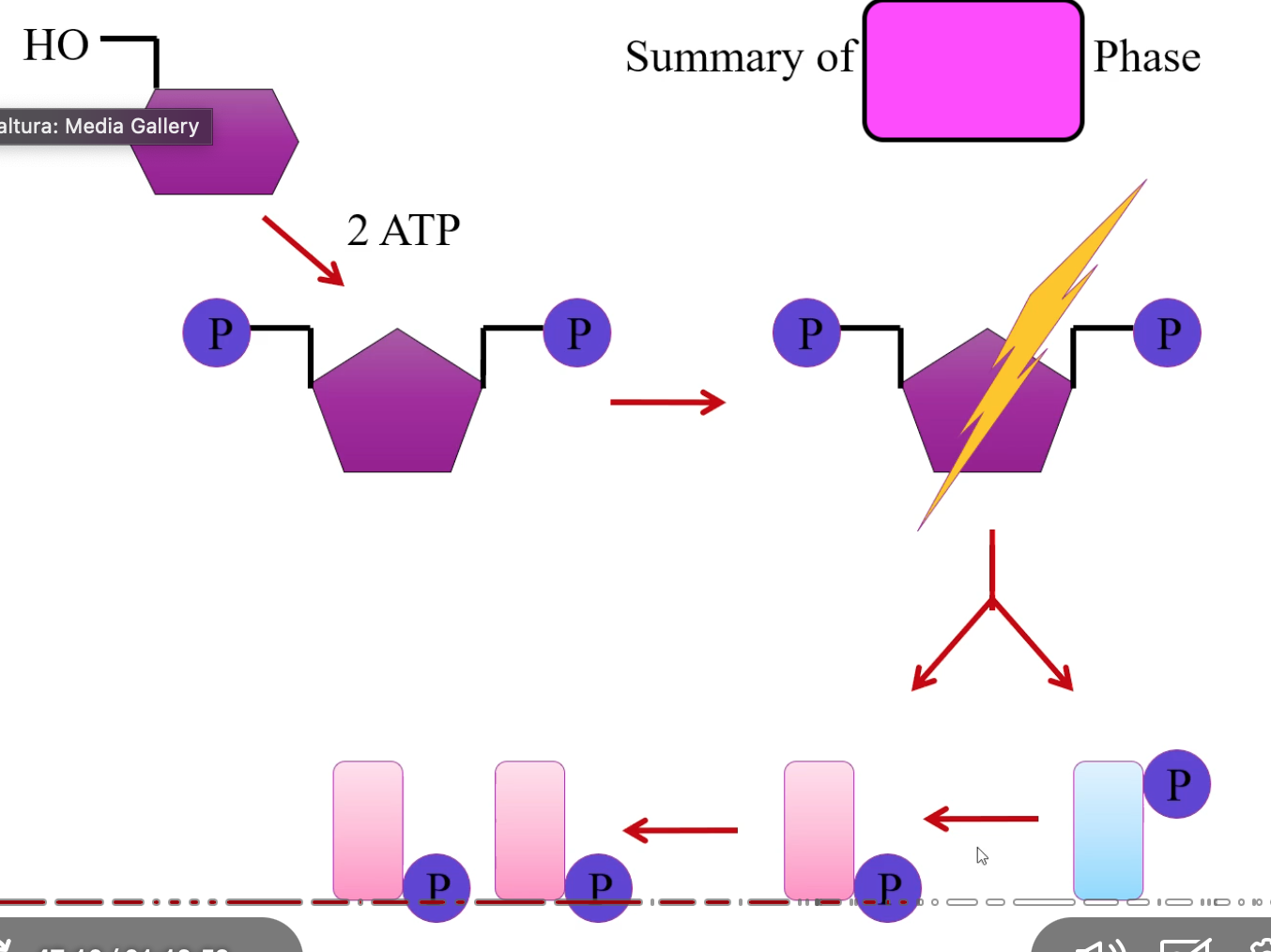
goal of preparatory phase =
preparatory phase structure change =
preparatory phase = input a little ATP to get more ATP later
6C aldose (glucose) → 6C ketose (fructose) w/ 2 phosphates
Glycolysis step 1:
rxn?
ATP used?
enzyme?
cofactor?
reversible?
isozyme =
glucokinase?
affinity for glucose and Km?
why?
glucose → glucose 6-phosphate
1 ATP —> 1 ADP
enzyme = hexokinase
cofactor = Mg2+
humans have 4 isozymes of hexokinase
isozymes = similar structure enzymes (products of diff genes) that catalyze the same reactions
glucokinase = isozyme that carries out step 1 in liver
low affinity, high Km
liver responsible for sending glucose to brain so it needs to be low affinity to let go (not self consuming)

Glycolysis Step 1 hexokinase Rxn:
2 steps rxn
what is the cell doing
group transfer or hydrolysis
rxn
C6 OH of glucose attacks gamma phosphate of ATP
bound Mg2+ stabilizes - charge in transition state
1st priming rxn = Cell investing E to initiate glycolysis
group transfer NOT hydrolysis

Glycolysis step 2:
rxn?
enzyme
cofactor
reversible?
involves?
how guarantee go forward?
rxn = isomeration of G6P to F6P
isomeration = glucose switch to fructose
enzyme =
cofactor
reversible?
involves ring opening
ring converted to linear
recircularizes into ketone
Low DG so remove product fast to drive

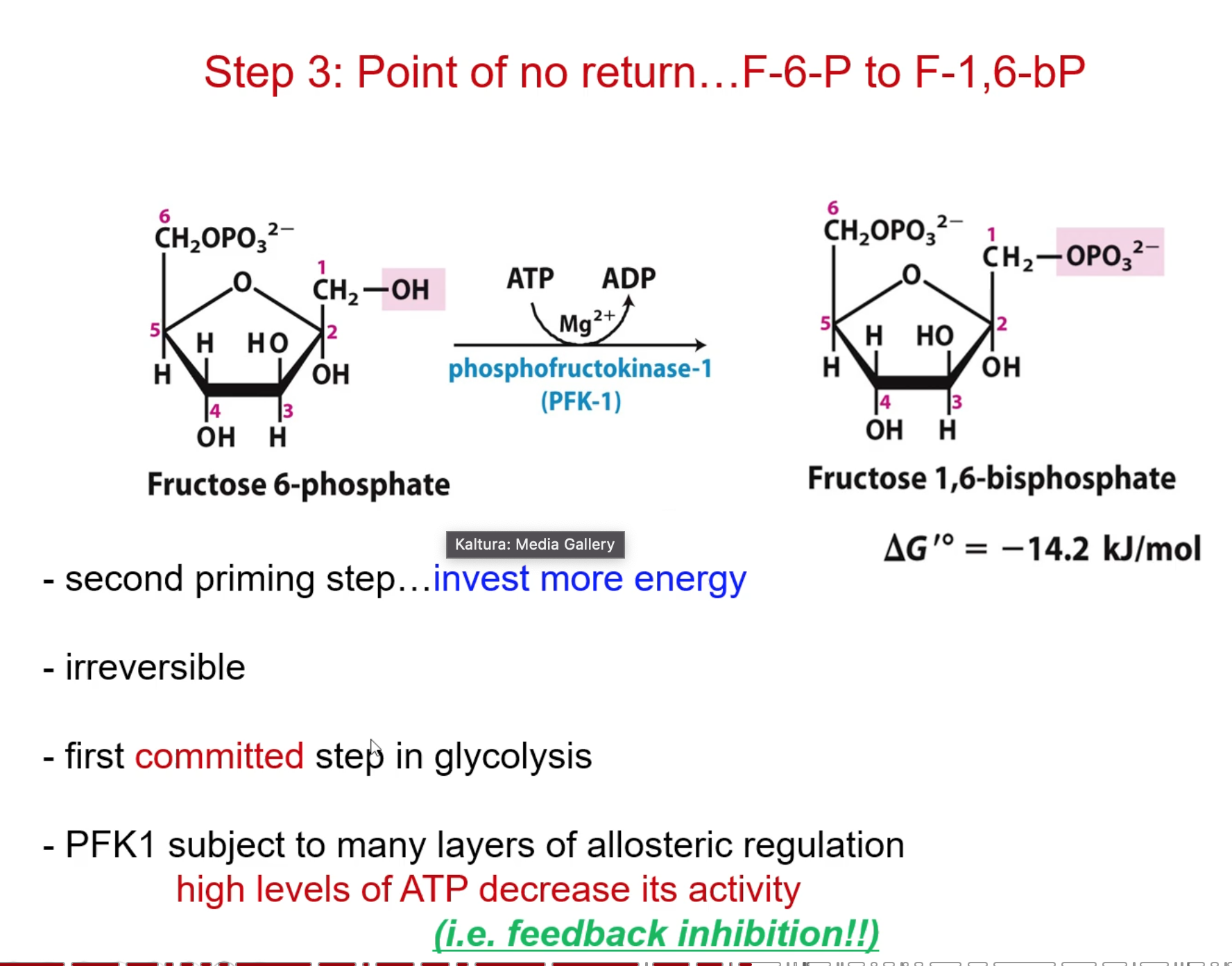
glycolysis step 3:
what is it
enzyme
ATP?
reversible
why special
what is it
enzyme = PFK-1 phosphofructokinase-1
ATP → ADP
irreversible
why specialspecial bc:
2nd priming steo
1st committed step= point of no return
point of regulation, ATP = negative feedback
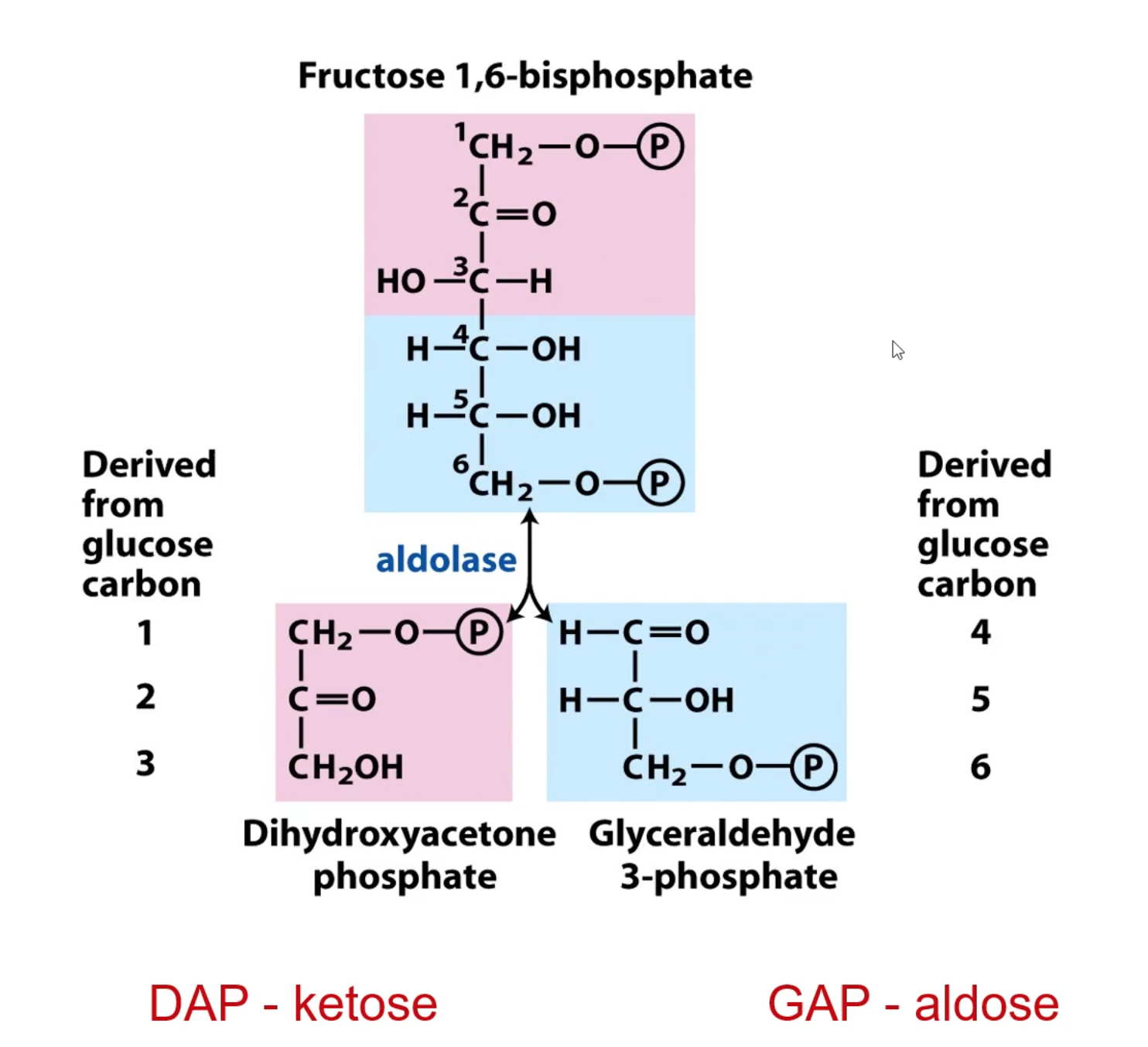
Glycolysis step 4:
what is it
enzyme
why special
how move forward despite large DG? why?
ring opening?
special bc cleave 6C sugar into 2 3C sugars
goes forward bc products quickly removed by next step
dihydroxyacetone phosphate is a ketose so its unstable and quickly converts to aldose

what is the mechanism behind the product being removed in step 4
how are GAP and DHAP numbered (from what #C of glucose)
dihydroxyacetone phosphate is a ketose so its unstable and quickly converts to aldose
Key concept:'
why does product removal drive a rxn w/ high DG’0 forward?
equation?
drives rxn forward bc it lowers Q to get a neg DG even w/ a high

glycolysis step 5:
what is it
enzyme
what kind of reaction
why DAP converted to GAP?
isomerization through enediol intermediate
only GAP substrate for next enzyme (
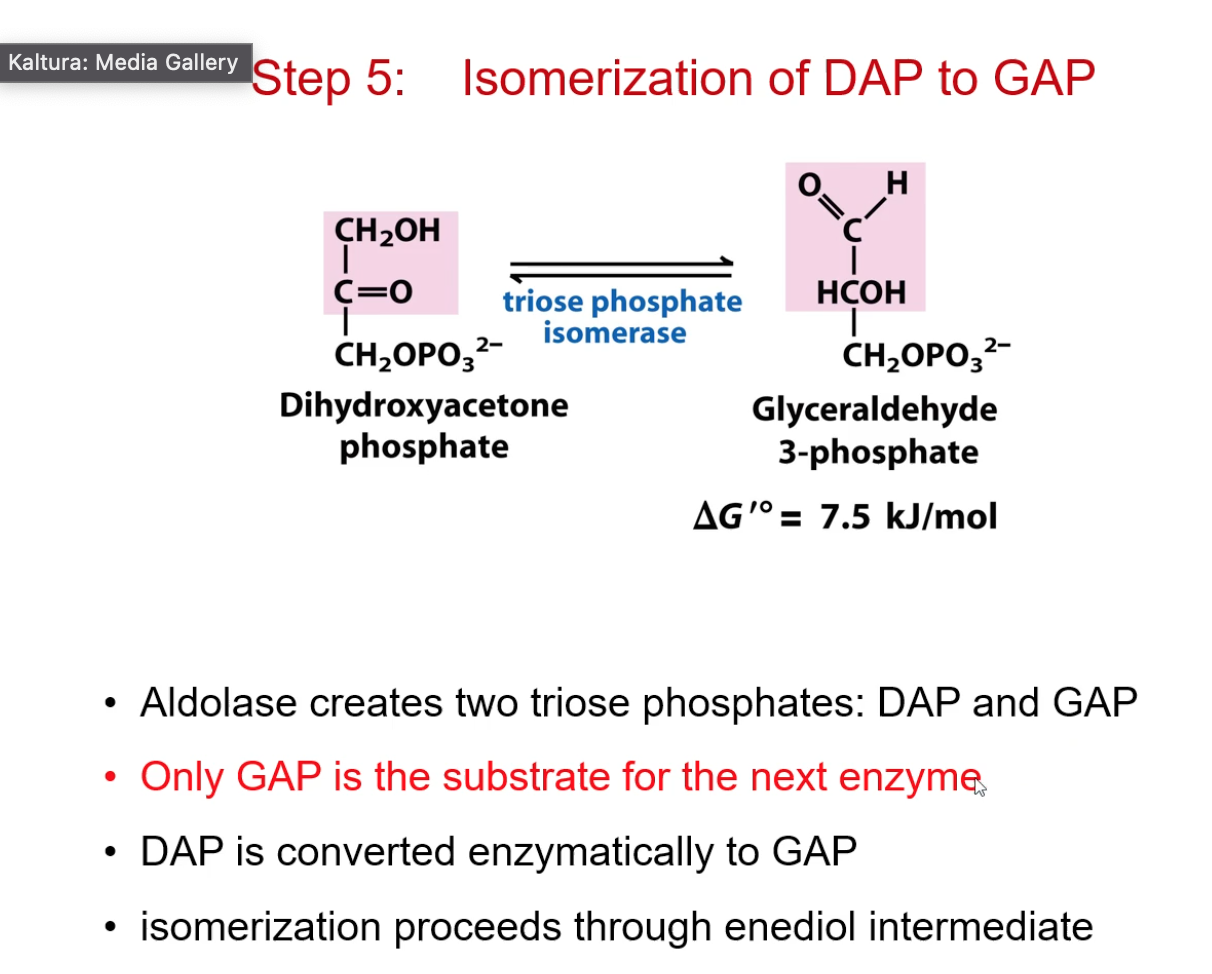
glycolysis step 5:
GAP carbon numbering
dihydroxyacetone phosphate flips and becomes an aldose


prep phase

glycolysis step 6:
overall rxn
2 involved reactions
loaded gun?
first what
1st E yielding step =
NAD+ picked up 2 e- → NADH, which will be used to make ATP later
2 reactions
oxidation of aldehyde w/ NAD+ gives NADH
favorable
phosphorylation yields a high-E product (acyl phosphate on
unfavorable

glycolysis step 6:
“loaded gun”
phosphorylation yields a high-E product (acyl phosphate on
unfavorable
loaded gun = acyl phosphate hydrolysis has very negative DG’0

glycolysis step 7:
why special
coupled? why?
enzyme named correctly? why?
special
2nd payoff phase
1st payoff with ATP
substrate level phosphorylation #1
steps 6 and 7 are coupled with 1,3 BPG as the common intermediate
7 has a favorable (-) DG so it can drive step 6 (unfavorable)
enzyme should be phosphotase bc it removes a phosphate from sugar (makes ATP from ADP)
discovered in reverse direction hence “kinase”
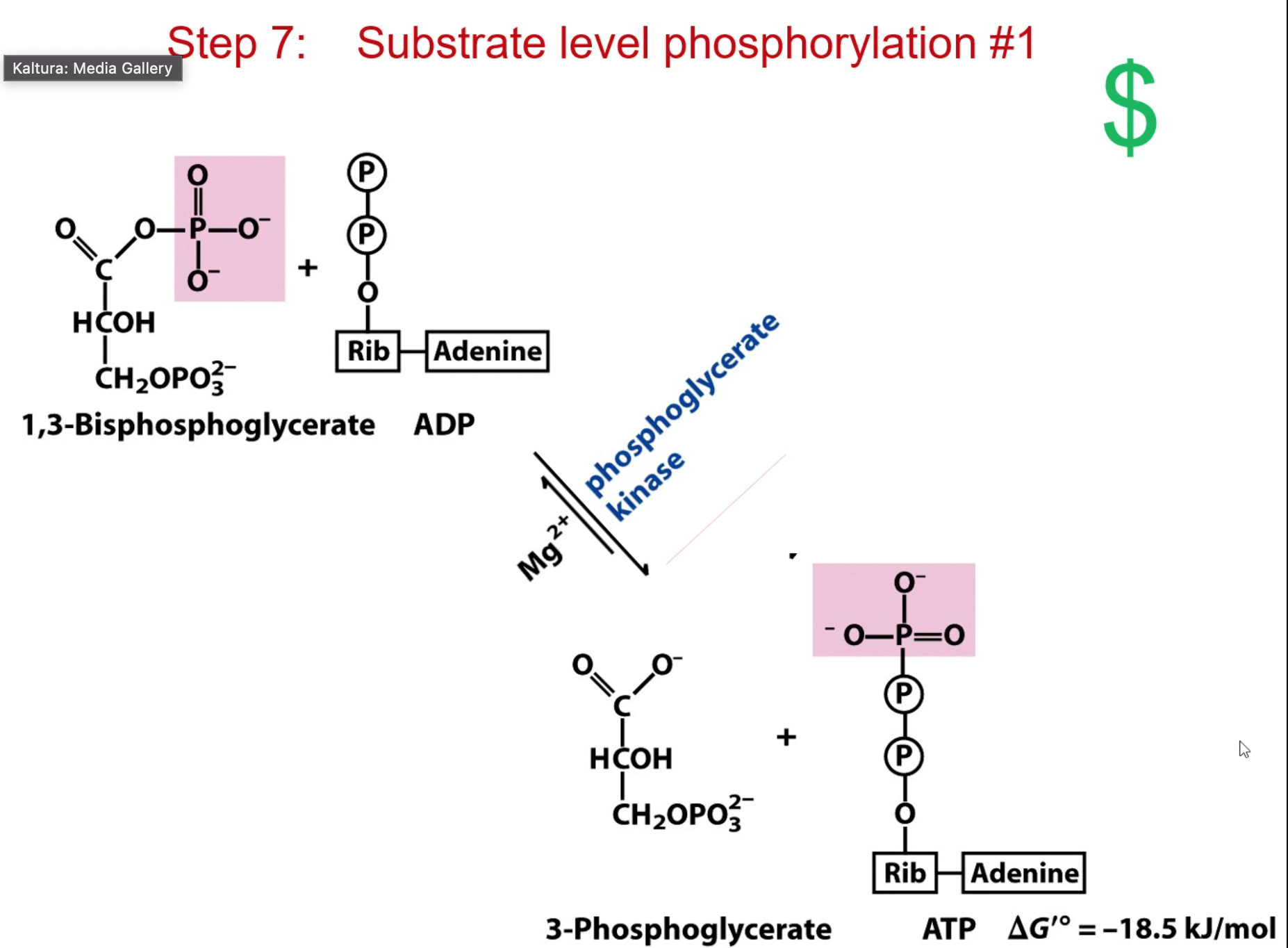
substrate level phosphorylation =
oxidative phosphorylation =
substrate level phosphorylation = generation of ATP from ADP and reactive chemical intermediates using soluble enzymes
oxidative phosphorylation = e- carrier, NADH or FADH2, donate e- to ETC and ATP synthase complex yields ATP
glycolysis step 8:
enzyme?
advantage of rearranging phosphate group?
phosphoglycerate mutase
placing Phosphate - charge nearby another O- makes it a better leaving group

glycolysis step 9:
type of reaction
role of Mg2+?
why PEP important?
type of reaction
part of enolase active site that stabilizes intermediate
PEP has high phosphorylation transfer potential compared to 2-phosphoglycerate

glycolysis step 10:
why special
enzyme correct name?
product(s)
regulation
enzyme requires
how many ATP?
special
payoff phase
2nd substrate level phosphorylation
enzyme has wrong name should be phosphatase
2 tautomers of pyruvate
enol and keto forms (keto more stable)
pyruvate kinase activity, regulated by level of Mg2+
when there is plenty of ATP, Mg ions sequestered by ATP and slows down pyruvate kinase
2 molecules of ATP bc 2 glyceraldehyde mCs

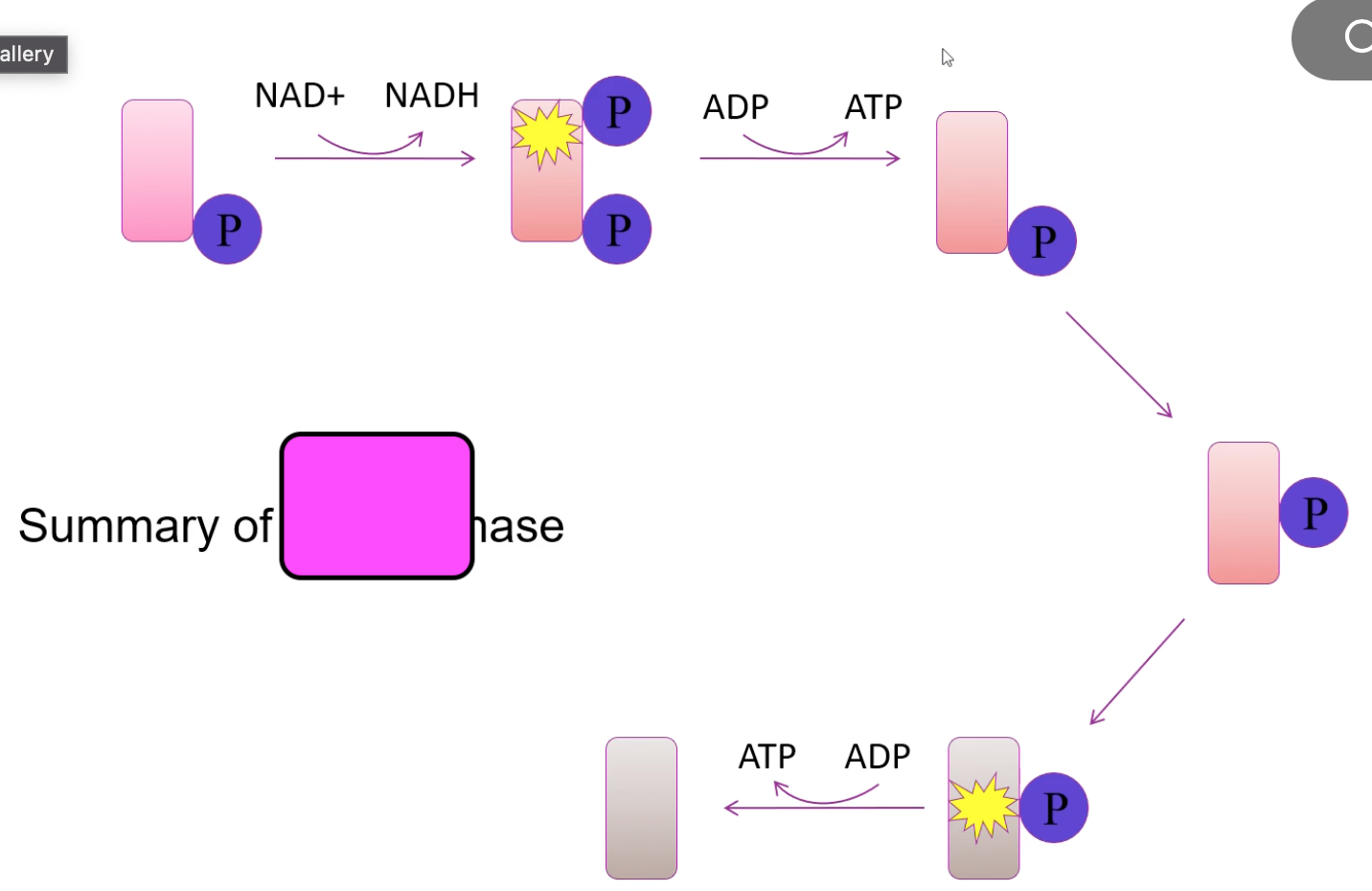
payoff phase
how many mCs of ATP did you get from payoff phase
in glycolytic pathway, what’s the total amount of ATP you get?
in glycolytic pathway, what’s the net amount of ATP you get?
4
4
2
fermentation:
what is it
reaction after glycolysis
why does it happen?
when/where does fermentation happen
fed state?
why important
what if person has LDH mutation?
fermentation = extract E but does not use O2 or change NAD+/NADH ratio
rxn in pic
NAD+ is a necessary reactant for glycolysis to run (step 6). However, running glycolysis full tilt depletes NAD+ stores
fermentation happens when you need ATP but have depleted NAD+ and can’t perform glycolytic pathway,
common in muscles during strenuous exercise
can be well fed and have plenty of sugar, NAD+ depletion will still stop glycolysis
important bc regenerates NAD+ so glycolysis can run forward again
can’t do strenuous activity

how do we get E out of dietary starch/glycogen?
how do we get E out of stored starch/glycogen?
glycolysis, but get converted to glucose mC at start of glycolysis pathway
dietary starch/glycogen → glucose + dextrans by hydrolysis rxns
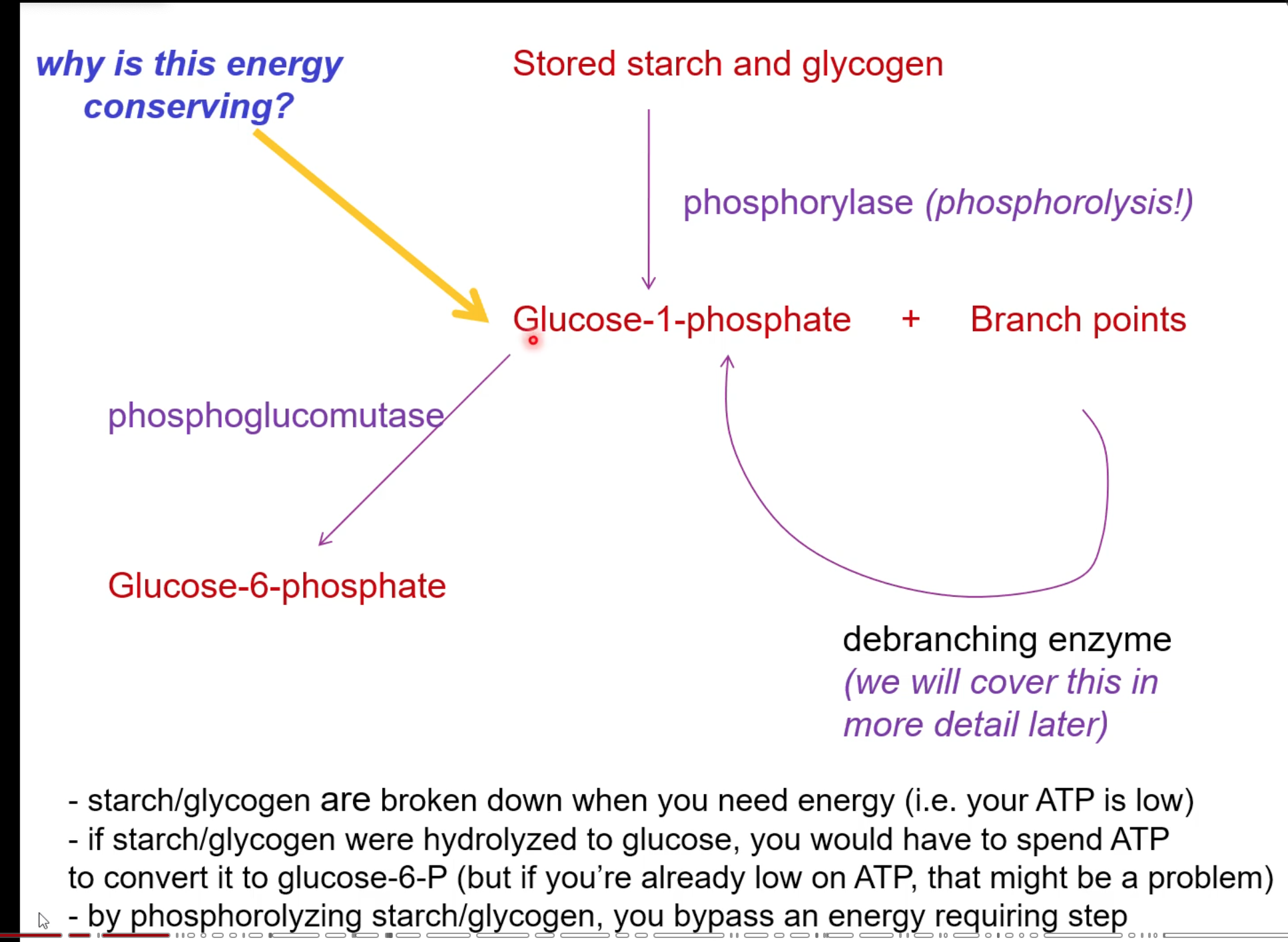
stored starch/glycogen → glucose 1-phosphate by phosphorolysis rxn → glucose 6-phosphate by a mutase
3 steps to start glycolysis from dietary starch/glycogen

4 steps to start glycolysis from stored starch/glycogen

difference b/t glucose/other sugars and glycogen net ATP yield?
why?
why is it important for gycogen to be phospholyzed instead of hydrolyzed
normal net ATP is 2 (2 in 4 out), glycogen net ATP is 3 (1 in, 4 out)
no ATP inputed to go from glycogen → glucose 1-phosphate → glucose 6-phosphate
stored starch/glycogen broken down in times of low ATP. would be problematic to need to hydrolyze starch/glycogen to glucose in times of low ATP bc hydrolysis takes ATP. phosphorolyzing starch/glycogen bypasses E requiring step
how do we get E out of other dietary sugars besides glucose (fructose, mannose, galactose, etc…)
when does net ATP from each change?
alternate dietary sugars get converted back to glucose with enzymes
just like glucose v. glycogen, net ATP depends on if the interconversion back to glucose takes requires ATP expenditure
sometimes needs E to push toward glycolytic pathway, sometimes doesn’t
2 fates of pyruvate after glycolytic pathway completion?
fermentation (anaerobic) = pyruvate → L-lactate
aerobic respiration = pyruvate → acetyl CoA
fermentation = (on first lectures flashcards)
aerobic respiration = 2 things what happens
“respiration” = ?
“aerobic” = ?
fermentation = (first lectures flashcards)
aerobic respiration = transporting pyruvate from cytoplasm to mitochondria, converting pyruvate into acetyl-CoA
respiration = taking e- and giving them to final e- acceptor
aerobic = final e- acceptor is O2

2 ways to make ATP
substrate level phosphorylation (step 7 and 10 of glycolysis)
ADP + Pi → ATP
oxidative phosphorylation
cofactors =
coenzymes =
why coenzymes important
what do these coenzymes do
biotin =
cofactors = frequently divalent cations
coenzymes = organic cofactors (usually vitamin derivatives) that do group transfer reactions
metabolism = catabolic + anabolic. breaking down and building up requires ability to move pieces around
biotin = a coenzyme that transfers CO2
aerobic respiration (stage 1):
reactant → product
enzyme
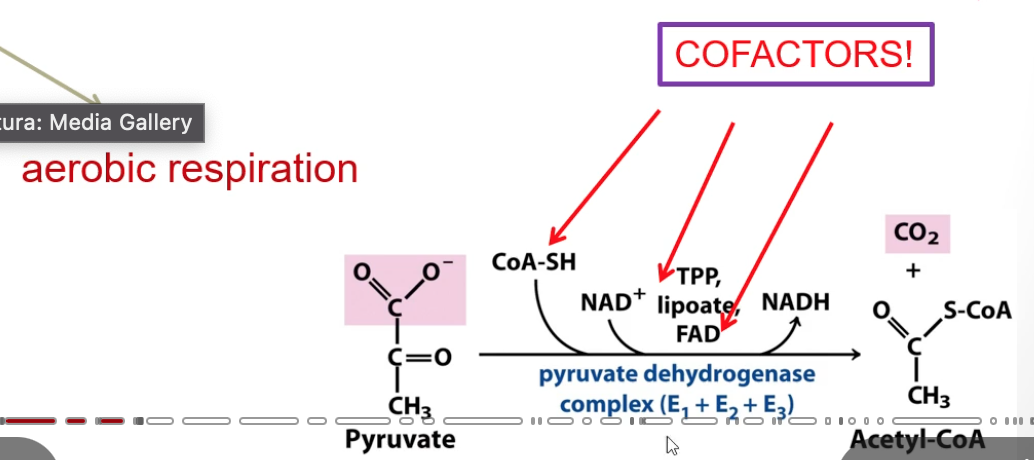
5 cofactors
pyruvate → acetyl CoA
PDH = pyruvate dehydrogenase complex (E1, E2, E3)
cofactors
NAD+
TPP
NAD+/NADH nicotinamide adenine dinucleotide:
soluble or insoluble
why?
completes what reaction
2 e- carriers
why?
soluble coenzyme used in oxidation reactions
can move b/t compartments
NAD+ and NADP+
enzymes are specific for one or the other which is important for regulation
TPP thiamine pyrophosphate:
cofactor of what
thiazolium ring
why so reactive
2 reactions TPP takes part in
recognize the structure
TPP = cofactor of PDH complex
thiazolium ring = has very acidic proton (proton leaves readily)
2 reactions TPP takes part in
decarboxylations = the carbo-anion attacks carbonyl carbons → C-C bond cleavage
two-carbon transfer reactions
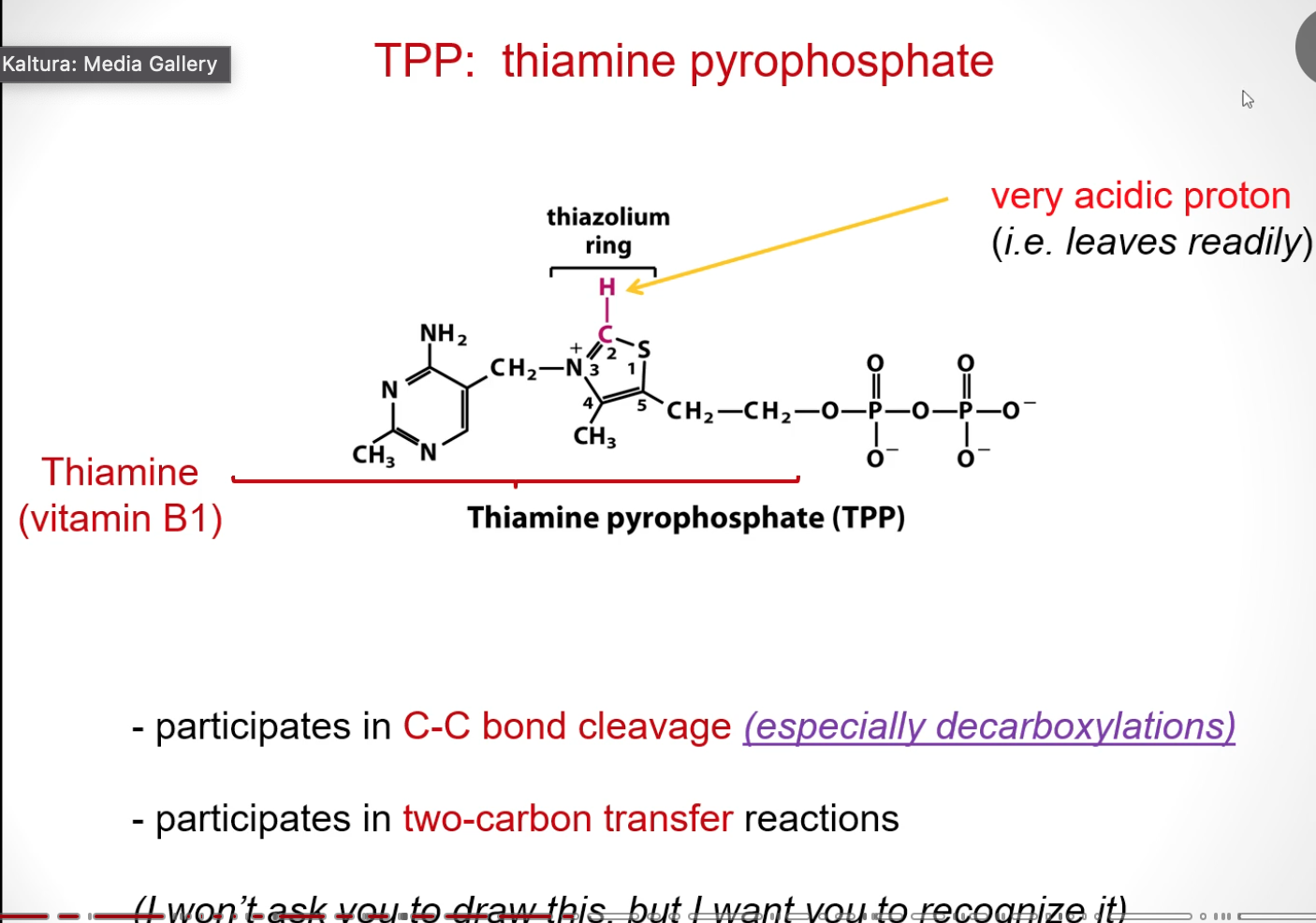
what is the role of thiazolium ring
4 steps of TPP reactivity in PDC
thiazolium ring = e- sink that makes decarboxylation easier
reactivity
acidic proton loss results in carbanion formation (C-)
carbanion is a great nucleophile that attacks C=O (carbonyl carbon)
if C=O next to COO- (keto acid), loss of CO2 (decarboxylation)
regeneration = hydroxyethyl TPP is left, picked up by acetaldehyde and the original TPP is regenerated
attacks pyruvate C=O, removes it’s CO2 (decarboxylation), regeneration (hydroxyethyl TPP → TPP)

aerobic respiration:
where does it happen
what is the process all about?
3 steps
why is aerobic respiration needed after glycolysis
what aerobic respiration require/produce
where does the CO2 we breathe out come from
pyruvate carrier brings pyruvate from cytoplasm to the mitochondrial matrix where aerobic respiration takes place
pushing e-’s along
acetyl CoA production = cellular re(PDH)
Acetyl CoA oxidation (e- extraction) = citric acid cycle/Krebs cycle/tricarboxylic acid cycle
e- transfer and oxidative phopshorylation (putting e- to work)
extracts much more E from glucose than glycolysis
also extract E from lipids and amino acids
requires O2, produces CO2
decarboxylation reaction by TPP
aerobic respiration stage 1:
what is it
draw overall reaction/cofactors
what happens to pyruvate
2 results
what should you associate with the word “oxidative”
stage 1 = acetyl CoA production
reaction
oxidative decarboxylation = pyruvate undergoes oxidative decarboxylation to produce acetyl CoA
e-’s withdrawn (will be used to make ATP)
CO2 released
oxidative = e- withdrawn
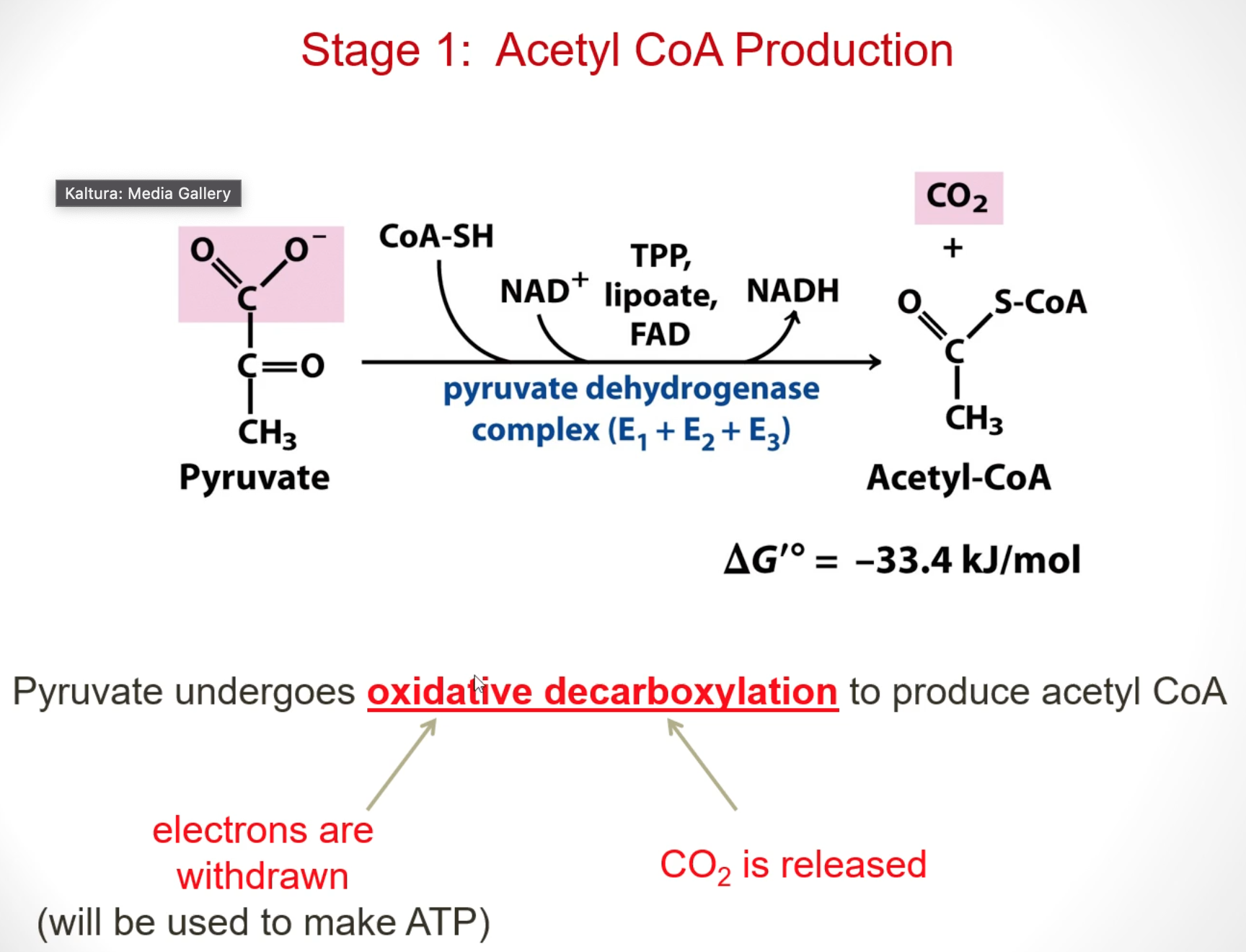
aerobic respiration stage 1
catalyzed by what
3 enzymes 5 cofactors
3 step mech
PDH = pyruvate dehydrogenase complex (E1, E2, E3)
cofactors =
mechanism
Pyruvate (3C) -(decarboxylation)→ 2C-
CO2 released
2C- -(oxidation)→ 2C+
2 e- released
2C+ (acetyl group) + CoA → acetyl-CoA (2C)
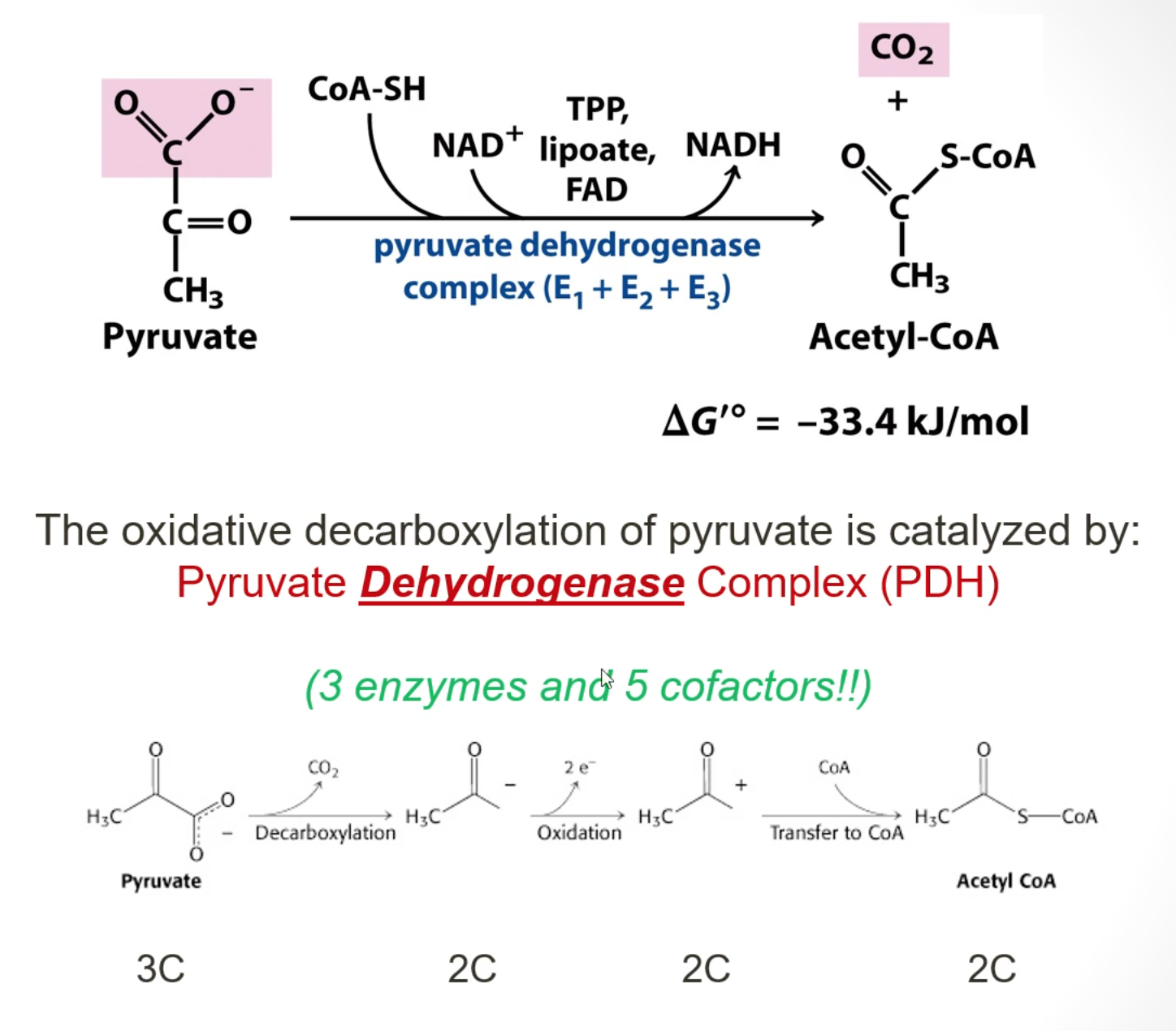
PDH: pyruvate dehydrogenase complex
structure =
3 subunits, prosthetic groups, reactions
substrate channeling
why important
draw PDH
3 enzyme subunits (E1, E2, E3), each subunit is associated w/ a prosthetic group that helps it catalyze specific reactions
subunit , prosthetic groups, reaction
E1 = TPP, oxidative decarboxylation of pyruvate
E2 = lipoamide, transfer of acetyl group to CoA
E3 = FAD, regeneration of the oxidized form of lipoamide
substrate channeling = intermediates never leave the complex
makes PDH very efficient

lipoamide:
what is it
2 parts structure
why Lys important
cofactor affixed of PDH E2 subunit
lipoamide at the end of a long amino acid linker on E2 Lys residue
Lys is long chain allows to swing mC from one active site to another

lipoamide:
how do the E1, E2, E3 subunits interact with the amino acid linker/ lipoamide
why E2 of PDH subunit different than
E2 subunit has 2 domains:
lipoate binding domain in one
active site in the other.
E1 and E3 also have active sites.

lipoamide:
2 things lipoate can carry
3 forms / recognize 3 forms
lipoate can carry e-’s and acyl groups
3 forms =
reduced,= SH-SH
acetylated, = S-C=O/C
oxidized forms = S-S

FAD+ / FADH2 flavin adenine nucleotide:
what is it
what does it do
flavoproteins =
soluble?
non soluble electron carrier generally tightly bound to proteins (sometimes covalently)
functions to temporarily hold e-’s
flavoproteins = proteins containing bound flavin nucleotides
not soluble
FAD v. NAD:
soluble?
why important
# of e-
freely diffusable
soluble
NAD is soluble so it can transport e- easily
FAD is not soluble, so temporarily holds e- but needs something to come pick up e- from it to push reactions forward
# of e-
NAD carries 2 e- = NADH
FAD can carry 1 or 2 e-
FADH = 1 e-, FADH2 = 2 e-
freely diffusable
NAD is freely diffusable
FAD tightly/covalently bonded to proteins (flavoproteins)

coenzyme A (CoA):
what is it
what does it do
business end
thioesters have high _____ bc of high ____
why high? j
thioester hydrolysis = very ____
acetyl-CoA carries thioester, which is like an ____ ____ group
cofactor (coenzyme) for PDH
CoA = picks up acetyl groups (2C fragments) to form thioester (acetyl-CoA)
business end = pantothenic acid
thioesters = high transfer group potential bc have high energy (high G)
high bc no resonance is possible for thioesters
thioester hydrolysis = highly exergonic
thioester is like a activated acetyl group

PDH 5 step mechanism
which enzyme/cofactor
decarboxylation
TPP
oxidation and transfer of acetyl group to lipoyl moiety (lipoamide)
E1
transesterification (transfer to CoA) = replace one thioester w/ another
E2
oxidation of lipoamide to regenerate the S-S form
E2
transfer of e- to NAD+
E3
PDH mechanism step 1 and 2:
decarboxylation
E1’s TTP binds pyruvate
pyruvate decarboxylation = hydroxyethyl TPP is formed
oxidized lipoamide swings into E1 and picks up 2 e- + acetyl group (resets TTP)
forms acetylated lipoamide (thioester-bound acetyl group)
acetylated lipoamide swings to E2 active site


how PDH mechanism step 1 and 2 (decarboxylation/oxidation) different from pyruvate decarboxylase (PDC)
after hydroxyethyl-TPP is formed:
PDH = HETTP’s 2C acetal group transferred to oxidized lipoamide
forms acetylated lipoamide (thioester)
where substrate channeling comes in?
PDC = acetal group being released as acetaldehyde
PDH step 3:
reaction
transesterificaation
soluble CoA enters active site
transesterificaiton = E2 moves 2C acetyl group from one thiol (lipoamide) to another (CoA)
produces reduced lipoamide + acetyl CoA
newly generated acetyl CoA diffuses away but electrons stay on lipoamide
reduced lipoamide swings into E3 active site
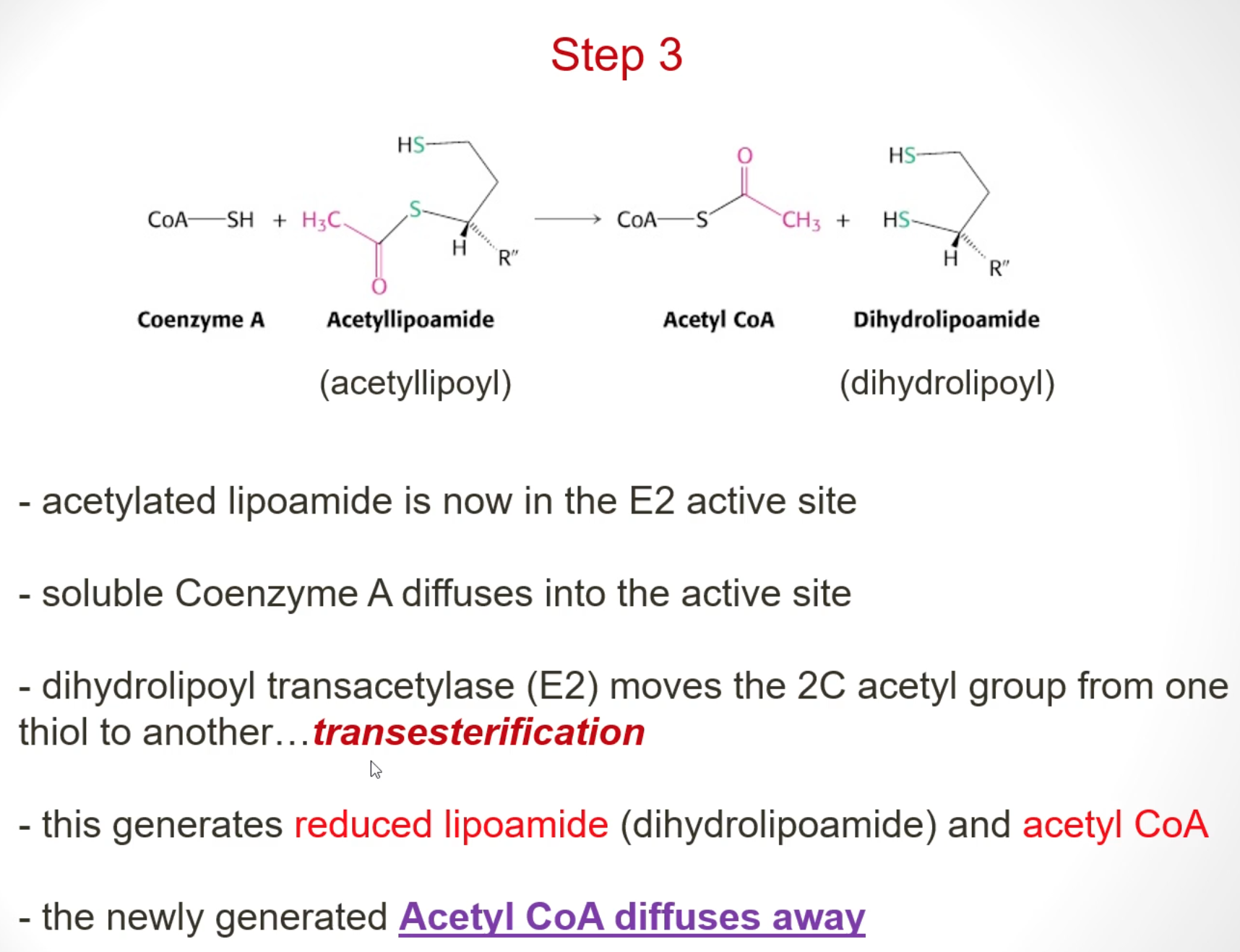
PDH step 3

PDH step 4
E3 oxides reduced lipoamide back to S-S (oxidized form)
result is transfer of 2 e- to FAD → FADH2

PDH step 5
NAD+ enters E3 active site
E3 transfers e-’s from FADH2 to NAD+
NADH + H+ diffuse away and reset system (ready for another round

aerobic respiration stage 1:
what is it
what goes in what comes out
reversible?
2 things acetyl CoA can go to after stage 1?
starved or fed state?
irreversible conversion of pyruvate into acetyl-CoA
committed step,
other ways for pyruvate ← acetyl-CoA, but this rxn is irreversible
acetyl CoA is committed to either:
citric acid cycle = starved bc cell needs energy
fatty acid synthesis = fed bc cell needs to store E
PDH regulation:
why highly regulated
3 things that activate/why
3 things that inhibit/why?
how do these activate/inhibit
regulated bc its the gatekeeper to the citric cid cycle and fatty acid synthesis
regulation
allosterically activated by AMP, CoA, NAD+
these signal low cell E → need more ATP
allosterically inhibited by ATP, acetyl-CoA, and NADH
these signal high E → don’t need more ATP right now (acetyl-CoA turned into fat)
how = kinases and phosphatase part of PDH complex. kinase is activated by ATP
PDH activated by phosphorylation of E1
PDH inhibited by dephosphorylation of E1
PDC( pyruvate decarboxylase) vs. PDH
PDH (people)= oxidative decarboxylation is The whole complex (E1, E2, D3) oxidative
pyruvate -(PDH)→ acetyl-CoA
PDC (yeast)= non oxidative pyruvate decarboxylation
pyruvate -(PDC)→ acetaldehyde + CO2 -(alcohol dehydrogenase)→ ethanol
citric acid cycle outputs:
for one acetyl-CoA
3 NADH, 1 FADH2, 1 GTP
2 acetyl CoAs enter from 1 glucose → glycolysis → respiration → 2 acytyl
so 6 NADH, 2 FADH2 and 2 GTP total
types of reactions:
condensation =
dehydration =
hydration =
oxidative decarboxylation
decarboxylation =
oxidative =
substrate level phosphorylation
dehydrogenation reaction
condensation = combining 2 mCs
removing water mC
add water
decarboxylation = remove CO2
oxidative = LEO loss of e-
substrate level phosphorylation = add Pi to ADP or GDP → ATP or GTP
dehydrogenation = removing e- w/ different carrier, hydration/dehydro steps
citric acid cycle:
amphibolic =
what enters
how many e- leave
how many decarboxylation rxns
how many substrate level phosphorylations
how many H20 are consumed
amphibolic = used in both anabolic and catabolic processes
intermediates can enter/leave at different points
8 e- per turn
acetyl coa enters
how many decarboxylation rxns = 4
how many substrate level phosphorylations = 1
how many H20 are consumed =

8 CAC steps
pneumonic for reactants/products
what to know for each
incoming substrate/exiting products
name of enzyme
type of reaction
know the pointed out structures in the lecture
FOLLOW THE CARBONS
“Our City Is Kept Safe and Sound From Fear and Malice”
Ocondensation
isomerization (dehydration/rehydration)
oxidative decarboxylation (NADH)
oxidative decarboxylation (NADH)
substrate level phosphorylation (GTP)
oxidation/dehydrogenation (FADH2)
hydration
oxidation/dehydrogenation (NADH)
CAC step 1:
what is it
what is regenerated
reversible?
oxaloacetate (OAA) substrate level/why?
how is rxn pushed forward if [OAA] is low
why?
pic
CoA is regenerated and recycled
irreversible
OAA = substrate in 1st rxn that is constantly consumed by the CAC
so, rxn concentration is low
driven forward by thioester hydrolysis
thioester hydrolysis (acetyl CoA is a an activated acetyl group high transfer pot)

citrate synthase (enzyme for CAC step 1: acetyl-CoA + OAA):
how does its structure prevent premature hydrolysis of acetyl-CoA?
open =
closed =
has to be ___ 1st
thioester hydrolysis = ___
why is that a problem?
how doe citrate synthase ensure acetyl-CoA transfers acetyl group to the correct place instead o?
dimer with open and closed conformations
open = cannot bind acetyl-CoA
closed = can bind acetyl- CoA
has to bind OAA before it will enter closed conformation
ensures acetyl group acceptor OAA is already in active site before it binds acetyl-CoA
thioester hydrolysis = release a lot of free E, (unstable (high G) bc no resonation)
problem = acetyl CoA wants to give up acetyl group to anything even water
solved by OAA binding conformation change of citrate synthase

CAC Step 2:
reaction (shown as 2 step, but memorize it as 1 step)
why is the purpose of this step?
DG’0 for this reaction?
how driven forward?
why = convert citrate to better substrate for oxidation (the goal of CAC)
citrate = tertiary alcohol (bad oxidation substrate)
isocitrate = secondary alcohol (good oxidation substrate)
high DG but driven forward by rapid product removal in step 3

aconitase:
active site structure =
iron sulfur clusters =
what’s the purpose
rxn?
iron sulfur cluster = Fe-S crystal lactic w/ Cys residues in enzyme active site
purpose:
allows e- to be taken 1 at a time
Fe-S center center position reactants and enable removal/addition of water
reaction = dehydration step, then a hydration step

CAC step 3:
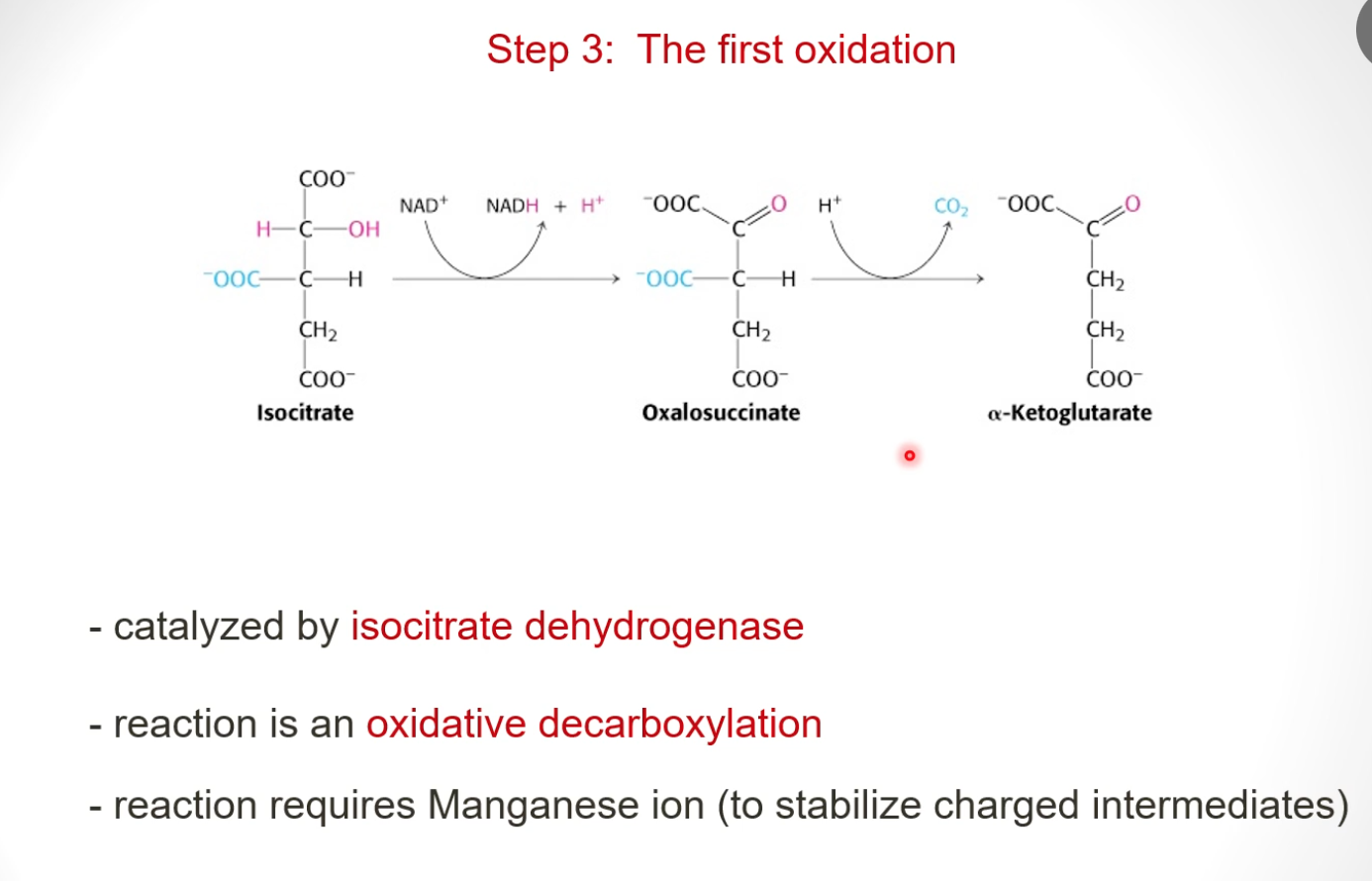
rxn (drawn as 2 step memorize/structures as 1 step)
reaction
what is the strategy
why notable
structures remember necessary for all runs
d
notable = first oxidation
oxidative decarboxylation
2 step = oxidation then decarboxylation
strategy = generate unstable intermediate that readily loses CO2
CAC step 4:
reaction?
why notable/ 2 important things this reaction does
what is a-ketoglutarate
what do we know about oxidative decarboxylation of a-ketoacids
where is CO2 leaving from?
oxidative decarboxylation (2x NADH)
2nd oxidation
transfers e- to NAD+
sets up reaction 5 by forming thioester (high group transfer potential)
a-keto acid
similar to PDH pyruvate dehydrogenase complex
CO2 leaving from C4

a-ketoglutarate dehydrogenase complex (a-KDH):
4 ways how similar to PDH
a-KDH is similar to PDH
same structure
E3 is identical
same 5 cofactors
NAD+ TPP lipoate FAD+, CoA-SH
same type of reaction (oxidative decarboxylation of a-keto acid)
EXACT SAME MECHANISM ALL STEPPS AS PDH

CAC step 5:
rxn
why special
what provides the E to do it?
correctly named?
only substrate level phosphorylation in the CAC
thioester cleavage (formed in previous step) fuels GTP formation per each acetyl-coa
syntheses utilizes NTP energy not make it, so named incorrectly. reverse found first

why GTP also E currency od cell?
nucleoside diphosphate kinase
DG
GTP = ATP bc also 3 phosphates, base doesn’t matter
all triphosphate are equivalent and interconvertible in terms of energy source
nucleoside diphosphate kinase = enzyme that readily converts b/t GTP and ATP
DG’0 = 0

CAC substrate level phosphorylation:
enzyme
4 step mech
succinyl-CoA synthetase
mech
enzyme bound succinylcholine CoA is converted to a succinylcholine phosphate (thioester converted to acyl phosphate)
acyl phosphate has high group transfer potential
phosphate transferred to histidine in enzyme’s' active site
enzyme transfers phosphate from His to GDP

CAC step 6:
rxn
why special
how regulated
what happens to FADH2
third oxidation
special:
only reaction in which electron acceptor is FAD,
only reaction that doesn’t occur in the mitochondrial matrix
occurs in ‘inner mitochondrial matrix”
strongly inhibited by malonate (succinate analog/competitive inhibitor)
e-’s passed along: FADH2 → Fe-S clusters → Coenzyme Q → ETC

succinate dehydrogenase:
only enzyme that is ______
where is it?
only CAC enzyme not in the mitochondrial matrix
found in inner mitochondrial matrix (bound to inner mitochondrial membrane or PM in bacteria)
Step 6:
rxn (don’t need to know intermediate step, just know its 2 step)
stereospecific?
hydration
fumarate only uses trans (fumarate) forward and only l malate reverse

fumarase:
why unique
forward and reverse
fumarate = highly stereospecific and only adds water in trans (diff sides of double bond)
forward: doesn’t work on cis version of fumarate (maleate)
reverse: doesn’t work on cis version of L-Malate (D-malate)

CAC step 8:
rxn
electron acceptor
favorable?
how go forward?
4th oxidation
NAD+
very unfavorable but oxaloacetate in cell is super low, s
product removal bc it gets used when cycle continues
citric acid cycle balance sheet:
3 nada 1 fadh2 1 gtp
2 pyruvate after glycolysis , so 2 acetyl CoAs, so X2

translating CAC products into ATP:
# GTP/cycle
how converted to ATP
what happens to intermediates
e- from CAC do what
NADH and FADH2 do what
ATP per?
1 GTP per cycle
nucleoside diphosphate kinase = GTP ←> ATP
intermediates are not depleted
e-’s reduce NAD+ and FAD and then are used to make ATP
NADH = 2.5 ATP
FADH2 = 1.5 ATP
ATP from 1 glucose:
how much ATP from 1 glucose
how efficient in reality
why 30-32; 3 or 5 ATP why different
30-32
only 65% bc lost to heat
two pathways for NADH e- from glycolysis to enter the mitochondria
2 NADH from glycolysis take aspartate shuttle or GAP shuttle
NADH → NADH → 10 protons → 2.5 ATP x2 = 5 ATP
no E lost
FADH2 as e- carrier into mitochondria = NADH → FADH2 → 6 protons → 1.5 ATP x2 → 3 ATP

CAC dirty little secret:
which carbons leave as CO2?
where from = oxaloacetate
carbons are NOT from acetyl CoA
acetyl CoA carbons will eventually leave but not during the first turn of the cycle

Anaplerotic reactions:
what are they
how regulated
carbons
where does it happen
most important anaplerotic reaction in mammals =
equation =
why are they needed
anaplerotic reaction = replenish metabolites (intermediates) for the CAC cycle
enzyme is allosterically activated by acetyl CoA
makes 4C intermediates by carboxylation of 3C
in matrix
regenerating oxaloacetate most important anaplerotic reaction in mammals to keep CAC from stopping
pyruvate +HCO3- + ATP ←(pyruvate carboxylase)-> oxaloacetate + ADP + Pi
needed bc of downside of being amphibolic
vital CAC intermediates can be used to make other things in other pathways
anabolic reactions can deplete cycle of vital CAC intermediates
intermediates must be replenished

pyruvate carboxylase:
reaction
how regulated
why
regulation compared to PDH
anaplerotic reaction
pyruvate carboxylase = allosterically activated by acetyl CoA (won’t work unless acetyl CoA present)
acetyl CoA signals well fed = don’t need to run CAC and have time to make extra oxaloacetate
in well fed state, high acetyl-CoA:
inhibits PDH (pyruvate→ acetyl CoA) bc don’t need more E from CAC
activates pyruvate carboxylase (pyruvate → oxaloacetate) bc have extra E to make more
pyruvate carboxylase:
cofactor/what used for
2 structures similar to lipoate
3 step mech
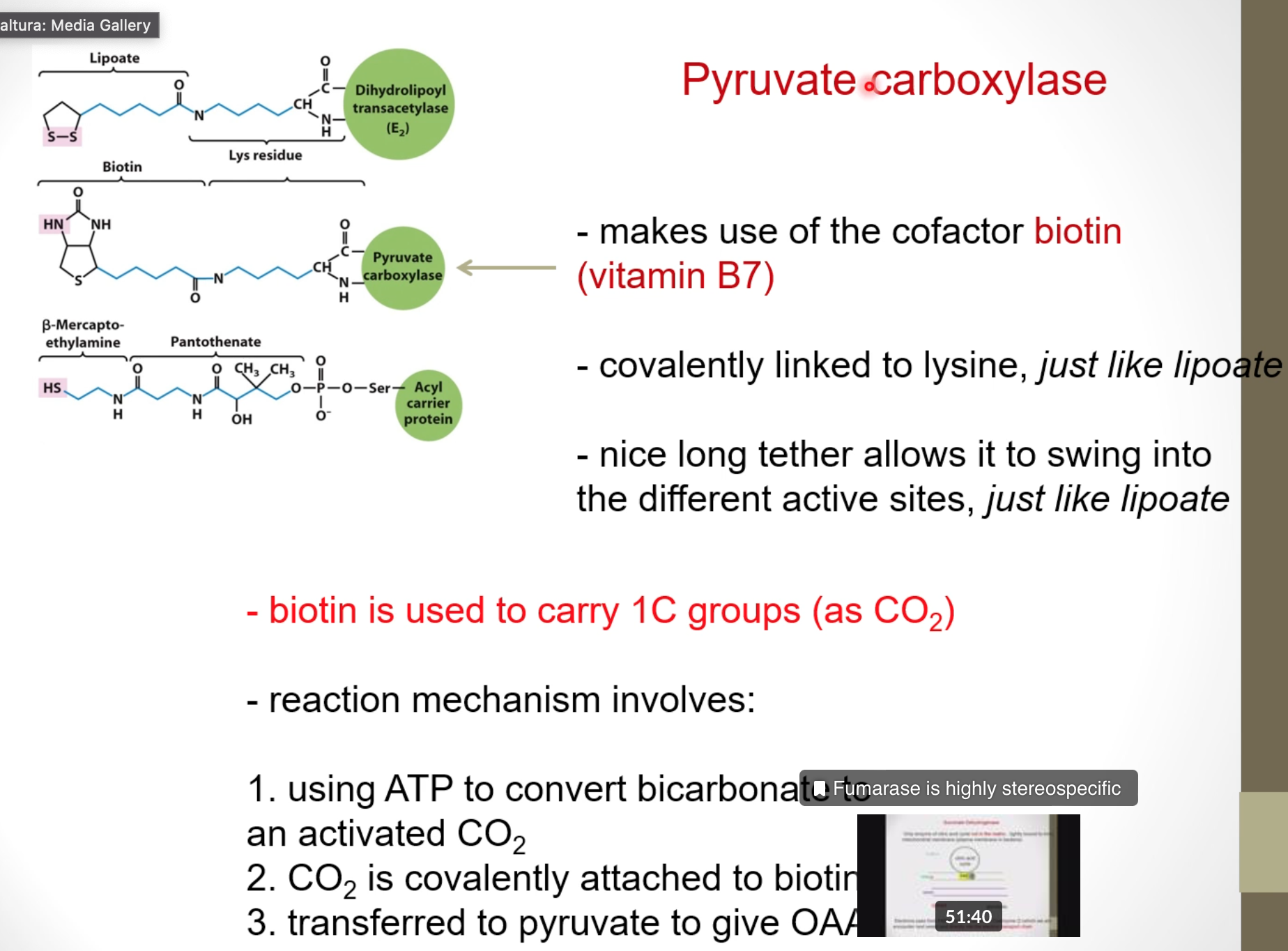
cofactor = biotin
biotin used to carry 1C groups (as CO2)
structure similar to lipoate
covalently linked to lysine
long tether allows two swing into different active sites
3 step mech
use ATP to convert bicarbonate to an activated CO2
CO2 is covalently attached to biotin
transferred to pyruvate to give OAA
4 points of CAC regulation
3 methods of regulation
4 points =
entry point via PDH
allostery = PDH inhibited by high ratios of ATP/ADP, NADH/NAD+, and acetyl-CoA/CoA
signal high E
3 strongly exergonic steps
citrate synthase = inhibited by low levels of OAA or acetyl-CoA
feedback inhibition
by ATP, citrate, and succinyl CoA
substrate availability: NADH producing reactions = inhibited by high levels of NADH

e- carriers from Glycolysis: glucose → pyruvate
e- carriers from PDH: pyruvate → acetyl CoA
e- carriers from CAC: acetyl-CoA → regenerated oxaloacetate
which steps
what is the final e- acceptor?
Glycolysis = 2 NADH
PDH = 2 NADH (from FADH2)
CAC = 3 NADH + 1 FADH2 ×2
steps 3, 4, 6, 8
O2 = final e- acceptor

NAD / FAD nomenclature
NAD only carries 2 e-,
NADH, NADH2, NADH + H = all the same
FAD can carry 1 or 2 e-
always specify FADH2
how do e- move:
oxidized v reduced
emf (e- motive force) =
what work will the emf be used to do, how?
e- move from lower to higher e- affinity
higher affinity = initially oxidized, becomes reduced
lower affinity = initially reduced, becomes oxidized
emf = difference in affinity (higher # - lower #)
work = making ATP, couple it with moving e- from lower to higher affinity

from what sources do animals get their energy
3 main examples
what is the E in those sources
how does the E transfer work
animals get E from REDUCED FUELS
reduced fuels = carbs, lipid, amino acids
E in the fuels = electrons
how
electrons from reduced fuelds used to reduce NAD/FAD _> NADH/FADH2
in oxidative phosphorylation, E from NADH/FADH2 used to make ATP
emf resulting from transfer of e- can be harnessed to do work

substrate level v. oxidative phosphorylation
substrate level = ADP + Pi → ATP
direct reaction: coupled w/ favorable reaction
oxidative =
not direct: coupled w/ favorable e- flow down electrochemical gradient
respiration is all about what?
3 major stages of respiration
respiration = pushing e-’s along
stages
acetyl-CoA production (PDH)
acetyl-CoA oxidation (CAC)
e- extraction
e- transfer (ETC) and oxidative phosphorylation
putting extracted e-’s to work
DE’0 =
DE’0 > 0 = f
DG’0 =
DE’0 = E(red) - E(ox)………..E(red) is more positive of the 2
DE’0 > 0 = favorable
DG’0 = -nF(DE’0)
ETC purpose
equation
ETC = passing e- from NADH (ultimately food) → O2
NADH + (H+) + ½O2 → (NAD+) + H20
chemiosmotic theory:
what is it
where do cells get E to phosphorylate ADP
how does that get established
theory of how cells make most of their ATP (ADP + Pi → ATP)
E to phosphorylate ATP from flow of protons down an electrochemical gradient
not a direct reaction like in substrate level phosphorylation
electrochemical gradient = from transporting protons against their electrical and chemical gradients during transport of e-
chemiosmotic theory:
where does it take place
4 step mech
where are H+ located
mitochondria
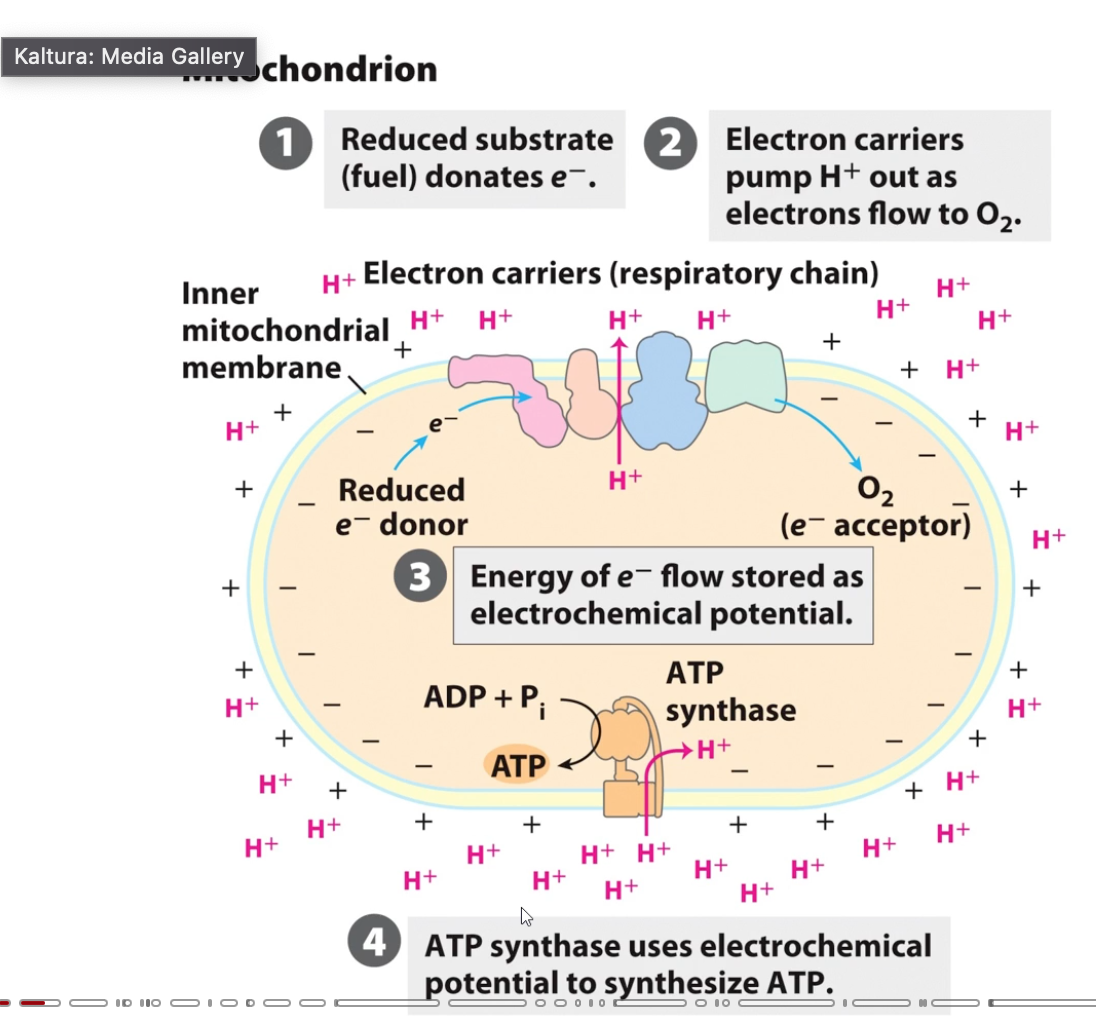
4 steps
reduced fuel donates e-
e- carriers pump H+ out as electrons flow to O2
E of e- flow stored as electrochemical potential (H+ gradient across membrane)
ATP synthase uses electrochemical potential to synthesize ATP
high H+ in cytoplasm, low H+ inside mitochondria
chemiosmotic theory:
requires _____ membranes
prok v euk
membrane requires proteins that facilitate 2 couple reactions
uphill v downhill
what is the gradient
requires topologically CLOSED membranes
PM in bacteria
Cristae (inner mitochondrial) membrane in mitochondria
1st (ETC): membrane has proteins that couple:
favorable = “downhill” e- -(ETC)→ O2
unfavorable = “uphill” pump H+ outside (against electrochemical gradient)
FORMS gradient = + cytoplasm, - mito matrix
2nd: membrane has protein that couple
favorable = “downhill” H+ outside → inside (with electrochemical gradient)
unfavorable = ADP + Pi → ATP

Mitochondrial proteins:
how isolate
5 proteins
which are ETC
how use prosthetic groups?
gentle lysis of cell yields…
5 protein complexes =
ETC = complexes 1-4
transfer e- from donor to acceptor
ATP synthase = complex 5
make ATP
complexes 1-4 are just scaffolds holding the "wiring (prosthetic groups) that actually participate in e- transfer
3 types of e- transfer in ETC
5 ETC e- carriers
3 types of e- transfer in ETC
direct transfer (reduction of Fe3 → Fe2)
as hydrogen = H+ + e-
has hydride = H-
5 e- carriers
NADH (2 e-) - previous lecture
flavoproteins (1 or 2 e-) - previous lecture
Fe-S proteins (1 e-)
cytochromes (1 e-)
ubiquinone (1 or 2 e-)
Fe-S proteins:
what is it
Fe-S cluster =
e- carrier carries 1 e- at a time
have Fe-S clusters = form crystal lattices in active site that allow to carry 1 e-