Properties of Fresh Meat: Shelf Life
 Call Kai
 Learn
 Practice Test
 Spaced Repetition
 Match
 Flashcards
 Knowt Play
1/56

There's no tags or description
Looks like no tags are added yet.
57 Terms
Shelf life
The amount of time a meat product is acceptable for human consumption
When does shelf life begin? When does it end?
Begins at slaughter and extends through all phases of production, transportation, display and consumer storage
What determines shelf life?
Microbial contamination
Microbial activity
Proteolytic degradation (tenderness)
Met-myoglobin reducing activity (oxidation)
What happens to retail cuts that are discolored at the “sell by” date or earlier?
Price is marked down/decreased
Package is discarded
Roughly how much money is lost from discoloration of meat?
$3.74 billion dollars
Roughly what percentage of all beef is discarded due to discoloration of meat?
~2.55%
Retail case life
The amount of time a product retains acceptable fresh lean color during retail display
Why do tenderloin and ground beef have a “sell/pull by” date of ~1 day?
They are composed mostly of type 1 fibers, of which change the fastest
Recall that type 1 fibers have large amounts of mitochondria
Why do chucks, shoulders, and rounds have a “sell/pull by” date of ~2 days?
They are locomotive muscles
Why do loins and ribs have a “sell/pull by” date of ~3 days?
They are composed mostly of intermediate fibers
(T/F) — Oxidation of muscle/lean can sometimes be a good thing
False. It is never a good thing
Why does meat quality deterioration occur?
Lipid oxidation and muscle pigment oxidation
What causes the change from oxymyoglobin → metmyoglobin? What does this do to the pigment of the meat?
Oxidation of the iron in the heme moiety of myoglobin (ferrous → ferric); brown discoloration
Why do some muscle discolor less rapidly?
Increased/conserved metmyoglobin reducing activity (MRA) resulting from increased/conserved reducing equivalents (aka stabilizers)
What chemical compound is a metmyoglobin reducing equivalent?
NADH2
What does increase MRA and reducing equivalents allow for in meat?
Allows the iron in myoglobin to remain in the reduced state for longer, resulting in brighter muscle color
Brighter color due to the pigment existing in a reduced-myoglobin/oxymyoglobin state
(T/F) — Lipid and muscle pigment oxidation are closely related
True
(T/F) — Delaying lipid breakdown will have no effect on the delay of meat discoloration
False. Delaying lipid breakdown will delay meat discoloration
Lipid oxidation rate and extent is primarly affect by the ___ content of tissue
PUFA (poly unsaturated fatty acid)
How does PUFA undergo auto-oxidation (ferrous → ferric)?
Via a free radical mechanism
Explain the process by which PUFA undergoes auto-oxidation.
Abstraction of a labile hydrogen from an unstaturated lipid forms a lipid radical
An oxygen molecule is then added to the radical, forming a lipid peroxyl radical
Lipid peroxyl radical then undergoes a reaction with an unsaturated lipid, forming a lipid peroxide
Said lipid peroxide is then broken down to form aldehydes, ketones, and carboxylic acids

What molecule is at position A?
Unsaturated lipid

What molecule is at position B?
Lipid radical

What molecule is at position C?
Lipid peroxyl radical
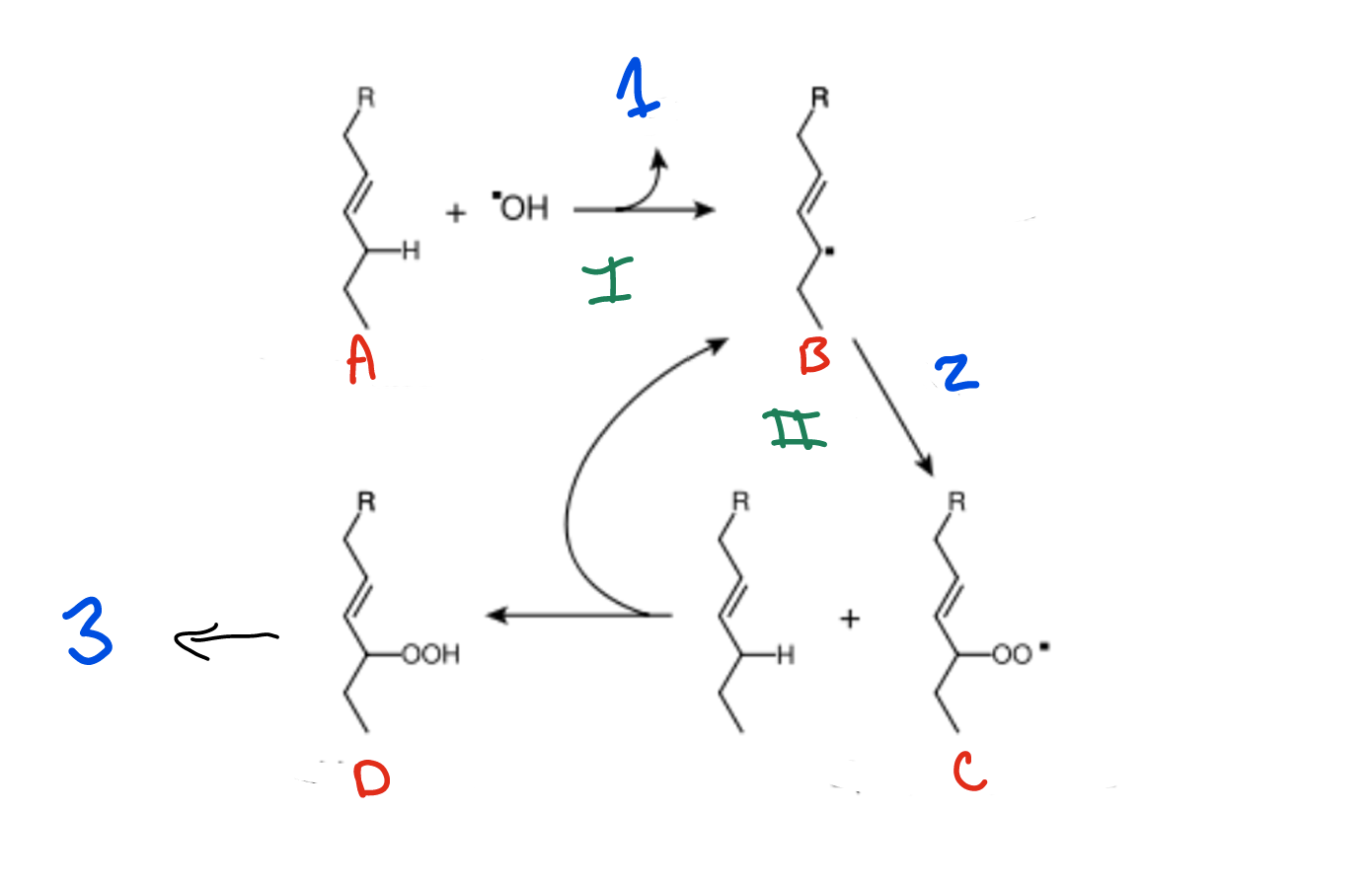
What molecule is at position D?
Lipid peroxide
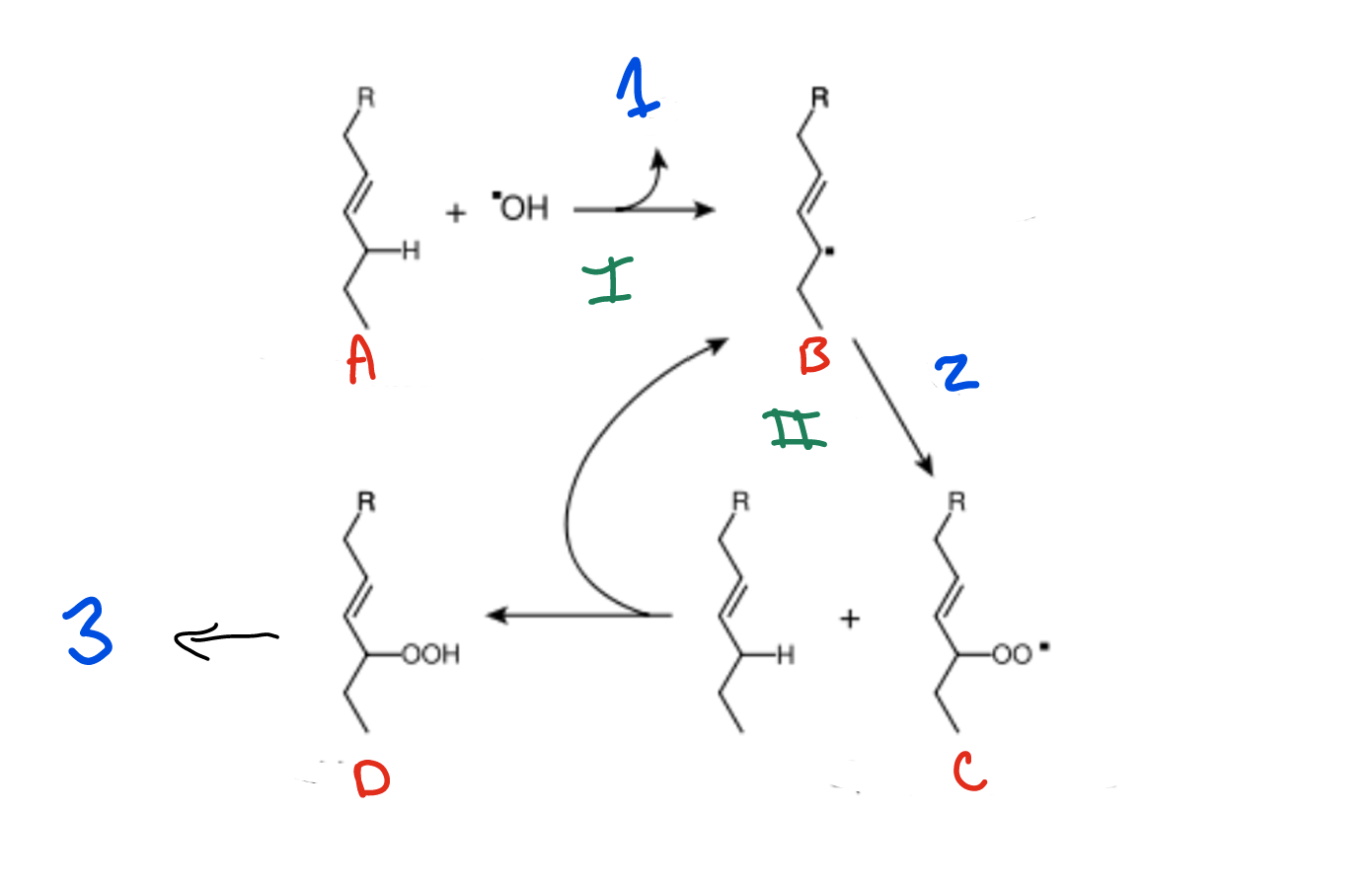
What step occurs at position I (roman numeral)?
Initiation
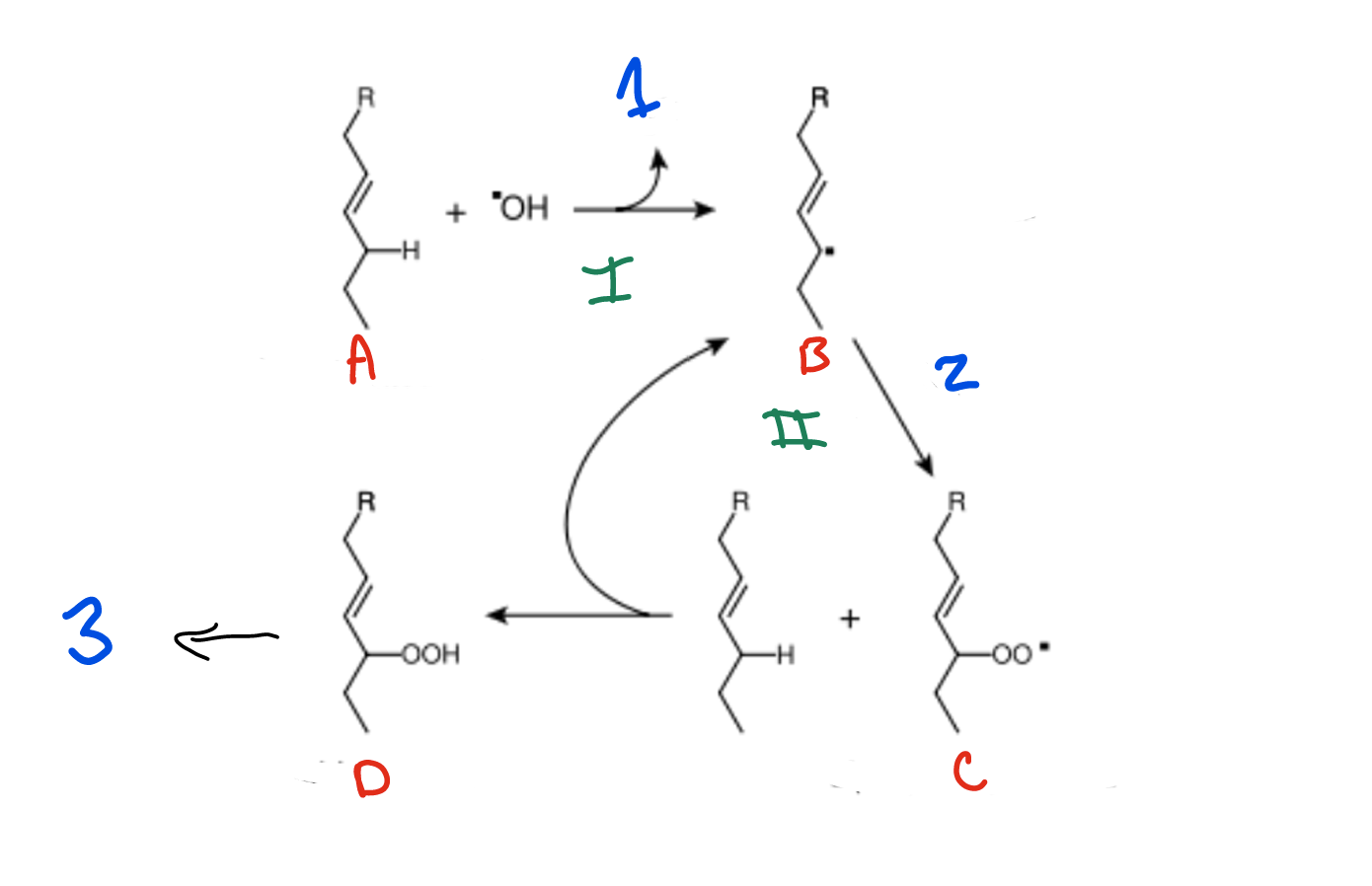
What step occurs at position II (roman numeral)?
Propagation—”addition of”

What molecule leaves at position 1 (non-roman numeral)?
H2O / water
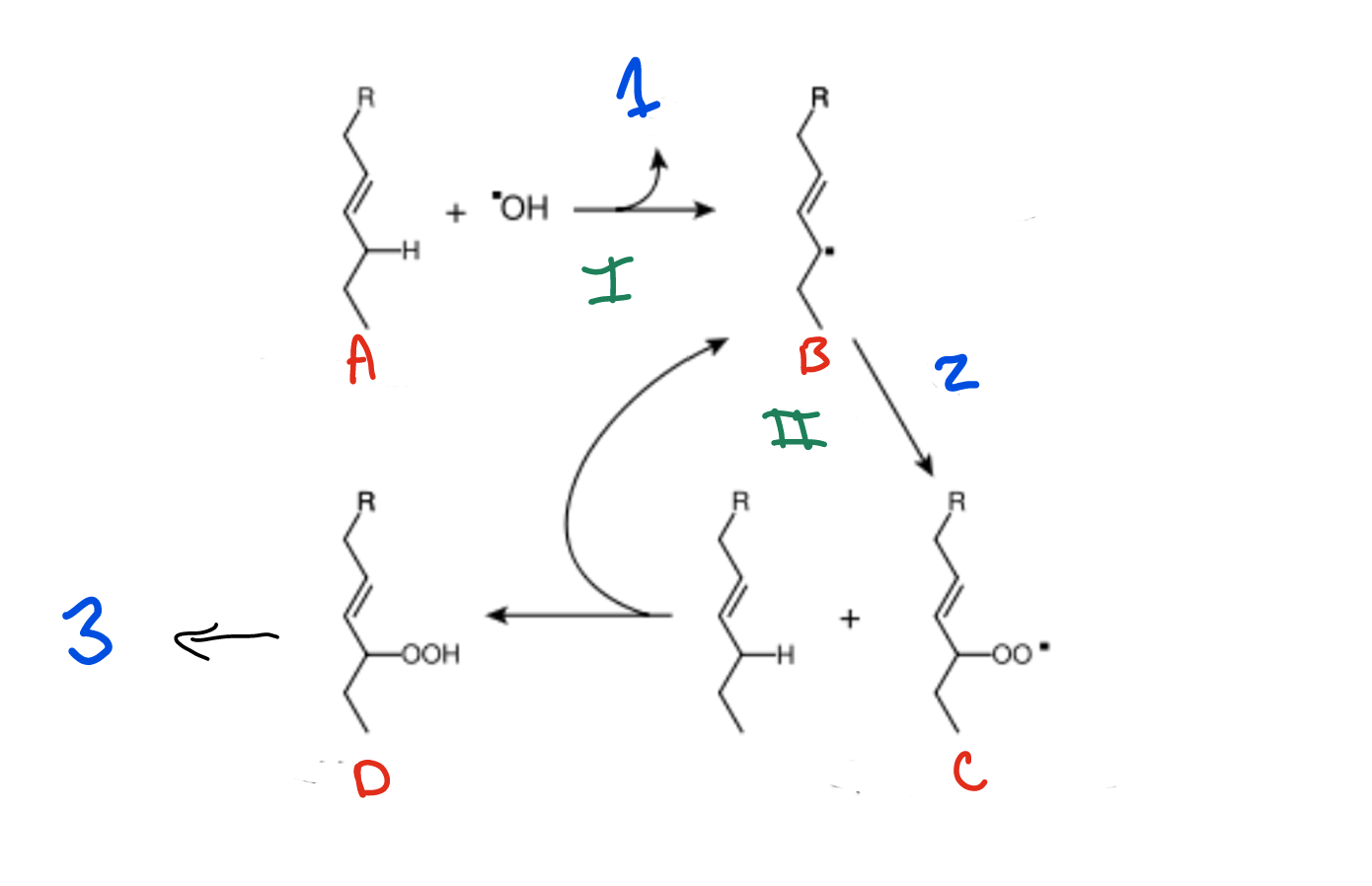
What molecule is added at position 2 (non-roman numeral)?
O2 / oxygen

What molecules are created at position 3?
Aldehydes, ketones, carboxylic acids
The breakdown of lipid peroxides produces what?
Aldehydes, ketones, and carboxylic acids
What do aldehydes, ketones, and carboxylic acids do to meat?
Negatively affect meat odor and flavor
Retail case life (and ultimately shelf life) of fresh meat is managed by?
Reducing or preventing oxidation
Antioxidants
Can extend the shelf life of products by slowing down oxidation and, thus, the creation of “off flavors”
Synthetic antioxidants
Manmade; BHA, BHT, TBHQ, ascorbic acid, gallic acid esters
Natural antioxidants
Not manmade; vitamins (C and E) and phytochemical oxidants (polyphenols and carotenoids)
What is the most widely used antioxidant in Europe and the USA?
Rosemary
What 3 groups can antioxidants be divided into?
Primary antioxidants
Secondary antioxidants
Tertiary antioxidants
Primary antioxidants
Function as free radical terminators
What is another term for primary antioxidants?
Scavengers
Secondary antioxidants
Important preventive antioxidants that function by retarding chain initiation
Tertiary antioxidants
Repair damaged biomolecules

Where on the chart do primary antioxidants work?
The propagation cycle—target the lipid peroxyl radical, donating an H to form a stable product

Where on the chart do secondary antioxidants work?
At or before initiation—keep the OH radical from forming or reaching the unsaturated lipid
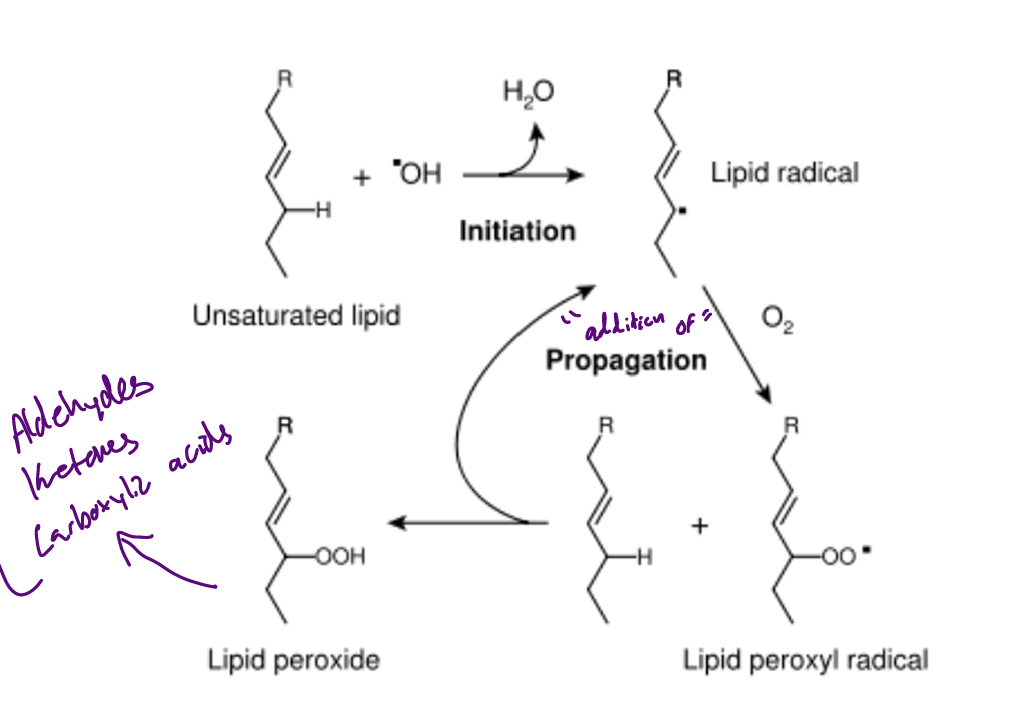

Where on the chart do tertiary antioxidants work?
Trick question; they don’t appear on this chart.
Act after the chain has done its damage by removing or repairing oxidized lipids
Aside from antioxidants, what else manages oxidation?
Temperature
Anaerobic packaging
Dark storage
Temperature and managing oxidation
Cold temperatures slow the oxidation reaction but cannot stop it
(T/F) — Freezing temperatures can stop oxidation
False
Anaerobic packaging and managing oxidation
Vacuum-sealed or in a modified atmosphere
Modified atmosphere = presence of CO2 or NO instead of O2
Dark storage and managing oxidation
Meat products are often stored and distributed in the absence of light to avoid photo-oxidation
Photo-oxidation
Oxidation caused by the action of light
The oxidation of unsaturated fats is (accelerated/decelerated) by exposure to light
accelerated
Enhanced meat
The addition of non-meat ingredients to whole meat products to improve palatability, case life, and retail yield
Done via injectors

Another term for enhanced meat is called?
Deep marination
What levels of solution are injected into meat products?
8-12% average
What historical issue was seen with injection-site lesions from vaccines?
Older vaccines contained adjuvants that contained inorganic metals that, when exposed to high levels of oxygen, oxidized—causing areas of meat to appear green
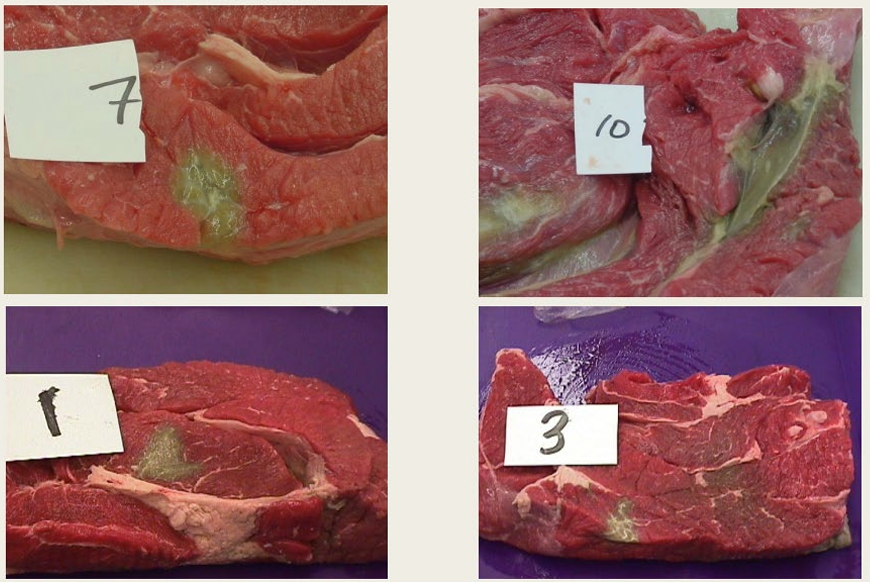
How was the issue with green-colored meat from injection-site lesions fixed?
Modern vaccines without inorganic metals took over