Eyes - Packet and PowerPoint 3
 Call Kai
 Learn
 Practice Test
 Spaced Repetition
 Match
 Flashcards
 Knowt Play
1/104

There's no tags or description
Looks like no tags are added yet.
105 Terms
What are the major tenants when dealing with glaucoma?
Intraocular pressure rises (Cause of fluid buildup)
Pressure causes damage to optic nerves (axons)
Glaucoma is an optic neuropathy produced by increased intraocular pressure
What are the 2 major types of glaucoma?
Open-angle glaucoma
Closed-angle glaucoma (Narrow-angle glaucoma, acute glaucoma)
How long do people have open-angle glaucoma?
Forever it is a chronic condition
How common is open-angle glaucoma?
Most common form of glaucoma (90% of glaucoma)
It is prevalent 65.6 million cases worldwide and 3.4 million cases in the USA
Open-angle glaucoma is an optic neuropathy characterized by what (think what it does to your vision)?
Progressive peripheral visual field loss
Followed by central field loss in a typical pattern
What is the process that leads to open-angle glaucoma?
Fluid produced by ciliary body can’t get through either the trabecular meshwork OR Canal of Schlemm because of a blockage, leading to increased pressure
What are some other names of Closed angle glaucoma?
Narrow angle glaucoma
Acute glaucoma
How common is closed angle glaucoma?
5% of glaucoma cases
What is a true ophthalmologic emergency when talking about glaucoma?
Closed angle glaucoma
What are the cavities of the eye?
Posterior cavity
Anterior cavity
Divided into the anterior and posterior chambers
Where is the posterior chamber?
Between the iris and the ciliary body and lens
Where is the anterior chamber?
Extends from the cornea to the iris
What does the ciliary body secrete?
Aqueous humor fluid
What is the path that aqueous humor fluid takes?
Is secreted by the ciliary body
Secreted into the posterior chamber
Flows through the pupil to the anterior chamber
At the base of the anterior chamber, the fluid passes through the Canal of Schlemm (a collecting duct)
It is then returned to the veins of the sclera
What is the pressure created by the fluid within the anterior chamber of the eye where it pushes against the inner surface of the cornea?
Intraocular pressure
What happens when aqueous humor cannot enter the canal of Schlemm?
Fluid pressure rises, distorting soft tissue within the eye
How is open-angle glaucoma described (the quote)?
A silent thief in the night that steals your vision
Why is open-angle glaucoma “a silent thief in the night that steals your vision?”
It develops slowly and goes unnoticed for years (robbing the patient of vision slowly)
Individuals with open-angle _________________________. Some patients are unaware of field loss even when it has progressed to central “tunnel vision.” Thus, open-angle glaucoma is __________________________________________________________.
Individuals with open-angle glaucoma rarely experience symptoms. Some patients are unaware of field loss even when it has progressed to central “tunnel vision.” Thus, open-angle glaucoma is generally detected incidentally on comprehensive ophthalmic examination.
How is open-angle glaucoma generally detected?
Incidentally on comprehensive ophthalmic evaluation
Do patients usually know when they are experiencing open-angle glaucoma?
No they think it is old age and some don’t know it even when it progresses to tunnel vision
What does intraocular pressure buildup damage?
The optic nerve (optic axons)
Why is open-angle glaucoma particularly dangerous?
It can progress gradually and go unnoticed for years
Open-angle glaucoma is a what?
An asymptomatic, progressive optic neuropathy characterized by enlarging optic disc, cupping, and visual field loss
What is open-angle glaucoma characterized by?
Enlarging optic disc
Cupping
Visual field loss
Open-angle glaucoma affects 2% of patients from what population?
Over age 40
Patients experience decreased quality of life and difficulties with what when dealing with open-angle glaucoma?
Driving (loss of peripheral vision)
Falls
Why do we need to know the risk factors of open-angle glaucoma?
It is asymptomatic
What are the risk factors for open-angle glaucoma?
African Americans over the age of 40
3x higher incidence and 6.6 times higher chance of blindness 10 years earlier than caucasians
Caucasians older that 65
Family history
2.5 times increased chance
Diabetes mellitus
Hypertension
Hypertension is connected to increased intraocular pressure
Myopic
Nearsighted people
What is the pathophysiology of open-angle glaucoma?
Microscopic blockage of aqueous humor outflow near the canal of Schlemm
What are the symptoms of open-angle glaucoma?
Patients rarely experience symptoms, but it often affects both eyes simultaneously
It is a modest amount of pressure buildup over time
Not red or painful
Pupil and cornea appear to be within normal limits
What is AAO stand for?
American Academy of Ophthalmology
What are the American Academy of Opthalmology’s recommendations for comprehensive eye examinations for glaucoma?
For adults without risk factors
Comprehensive eye exam every 5-10 years in patients under 40
Every 2 years in patients aged 40-54
Every 1-3 years in patients aged 55-64
Every 1-2 years in patients 65 and over
For adults with risk factors for glaucoma
Comprehensive eye exam every 1-2 years in patients under 40
Every 1-3 years in patients aged 40-54
Every 1-2 years in patients 55 and over
What is the only way to detect open-angle glaucoma?
Regular eye examinations that include tonometry (painless pressure test)
What physical finding are found in patients with open-angle glaucoma?
Evidence of increased intraocular pressure over 22 mm Hg
Retinal changes
Pale optic disc
Cup enlarges (greater than 50% of the vertical disc diameter)
Cupping (a scooped-out appearance of the central cup and nasal displacement of the blood vessels)
Loss in visual fields
Peripheral vision gradually shrinks
How do we measure the pressure of the eye (the test)?
Tonometry
What does tonometry measure?
The force necessary to make an indentation in the eye (pressure of the eye)
What tools are used in tonometry?
Tono-pen
Non-contact device (Air puff machine)
What is cupping when discussing open-angle glaucoma?
A scooped-out appearance of the central cup
Nasal displacement of the blood vessels
What are the results of a Snellen chart for open-angle glaucoma?
Normal (patient often has good visual acuity but poor peripheral field vision)
How can open-angle glaucoma be simulated?
Rolling up a piece of paper and looking through it (you can see straight but not well in the periphery)
What vision diagnostic tool do we use to check vision for open-angle glaucoma?
Automated perimetry
How is the diagnosis of open-angle glaucoma made?
Evidence of intraocular pressure over 22 mm Hg by tonometry
Automated perimetry is an important diagnostic tool that is ________________________________________________________________________________________________________.
Automated perimetry is an important tool that is much more reliable at detecting visual field loss in glaucoma compared with confrontational field testing.
What is better at detecting visual field loss in glaucoma, automated perimetry or confrontational field testing?
Automated perimetry
What does a perimetry test (visual field test) measure?
Measures all areas of eyesight, including peripheral vision
What kind of testing is done using automated perimetry?
Perimetry test (visual field test)
What is the normal intraocular pressure?
8-21 mm Hg
How does a perimetry field test work?
The patient looks inside a bowl-shaped instrument called a perimeter, and the patient will stare at the center of the bowl, light flashes, and the patient presses a button each time they see a flash
What do the dark areas on a perimetry test represent?
Worse vision
What is the best way to monitor glaucoma progression?
Perimetry test
Perimetry test is the best way to monitor what?
Glaucoma (specifically open-angle glaucoma) progression
What does a typical perimetry test look like for a person with open angle progressively (from initial to end-stage)
Starts out with black dot (blind spot) with some blackness in the periphery and then slowly progresses inward till it is all black
Is there a cure for open-angle glaucoma?
No
What is the primary goal of treatment for open-angle glaucoma?
Lowering intraocular pressure which has shown to reduce risk of progression of visual field loss and optic disc change
What therapies do we offer for open-angle therapy?
Pharmacological therapy
Increase aqueous outflow
Prostaglandins
Latanoprost
Bimatoprost
Travoprost
Cholinergic agonists
Acetylcholine (Miochol-E)
Carbachol (Miostat)
Pilocarpine
Alpha adrenergic agonists
Brimonidine
Decrease aqueous production
Alpha adrenergic agonists
Brimonidine
Beta blockers
Levobunolol
Carteolol
Metipranolol
Laser therapy (Trabeculoplasty)
What are the problems with pharmacological therapy for open-angle glaucoma?
Often requires usage of multiple medications
Medications are expensive for once or twice a day dosing
Medications are high dosing per day regiments (3-4 x daily) = Less costly-concern more compliance-concern
In what ways does pharmacological therapy fight against open-angle glaucoma?
Increase aqueous outflow
Decreasing aqueous production
What medications increase aqueous outflow (I want the family of medication and the name)?
Prostaglandins
Latanoprost
Bimatoprost
Travoprost
Cholinergic agonists
Acetylcholine (Miochol-E)
Carbachol (Miostat)
Pilocarpine
Alpha adrenergic agonists
Brimonidine
Name the prostaglandin medications used for increasing aqueous outflow for open-angle glaucoma?
Latanoprost
Bimatoprost
Travoprost
Name the cholinergic agonist medications used for increasing aqueous outflow for open-angle glaucoma?
Acetylcholine (Miochol-E)
Carbachol (Miostat)
Pilocarpine
Name the alpha adrenergic agonist medications used for increasing aqueous outflow and decreasing aqueous production for open-angle glaucoma?
Brimonidine
Name the beta blocker medications used for decreasing aqueous production for open-angle glaucoma?
Levobunolol
Carteolol
Metipranolol
What type of laser therapy do we use to treat open-angle glaucoma?
Trabeculoplasty
What does a trabeculoplasty do?
Increases aqueous outflow by improving drainage through the trabecular meshwork
Lasers 80-100 tiny holes into the trabecular meshwork —> The holes cause the burnt tissue to contract —> Pulls the meshwork more open on the adjacent tissue —> Allows for better drainage (treats the open-angle glaucoma)
What is the first line treatment for open-angle glaucoma?
Pharmacological therapy
Laser therapy
Is closed-angle glaucoma a medical concern?
It is an OPTHALMOLOGIC EMERGENCY
What can closed-angle glaucoma lead to?
Vision loss and blindness may occur quickly
What is the epidemiology of closed-angle glaucoma?
Passageway of aqueous outflow is ABRUPTLY blocked by closure of the angle (due to the iris plastering up against the cornea
When the drainage pathway is narrowed or blocked aqueous humor does not drain
Leads to increases intraocular pressure and damage to the optic nerve
What are some medications that can cause the pupil to dilate?
SSRIs (selective serotonin reuptake inhibitors)
Adderall
What ethnicities are more likely to get open-angle glaucoma?
Those descended from
African Americans
Caucasians
What ethnicities are more likely to get closes-angle glaucoma?
Those descended from Asians
What are 2 causes of closed-angle glaucoma?
Dilation of the pupil may cause the iris to bunch up against the cornea blocking the outflow (causes pressure to build up quickly causing the emergency)
The iris coming into close opposition (location, position) with the lens when the pupil is in the mid-dilated position preventing aqueous humor from passing from the posterior chamber to the anterior chamber (fluid cannot drain —> pressure builds up —> pressure forces the iris forward blocking the outflow pathway)
What canals are blocked with a closed-angle glaucoma?
Trabecular meshwork and canal of Schlemm
What are the risk factors for closed-angle glaucoma?
Family history of closed-angle glaucoma)
Age over 60
Female
Hyperopia
Patients of Asian descent
Medications
Psychiatric medication (tricyclic antidepressants)
Diuretics (Hydrochlorothiazide)
Beta 2 adrenergic agonist (Albuterol)
Antihistamines (Tagamet (Cimetidine) and Zantac (Ranitidine))
What medications increase your risk of closed-angle glaucoma?
Psychiatric medication (tricyclic antidepressants)
Diuretics (Hydrochlorothiazide)
Beta 2 adrenergic agonist (Albuterol)
Antihistamines (Tagamet (Cimetidine) and Zantac (Ranitidine))
What are the symptoms of closed-angle glaucoma?
Painful, red eye
Pain described as intense
Patient sees halos around light
Marked decrease in vision
Significant nausea and vomiting
What is seen in a physical exam of closed-angle glaucoma?
Unilateral painful red eye
Extremely high intraocular pressure (as high as 60 mm Hg)
Eye ball feels rock hard (normally it is a slightly rubbery conistency)
The iris becomes paralyzed, causing pupil to be fixed at 4-6 mm (unresponsive to light)
Cornea appears hazy
A marked decrease in vision
What is the gold standard method of diagnosis for closed-angle (angle closure) glaucoma?
Gonioscopy
What is a gonioscopy?
Slit lamp is used by an ophthalmologist to visualize the angle
What do we do when someone comes in with closed-angle glaucoma?
Immediate referral to ophthalmologist (must be seen within one hour)
Besides immediately referring the patient to an ophthalmologist how do we treat closed-angle glaucoma?
Control eye pressure
Pilocarpine 4%
2 drops every 5 minutes for 3 doses (usually work within 20-60 minutes)
Constriction serves to pull the iris away from the cornea
Oral glycerol (70 cc in 70 cc fruit juice) or mannitol IV 2 mg/kg
Laser peripheral iridotomy
What is the dosage amount for pilocarpine 4% for closed-angle glaucoma?
2 drops every 5 minutes for 3 doses
How long does it take for pilocarpine 4% to work with closed-angle glaucoma?
20-60 minutes
How does pilocarpine 4% work at treating closed-angle glaucoma"?
Causes the pupil to constrict pulling the iris away from the cornea
How do we control eye pressure in the eye for closed-angle glaucoma?
Pilocarpine 4% (2 drops every 5 minutes for 3 doses)
Oral glycerol 70 cc in 70 cc fruit juice or mannitol IV 2 mg/kg
What does oral glycerol 70 cc in 70 cc fruit juice and mannitol do?
These are osmotic agents which draw water out of the eye and reduce presssure
What is laser peripheral iridotomy?
Creation of a hole in the peripheral iris through which aqueous humor can flow and reach the angle

What does this show?
Normal fluid making and absorption

What does this show?
Open-angle glaucoma (aqueous outflow by the canal of Schlemm is diminished)

What does this show?
Closed-angle glaucoma (iris abnormally positioned to block aqueous outflow through the anterior chamber)

What does this show?
Non-contact air puff machine
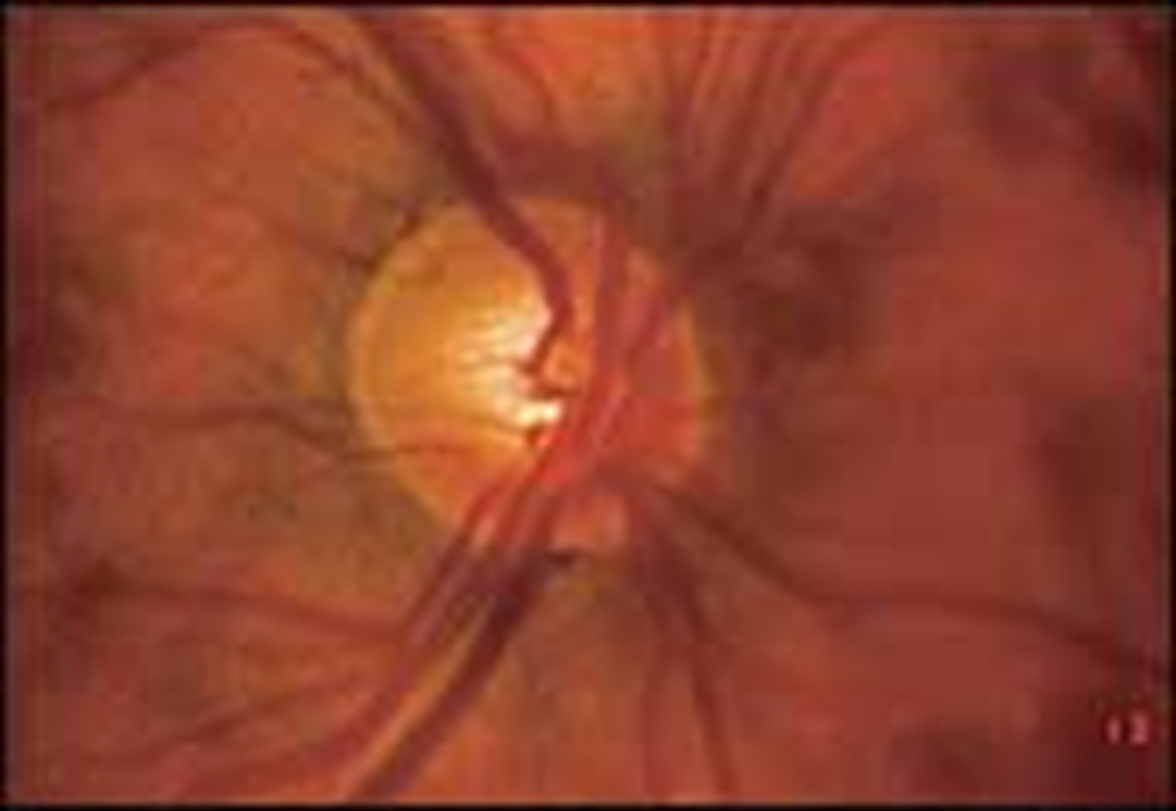
What is this?
Normal inside of eye

What is this?
Open-angle glaucoma (cup-to-disc ratio of this optic nerve is bigger than 0.5)

What is this?
Open-angle glaucoma (cup-to-disc ratio is too big and vessels are hard to fully tract)

Is this a right or left eye?
Right eye

What is this?
Open-angle glaucoma

What diagnostic tool is used to do this test and what is the test called?
Automated perimetry - Diagnostic tool
Perimetry test - The name of the test

What kind of injection is this?
Ciliary injection

What disease is this?
Closed-angle glaucoma (cornea is hazy and red eye)