Alkene Reactions

0.0(0)
Studied by 0 people
call kaiCall Kai
learnLearn
examPractice Test
spaced repetitionSpaced Repetition
heart puzzleMatch
flashcardsFlashcards
GameKnowt Play
Card Sorting

1/9

encourage image

There's no tags or description

Looks like no tags are added yet.

10 Terms

1
New cards

Addition of HX

- used to convert alkenes to haloalkanes

- electrophillic addition reaction

- Markov addition

- carbocation rearrangements are possible

- reagents: pure sample (HX) or polar solvent (acetic acid)

Mechanism:

1) protonation of alkene pi bond to form carbocation

2) reaction with X- to give haloalkane

<p>- used to convert alkenes to haloalkanes</p><p>- electrophillic addition reaction</p><p>- Markov addition</p><p>- carbocation rearrangements are possible</p><p>- reagents: pure sample (HX) or polar solvent (acetic acid)</p><p>Mechanism: </p><p>1) protonation of alkene pi bond to form carbocation</p><p>2) reaction with X- to give haloalkane</p>
2
New cards

Acid Catalyzed Hydration

- used to convert alkenes to alcohols

- electrophillic addition reaction

- Markov regioselevtivity

- carbocation rearrangements are possible

- reagents: H20, H+, H2SO4 (aq)

Mechanism:

1) protonation of alkene pi bond to form carbocation

2) reaction with H2O to give alcohol product

<p>- used to convert alkenes to alcohols</p><p>- electrophillic addition reaction</p><p>- Markov regioselevtivity</p><p>- carbocation rearrangements are possible</p><p>- reagents: H20, H+, H2SO4 (aq)</p><p>Mechanism: </p><p>1) protonation of alkene pi bond to form carbocation</p><p>2) reaction with H2O to give alcohol product</p>
3
New cards

Addition of Halogens

- used to convert alkenes to vicinal dihalide

- electrophillic addition reaction - attacks the less substituted Carbon

- anti addition stereoselectivity

- rearrangements do not occur

- stereospecific (Z alkenes give different products than E)

- reagents: CH2Cl2

Mechanism:

1) attack by the alkene pi bond to give bridged bromonium ion intermediate

2) attacked by X- from the backside to give vicinal dihalide

<p>- used to convert alkenes to vicinal dihalide</p><p>- electrophillic addition reaction - attacks the less substituted Carbon</p><p>- anti addition stereoselectivity</p><p>- rearrangements do not occur</p><p>- stereospecific (Z alkenes give different products than E)</p><p>- reagents: CH2Cl2</p><p>Mechanism: </p><p>1) attack by the alkene pi bond to give bridged bromonium ion intermediate</p><p>2) attacked by X- from the backside to give vicinal dihalide</p>
4
New cards

Addition of HOCl and HOBr

- used to convert alkenes to halohydrins

- Markov regioselectivity (OH bonds to more substituted carbon)

- rearrangements do not occur

- anti-addition stereoselectivity

- stereospecific (Z alkenes give different products than E)

- reagents: Br2/H2O- Br

Mechanism:

1) attack by the alkene pi bond to give bridged bromonium ion intermediate

2) attacked by H2O from the backside to give new intermediate

3) loss of proton to give halohydrin

<p>- used to convert alkenes to halohydrins</p><p>- Markov regioselectivity (OH bonds to more substituted carbon)</p><p>- rearrangements do not occur</p><p>- anti-addition stereoselectivity</p><p>- stereospecific (Z alkenes give different products than E)</p><p>- reagents: Br2/H2O- Br</p><p>Mechanism: </p><p>1) attack by the alkene pi bond to give bridged bromonium ion intermediate</p><p>2) attacked by H2O from the backside to give new intermediate</p><p>3) loss of proton to give halohydrin</p>
5
New cards

Oxymercuration-Reduction

- used to convert alkenes to alcohols

- anti addition stereoselectivity

- Markov regioselectivity (OH group bonded to the more highly subsituted carbon)

- rearrangements do not occur

- stereospecific (Z alkenes give different products than E)

- first step is anti stereoselective

- second step is random (anti & syn addition)

- rearrangements are not observed

- reagents: 1) Hg(OAc)2, H2O --> 2) NaBH4

Mechanism:

1) attack by the alkene pi bond to give bridged bromonium ion intermediate

2) attacked by H2O from the backside to give new intermediate

3) loss of proton to give alcohol

<p>- used to convert alkenes to alcohols</p><p>- anti addition stereoselectivity</p><p>- Markov regioselectivity (OH group bonded to the more highly subsituted carbon)</p><p>- rearrangements do not occur</p><p>- stereospecific (Z alkenes give different products than E)</p><p>- first step is anti stereoselective</p><p>- second step is random (anti & syn addition)</p><p>- rearrangements are not observed</p><p>- reagents: 1) Hg(OAc)2, H2O --> 2) NaBH4</p><p>Mechanism: </p><p>1) attack by the alkene pi bond to give bridged bromonium ion intermediate</p><p>2) attacked by H2O from the backside to give new intermediate</p><p>3) loss of proton to give alcohol</p>
6
New cards

Hydroboration-Oxidation

- used to convert alkenes into alcohols

- non-Markov regioselectivity

- syn-stereoselectivity

- rearrangements do not occur

- stereospecific (cis alkenes give different products than trans alkenes)

Mechanism

1) coordination by the alkene pi bond to vacant 2p orbital of Borane

2) 4 membered ring ring transition state

3) adds H to more substituted/ Boron to less substituted

4) basic peroxides replaces the boron with OH

<p>- used to convert alkenes into alcohols</p><p>- non-Markov regioselectivity</p><p>- syn-stereoselectivity</p><p>- rearrangements do not occur</p><p>- stereospecific (cis alkenes give different products than trans alkenes)</p><p>Mechanism</p><p>1) coordination by the alkene pi bond to vacant 2p orbital of Borane</p><p>2) 4 membered ring ring transition state</p><p>3) adds H to more substituted/ Boron to less substituted</p><p>4) basic peroxides replaces the boron with OH</p>
7
New cards

Oxidation to a glycol by OsO4

- used to convert alkenes to diols

- syn addition

- no rearrangement

- stereoselctive (syn addition gives different products than trans alkenes)

- Reagents: 1) OsO4 --> 2) NaHSO3, H2O

Mechanism

1) addition of OsO4 to get a cyclic osmate

2) complicated electron transfer steps to get a cis glycol
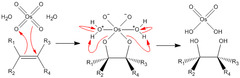
<p>- used to convert alkenes to diols</p><p>- syn addition</p><p>- no rearrangement</p><p>- stereoselctive (syn addition gives different products than trans alkenes)</p><p>- Reagents: 1) OsO4 --> 2) NaHSO3, H2O</p><p>Mechanism</p><p>1) addition of OsO4 to get a cyclic osmate</p><p>2) complicated electron transfer steps to get a cis glycol</p>
8
New cards

Oxidation by Ozone

- used to convert alkenes into 2 carbonyl groups

- Reagents: 1) O3, CH3Cl2 2) (CH3)2S (reducing agent)

Mechanism

1) formation of a ozonide intermediate

2) reduction using DMSO to give carbonyl products

<p>- used to convert alkenes into 2 carbonyl groups</p><p>- Reagents: 1) O3, CH3Cl2 2) (CH3)2S (reducing agent)</p><p>Mechanism</p><p>1) formation of a ozonide intermediate</p><p>2) reduction using DMSO to give carbonyl products</p>
9
New cards

Addition of H2; Catalytic reduction

- used to reduce alkenes into alkanes

- syn stereoselctivity

- without rearrangement

- stereospecific (Z alkenes give different products than alkene)

- if one side is more hindered, the reaction is stereoselective for the less hindered side

- Reagents: H2, metal catalyst;

- Conditions: 25 C, 3 atm

Mechanism

1) H & alkene are adsorbed on metal surface

2) one H atom is transferred to the alkene (forms new CH bond)

3) 2nd C-H bond is formed, and the alkane is desorbed

<p>- used to reduce alkenes into alkanes</p><p>- syn stereoselctivity</p><p>- without rearrangement</p><p>- stereospecific (Z alkenes give different products than alkene)</p><p>- if one side is more hindered, the reaction is stereoselective for the less hindered side</p><p>- Reagents: H2, metal catalyst; </p><p>- Conditions: 25 C, 3 atm</p><p>Mechanism</p><p>1) H & alkene are adsorbed on metal surface</p><p>2) one H atom is transferred to the alkene (forms new CH bond)</p><p>3) 2nd C-H bond is formed, and the alkane is desorbed</p>
10
New cards

Enantiselective Reduction

- used to convert methyl groups on alkenes to R or S configs

- S-BINAP makes methyl group on trans alkene into R config

- S-SINAP makes methyl group on cis alkene into S config

- Reagents: H2, (R)/(S)- BINAP-RuCl3

<p>- used to convert methyl groups on alkenes to R or S configs</p><p>- S-BINAP makes methyl group on trans alkene into R config </p><p>- S-SINAP makes methyl group on cis alkene into S config </p><p>- Reagents: H2, (R)/(S)- BINAP-RuCl3</p>



