Exam 2 Picture review file
 Call Kai
 Learn
Learn Practice Test
 Spaced Repetition
 Match
Match Flashcards
 Knowt Play
1/312

There's no tags or description
Looks like no tags are added yet.
Name | Mastery | Learn | Test | Matching | Spaced | Call with Kai | Chat |
|---|
No analytics yet
Send a link to your students to track their progress
313 Terms
Phylogeny
The evolutionary history of a species or group of related species

systematics
classifies organisms and determines their evolutionary relationships

Binomial Nomenclature
Classification system in which each species is assigned a two-part scientific name
In the 18th century, Carolus Linnaeus published a
system of taxonomy based on resemblances

Two key features of his system remain useful today: two-part names for
species and hierarchical classification
Linnaean classification
Domain, Kingdom, Phylum, Class, Order, Family, Genus, Species

The evolutionary history of a group of organisms can be represented in a
branching phylogenetic tree
The "tips" of the tree branches represent the
the taxa in the study

Phylogenetic trees can be drawn
horizontally, vertically, or diagonally without changing the relationships between groups

Tree branches can be rotated around a branch point without
changing the evolutionary relationships

Phylogenetic trees show patterns of descent, not
phenotypic similarity
Phylogenetic trees do not indicate _______ species evolved or how much ________ occurred in a lineage
When, How much
It should not be assumed that a taxon evolved from
the taxon next to it
To infer phylogenies, systematists gather information about the
morphologies, genes, and biochemistry of living organisms
Phenotypic and genetic similarities due to shared ancestry are called
homologies
Organisms with similar morphologies or DNA sequences are likely to be more
closely related than organisms with different structures or sequences

Systematists need to determine if a similarity is the result of
homology or analogy when creating trees
Homology is similarity due to
shared ancestry

Analogy is similarity due to
convergent evolution

A valid clade is monophyletic
signifying that it consists of the ancestor species and all its descendants

A polyphyletic grouping includes distantly related species but does not include their most
most recent common ancestor

In some trees, the length of a branch can
reflect the number of genetic changes that have taken place in a particular DNA sequence in that lineage
A paraphyletic grouping consists of
an ancestral species and some, but not all, of the descendants

MONOPLYLETIC
pertaining to a group of taxa that consists of a common ancestor and all its descendants, equivalent to a clade

Polyphlyletic
set of organisms that includes members derived from two or more distinct ancestral lineages, rather than a single common ancestor

the longer the branch lengths connecting two organisms
more genetic changes have taken place
PARAPLYLETIC
a taxonomic grouping that includes a common ancestor and some, but not all, of its descendants

Examples of a paraphyletic and a polyphyletic group
the tree different types of phyletic groupings

When inferring evolutionary relationships, it is useful to know _
in which clade a shared derived character first appeared

Occam's razor
The simplest explanation is usually the right one.
Which would have more genetic changes: comparing chicken vs. human -OR- human vs. mouse?
more genetic changes than a comparison between a human and a mouse.

In other trees, branch length can be
proportional to time, and branching points can be determined from the fossil record

Which organism is the most ancient here
Drosophila

How many EXTANT species?
7

Repeated gene duplications result
in gene families
You should know how parsimony can be used to estimate which tree would be the "best" or the "most accurate" one from a given data set.
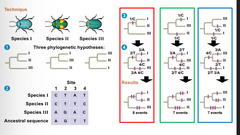
So which two species would be more closely related using this approach?
Species I and II

Gene duplication increases the number
of genes in the genome, providing more opportunities for evolutionary changes

Duplicated genes can be
traced to a common ancestor
Orthologous vs. Paralogous genes example
-Orthologous genes are found in different organisms, but are derived from a single common ancestral gene present in the common ancestor of those organisms
-Paralogous genes are genes present in a particular organism that are related to each other through a gene duplication event
Individual genes vary
in how clocklike they are
Orthologous genes are found in
a single copy in the genome and are homologous between species

Primate proteins appear to
Have evolved more slowly than other mammals
Paralogous genes result from
gene duplication so are found in more than one copy in the genome

They can diverge only after
speciation occurs

HISTONE gene
Example of paralogous and orthologous genes in organisms.

Molecular clocks are
calibrated against branches whose dates are known from the fossil record

They can diverge within the species
that carries them and often evolve new functions

why HIV is so interesting from a biological perspective for viruses.
HIV is a retrovirus, meaning it carries its genetic info as RNA. Once it enters a cell, it uses an enzyme called reverse transcriptase to turn its RNA into DNA.
HIV is estimated to have first appeared in the human population in
HIV first appeared in the human population in the early 20th century, specifically around 1920.

Gram-positive bacteria are
particularly susceptible to this type of antibiotics
Scales at which Organisms "Mutate" or "Evolve"
organisms "mutate" or "evolve" vary dramatically from months (viruses) to millions of years (animals). The figure above plots the average genome size in base-pairs (x-axis) versus the average mutation-rate(y-axis) for various organisms. In addition, a second y-axis ("minimum time to 1% mutation") illustrate approximate timescales corresponding to each rate.

horizontal gene transfer
The transfer of genes from one genome to another through mechanisms such as transposable elements, plasmid exchange, viral activity, and perhaps fusions of different organisms.

how horizontal gene transfer contributed to our understanding of the tree of life.
HGT proved that genes can also move horizontally between unrelated organisms, even across different species.

Cocci
spherical bacteria (ball shaped) (1 nano meter)

Bacilli (bacillus)
rod-shaped bacteria (cause of tuberculosis) (1 nano meter)

Spirilli
spiral shaped bacteria (3 nano meters)

Gram-positive bacteria
Bacteria that have a thick peptido glycan cell wall, and no outer membrane. They stain very darkly (purple) in Gram stain.

Gram-negative bacteria
Bacteria that have complex cell walls with less peptidoglycan but with lipopolysaccharides. Very toxic and hard to treat.

A sticky outer layer of polysaccharide or protein called a
capsule is present in some prokaryotes
Antibiotics used for gram-negative
Ciprofloxcin, gentamicin

Many antibiotics target
peptidoglycan and damage bacterial cell walls

The capsule allows
adherence to the substrate, or other individuals, and can shield pathogenic bacteria from the host immune system
Antibiotics used for gram-positive
Erythromycin, penicillin

fimbriae
finger or fringe like projections at the end of the fallopian tubes
Many prokaryotes form metabolically inactive endospores
which can remain viable in harsh conditions for centuries (spores in tombs of Egyptian pharaohs)

Some prokaryotes have hair-like appendages called
fimbriae

Pili (or sex pili) are longer than
fimbriae and allow prokaryotes to exchange DNA
compartmentalization in bacteria
Bacteria use compartmentalization to organize their internal chemistry, much like a factory uses different rooms for different hazards.
Prokaryotic cells usually
lack complex compartmentalization

Some prokaryotes do have specialized
membranes that perform metabolic functions

These are usually infoldings of the
plasma membrane

The prokaryotic genome has
less DNA than the eukaryotic genome
Most of the genome consists
of a circular chromosome
A piece of DNA called the F factor
is required for the production of pili
The chromosome is not contained in a nucleus; it is located in the
nucleoid region with no surrounding membrane

Typical prokaryotes also have smaller rings of independently replicating DNA called
plasmids

Conjugation is the process where genetic material is transferred
between prokaryotic cells
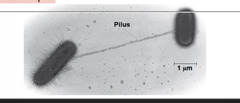
In bacteria, the DNA transfer is
always one way

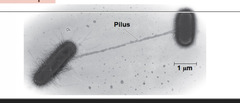
A donor cell attaches to a recipient by a
pilus and transfers DNA through a structure called the "conjugation or mating bridge"
Metabolic cooperation
occurs between different prokaryotic species in surface-coating colonies called biofilms
Cooperation between prokaryotes allows them to use
environmental resources they could not use as individual cells

These gram-negative bacteria include
photoautotrophs, chemoautotrophs, heterotrophs
how metabolic cooperation plays a role in bacteria.
It occurs when different bacterial cells or species work together to survive and grow in environments where they couldn't succeed alone.

In the cyanobacterium Anabaena, photosynthetic cells and nitrogen-fixing cells called
heterocysts (or heterocytes) exchange metabolic products

Some are
anaerobic and others aerobic
Sulfate-consuming bacteria and methane-consuming bacteria on the ocean floor use
each other's waste products

Scientists hypothesize that mitochondria evolved from
aerobic alpha proteobacteria through endosymbiosis
There are currently five subgroups of proteobacteria recognized by molecular systematists
Alpha,Beta, gamma ,Delta ,epsilon

Alpha Proteobacteria
closely associated with eukaryotic hosts

Rhizobium, which forms
root nodules in legumes and fixes atmospheric N2
Agrobacterium
which produces tumors in plants and is used in genetic engineering
Nitrosomonas, a soil bacterium
converts NH4+ to NO2-
Beta Proteobacteria
the soil bacterium Nitrosomonas, which converts NH4+ to NO2- ,subgroup is nutritionally diverse

Other members include
aquatic species and pathogens
Some heterotrophs are pathogenic, such as
Legionella, Salmonella, and Vibrio cholerae
Gamma Proteobacteria
Autotrophic members include sulfur bacteria such as Thiomargarita namibiensis

Campylobacter (epsilon $
a bacterium that sometimes causes abortion in animals and food poisoning in humans.
Helicobacter pylori (H. pylori) (epsilon)
a bacterium residing in the GI tract that causes peptic ulcers
Delta Proteobacteria
The slime-secreting myxobacteria, which produces drought-resistant "myxospores"
