bio exam 3
 Call Kai
 Learn
 Practice Test
 Spaced Repetition
 Match
 Flashcards
 Knowt Play
1/230

There's no tags or description
Looks like no tags are added yet.
231 Terms
Species diversity:
species richness and evenness of a community
Phylogenetic diversity:
evolutionary distinctiveness of the community
Functional diversity:
ecological distinctiveness of the community, diversity of functional groups

D

A
Plant biodiversity increases _____________
ecosystem productivity
3 main reasons that plant biodiversity increases ecosystem productivity
1: resource use efficiency
2: facilitation: one species that makes the environment more favorable for other species
3: chance inclusion of high productivity species
Nitrogen fixation occurs ______. Increased rates of nitrogen fixation will ________ net primary productivity.
A. When plants assimilate nitrogen into their tissues; increase
B. When plants assimilate nitrogen into their tissues; decrease
C. When N2 gas is transformed into an aqueous nitrogen compound; increase
D. When N2 gas is transformed into an aqueous nitrogen compound; decrease
E. When nitrogen in the soil returns to the atmosphere; increase
F. When nitrogen in the soil returns to the atmosphere; decrease
C
Biodiversity supports ecosystem stability by 2 measurements
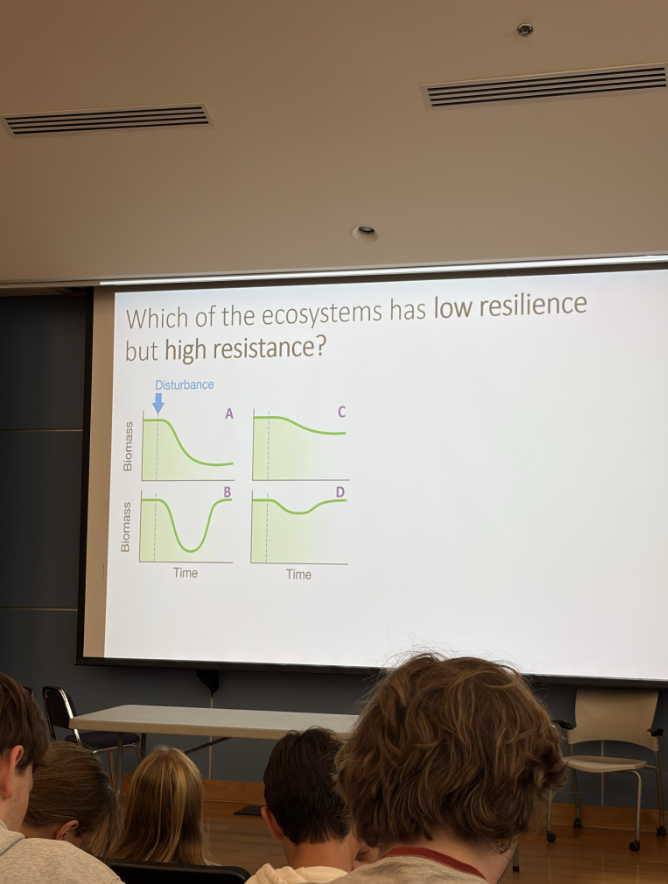
Resilience and resistance
1: Resilience:
measure of how quickly an ecosystem recovers after a disturbance (ex: wildfire, flood, etc.)
Measure by biomass
2: Resistance:
ability of an ecosystem to remain unchanged during a disturbance
C
Ecosystem services:
the direct and indirect benefits that HUMANS derive from ecosystems
Provisioning services are ______ benefits gained by ________________
direct; harvesting raw materials from ecosystems
Ex: farm grows cotton, how much does the cotton sell for
Regulating services are ________ benefits received from _________________
indirect; natural processes of ecosystems
Ex: soil formation, water purification
Cultural services are the _____________ benefits received from ________________
direct and indirect; human interactions with the ecosystems
Ex: hiking, tourism
Supporting services are ______ processes that ____________
indirect; enable the other ecosystem services
(wont be a multiple choice between regulating and supporting bc they're too similar)
3 types of supporting services
1: Primary production: plants produce energy allows everything else to function
2: Nutrient cycling
3: Pollination and pest control of plants
Ex question: Which of the following is a provisioning ecosystem service?
A. Harvesting bamboo to use in the textile industry
B. Camping in a national park
C. Pollination of coffee plants by bees
D. Nutrient cycling caused by fungal decomposers
A
Why ecosystem services matter in conservation
Measuring ecosystem services assigns economic value to natural resources
Biogeography:
variation in species diversity and distribution across space
graph showing a prediction of how species diversity varies by latitude
(The latitudinal diversity gradient)

4 main hypotheses to explain the latitudinal diversity gradient
energy hypothesis
earth history hypothesis
evolutionary history hypothesis
ecological interactions hypothesis
energy hypothesis
More solar energy per unit area in the tropics
More photosynthesis results in higher net primary production
Supports more complex food webs and more species
earth history hypothesis
Based on patterns on continental drift, tropical areas are the oldest (older meaning it happens in patterns, has been in its current latitude for longer)
Tropics have been in place for longer making them older (driver)
When an area is older, means there's been more time for evolution
More species have originated in tropic latitudes than higher latitudes
More species originated in the tropics (more speciation)
Niche conservatism: because species usually stay where they originated, expect there to be more diversity there today
evolutionary history hypothesis
Low seasonality in the tropics leads to faster generation times
Faster generation times increases the rate of speciation
More diversification = more species
ecological interactions hypothesis
Lack of seasonality increases specialization (variety of niche space an organism uses)
Increased specialization reduces average niche space, allowing more species to use resources
More specialized species reduces their niche space
Use a narrower variety of resources
More species that use different sets of resources
Ex question: Species diversity is higher in the tropics due to low seasonality, which
A. results in environmental conditions that make it easier for organisms to survive and reproduce.
B. speeds up diversification by imposing stronger selection pressures.
C. speeds up diversification by increasing the number of generations that organisms have per year.
D. results in increased niche size, such that organisms can utilize a wider variety of resources.
C
Species-area relationship:
larger regions support more species
Equilibrium theory of island biogeography
The number of species on an island (or isolated land areas) depends on a balance between: immigration rates and extinction rates
immigration rates:
determined by an islands proximity to a species source
Closer islands = higher immigration rates
Extinction rates:
Determined by island size
Larger islands = lower extinction rates

E

D

B
The equilibrium theory of island biogeography can be used to predict _____________
regional diversity of many habitats
Historical biogeography:
how past environmental factors still lead to the current distributions we see today
Biogeographic regions correspond to ______________
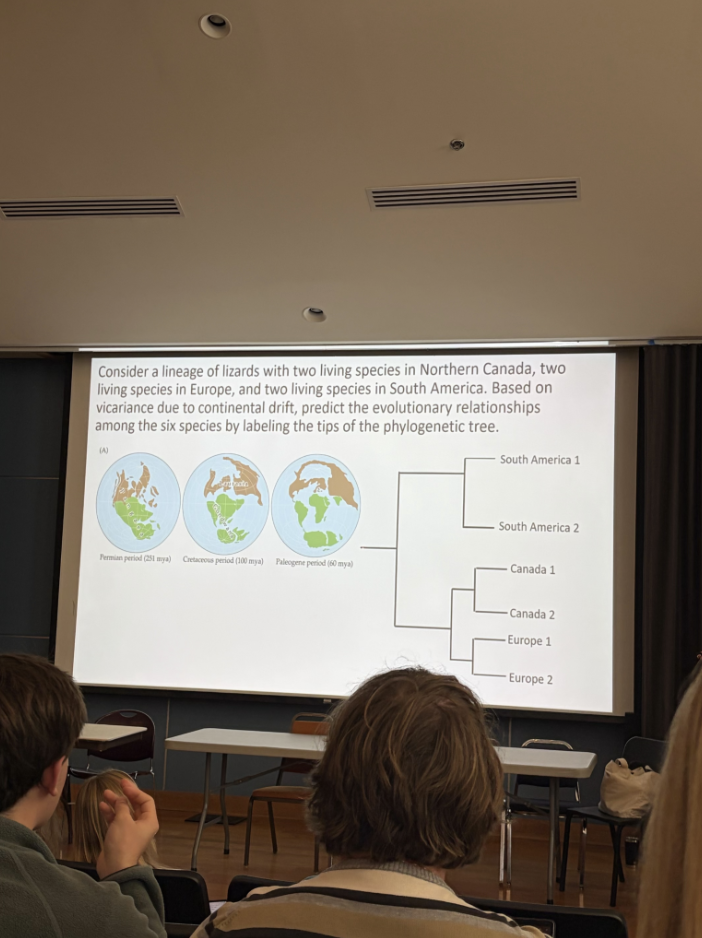
earth's tectonic plates
Continental drift:
2.5 centimeters (1 inch) per year
Continental drift causes ________, leading to __________
vicariance, speciation
major patterns of continential drift
1: The neartic and paleartic have some similar biota because a land bridge across the bering strait has allowed exchanges of species over the last 100 my
2: the neartic and neotropical regions differ substantially despite modern-day proximity (they had no contact until around 6 mya)
3: the neotropical, ethiopian, and australian regions have been isolated for a long time and have very distinctive forms of life

biodiversity changes over time b/c of 2 processes
1: speciation: increases diversity
2: extinction: removes species resulting in decreased biodiversity
Background extinction:
lower, average rate of extinction observed from regular evolutionary and ecological processes
Mass extinction:
the rapid extinction of many diverse species around the world
Current extinction rates indicate a ____________
6th mass extinction
Just with vertebrates right now
6 major outcomes of human behavior that lead to this 6th mass extinction
1: habitat loss/destruction
2: overexploitation
3: invasive species and diseases
4: Pollution
5: Climate change (indirectly)
G

false
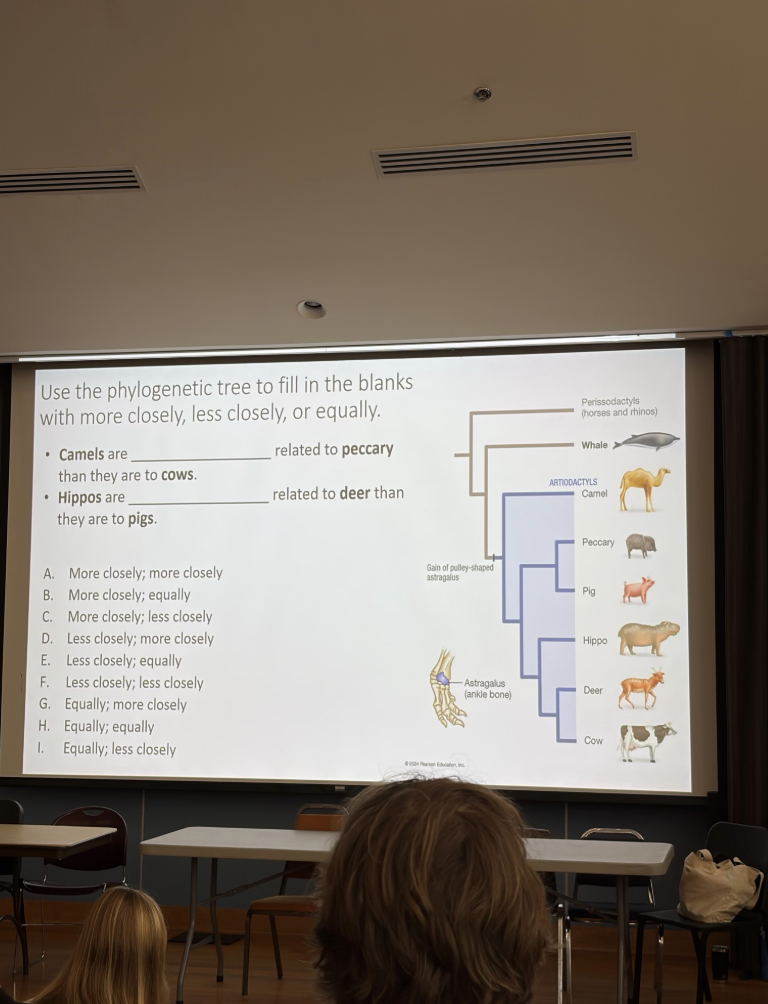
Phylogenetic trees are a tool that allow us to study __________ in lineages
macroevolution
Rocks form in a ________ pattern
predictable

A
Process of fossilization
An organism dies…
Is buried…
Then dissolves…
Sediment and minerals fill in the open space, creating a cast shaped like the organism

D
The fossil record is ________ toward certain lineages
biased
4 types of biases in the fossil record:
Habitat bias
Morphological bias
Temporal bias
Abundance bias
Habitat bias in the fossil record
Sedimentation is crucial for fossilization
Almost every fossil is found in sedimentary rock
Oxygen and decomposition: habitats with low oxygen have slow decomposition bc everything decomposing are going to require oxygen so areas with not very much oxygen have slow rates of decomposition
Morphological bias in the fossil record
Organisms with bony or other hard structures are more likely to fossilize
Temporal bias in the fossil record
Fossils are likely to become damaged over time, resulting in a bias toward newer fossils
Abundance bias in the fossil record
Common species are more likely to fossilize than rare species
Phylogenetic trees and the fossil record support descent with _________, due to _______________
modification; evolutionary change
Evidence that species change through time
1: vastness of geological time - the earth is OLD
2: species have gone extinct over time
3: transitional features link older and younger species
4: vestigial traits demonstrate that species evolve from ancestors and selection pressures change through time
5: species are observed changing today
age of the earth
4.6 billion years old
Earth's four eons
Hadean 13%
Phanerozoic 12%
Archean 33%
Proterozoic 42%
Extinct species:
a species that is no longer present on earth
Extant species:
a species living today
Transitional features:
anatomical or genetic traits that exhibit an intermediate state between an ancestral group and its later descendants
Evidence that species are related by common ancestry
1: Related species share homologies: similarity due to common ancestry
Genetic homology
Developmental homology
Structural homology
2: similar species are found in the same geographic area
3: observations of speciation occurring in modern times
The precambrian makes up approximately ___% of earth's history
90%
eons within Precambrian
hadeon
archean
proterozoic
Hadean eon:
Starts with formation of earth
Ends with first ocean
Theia collided with earth and a bunch of debris scattered
This impact caused earth to tilt
Lots of temperature change
No life
Water formed oceans - LAST STEP
Life evolves in oceans
Archaean eon:
Origin of life was 3.8-3.6 billion years ago
Deep sea smokers: where life originated
Organisms in deep sea smokers: chemoautotrophs: autotrophs but not doing photosynthesis so
Lots of inorganic compounds in these smokers and strong chemical gradients
Early organic compounds needed energy: earliest life forms utilized the chemical gradients to do produce something that looked like ATP
3.8 billion years ago (origin of life, HAVE TO KNOW)
Evolution of photosynthesis comes next
Atmosphere has low oxygen but as more organisms grow, oxygen begins to build up
First cyanobacteria fossils
origin of life
3.8 billion years ago
Proterozoic eon:
First eukaryotes in the fossil record
Diversification continues: animals, bilateral animals (symmetrical - right and left arm)
Ends with appearance of bilateral animals


The phanerozoic eon makes up approximately ____% of earth's history
10%
Adaptive radiation occurs when…
a single lineage rapidly produces many descendent lineages with a wide range of adaptive forms
2 major triggers of adaptive radiation
1: Caused by the innovation of a new trait
2: New niche space opened up
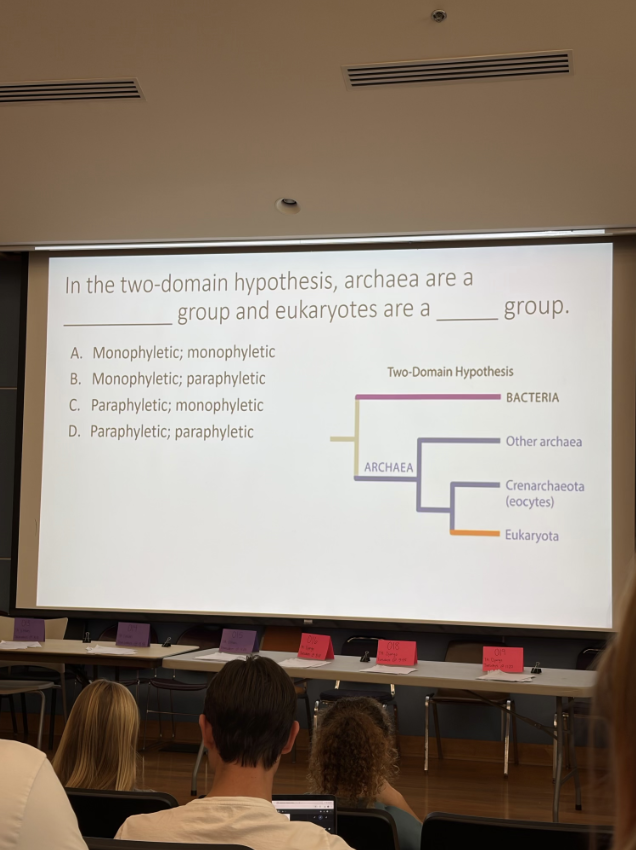
3 domains of life:
bacteria, archaea, and eukarya
Are each one monophyletic group that represents the domain
The three-domain hypothesis is currently under question by researchers
C
Ex question: A key difference between eukaryotes and prokaryotes is
A. Prokaryotic cells do not have nuclei so their DNA is found in the cytoplasm while eukaryotic cells have DNA found in membrane bound nuclei.
B. Prokaryotic organisms are always unicellular while eukaryotic organisms are always multicellular.
C. Prokaryotic organisms can be autotrophic or heterotrophic while eukaryotic organisms are always heterotrophic since eukaryotic cells have mitochondria.
D. Only eukaryotes can be found in terrestrial environments.
A
Bacteria and archaea are __________
prokaryotes
All prokaryotes cells have:
Genetic material (DNA)
A plasma membrane
Ribosomes
All bacteria and archaea are unicellular
Plants, animals, fungi, and protists are __________
eukaryotes
Eukaryotes:
can be single or multicellular
Most eukaryotic organisms are protists
Microbiome:
the community of microbes that naturally inhabits a particular area
Bacteria and archaea live in ________ environments
extreme
Bacteria and archaea living in extreme environments is a hot area of research because
1: helps us better understand the origin of life
2: explorations in extraterrestrial life
3: commercial applications: enzymes that function at extreme temperatures
Bacteria and archaea are _____________ diverse
morphologically
Bacteria and archaea can be _________ or _________
autotrophs or heterotrophs
autotrophs:
generate their own energy
Photoautotrophs:
generate energy from sunlight through photosynthesis
Cyanobacteria…
photoautotrophs; make oxygen as byproduct early on, allowed other organisms to develop later, know lineage
Chemoautotrophs:
generate energy from organic or inorganic chemical compounds
heterotrophs:
gain energy from molecules produced by other organisms
Many heterotrophic prokaryotes are __________
symbiotic
3 Key differences between bacteria and archaea
1: bacteria have a peptidoglycan in cell wall
2: machinery used in the central dogma in archaea are more like those found in eukaryotes than bacteria
3: bacteria are often pathogenic while archaea are not
Pathogens:
microorganisms that cause disease
_________ are often pathogenic
Bacteria
Virulence:
the degrees to which a pathogen causes disease in its host
High virulence: mortality
Low virulence: the sniffles