lecture 20
 Call Kai
 Learn
 Practice Test
 Spaced Repetition
 Match
 Flashcards
 Knowt Play
1/17

There's no tags or description
Looks like no tags are added yet.
18 Terms
transcription and translation

DNA and RNA use closely related nucleotide codes. During transcription, RNA is produced from a DNA template; its sequence matches the DNA coding strand except that U replaces T.
During translation, ribosomes read mRNA in groups of three nucleotides (codons) and assemble an amino-acid chain.
The example shows the beginning of the β-globin protein: Met–Val–His. Methionine aminopeptidase removes Met during translation, and mature β-globin begins Val-His-Leu.
cracking the genetic code

In 1961, Marshall Nirenberg and Heinrich Matthaei added artificial RNA containing only uracil (poly-U) to a protein-synthesizing bacterial extract. The resulting polypeptide contained only phenylalanine, demonstrating that UUU codes for phenylalanine.
By 1966, scientists had deciphered all 64 codons. The genetic code contains 61 amino-acid codons and 3 stop codons. AUG specifies methionine and usually serves as the start codon.
The codon table is read using the mRNA sequence in the 5′ → 3′ direction.
translation

Translation converts the nucleotide sequence of mRNA into an amino-acid chain (polypeptide). Four components work together:
mRNA: Contains the genetic message, read in three-nucleotide codons.
Amino acids: Building blocks of proteins.
tRNA: Carries a specific amino acid and uses its anticodon to recognize the corresponding mRNA codon.
Ribosome: Moves along the mRNA and catalyzes peptide-bond formation, joining amino acids into a growing chain.
After each amino acid is added, the growing polypeptide is transferred to the incoming tRNA. The empty tRNA leaves and can be reused.
tRNA: the adaptor

Transfer RNA (tRNA) connects mRNA codons to amino acids. Each tRNA has an anticodon that pairs with a complementary mRNA codon in the opposite (antiparallel) direction.
An enzyme called aminoacyl-tRNA synthetase uses ATP to attach the correct amino acid to the 3′ end of its corresponding tRNA. This process is called tRNA charging.
For example, the mRNA codon 5′-GCA-3′ pairs with the tRNA anticodon 3′-CGU-5′ and specifies alanine.
initiation, elongation, termination; polysomes

Translation occurs in three stages:
Initiation: The ribosome assembles at a start codon (usually AUG), which specifies methionine and establishes the reading frame.
Elongation: The ribosome moves along mRNA from 5′ → 3′, reading successive codons and joining amino acids through peptide bonds. The polypeptide grows from its N-terminus to C-terminus.
Termination: A stop codon (UAA, UAG, or UGA) signals release of the polypeptide.
Stop codons do not encode amino acids in the standard code.
A polysome consists of multiple ribosomes translating the same mRNA simultaneously, allowing production of many protein molecules from one message.
In bacteria, translation can begin while the mRNA is still being transcribed because bacteria lack a nucleus.
ribosomes: human 80S vs bacterial 70S

Human cytoplasmic ribosomes are 80S (40S + 60S), while bacterial ribosomes are 70S (30S + 50S). Both contain rRNA and proteins; rRNA in the large subunit catalyzes peptide-bond formation.
These structural differences allow antibiotics to selectively inhibit bacterial protein synthesis:
Gentamicin (30S): Causes misreading of mRNA, producing faulty proteins.
Azithromycin (50S): Interferes with elongation, causing the growing polypeptide to stall.
Human cytoplasmic ribosomes are largely spared. However, mitochondrial ribosomes resemble bacterial ribosomes, so antibiotic selectivity is not absolute.
“S” stands for Svedberg unit, a measure of how quickly a particle sediments during centrifugation; because it depends on size and shape, S values are not additive (40S + 60S = 80S, not 100S).
gene sequence vs functional protein

Translation produces an amino-acid chain (polypeptide), but the correct amino-acid sequence alone does not guarantee a functional protein.
The polypeptide may also need to fold into the correct 3D shape, reach the appropriate cellular location, undergo cleavage or chemical modifications, and avoid premature degradation.
These processes are collectively involved in protein maturation and regulation.
Many chemical changes occurring during or after translation are called posttranslational modifications (PTMs).
Examples include phosphorylation and proteolytic cleavage, such as activation of zymogens.
proteins must fold

A newly synthesized polypeptide must fold into a specific three-dimensional (3D) structure to function properly.
The amino-acid sequence contains information that determines the protein's native structure. Folding is driven mainly by the hydrophobic effect and stabilized by hydrogen bonds (backbone and side chain), ionic interactions and van der Waals contacts; in many secreted proteins, disulfide bonds then lock the folded structure.
Molecular chaperones help proteins fold correctly and reduce misfolding and aggregation.
If a protein fails to fold properly, it may lose its function, form aggregates, or be targeted for degradation.
can AI predict a protein’s shape?

AlphaFold is an artificial intelligence system that predicts a protein's threedimensional (3D) structure from its amino-acid sequence. It was recognized with the 2024 Nobel Prize in Chemistry.
AlphaFold predicts a structure computationally.
Inside cells, proteins must fold under appropriate conditions, often assisted by molecular chaperones.
A predicted structure does not guarantee that a protein will fold correctly or function normally. This distinction is important for understanding diseases caused by protein misfolding, such as cystic fibrosis.
when folding fails: cystic fibrosis (F508del)

CFTR is a chloride ion channel that helps keep mucus hydrated, particularly in the lungs.
In the F508del mutation, three DNA nucleotides are deleted, removing one amino acid (phenylalanine) without shifting the reading frame. The mutant CFTR protein is synthesized, but much of it misfolds, is retained in the endoplasmic reticulum (ER), and is degraded.
As a result, fewer functional CFTR channels reach the cell membrane, reducing chloride secretion and contributing to thick mucus and recurrent lung infections.
Trikafta improves CFTR function through two mechanisms: correctors (elexacaftor and tezacaftor) improve protein folding and trafficking to the membrane, while a potentiator (ivacaftor) improves channel opening. The CFTR that does reach the membrane also opens poorly, which is why a potentiator is added. The treatment acts on the defective protein.
where proteins fold and travel: cytosol, ER, golgi
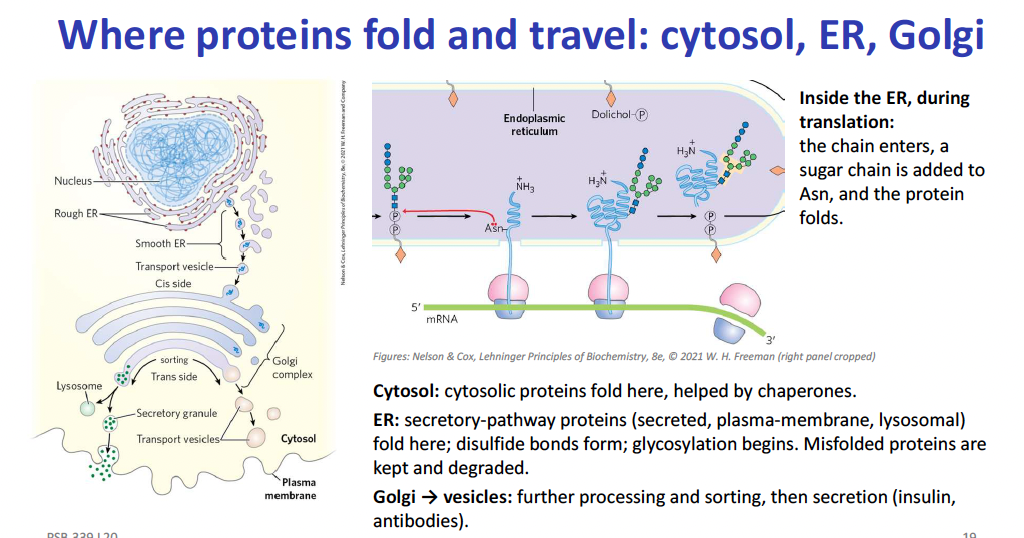
A protein's destination determines where it is synthesized, folded, and processed.
Cytosol: Proteins destined for the cytosol are synthesized on free ribosomes and fold with the help of chaperones.
Rough endoplasmic reticulum (ER): Proteins destined for secretion or membranes enter the ER during translation, directed by a signal sequence. Here, proteins fold, form disulfide bonds, and may begin glycosylation (addition of sugar chains).
Golgi apparatus: Proteins undergo further modification and sorting before transport in vesicles to their destinations, including the cell membrane or outside the cell.
Misfolded proteins may be retained in the ER and targeted for degradation, as shown by F508del-CFTR in cystic fibrosis.
Examples: Insulin and antibodies travel through the ER–Golgi secretory pathway before secretion
the ubiquitin-proteasome system

The ubiquitin–proteasome system removes damaged, misfolded, or unnecessary proteins from cells.
Tag: Enzymes attach ubiquitin molecules to a protein, marking it for degradation.
Destroy: The proteasome recognizes the ubiquitin tag, unfolds the protein, and breaks it into short peptides. Ubiquitin is recycled.
For example, much of the misfolded F508del-CFTR protein is retained in the ER and subsequently degraded by the proteasome.
The amount of a protein in a cell depends on the balance between protein synthesis and degradation.
proteolytic processing: insulin

Insulin is initially synthesized as preproinsulin, a precursor protein that undergoes several processing steps:
In the ER: The signal peptide is removed to form proinsulin, which folds and forms disulfide bonds.
In secretory granules: Enzymes remove the C-peptide, producing mature insulin.
Mature insulin consists of A and B chains joined by disulfide bonds, which help maintain its functional structure.
Insulin and C-peptide are secreted in equal molar amounts. Because injected insulin does not contain C-peptide, blood C-peptide levels help assess the body's own insulin production.
𝛾-carboxylation: vitamin K and warfarin

Vitamin K is required for γ-carboxylation, a modification that allows certain clotting factors to bind Ca²⁺ and function.
Warfarin blocks vitamin K recycling, reducing the activity of newly synthesized clotting factors. It does not directly inactivate clotting factors already circulating in the blood.
Warfarin's full anticoagulant effect takes several days because existing functional clotting factors must be cleared. Patients taking warfarin should maintain consistent dietary vitamin K intake.
In 1795, the Royal Navy began routinely supplying sailors with lemon juice. Why did this improve its military effectiveness?
During long voyages, sailors developed scurvy: bleeding gums, severe bruising and wounds that failed to heal. In 1747, James Lind found that sailors given citrus fruit recovered faster than those given other remedies, but the Royal Navy did not routinely issue lemon juice until 1795. Fleets could then stay at sea for months without losing large parts of their crews to scurvy. Today we know the mechanism: vitamin C is required for the hydroxylation of proline and lysine during collagen synthesis. Without adequate vitamin C, collagen is under-hydroxylated, its triple helix is unstable, and connective tissue weakens.
hydroxylation: vitamin C and collagen

Collagen requires hydroxylation, a chemical modification in which –OH groups are added to certain proline and lysine residues. Vitamin C is required for this process.
Hydroxylation helps stabilize collagen's triple-helix structure, providing strength to connective tissues.
Vitamin C deficiency reduces hydroxylation, producing weak, unstable collagen. This causes scurvy, characterized by bleeding gums, easy bruising, and poor wound healing.
Collagen also undergoes other maturation steps, including glycosylation, cleavage, and secretion.
glycosylation
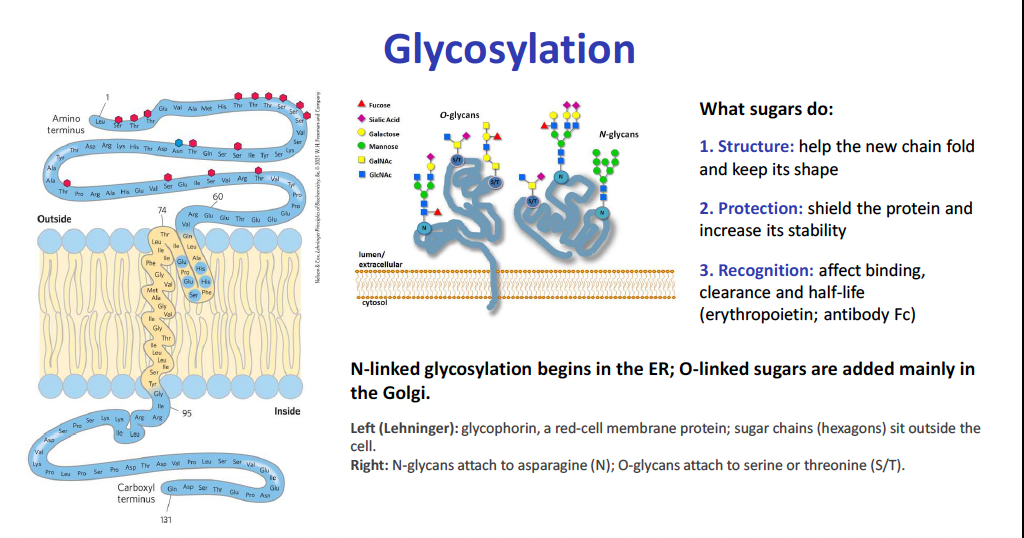
Glycosylation is the addition of sugar chains (glycans) to proteins. It is an important modification that affects protein function.
Glycosylation serves three major purposes:
Folding and structure: Helps proteins fold correctly and maintain their shape.
Protection: Can improve protein stability and protect against degradation.
Recognition: Influences how proteins interact with other molecules, their activity, and how long they remain in circulation (half-life).
Many secreted and membrane proteins begin glycosylation in the endoplasmic reticulum (ER) and undergo further processing in the Golgi apparatus.
For example, glycosylation affects the circulating half-life of erythropoietin and the immune functions of antibodies.
DNA to functional protein
