Week 9 - Kidneys & Homeostasis & Disease

0.0(0)
Studied by 0 people
call kaiCall Kai
learnLearn
examPractice Test
spaced repetitionSpaced Repetition
heart puzzleMatch
flashcardsFlashcards
GameKnowt Play
Card Sorting

1/8

encourage image

There's no tags or description

Looks like no tags are added yet.

9 Terms

1
New cards

Kidney’s help regulate blood pressure

Speed of BP regulation:

Fast (seconds): Baroreceptor reflex

Intermediate (minutes): Renal/Kidney function - Hormones (Renin & Angiotensin II)

Slow (hrs to days): Long-term kidney function - Kidney’s water/salt intake

2
New cards

Hormones and Kidney function: Renin

3 pathways for Renin to be released.

Overall, a decrease in BP causes it.

What does Renin do?

  • Converts inactive angiotensinogen from the liver into inactive angiotensin I.

ACE then converts inactive angiotensin I into active angiotensin II

<p>3 pathways for <strong><mark data-color="purple" style="background-color: purple; color: inherit;">Renin</mark></strong> to be released.</p><p>Overall, a <strong>decrease in BP</strong> causes it.</p><p><u>What does </u><strong><u><mark data-color="purple" style="background-color: purple; color: inherit;">Renin</mark></u></strong><u> do?</u></p><ul><li><p>Converts inactive <mark data-color="purple" style="background-color: purple; color: inherit;">angiotensinogen</mark> from the liver into inactive <mark data-color="purple" style="background-color: purple; color: inherit;">angiotensin I</mark>.</p></li></ul><p><mark data-color="purple" style="background-color: purple; color: inherit;">ACE</mark> then converts inactive <mark data-color="purple" style="background-color: purple; color: inherit;">angiotensin I</mark> into active <mark data-color="purple" style="background-color: purple; color: inherit;">angiotensin II</mark></p>
3
New cards
<p>Hormones and Kidney function: <strong><mark data-color="purple" style="background-color: purple; color: inherit;">Angiotensin II</mark></strong></p>

Hormones and Kidney function: Angiotensin II

Overall, increases blood pressure

In diagram: Vasopressin = ADH

To act, Ang II binds to angiotensin type 1 receptors (AT1R)


Within the proximal tubule:

  • Angiotensin II increases the activity of the apical Na+/H+ exchanger

  • This increases Na+ uptake into blood

  • Na+ and water reabsorption is coupled in proximal tubule

  • Thus, water moves with Na+


<p>Overall, <strong>increases blood pressure</strong></p><p>In diagram: <mark data-color="purple" style="background-color: purple; color: inherit;">Vasopressin = ADH</mark></p><p>To act, Ang II binds to angiotensin type 1 receptors (<strong><mark data-color="purple" style="background-color: purple; color: inherit;">AT1R</mark></strong>)</p><p></p><p>Within the <strong>proximal tubule</strong>:</p><ul><li><p>Angiotensin II <em><u>increases</u></em> the activity of the <mark data-color="blue" style="background-color: blue; color: inherit;">apical Na+/H+ exchanger</mark></p></li><li><p>This increases Na+ uptake into blood</p></li><li><p>Na+ and water reabsorption is coupled in proximal tubule</p></li><li><p>Thus, water moves with Na+</p></li></ul><p></p>
4
New cards
<p>Hormones and Kidney function: <strong><mark data-color="purple" style="background-color: purple; color: inherit;">Vasopressin/ADH (anti-diuretic hormone)</mark></strong></p>

Hormones and Kidney function: Vasopressin/ADH (anti-diuretic hormone)

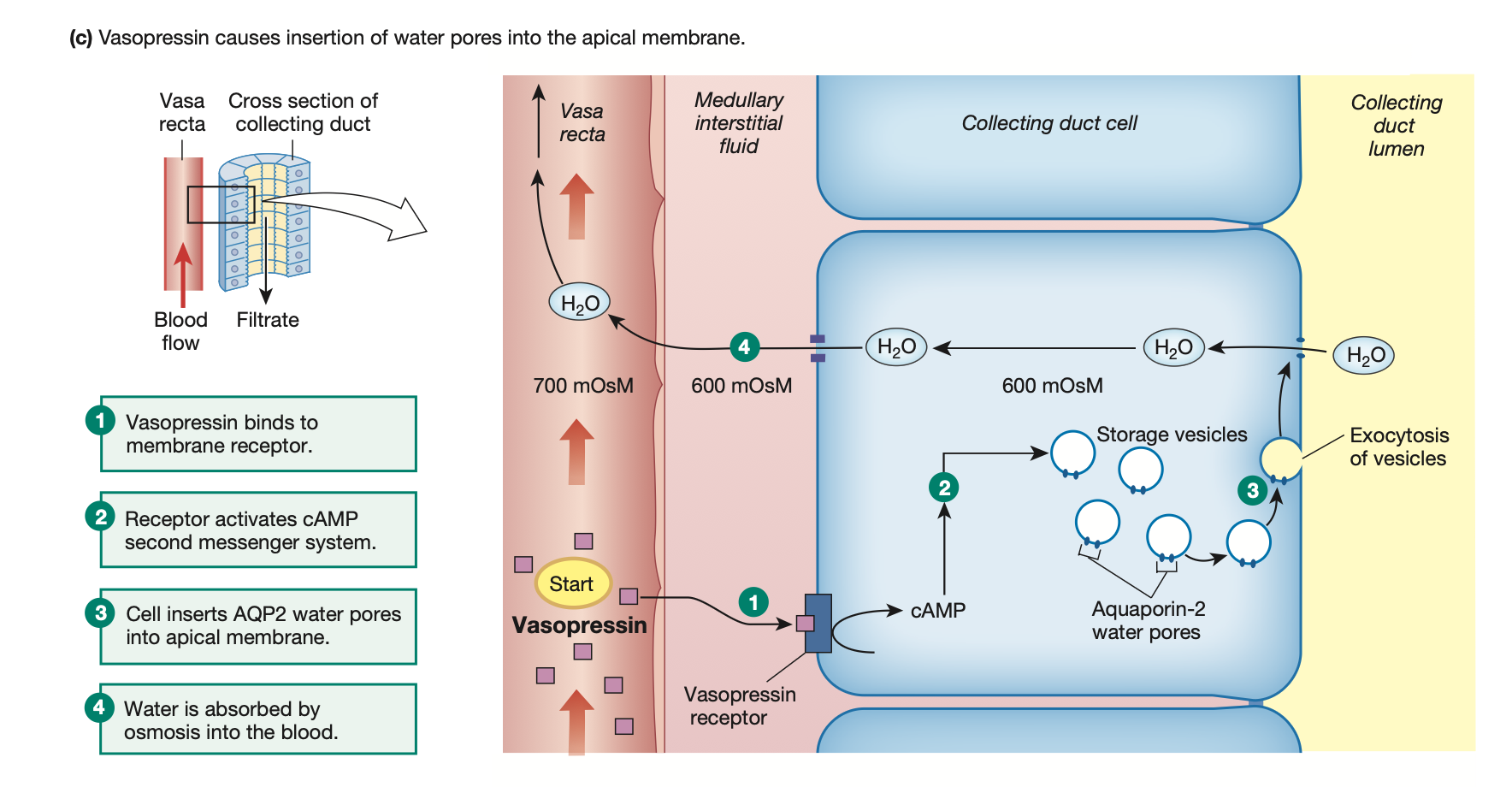
ADH helps increase water absorption.

  • Remember how ADH allows the collecting ducts to become permeable to water

    • Thus the sharp concentration gradient of dilute urine (low Osm) to concentrated blood (high Osm)

    • When permeable to water, gradient flattens as osmosis occurs collecting duct → blood vessel/vasa recta/peritubular network

This increases blood volume in the returning capillaries, which in turn increases BP.


Stimulus for ADH release: Released from hypothalamus

  • Decrease in BP

  • Decrease in stroke volume/blood volume

  • Increased plasma osmolarity


ADH cannot cross cell membrane
<p>ADH helps increase water absorption.</p><ul><li><p>Remember how ADH allows the collecting ducts to become permeable to water</p><ul><li><p>Thus the sharp concentration gradient of dilute urine (low Osm) to concentrated blood (high Osm)</p></li><li><p>When permeable to water, gradient flattens as osmosis occurs collecting duct → blood vessel/vasa recta/peritubular network</p></li></ul></li></ul><p>This increases<strong> <u>blood volume</u></strong> in the returning capillaries, which in turn <strong>increases BP</strong>.</p><p></p><p>Stimulus for ADH release: Released from <strong><mark data-color="purple" style="background-color: purple; color: inherit;">hypothalamus</mark></strong></p><ul><li><p>Decrease in BP</p></li><li><p>Decrease in stroke volume/blood volume</p></li><li><p>Increased plasma osmolarity</p></li></ul><p></p><p>ADH cannot cross cell membrane </p>
5
New cards
<p>Hormones and Kidney function: <strong><mark data-color="purple" style="background-color: purple; color: inherit;">Aldosterone</mark></strong></p>

Hormones and Kidney function: Aldosterone

How is it released?

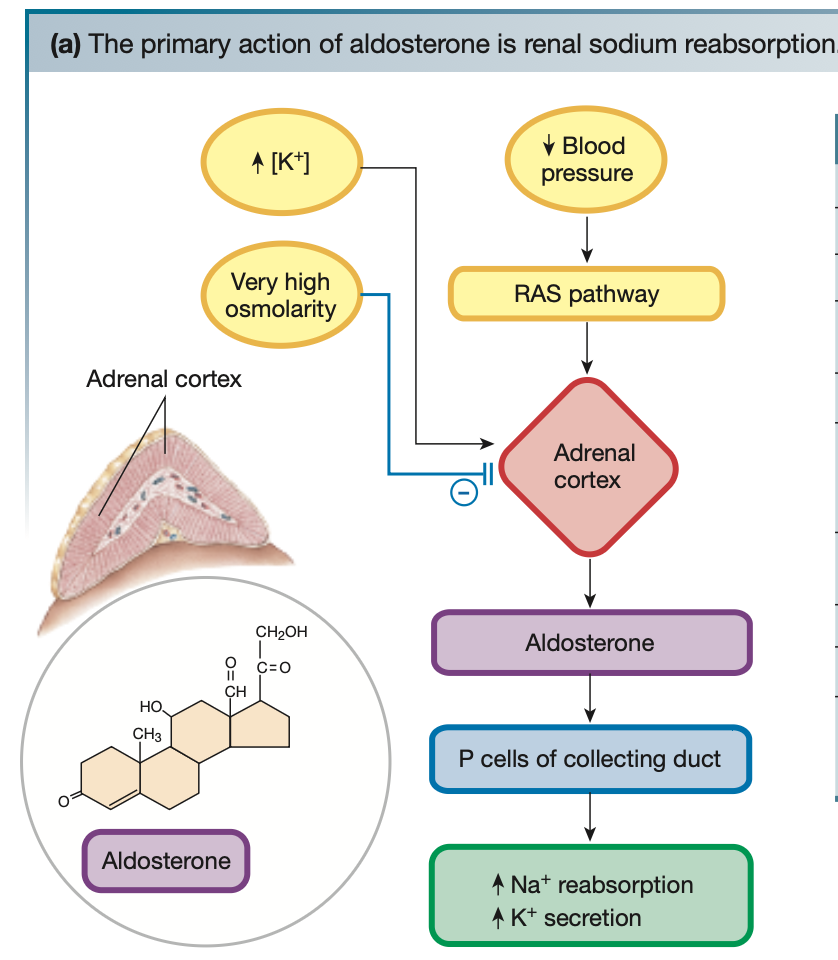
Adrenal glands (sit on top of kidney) release Aldosterone. Released when high K+ plasma concentration or angiotenin II activated. However, high blood plasma osmolarity (e.g during dehydration) would inhibit aldosterone (to prevent Na+ from migrating out into the tubules)


What does Aldosterone do?

Within the distal tubule & collecting ducts, controls the NaK pump (active, uses ATP).

  • reabsorption of Na+ and in turn, K+ secretion

  • ENAC pumps - sodium channels on nephron side open up

  • NaK pump on blood vessel side open up

Water follow Na+, so more sodium reabsorption, more water retained. Only works if tubule is permeable to water (ADH present)

<p><em>How is it released?</em></p><p><strong><mark data-color="yellow" style="background-color: yellow; color: inherit;">Adrenal glands</mark></strong> (sit on top of kidney) release <strong><mark data-color="purple" style="background-color: purple; color: inherit;">Aldosterone.</mark></strong> Released when high K+ plasma concentration or angiotenin II activated. However, high blood plasma osmolarity (e.g during dehydration) would inhibit aldosterone (to prevent Na+ from migrating out into the tubules)</p><p></p><p><em>What does </em><strong><em><mark data-color="purple" style="background-color: purple; color: inherit;">Aldosterone</mark></em></strong><em> do?</em></p><p>Within the <mark data-color="yellow" style="background-color: yellow; color: inherit;">distal tubule &amp; collecting ducts</mark>, controls the NaK pump (active, uses ATP).</p><ul><li><p><em><u>reabsorption of Na+</u></em><u> and in turn, </u><em><u>K+ secretion</u></em></p></li><li><p><strong><em><u>ENAC pumps</u></em></strong><em><u> - sodium channels on nephron side open up</u></em></p></li><li><p><strong><em><u>NaK pump</u></em></strong><em><u> on blood vessel side open up</u></em></p></li></ul><p>Water follow Na+, so more sodium reabsorption, more water retained. Only works if tubule is permeable to water (<strong><em>ADH present</em></strong>)</p>
6
New cards
<p>Overall diagram of Angiotensin</p>

Overall diagram of Angiotensin

knowt flashcard image
7
New cards

K+ regulation in the kidney

  1. K+ enters nephron in renal corpuscle (glomerulus → bowman’s capsule_

  2. 90% of this k+ in the nephron is reabsorbed in the proximal tubule and (ascending) loop of Henle

  3. Distal tubule is where hormones (aldosterone) play a part in controlling how much K+ is actually secreted in the urine, depending on the body’s needs at the time


K+ is TIGHTLY regulated

8
New cards

Natriuretic peptides - ANP & BNP

ANP & BNP - Oppose the function of the renin-angiotensin hormones

  • Perform diuresis & Natriuresis - excretion of water & sodium

ANP released by atria, BNP released by ventricles.

When more blood in atria, more blood volume, more stretch, ANP released, decreases BP.

<p><strong>ANP &amp; BNP</strong> - Oppose the function of the renin-angiotensin hormones</p><ul><li><p>Perform diuresis &amp; Natriuresis - excretion of water &amp; sodium</p></li></ul><p>ANP released by atria, BNP released by ventricles.</p><p>When more blood in atria, more blood volume, more stretch, ANP released, decreases BP.</p>
9
New cards

Symptoms of Kidney disease

Kidney itself has no pain receptors, only on the surface. Distension of the organ may cause abdominal/lower back pain.

Diseases mainly caught in urine. (e.g presence of blood, glucose, proteins or crystals in urine).

2 main causes of CHRONIC kidney disease: Hypertention & diabetes

  • Occurs if >75% of nephrons have lost function

  • Measured by observing GFR for 3 months min with <60 ml/min/1.73 m2 produced

  • Only dialysis or organ transplantation for treatment