transition elements
 Call Kai
 Learn
Learn Practice Test
 Spaced Repetition
 Match
Match Flashcards
 Knowt Play
1/34

There's no tags or description
Looks like no tags are added yet.
Name | Mastery | Learn | Test | Matching | Spaced | Call with Kai | Chat |
|---|
No analytics yet
Send a link to your students to track their progress
35 Terms
where are the d block elements located?
between group 2 and group 13 of the periodic table
what is the case across the periodic table from scandium to zinc?
the 3d sub shell has the highest energy and electrons are added to 3d orbitals - hence the name d block elements
first row of the d block elements:

features of the d block elements:
all metallic, displaying the typical physical properties of metals
high melting and boiling points
shiny
conduct electricity and heat
uses:
copper, silver, nickel and zinc have been used in coinage
iron is used in construction and the production of tools
copper is used for electrical cables and water pipes
titanium is known for great strength and is used in the aerospace industry and in medical applications like joint replacement and cosmetic dentistry

what does the electron configuration of an atom or ion show?
the arrangement of electrons in shells and subshells. electrons occupy orbitals in order of increasing energy

electron configurations of the elements scandium to zinc:

why does chromium and copper not follow the expected principle for placing electrons singly in orbitals before pairing?
stability. it is believed that a half filled / fully filled d subshell gives additional stability to atoms of chromium and copper
what happens when the d block elements, Sc to Zn, form positive ions from their atoms?
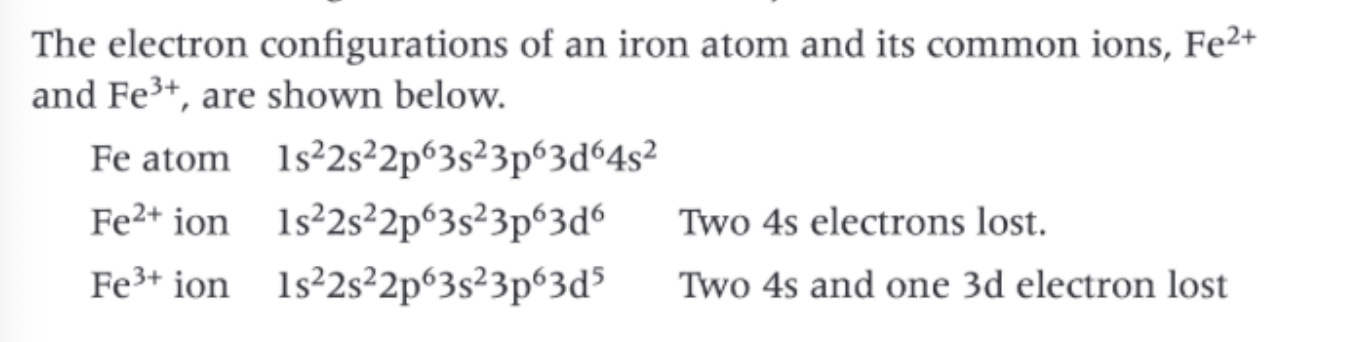
they lose their 4s electrons before losing any of the 3d electrons
what does this mean?
when forming an atom, the 4s orbital fills before the 3d orbitals
when forming an ion, the 4s orbital empties before the 3d orbitals
example with iron:
what are transition elements?
d block elements that form at least one ion with a partially filled d orbital
are scandium and zinc transition elements?
no
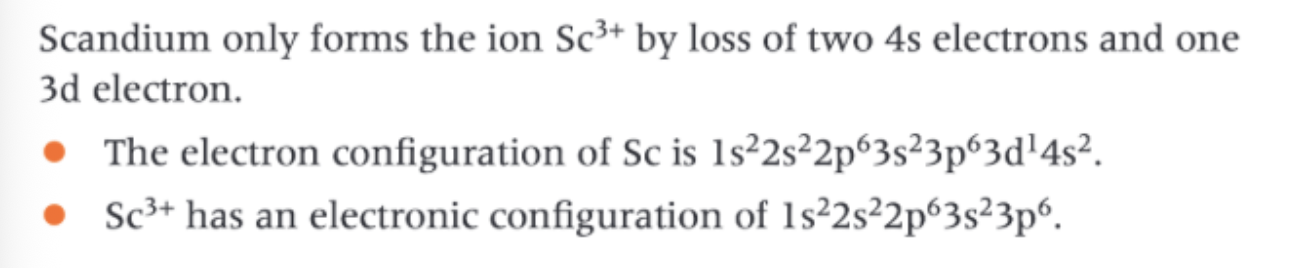
why not scandium?
why not zinc?

therefore why aren’t zinc or scandium classified as transition elements?
Sc3+ ions have empty d orbitals and Zn2+ ions have full d orbitals, so neither of them form ions with partially filled d orbitals
properties of transition metals and their compounds:
they form compounds in which the transition element has different oxidation states
they form coloured compounds
the elements and their compounds can act as catalysts
what do transition elements form?
compounds with more than one oxidation state, eg. iron forms 2 chlorides, FeCl2 and FeCl3
when does the number of oxidation states increase?
across the transition elements series to manganese, and then decreases
what do all of the transition elements form?
2+ ions, resulting from the loss of 2 electrons
what does each oxidation state often have?
a characteristic colour
diagram to show common oxidation states and colours in transition element compounds and ions:

what is a species containing a transition element in its highest oxidation state often?
a strong oxidising agent
worked example: oxidation numbers of ions containing transition elements:

examples of coloured compounds and ions of transition elements:
potassium dichromate (VI) is bright orange
cobalt (11) chloride is pink purple
nickel (11) sulfate is green
hydrated copper (11) sulphate is blue
what can the solid compounds be dissolved in water to produce?
coloured solutions