Introduction to Operative Exam 2 Review (long version)
 Call Kai
 Learn
 Practice Test
 Spaced Repetition
 Match
 Flashcards
 Knowt Play
1/192

There's no tags or description
Looks like no tags are added yet.
193 Terms
cotton rolls / gauze / dry angles aid in blocking saliva from the ___________ gland
parotid
T/F: cotton rolls/ gauze / dry angles isolate the soft tissue, tooth, and pulp from bacteria in the mouth
false
this isolation method is used in pediatrics, placing pit and fissure sealants, cervical class V lesions, crown preps, and making impressions
cotton rolls / gauze / dry angles
the isovac isolation is designed to isolate _____ quadrants at once
2
T/F: the isovac isolation isolates the soft tissue, tooth, and pulp from bacteria in the mouth
false
the isovac isolation provides tongue and cheek retraction and bite block with continuous what?
suction
T/F: the isovac isolation has different mouthpieces available based on the size of the patient's mouth
true
the saliva ejector / auxiliary devices uses __________ to remove saliva
suction
the high volume evacuator is used in tandem with what 2 things
highspeed handpiece, water spray
for certain cases such as carious or non-carious cervical lesions, you would use one of these 3 things
tissue retraction cord, electrosurgery/laser, surgical flap
invented the rubber dam / dental dam in 1864 (wouldn't call him the GOAT tho...)
sanford c. barnum
the rubber dam gives you better access to the working field and better _______________
visualization
the rubber dam gives good isolation and protects (hard/soft) tissue
soft
the rubber dam provides good isolation and keeps ___________ away from the operating field
moisture
T/F: the rubber dam can cause a reduction in the amount of aerosols
true
T/F: the rubber dam protects the soft tissue, the pulp from bacteria, AND the operator
true
T/F: the rubber dam provides safety to the patient when using certain materials
true
T/F: the rubber dam provides no prevention of the patient swallowing or aspirating materials
false
the 5x5 inch rubber dam is used with (children/adults)
children
the 6x6 rubber dam is used with (children/adults)
adults
there are different weights to the rubber dams (light, medium, heavy, extra heavy, super heavy) --> which do we use?
heavy
can you call the retainer a clamp
no

what is this
bow

what are these
removal holes

what are these
removal holes
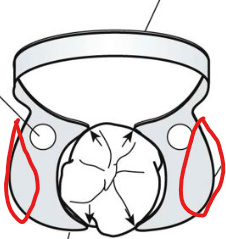
what are these
jaws
W8A --> this retainer is ________ positioned and used for _________
apically, molars
W56 --> this retainer is used for
molars
W2A --> this retainer is _________ positioned and used for ___________
apically, premolars
212 --> this is a gingival _____________
retractor
the W in the rubber dam retainers stands for
wingless
the A in the rubber dam retainers stands for
apically positioned
in order for easy retrieval in case something goes wrong, you should always ________ the retainer
ligate
the 4 points of the jaws on the dental dam retainer should touch the
teeth
T/F: you only need to ligate one side of the retainer
false
when punching holes in the dental dam, if you are preparing / restoring a maxillary in a patient, you should start the central incisors approximately ___ inch from the ____ edge
1, top
when punching holes in the dental dam, if you are preparing / restoring a mandibular on a patient, you should start the central incisors approximately ___ inches from the _______ edge
2, bottom
when punching holes in the dental dam, if you are preparing / restoring on a dentoform: start maxillary or mandibular central approximately ______ inches from the edge
1.5
for an anterior isolation using a dental dam, you typically isolate from
canine to canine
for a posterior isolation using a dental dam, you typically isolate from
second molar to canine/central incisor
when punching holes in a rubber dam, you should punch the holes approximately ___ mm apart
5
when punching holes in a rubber dam, the smallest hole is generally for
lower incisors
when punching holes in a rubber dam, a small (but not smallest) hole is generally used for
maxillary incisors
when punching holes in a rubber dam, the medium hole is generally used for (2 types of teeth)
canines and premolars
when punching holes in a rubber dam, the larger (but not largest) hole is generally used for
molars
when punching holes in a rubber dam, the largest hole is generally used for the
tooth with retainer
T/F: you need to pay attention to the arch form and shape, missing teeth, and tooth alignment when using a rubber dam
true
the number of teeth to _________ with the rubber dam depends on the tooth being prepared and restored
isolate
in determining the number of teeth to isolate in a rubber dam placement, in general you should go from the most posterior accessible tooth to a tooth that does what?
crosses the midline
in determining the number of teeth to isolate in a rubber dam placement, in general for maxillaries you go from
molar to opposite central
in determining the number of teeth to isolate in a rubber dam placement, in general for mandibulars you go from
molar to opposite lateral
in determining the number of teeth to isolate in a rubber dam placement, in general for anterior isolation you go from
canine to canine
T/F: in placing the dental dam, you can do the retainer over the dam, the dam over the retainer, or the retainer IN the dam
true
for the final steps of placing the dental dam, you should use the explorer or the FP tarno to _________ the dental dam around the cervical neck of the tooth
invert
inverting the dental dam around the cervical neck of the tooth aids in sealing out (what 2 things)
saliva, gingival fluid
in the removal of the dental dam, you should pull the dam from where to where
buccal to lingual
in removal of the dental dam, after pulling the dam from buccal to lingual you should snip the ___________ septum with scissors
interproximal
in removal of the dental dam, after snipping the interproximal septum, you should remove the
retainer
in removal of the dental dam, after removing the retainer, you should remove the
rubber dam
in removal of the dental dam, after removing the retainer and the rubber dam, you should check the dam for
completeness
T/F: after checking the rubber dam for completeness post removal, you should NOT remove any pieces left in the mouth
false
when placing the retainer, you should seat the _________ jaws first
lingual
after you place the retainer, you should check the _________ by pulling up on the bow or pushing down on the beaks
stability
after you place the rubber dam over the posterior retainer, you should anchor the dam on the __________ most tooth
anterior
recall the orientation of the frame: the curved bar parallels the
shape of the chin
Which G.V. Black cavity classification: "pit and fissure --> any tooth with pit and fissure --> premolars, molars, lingual of maxillary laterals, buccal pit"
class 1
Which G.V. Black cavity classification: "smooth surface --> involves proximal surface of POSTERIOR tooth (premolars and molars)"
class 2
Which G.V. Black cavity classification: "smooth surface --> involve proximal surface of ANTERIOR tooth (but not the incisal edge)"
class 3
Which G.V. Black cavity classification: "smooth surface --> MUST involve the incisal angle (anterior only)"
class 4
Which G.V. Black cavity classification: "smooth surface --> involves caries in gingival 1/3 of tooth --> may be buccal or lingual, anterior or posterior"
class 5
Which G.V. Black cavity classification: "ALL other types, cusp tips (especially canines)"
class 6
sealants are (low/high) viscosity resin materials used to seal up grooves and fissures
low
T/F: sealants are typically for primary grooves/pits in mandibular and maxillary teeth
true
Sealants are placed to prevent
caries
sealants provide a _________ barrier to prevent caries
physical
T/F: the areas where sealants are placed are typically those that are susceptible and difficult to clean
true
the 2 main tooth types that get pit and fissure sealants are
premolars and molars
T/F: the tooth will NOT remineralize if etch gets on areas not intended to receive sealant
false
T/F: age is an important factor when considering placement of PFS
true
T/F: anatomy of the teeth is an important factor when considering placement of PFS
true
T/F: caries risk statues is NOT an important factor when considering placement of PFS
false
T/F: you should check PFS at all recall visits
true
the retention of pit and fissure sealants mainly depends on the enamel ______
etch
in preventative resin restorations, small isolated areas of caries in ________ is judiciously removed, preserving tooth structure
dentin
_________ control is particularly important when performing an enamel etch
moisture
what do we use as our enamel etchant
37% phosphoric acid
using phosphoric acid to etch the enamel (increases/decreases) surface area
increases
using phosphoric acid to etch the enamel increases the surface area to provide ___________ retention for the restoration
mechanical
after the etchant has been applied, rinsed, and dried, the enamel should appear
frosty
what should you use to clean the tooth surface before acid etching (2 things)
pumice and hydrogen peroxide
T/F: you should not acid etch after using an oil-based prophy paste or after fluoride application
true
after performing acid etching, is rinsing an important step?
yes
T/F: after placing your sealant, you should remove the excess with a cotton pellet/brush
true
what important step comes immediately after placing the sealant and removing the excess
curing
the periapical films are placed in which rows of the film mount
top and bottom
the periapical films show what 2 parts of the selected teeth in the area
root and crown
bite wing films are placed in what rows of the film mount
middle
bitewing films primarily show the maxillary and mandibular crowns of the selected teeth in the area when the patient is in ____________
occlusion
bitewing films are taken of (anterior/posterior) teeth
posterior
when viewing full-mouth radiograph series --> the left side of the film mount = the patient's ______ side
right