Polymers Prelim 1
 Call Kai
 Learn
Learn Practice Test
 Spaced Repetition
 Match
Match Flashcards
 Knowt Play
1/31

Earn XP
Description and Tags
light work
Name | Mastery | Learn | Test | Matching | Spaced | Call with Kai | Chat |
|---|
No analytics yet
Send a link to your students to track their progress
32 Terms
Macromolecule/Polymer
molecules containing long sequences of (molecular) repeating units covalently linked together.
Monomer
A single unit that can repeat
Different chain structures?
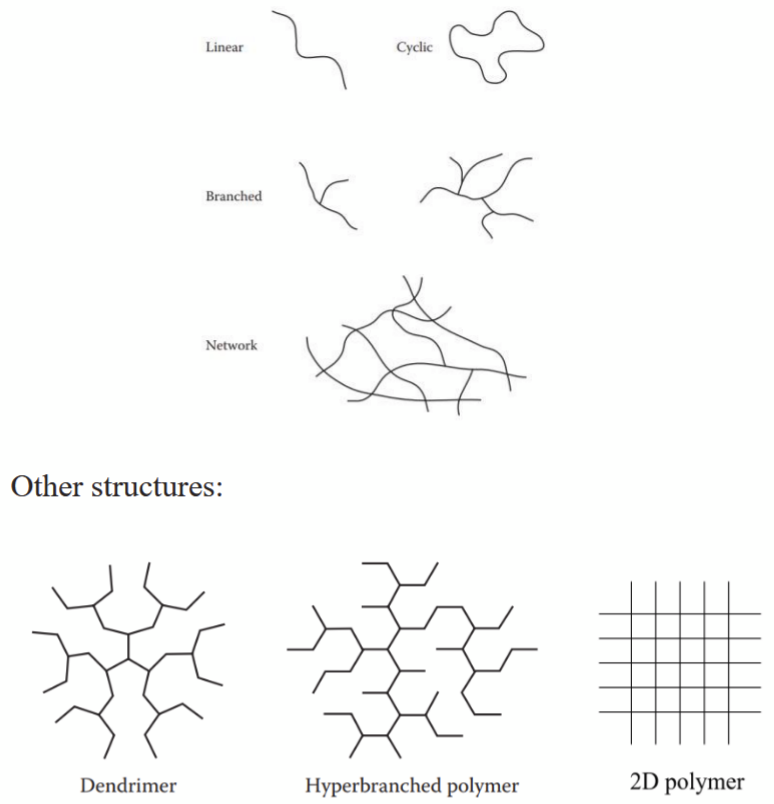
Homopolymer?
Derived from one species of monomer. However, the repeat unit may contain one or more species of monomer unit. Example: nylon 6 6
Copolymer Types?
Made of 2 or more types of repeat units.
Block: Large chunks of A, then large chunks of B: AAAAAABBBBBBBBBAAAA
Random: Completely random which monomers are where AABABBABABBAABAB
Alternating: 2 units repeating back and forth: ABABABA
Graft: Chains of B split off of A. Lowk godrick the grafted but he’s A and arms are B
Statistical: Distribution of repeat units follows known statistical law/distribution ABAABA

Classes of Polymers?
Polymers can be:
Thermoplastics: Linear/Branched, melt with heat
Crystalline: @T_m, order → disorder
Amorphous: @T_g, glassy(hard) → rubbery(soft)
Thermosets: Rigid, lots of crosslinking.
Elastomers: crosslinked, can stretch and return quick to og state
Molar Mass with Polymerization? simple
x: DOP, number monomers. X0: monomer molar mass

X_i mole fraction?

W_i weight fraction?

M_n number average Molar Mass?
Also, M_n = x_n (avg chain length) * M_o (mean molar mass)

Molar mass averages for polymers vs oligomers?

Weight and Z average Molar mass?

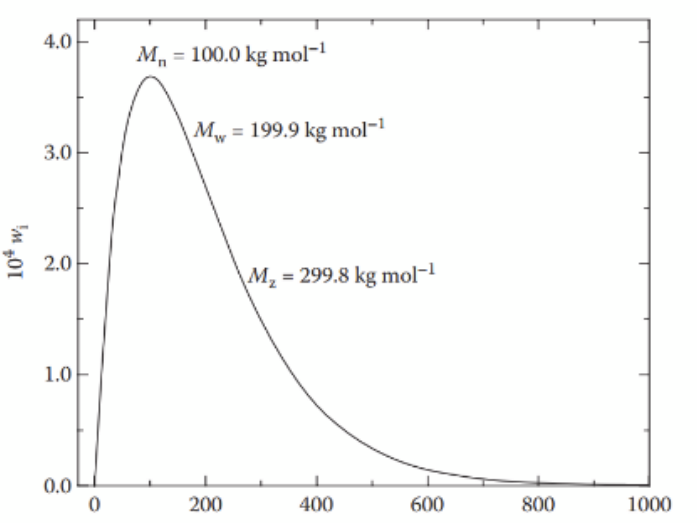
Polydispersity PDI?
PDI usually from 1.5-2. It’s the distribution in the sizes of chains. If all chains are the same length, PDI=1. Plotted Mi vs Wi, it looks like a distribution chart.
PDI = M_w/M_n
Viscosity, T_g, processability, Solubility as a function of M_n?

Functionality?
Number of chain links.
Linear polymers can only have functionality 2.
Branched or network polymers need 3+

Condensation Polymerization
n(H-A-H)+n(HO-B-OH) react to make H[A-B]nOH+H20(2n-1), meaning a byproduct is water. (might also be step growth?)
Examples: Polyester, PET, Polysiloxane, polyamides. More aromatic groups (benzene rings) make it perform better @ higher temps, etc…
![<p>n(H-A-H)+n(HO-B-OH) react to make H[A-B]nOH+H20(2n-1), meaning a byproduct is water. (might also be step growth?)</p><p>Examples: Polyester, PET, Polysiloxane, polyamides. More aromatic groups (benzene rings) make it perform better @ higher temps, etc…</p>](https://assets.knowt.com/user-attachments/a1146b59-ad72-452c-ae79-1a65253b38b7.png)
Addition Polymerization
Like condensation, but R1 on A and R2 on B combine within the polymer instead of being ejected as water.

Step-Growth Polymerization
Monomer makes dimer that makes… quadmers? They just keep combining and adding on without any ejections or structure changes.

Chain Growth Polymerization
like step-growth, but only one adds onto the end of a chain every time.

Linear step polymerization
subset of step growth polymerization
needs functionality f=2
Chain links usually have heteroatoms: CO, NH, etc…
Require high conversion reactions: Xn = 1/(1-p) where p is conversion%.
molar mass 10-100kg/mol
Principle of Equal Reactivity
The reactivity of a functional group is independent of the length of the chain its on and doesn’t react with anything having to do with the other functional groups.
Carothers Theory
If I know how many monomers reacted, can I predict the avg chain length?
Xn = N0/N (# molecules before over # molecules after)
For linear, BALANCED step polymerization: Xn = 1/(1-p) where p=(#fct’l groups reacted/initial)
When unbalanced (A=/B), Xn=(1+r)/(1+r-2rp)

Carothers theory and purity?
first one means that the purer the reaction the longer the average chain length when NA=NB. bottom plot means that as NA and NB separate in either direction the avg chain length goes down

Probability of a monomer x long at y time existing?
p is extent of reaction, x monomer units, time t. P^(x-1): each monomer has p prob to react, and all of them have to link except the last one: x-1. the last one has to be unlinked: 1-p.
If you want the # of monomoers that length, multiply this probability by N0: total # monomers, and another 1-p since the other side has to be unlinked too.
