chemistry light unit
 Call Kai
 Learn
Learn Practice Test
 Spaced Repetition
 Match
Match Flashcards
 Knowt Play
1/27

There's no tags or description
Looks like no tags are added yet.
Name | Mastery | Learn | Test | Matching | Spaced | Call with Kai | Chat |
|---|
No analytics yet
Send a link to your students to track their progress
28 Terms
if asking for/given wavelength and energy…
use E=hc/λ
if asking for/given frequency and energy
use E=hv
if asking for wavelength or frequency and NOT given energy…
use c=λv
if given 2 “n”s and need to find energy…
use E hi - E lo = triangle E
frequency and wavelength are…
inversely proportionate
the higher the frequency…
the shorter the wavelength
the lower the frequency…
the longer the wavelength
frequency and energy are…
directly proportional
the higher the frequency…
the more the energy
the more the energy…
the higher the frequency
list the electromagnetic radiations from least harmful to most (left to right, least to most radiation)
long radio waves, radio waves, microwaves, infrared, visible light, uv, x-rays, gamma rays
what is the acronym that helps memorize the electromagnetic radiations?
large rude martians invented very unusual x-ray guns
what is a quantum?
the minimum amount of energy that can be gained or lost by an atom. not continous, discrete chunks of energy
what are photons?
particles of electromagnetic radiation which carry a quantum of energy but have no mass
what is the photoelectric effect?
when electrons are emitted from a metal’s surface what light of a certain frequency shines on it. depends on the energy of the photon, not intensity (brightness)
what is meant by the “dual nature” of light?
that is has both wave-like and particle-like properties
what is the atomic emission spectrum?
the idea that elements emit characteristically-colored light when energized.
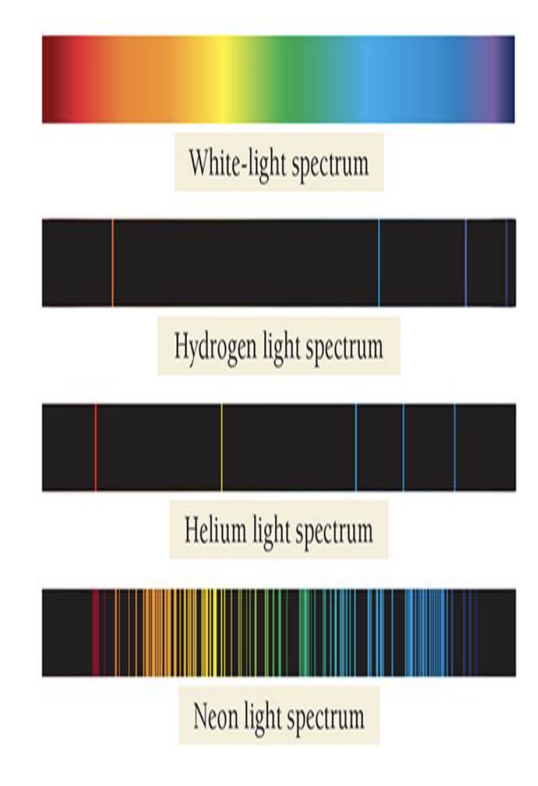
is the atomic emission spectrum the same for all elements?
no, the emission spectra of individual elements includes only certain specific wavelengths
what is a principal energy level in an atom?
the higher the principal quantum number, the higher the energy of the orbital. the possible principal quantum numbers are n=1, 2, 3… with energy increasing as n increases
what is the principal quantum number?
n
what is ground state for an electron?
the lowest energy state possible for an element
how do you identify ground state in electron configuration?
electron configuration is completely in order, and it is the last orbital
what is excited state for an electron?
when the absorption of energy causes the electron to jump or make a transition from the 1s orbital to a higher-energy orbital. when the electron is in a higher-energy orbital, it is said to be in an excited state
how do you identify excited state in electron configuration?
electron configuration is out of order at the end, jumping to a higher-energy orbital than if it were in order.
what does ionization imply?
that E(hi) is infinity
what is hund’s rule (the bus seat rule)?
when electrons have a choice of entering two equal orbitals they enter the orbitals so that a max number of unpaired electrons result (fill all seats before sitting next to someone else)
what is the aufbau principle?
when electrons occupy orbitals, they try to have the lowest amount of energy possible
what is the pauli exclusion principle?
only two electrons can fit in each orbital, and they must spin in opposite directions: one clockwise, the other counterclockwise