4.6 monetary policy
 Call Kai
 Learn
 Practice Test
 Spaced Repetition
 Match
 Flashcards
 Knowt Play
1/19

There's no tags or description
Looks like no tags are added yet.
20 Terms
The FOMC (Federal Open Market Committee)
targets the federal funds rate. In a limited-reserves system the Fed hits the target by changing the quantity of reserves.
Monetary policy
A central bank's use of its tools to reach macroeconomic goals such as price stability
Federal funds rate
The rate banks charge other banks for overnight loans of reserves. It is the U.S. policy rate.
Who lends? | A bank with extra reserves |
Who borrows? | Another bank that needs reserves |
Who sets it? | Determined by banks in the market. The FOMC sets the target. |
Role | The policy rate. This is the rate the news means. |
Main tool to move it (limited reserves) | Open market operations |
Discount rate
The rate the Fed charges banks that borrow from it. Not the federal funds rate.
Discount rate | ||
Who lends? | The Fed | |
Who borrows? | A bank | |
Who sets it? | The Fed sets it directly | |
Role | A tool that affects banks' cost of borrowing from the Fed | |
Main tool to move it (limited reserves) | Changing the discount rate itself |
Interest on reserves
The rate the Fed pays banks on reserves held at the Fed
Open market operations (OMO)
The Fed buying or selling government bonds
Monetary base
Reserves plus currency.
A1. The chain
Fed action → reserves change → monetary base changes → money supply changes by more than the base (multiplier) → federal funds rate (the policy rate) and other nominal interest rates change → investment and consumption change → AD changes → real GDP and price level change
limited reserves ground rules
Banks lend out all excess reserves, so they hold no excess reserves.
No one holds cash outside the banking system. Every loan is redeposited.
The money multiplier = 1 ÷ required reserve ratio.
The policy rate: what the Fed is aiming at
targeting an overnight interbank lending rate, often called the policy rate. In the United States, this is the federal funds rate .
Open market operations
Bonds held by the Fed
Open market operations: Expansionary move
Buy bonds
Open market operations: Contractionary move
Sell bonds
Required reserve ratio: Expansionary move
Lower it
Required reserve ratio: Contractionary move
Raise it
Discount rate: Expansionary move
Lower it
Discount rate: Contractionary move
Raise it
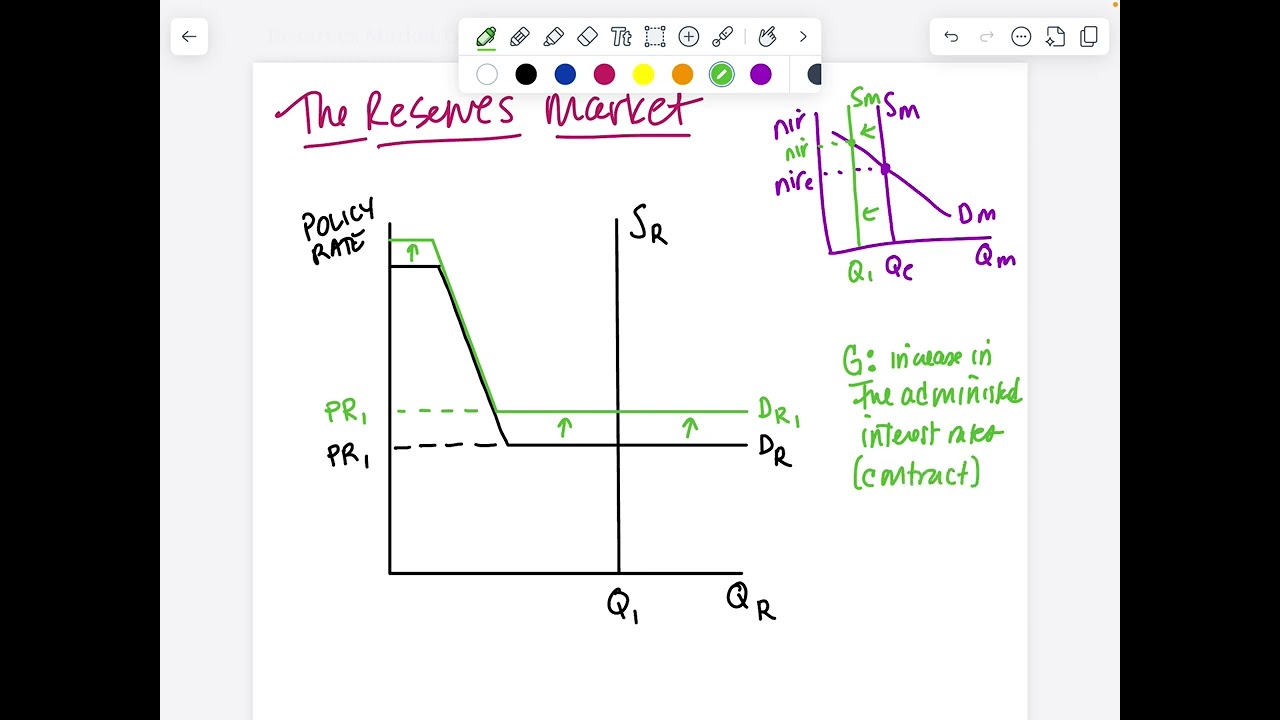
Ample reserves: contractionary
raise Interest on Reserves/Admin Rates
Ample reserves: Expansionary
lower Interest on Reserves/Admin Rates
reserve market graph