Nursing Management Functions
 Call Kai
 Learn
 Practice Test
 Spaced Repetition
 Match
 Flashcards
 Knowt Play
1/53

There's no tags or description
Looks like no tags are added yet.
54 Terms
Planning
1. What
2. Why
3. How
4. When
5. Where
6. Who
is a management function that involves deciding in advance what needs to be done.
It involves identifying needs, setting objectives, choosing actions, allocating resources, and evaluating results.
It answers 6 basic questions:
1. __ needs to be done?
2. __ should it be done?
3. __ will it be done?
4. __ will it be done?
5. __ will it happen?
6. __ will be responsible?
Goal-oriented
Based on Facts and Assessment
Participation
Flexibility
Continuity
PRINCIPLES OF PLANNING
__ – Every plan must support clear organizational or patient-care objectives.
__ – Plans should be based on reliable data, such as patient census, staffing levels, incident reports, and patient outcomes.
__ – Involving staff nurses and stakeholders improves planning and encourages teamwork.
__ – Plans should be adjustable when changes occur in staffing, supplies, patient census, or emergencies.
__ – Planning is an ongoing process. Previous results serve as a basis for future plans.
Coordination and Integration
Priority Setting
Efficiency and Economy
Simplicity and Clarity
Evaluation
PRINCIPLES OF PLANNING
__ – Unit plans should be aligned with institutional goals, policies, and other departments.
__ – Urgent, important, and high-risk needs should be addressed first, especially those affecting patient safety.
__ – Achieve desired results while avoiding unnecessary expenses and waste.
__ – Instructions, responsibilities, timelines, and expected outcomes should be easy to understand.
__ – Plans should have measurable indicators to determine their effectiveness and identify areas for improvement.
Future-oriented
Intellectual and Decision-based
Primary Management Function
Continuous and Dynamic
Universal
All-inclusive
Interdependent Action-focused – Converts goals into specific activities, assignments, schedules, and standards.
CHARACTERISTICS OF PLANNING
__ – Anticipates future needs and prepares for possible situations.
__ – Requires analysis, judgment, and choosing the best course of action.
__ – Provides direction for organizing, staffing, directing, and controlling.
__ – Changes according to new information and circumstances.
__ – Applied by managers at all levels, from nursing service administrators to charge nurses.
__ – Considers objectives, personnel, time, equipment, supplies, finances, and possible risks.
__ – Unit plans must be aligned with other departments and the institution's overall plan.
__ – Converts goals into specific activities, assignments, schedules, and standards.
PLANNING PROCESS
Assess the Situation
Identify and Define the Problem or Opportunity
Establish Goals and Objectives; (1) Goals, (2) Objectives
Implement the Plan
Monitor and Evaluate
practical planning cycle includes the following steps:
__ - Gather information about current conditions, needs, problems, strengths, and available resources.
__ - Clearly state the issue and identify its causes rather than focusing only on symptoms.
__ - (1)__ describe the desired results; (2)__ should follow the SMART criteria.
__ - Communicate the plan, clarify responsibilities, provide resources, and begin activities.
__ - Compare actual results with objectives, identify gaps, and revise the plan when necessary
SMART
Specific
Measurable
Achievable:
Relevant
Time-bound
SMART is a guide for creating clear and achievable objectives.
S – __: Clearly states what needs to be accomplished.
M – __: Includes criteria to measure progress or success.
A – __: Can realistically be accomplished with available resources.
R – __: Supports the overall goals and needs.
T – __: Has a specific deadline or timeframe.
Strategic planning
(Type of Planning)
is a long-term and organizationwide plan that provides direction for the future of an organization. It is usually led by top-level administrators and guided by the institution's mission, vision, and goals.
Examples in Nursing:
Opening a new nursing unit.
Introducing an electronic health record system.
Developing a hospital-wide patient safety program.
Creating a long-term nurse recruitment strategy.
operational planning
(Type of Planning)
refers to short-term and specific activities that help achieve the goals of strategic planning. It is usually prepared by nurse managers, department heads, and unit leaders.
It identifies what needs to be done, who will do it, when it will happen, and what resources are needed.
Examples in Nursing:
Preparing monthly duty schedules.
Assigning daily nursing responsibilities.
Planning staff training.
Preparing medical supply requests.
Conducting hand-hygiene audits.
A. Organizational Vision, Mission, Philosophy, Goals, and Values
Vision
Mission
Philosophy
Goals
Values
(Element of Planning)
__: A statement describing the desired future or what the organization hopes to become. It provides inspiration and long-term direction
__: A statement explaining the organization's purpose, whom it serves, and what services or contributions it provides.
__: The fundamental beliefs and principles that guide the organization's decisions and approach to care. A nursing philosophy may emphasize dignity, holistic care, evidence-based practice, and respect for individual differences.
__: Broad results the organization or nursing service intends to achieve. Goals should be consistent with the mission and vision.
__: Shared standards and beliefs that guide behavior, choices, and relationships. Examples include compassion, integrity, accountability, respect, teamwork, excellence, and patient safety.
Forecasting
1.Quantitative
2.Qualitative
(Element of Planning)
is the process of predicting future needs using past records, current trends, and available data. It helps nursing managers prepare for patient census, staffing, supplies, equipment, and expenses.
Types:
1.Quantitative – Uses numerical data and records.
2.Qualitative – Uses opinions, feedback, and professional judgment.
Gantt Chart
(Element of Planning)
is a visual planning tool that displays activities against a timeline. It shows when each task begins and ends, how long it is expected to take, and which tasks may overlap.
It helps managers monitor progress and identify delays

Budgeting
(Element of Planning)
is the process of estimating expenses and allocating financial resources for nursing needs, such as staff, equipment, and supplies.
1. Operating budget
2. Personnel or staffing budget
3. Capital budget
4. Cash budget
5. Flexible budget
6. Fixed budget
7. Program or project budget
E. Types of Budgets (Element of Planning)
1. __: Covers routine expenses required to run the nursing service, such as salaries, benefits, supplies, utilities, and routine operating costs.
2. __: Estimates the cost of nursing personnel, including salaries, overtime, benefits, and other staffing-related expenses. It is often part of the operating budget.
3. __: Covers major long-term purchases or improvements, such as ventilators, patient monitors, beds, major equipment, and facility renovation.
4. __: Estimates cash expected to come in and go out during a specified period to help ensure that funds are available when needed.
5. __: Adjusts expected costs according to activity or service volume, such as changes in patient census or workload.
6. __: Prepared for a defined level of activity and generally does not automatically change when actual volume differs.
7. __: Allocates resources for a specific program, such as staff training, an infection-control campaign, or a patient-education project.
Budget variance
favorable variance
unfavorable variance
managers
is the difference between the budgeted amount and the actual amount spent or received. A (1)__ means the result is financially better than planned; an (2)__ means it is worse than planned. (3)__ must still determine whether spending less affected quality or safety.
F. Costing of Nursing Care Services
costing
(Element of Planning)
__ is calculating the expenses and resources needed to provide quality nursing care.
Direct labor
Direct supplies
Equipment and depreciation
Indirect or overhead costs
Training and quality costs
Common cost components include:
__: salaries, overtime, and benefits of nurses and other personnel directly involved in care.
__: gloves, dressings, syringes, IV sets, and other items used for patient care.
__: the cost of using and maintaining equipment over its useful life.
__: utilities, housekeeping, administration, building maintenance, and other shared expenses.
__: orientation, continuing education, audits, and activities that support safe practice.
Cost per patient day
Cost per nursing hour
Activity-based costing
Case or service costing
Basic costing approaches:
__: Total nursing service cost for a period divided by the number of patient days during that period.
__: Total nursing labor cost divided by the total nursing hours provided.
__: Assigns costs to specific activities based on the resources each activity consumes.
__: Estimates the cost of providing care for a particular case, procedure, or service.
Incomplete or inaccurate data
Unclear objectives
Limited budget and resources
Resistance to change
Poor communication
BARRIERS IN PLANNING
__: Use updated census, acuity, staffing, supply, and outcome records; verify information before deciding.
__: Write specific, measurable objectives and communicate expected results.
__: Prioritize essential patient-safety needs, justify requests with evidence, and explore efficient alternatives.
__: Involve staff early, explain the reason for the plan, listen to concerns, and provide training.
__: Use clear written plans, endorsements, meetings, and defined reporting channels.
Time constraints and emergencies
Lack of staff participation
Unrealistic assumptions
Conflicting priorities
Failure to evaluate
BARRIERS IN PLANNING
__: Set priorities, create contingency plans, and review plans regularly.
__: Seek input from the people who will implement the plan and clarify their roles.
__: Use reliable forecasts, consider risks, and revise assumptions when conditions change.
__: Align unit activities with institutional goals and clarify which needs take precedence.
__: Set indicators and review outcomes so that ineffective plans can be corrected.
ORGANIZING
is the management function of arranging work, people, authority, and resources so that objectives can be achieved.
In nursing, it determines how duties are divided, who reports to whom, how departments coordinate, and how staff and equipment are arranged to provide continuous patient care.
Classical theory
Scientific management (Frederick W. Taylor)
Administrative theory (Henri Fayol)
(MAJOR ORGANIZATIONAL THEORIES)
__: Emphasizes formal structure, division of work, authority, rules, and efficiency. It includes scientific management, administrative management, and bureaucratic approaches.
__ (by:__): Focuses on analyzing tasks and finding efficient methods of performing work. In nursing, standardized procedures and workload analysis reflect this approach, provided that individual patient needs are considered.
__ (by__): Emphasizes general principles of management, including planning, organizing, command/leadership, coordination.
Bureaucratic theory (Max Weber):
Human relations theory (Elton Mayo and others)
Systems theory
Contingency theory
(MAJOR ORGANIZATIONAL THEORIES)
__ (by__): Emphasizes formal rules, clear authority, defined roles, hierarchy, and selection based on competence. It can support consistency but may become rigid if applied without flexibility.
__ (by__): Highlights the importance of social relationships, communication, teamwork, morale, and staff needs in workplace performance.
__: Views an organization as a set of connected parts that interact with one another and with the environment. A change in staffing, supplies, or policy can affect the entire nursing service.
__: States that there is no single best management approach for every situation. The appropriate structure or leadership response depends on the people, task, environment, and circumstances.
Unity of command
Division of work
Scalar chain or chain of command
Span of control
PRINCIPLES OF ORGANIZING
__: each employee should know the immediate supervisor from whom instructions and accountability are received.
__: tasks are divided according to roles, competence, and workload to promote efficiency.
__: authority and communication follow a defined line from higher to lower levels, while urgent situations may require approved direct communication.
__: the number of people directly supervised should be manageable, considering task complexity and staff experience.
Authority and responsibility
Coordination
Delegation
Flexibility
Continuity
PRINCIPLES OF ORGANIZING
__: authority to make decisions should be matched with responsibility for the work assigned.
__: individual and departmental activities must be integrated to avoid duplication and gaps in care.
__: appropriate tasks may be assigned to qualified personnel while the delegating nurse retains accountability for the delegation decision and appropriate follow-up.
__: structure should allow adaptation to patient needs, emergencies, and organizational changes.
__: the arrangement of work should support uninterrupted nursing care across shifts and departments.
Organizational structure
is the formal arrangement of positions, responsibilities, authority, and communication relationships in an institution. It clarifies who performs each function, who makes decisions, and how accountability is maintained.
Line structure
(TYPE OF ORGANIZATIONAL STRUCTURE)
Authority flows directly from the highest level to lower levels. It is simple and has a clear chain of command, but decision-making may become concentrated at the top

Functional structure
(TYPE OF ORGANIZATIONAL STRUCTURE)
Employees or departments are grouped according to specialized functions, such as nursing, pharmacy, laboratory, and finance. It supports expertise but requires coordination across functions

Line-and-staff structure
(TYPE OF ORGANIZATIONAL STRUCTURE)
Combines direct line authority with specialist advisory support. For example, a nursing director may have line authority while infection-control or quality specialists provide expert guidance
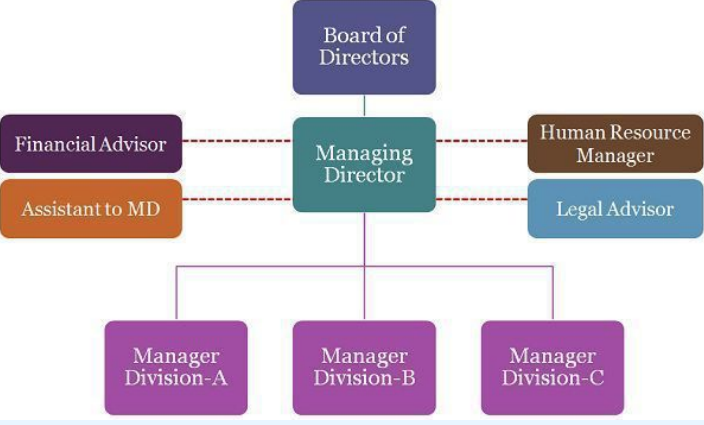
Matrix structure
(TYPE OF ORGANIZATIONAL STRUCTURE)
Employees may work with both a functional manager and a project or program leader. It supports collaboration but can create confusion if authority is not clear.
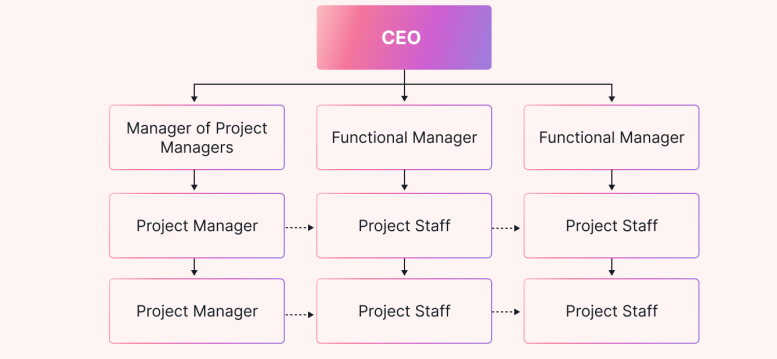
Flat structure
(TYPE OF ORGANIZATIONAL STRUCTURE)
Has fewer management levels and a wider span of control. It may encourage communication and faster decisions but can place heavy demands on supervisors.


Centralized structure
Decentralized structure
(TYPE OF ORGANIZATIONAL STRUCTURE)
__: Major decisions are made by senior management. It can promote consistency but may slow local responses.
__: Decision-making authority is distributed to lower levels or units. It can support responsiveness and staff participation but requires clear limits and accountability.
Division and specialization of work
Departmentalization
Hierarchy
Chain of command
Span of control
Centralization or decentralization
Formalization
Coordination mechanisms
COMPONENTS OF ORGANIZATIONAL STRUCTURE
(DDHCSCFC)
organizational chart
staffing
is a visual diagram showing positions, reporting relationships, and lines of authority. It helps staff understand the chain of command and where to direct concerns. It does not show every informal relationship or all details of daily work.
is the process of hiring, assigning, training, and keeping enough qualified staff to provide safe and effective patient care.
1. census, acuity, workload, & unit needs.
2.number & types
3.Recruit & select
4.licenses, credentials, qualifications, & references.
5.Orient & assign
6.training, coaching, & evaluation.
7.schedules; workloads
8.staff performance
STAFFING PROCESS
1.Assess patient c__, a__, w__, and u__.
2.Determine the n__ and t__ of staff needed per shift.
3.Re__ and s__ qualified applicants.
4.Verify l__, c__, q__, and r__.
5.O__ and a__ new staff to appropriate units.
6.Improve staff skills through t__, c__, and e__.
7.Prepare s__ and distribute w__ fairly.
8.Monitor s__ and adjust staffing plans as needed.
·Right number
·Right competence
·Right person and role
·Continuity of care
·Fairness
·Flexibility
·Legal and ethical compliance
·Staff development and retention
PRINCIPLES OF STAFFING
(RRRCFFLS)
SKILLS MIX
SCHEDULING
The combination of nurses and support staff with different skills and qualifications working together to provide safe patient care
is the process of assigning nurses their work shifts and duties to ensure enough staff are available to care for patients.
Fixed Schedule
Rotating Schedule
Self-Scheduling
Centralized Scheduling
Decentralized Scheduling
Types of Scheduling:
__ – Nurses follow the same regular shifts.
__ – Nurses take turns working morning, afternoon, and night shifts.
__ – Nurses choose their preferred shifts, subject to approval.
__ – A central office prepares schedules for different hospital units.
__ – The head nurse prepares the schedule for their own unit.
directing/leading
delegation
motivation
is the management function of guiding, communicating with, motivating, supervising, and supporting staff as they perform assigned duties. It turns plans and organizational arrangements into action. Effective nurse leaders promote safe practice, teamwork, accountability, professional growth, and patient-centered care.
is the transfer of responsibility for performing a specific task to another qualified person while the nurse who delegates retains accountability for the overall delegation decision and appropriate supervision. It must follow the person's legal scope of practice, competence, institutional policy, and the patient's condition.
is the internal drive or external influence that encourages a person to act toward a goal. In nursing management, motivation affects job satisfaction, performance, teamwork, attendance, and willingness to improve.
Right task
Right circumstance
Right person
Right direction/communication
Right supervision/evaluation
Five Rights of Delegation
__: The task is appropriate to delegate and is permitted by law and policy.
__: The patient's condition, environment, available resources, and situation make delegation safe.
__: The delegatee has the necessary education, training, demonstrated competence, and authority.
__: Instructions are clear and include the task, expected result, limits, reporting requirements, and when to seek help.
__: The delegating nurse provides the level of monitoring required, evaluates the result, and gives feedback.

Maslow's hierarchy of needs
(motivation theory)
People have needs commonly described from basic physiological and safety needs to belonging, esteem, and self-actualization. Managers should recognize that unmet basic or safety needs can affect work performance.

Herzberg's two-factor theory
(motivation theory)
Hygiene factors, such as salary, policies, supervision, and working conditions, help prevent dissatisfaction. Motivators, such as achievement, recognition, responsibility, and growth, can increase satisfaction.

McGregor's Theory X and Theory Y
Theory X
Theory Y
(motivation theory)
__ assumes employees generally need close control;
__ assumes people can be self-directed and responsible when conditions support participation and achievement.

Expectancy theory (Vroom)
(motivation theory)
Motivation is influenced by whether employees believe effort can lead to good performance, performance can lead to valued outcomes, and those outcomes matter to them
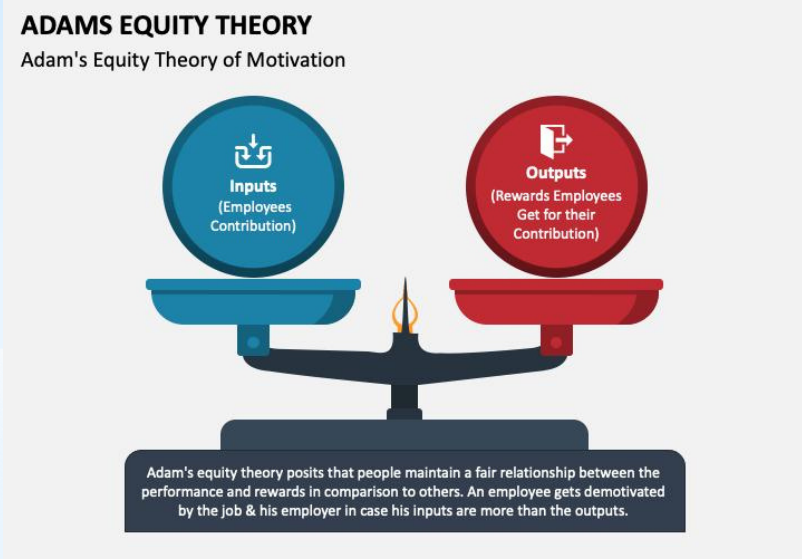
Equity theory (Adams)
(motivation theory)
Employees compare the fairness of their contributions and rewards with those of others. Perceived unfairness can reduce motivation.
Scientific Decision Making
Conflict Management; Conflict
A a systematic, evidence-informed approach to selecting the best action among alternatives. It combines reliable data, clinical and managerial expertise, ethical principles, staff input, and evaluation of outcomes.
__ is a disagreement or perceived incompatibility between individuals or groups. In nursing, it may arise from workload, unclear roles, communication problems, differences in values, limited resources, or misunderstandings. Unresolved conflict can affect teamwork, morale, and patient safety.
Intrapersonal
Interpersonal
Intragroup
Intergroup
Types of Conflict
__: Conflict within an individual, such as competing responsibilities or values.
__: Conflict between two people, such as two staff members disagreeing about an assignment.
__: Conflict among members of the same team or unit.
__: Conflict between departments or professional groups, such as disagreements over patient transfer processes.
Avoiding
Accommodating
Competing or directing
Compromising
Collaborating
Common Conflict-Handling Approaches:
__: Delaying or withdrawing from the conflict . May be appropriate for a minor issue or when emotions need to cool, but does not solve persistent problems.
__: Giving priority to the other person's concern. Useful when the issue matters more to the other party or preserving the relationship is important.
__: Using authority to make a decision, especially when an immediate safety issue requires urgent action. Overuse can damage relationships.
__: Each party gives up something to reach an acceptable middle ground.
__: Parties openly identify concerns and work together toward a solution that addresses the important needs of everyone. Often useful for complex or recurring issues
CHANGE MANAGEMENT
is the planned process of helping individuals and organizations move from a current way of working to a desired future state. Changes in nursing may involve new policies, equipment, documentation systems, staffing patterns, clinical protocols, or quality improvement programs.
Reasons for Change
New evidence, clinical guidelines, laws, or professional standards.
Patient-safety concerns and quality-improvement findings.
New technology, equipment, or electronic documentation.
Changes in patient population, service demand, or available resources.
Organizational restructuring or policy updates.
Lewin’s Change Model
Unfreezing:
Changing or moving
Refreezing
__: Prepare people for change by explaining why it is needed, sharing evidence, identifying concerns, and building readiness.
__: Introduce the new process, provide education and resources, support staff, and solve implementation problems.
__: Reinforce the new practice through policies, orientation, monitoring, feedback, and recognition so it becomes part of routine work.
Resistance to change may result from fear, lack of information, habit, workload, poor timing, or concern about competence. Leaders can reduce resistance by involving staff, communicating honestly, providing training, listening to feedback, and demonstrating the benefits. Change should be monitored to ensure that it improves rather than harms patient care.
TIME MANAGEMENT
is the purposeful use of time to complete essential tasks efficiently while maintaining quality and safety. Nurses work in environments with competing demands, so they must prioritize, organize, delegate appropriately, and respond to unexpected events.
A useful priority reminder is: unstable before stable, urgent before routine, safety-critical before convenience, and time-sensitive treatment before tasks that can safely wait. Priorities must always be based on the patient's actual condition.
Prioritize care
Plan the shift
Cluster care
Use a task list
Delegate appropriately
Avoid unnecessary interruptions
Document promptly
Evaluate and adjust
Practical Time-Management Strategies
__: Address immediate threats to life and safety first, then urgent and important needs. Use clinical judgment and frameworks such as ABCs when appropriate.
__: Review endorsements, patient conditions, orders, medications, procedures, and scheduled activities at the start of duty.
__: Group appropriate activities for the same patient to reduce unnecessary trips and interruptions, without delaying urgent care.
__: Write down tasks, deadlines, and follow-up needs; update the list when priorities change.
__: Assign suitable tasks to qualified personnel and provide clear directions and follow-up.
__: Use focused communication and organize supplies, while remaining responsive to urgent patient needs.
__: Complete accurate documentation as close to the time of care as practical, following policy.
__: At the end of the shift, identify unfinished tasks, communicate them during handover, and reflect on barriers.
Supervision
is the process of guiding, observing, supporting, and evaluating staff to ensure that work is performed safely and according to professional standards, policies, and expected outcomes. Good supervision is not simply fault-finding; it combines accountability with teaching, coaching, and support.
Effective __ involves setting clear expectations, observing performance appropriately, communicating respectfully, giving specific and timely feedback, documenting according to policy, and agreeing on improvement actions. The amount of supervision should match the task's risk, the patient's condition, and the staff member's competence.
Purposes:
Promote patient safety and quality of nursing care.
Ensure that policies, procedures, and standards are followed.
Clarify assignments, responsibilities, and expected performance.
Identify learning needs and improve staff competency.
Provide feedback, coaching, and support.
Recognize good performance and address problems early.
Maintain communication and coordination within the unit.
1. Individual conferences
2. Group conferences
3. Initial assessment records
4. Anecdotal records
5. Supervision of nursing procedures
6. Control of initial experiences
7. Assistance with bedside care
Reassurance
9. Incidental teaching
Techniques of Supervision
(IGIASCARI)
Direct supervision
Indirect supervision
Clinical supervision
Supportive or developmental supervision
Types and Methods of Supervision
__: The supervisor observes or is immediately available while a task is performed. It may be needed for new, complex, or higher-risk activities.
__: The supervisor monitors through reports, documentation, audits, outcomes, and scheduled follow-up.
__: Structured professional support that helps nurses reflect on practice, develop skills, and improve patient care.
__: Focuses on coaching, learning, problem-solving, and professional growth