Ch 8 Lipids and proteins are associated in biological membranes
 Call Kai
 Learn
Learn Practice Test
 Spaced Repetition
 Match
Match Flashcards
 Knowt Play
1/61

There's no tags or description
Looks like no tags are added yet.
Name | Mastery | Learn | Test | Matching | Spaced | Call with Kai | Chat |
|---|
No analytics yet
Send a link to your students to track their progress
62 Terms
lipid
marginally soluble in water readily soluble in solvents
open chain compounds with polar heads and nonpolar tails
fused ring compounds

fatty acids
amphipathic: polar end (water soluble) and another with hydrocarbon nonpolar (insoluble in water)
unbranched hydrocarbon tail
even number of C atoms
saturated fatty acid
C double bond in the nonpolar chain usually cis, lower melting point
cis points kink in tail trans = tail remains fully extended
unsaturated fatty acid
only single carbon bonds

Triacylglycerol/ triglyceride
a lipid formed by esterification of three fatty acids to glycerol
can store fatty acids
doesn’t exist in membranes
concentrated store of metabolic energy
Complete oxidation of fats yields 9kcal/g vs 4kcal/g carbohydrates

glycerol
a three-carbon compound that contains three hydroxyl groups, one bound to each carbon
lipases
enzymes that hydrolyze lipids
breaks ester linkages of triacylglycerols into 3 fatty acids
saponification
uses a salt base like KOH or NaOH to produce glycerol, and the salts of the fatty acids. Salts=soap
Phosphoglycerides
roader class of glycerol‑based phospholipids containing two fatty acids and a phosphate head group.
make up membranes

phosphatidic acid
glycerol with two of the OH groups esterified with fatty acids and 3rd OH is esterified with phosphoric acid

phosphatidyl ester (Phosphoacylglycerols)
phosphatidic acid with another alcohol esterified to the phosphoric acid moiety
the polar head group is charged, because the phosphate group is ionized at neutral pH.
wax
mixtures of esters of long-chain acids and long-chain alcohols
frequently used as protective coating
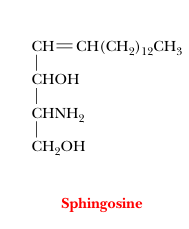
sphingolipids
lipids whose structure is based on sphingosines, not glycerol
simplest compounds=ceramides: 1 fatty acid group linked to sphingosine
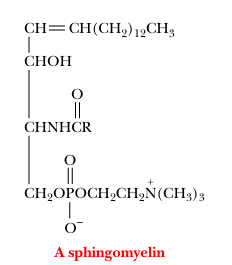
sphingomyelins
compounds which the primary alcohol of sphingosine is esterified to phosphoric acid which is also esterified to another amino alcohol
glycolipids
a lipid to which a sugar moiety is bonded
ceramides often act as parent compound
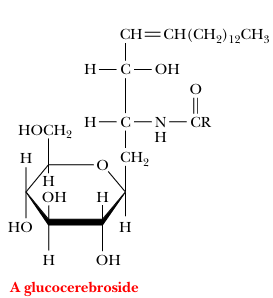
cerebroside
a glycolipid that contains sphingosine and a fatty acid in addition to the sugar moiety
steroids
lipids with a characteristic fused ring (A,B, and C) and 1 five-membered ring
cholesterol
steroid that occurs in cell membranes the precursor of other steroids
only contains a single OH group-mainly hydrophobic
can modify role of membrane proteins
membranes
separate inside cell from environment, transport specific substances into or out of cell, house enzymes and proteins

lipid bilayer
aggregate of lipid molecules in which the polar head groups are in contact with water and the hydrophobic tails are not
held together by noncovalent interactions like van-der-waals and hydrophobic interactions
membrane fluidity with saturated fatty acids
no cis double bonds= close packing of molecules=rigidity
membrane fluidity with unsaturated fatty acids
cis kinks= disorder in the packing of chains= more open structure=more fluidity

stabilizes the extended straight chain arrangement of saturated fatty acids by van der waals
order of increasing fluidity: animal, plant, prokaryote
how does cholesterol restrict fluidity to the membrane

lipid bilayer asymmetry
various mixture of lipids on inner and outer surface
concentration of bulky molecules is higher in the outer layer, which has more room facing the outer environment

disorders, more
heat___ bilayers making them ___ fluid
flip-flop, laterally
lipids don’t often ____, but can move____ within each layer of the bilayer
peripheral proteins
proteins loosely bound to the outside of the membrane, usually bound to charged heads by polar/electrostatic interactions
integral proteins
proteins embedded in a membrane
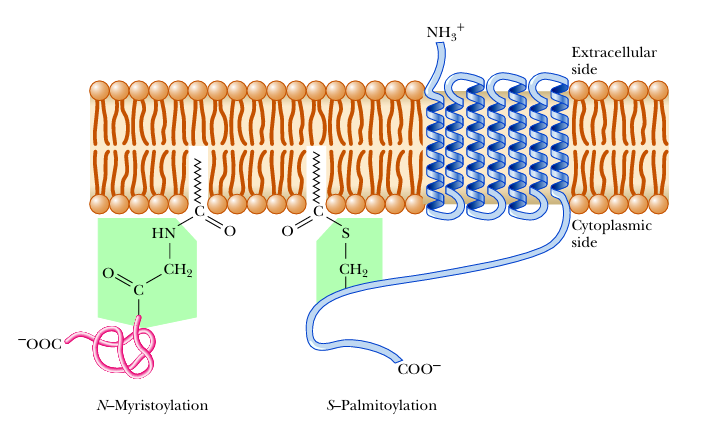
completely span membrane (often in a-helix or beta-sheets)
anchored to lipids via covalent bonds from cysteines or free amino groups on protein to lipid anchors
how are proteins attached to the membrane?
transport proteins
components of a membrane that mediate the entry of specific substances into a cell
receptor proteins
proteins on a cell membrane with specific binding sites for extracellular substances

fluid mosaic model
model for membrane structure in which proteins and a lipid bilayer exist side by side without covalent bonds between proteins and lipids
rafts
assemblages of lipids
preferential association can take place among sphingolipids, sterols, and membrane proteins
laterally
proteins can also float ____ like the lipids of the bilayer
structure and protection from environment
transport
receptor property
catalysis
what are the functions of the cell membrane
semipermeable
membranes are ______, some things can flow through
passive transport
process by which a substance enters a cell without using cells energy
enter using energy from going down the concentration gradient (high—> low)
active transport
energy requiring process of moving substances into a cell against a concentration gradient (low—> high)
simple diffusion
type of passive transport that involves the process of passing through a pore or opening in a membrane without requirement for a carrier or for the expenditure of energy
only small nonpolar/uncharged molecules like O2, N2, and CO2
rate of movement determined by steepness of concentration gradient across the membrane

facilitated diffusion
process by which substances enter a cell by binding to a carrier protein, doesn’t require energy uses the energy from flowing down their concentration gradient
Ex) Glucose flows through Glucose permease carrier protein from high concentration in blood to low concentration inside RBC
hyperbolic curve like Michelis-menten
primary active transport
carrier protein + hydrolysis of a high energy molecule

necessary for resetting action potential so that Na+out>Na+inside and K+inside>K+outside
3 Na+ ions from inside cell bind and 1 subunit of protein hydrolyzes the ATP and transfers the phosphate group to an aspartate chain on another subunit
phosphorylation causes confirmational change in protein (opens pore) so 3 Na+ released outside cell
outside cell 2 K+ ions bind to pump enzyme which is still phosphorylated
2nd confirmational change regenerates enzymes original form such that 2K+ ions released inside cell
explain Na+/Ka+ pump
secondary active transport
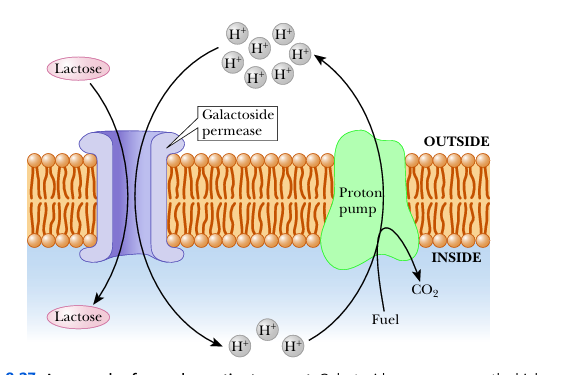
transporter uses he energy from one molecule moving down it’s concentration gradient to drive another molecule up it’s gradient
proton pumps
integral membrane proteins that create a hydrogen ion gradient across the membrane (uses ATP)
A receptor only works when the key functional groups in its binding site are arranged in the correct 3‑D geometry so the ligand can fit and interact properly.
requirement for membrane receptors to work
can be inhibited using inhibitors
tyrosine kinase
G-proteins
controlling membrane receptor activity
tyrosine kinase
regulate proteins by adding or removing phosphate groups
G-proteins
membrane associated signaling proteins that require GP hydrolysis to function
Low-density- lipoprotein(LDL)
principle carrier of cholesterol in the blood stream
consists of various lipids (cholesterol and phosphoglycerates and protein)

LDL protein portion binds to LDL receptor on cell membrane
complex forms between LDL receptor and protein is endocytosed into the cell
receptor protein recycled back to the surface
cholesterol protein used in cells
excess cholesterol inhibits synthesis of LDL receptor
*too few LDL receptors= excess cholesterol in bloodstream= possible deposit in arteries
how is cholesterol regulated
Vitamin A
serves as the site of the primary photochemical reaction in vision
beta-carotene: percussor to A, unsaturated hydrocarbon
retinol
alcohol form of Vit A
retinal
aldehyde form of Vit A
rhodopsin
retinal+opsin, molecule crucial to vision; main found on rods (rods are 60% and 40% lipids)
Vitamin D
regulated Ca+ and phosphorous metabolism
Cholesterol + UV—> Vit D3 (cholecalciferol)
D3: synthesis of Ca2+ binding proteins which increase absorption of dietary calcium
deficiency in children=rickets
Vitamin E
serves as an antioxidant
most active form= a-tocopherol
reducing agent—> reacts with oxidizing (such as free radicals) agents before they can attack other biomolecules
free radical
highly reactive molecule that have at least 1 unpaired electron
Vitamin K
regulatory function in blood clotting required to modify prothrombin and other proteins
prostaglandins
derivatives of arachidonic acid that contain a 5-membered ring and are at pharmaceutical importance (biologically active: BP control, smooth muscle contraction, inflammation)
arachidonic acid
a fatty acid that contains 20 carbon atoms and 4 double bonds; the precursor of prostaglandins and leukotrienes
prevention of blood clots
leukotrienes
substances derived from leukocytes and have 3 double bonds have pharmaceutical importance
constrict smooth muscle especially in the lungs
synthesis of leukotriene C facilitated by allergic reaction causes constriction of the airway
thromboxanes
also derived from arachidonic acid known to induce platelet aggregation and smooth muscle contraction