Comprehensive Review: Chemistry, Physics, Biology, and Personal Development
 Call Kai
 Learn
 Practice Test
 Spaced Repetition
 Match
 Flashcards
 Knowt Play
1/34

Earn XP
Description and Tags
Vocabulary practice flashcards covering organic chemistry functional groups and nomenclature, states of matter, solutions, electrostatic physics, recombinant genetics, and developmental psychology.
35 Terms
Catenation
The ability of carbon atoms to bond with themselves to form an infinite series of possible chains.
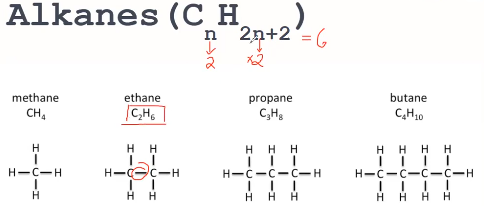
Alkanes
Saturated hydrocarbons consisting entirely of carbon and hydrogen atoms connected by single covalent bonds, following the general formula CnH2n+2.
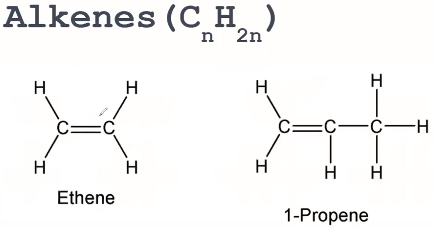
Alkenes
Unsaturated hydrocarbons, also known as olefins, containing at least one carbon–carbon double bond (C=C) and sharing electrons via sigma and pi bonds.
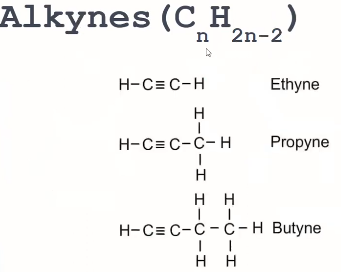
Alkynes
Unsaturated hydrocarbons characterized by the presence of at least one carbon–carbon triple bond (C≡C) with the general formula CnH2n−2.
Functional Groups
Specific groupings of atoms within molecules that impart characteristic chemical properties and behaviors, regardless of the other atoms present.
Alkyl Halides
Organic compounds, also termed haloalkanes, in which one or more hydrogen atoms of an alkane are replaced by halogen atoms (F, Cl, Br, or I), represented by the general formula R-X.
Aldehydes
Carbonyl compounds (R-HC=O) wherein a carbon atom is double-bonded to an oxygen atom and attached to at least one hydrogen atom at the terminal end of a carbon chain.
Ketones
Organic compounds (R-RC=O) containing a carbonyl carbon double-bonded to an oxygen atom and bonded to two other carbon-containing groups within an internal chain.
Carboxylic Acids
Organic compounds containing a carboxyl group (−COOH) positioned at the terminal end of a carbon chain, represented by R-COOH.
Ester
A carboxylic acid derivative represented by the general formula RCOOR′, formed when the acidic hydrogen atom of the hydroxyl group is replaced by an alkyl or organyl group.
Amides
Also called carboxamides; functional groups comprising a carbonyl group (C=O) linked directly to a nitrogen atom, represented as R-C(=O)-NR′R′′.
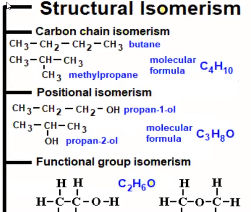
Constitutional Isomers
Molecules that share identical molecular formulas but differ in the connectivity or bonding order of their constituent atoms.
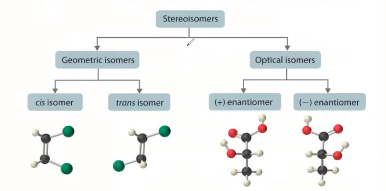
Stereoisomers
Isomeric molecules that possess the same molecular formula and sequence of bonded atoms but differ in the three-dimensional (3D) spatial orientation of their atoms.
Thermoplastic
A plastic polymer held together by weak intermolecular forces that becomes moldable at elevated temperatures, solidifies upon cooling, and softens reversibly upon reheating.
Thermosets
Rigid polymers featuring permanent cross-links that, once shaped and cured, cannot be melted or reshaped by reheating.
Intermolecular Forces
Attractive and repulsive electrostatic forces that mediate interactions between neighboring molecules or particles.
London Dispersion Forces
The weakest category of intermolecular attraction, caused by temporary instantaneous dipoles formed as electrons move continuously around atomic nuclei.
Hydrogen Bonding
The strongest type of dipole-dipole attraction, occurring when a hydrogen atom bonded to a highly electronegative atom (N, O, or F) interacts with a lone pair on another electronegative atom.
Surface Tension
The measure of the energy required to stretch or increase the surface area of a liquid by a unit amount.
Viscosity
The physical property that quantifies a fluid's internal friction and resistance to flow.
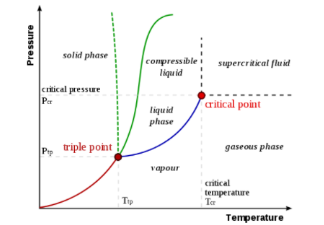
Phase Diagram
A graphical chart plotting pressure versus temperature to display the equilibrium conditions under which distinct states of matter (solid, liquid, gas) exist.
Triple Point
The distinct condition of temperature and pressure at which the solid, liquid, and gas phases of a substance coexist simultaneously in thermodynamic equilibrium.
Solvation
The physical process of attraction and association between molecules of a solvent and the ions or molecules of a solute.
Molarity (M)
A concentration unit expressing the amount of a given substance in moles of solute dissolved per liter of solution (mol/L).
Molality (m)
A concentration metric defined as the number of moles of solute dissolved per kilogram of solvent (mol/kg).
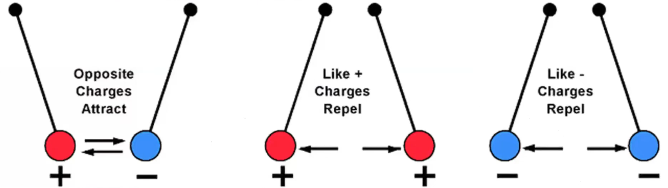
Law of Charges
The fundamental electrostatic principle stating that like charges repel one another, whereas unlike charges attract.
Coulomb's Law
The physical law stating that the magnitude of electrostatic force between two point charges is directly proportional to the product of their charges and inversely proportional to the square of their distance: F=kr2∣q1q2∣.
Dielectric Constant (K)
A property of an insulating material quantifying its capacity to store electrical energy and enhance capacitance relative to a vacuum.
Resistivity (\rho)
An intrinsic electrical property of a material indicating how strongly it opposes the flow of electric current, calculated as ρ=RLA.
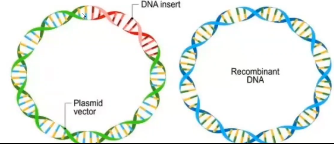
Recombinant DNA (rDNA)
Artificially engineered genetic material created by joining DNA fragments from two different biological sources within a host organism.
Restriction Enzyme
A specialized bacterial enzyme utilized in genetic engineering to cleave DNA molecules at specific target nucleotide sequences.
Hardy-Weinberg Equilibrium
A theoretical genetic principle stating that allele and genotype frequencies in a population remain stable across generations assuming no mutation, migration, natural selection, or genetic drift, and with random mating in large populations (p2+2pq+q2=1).
Genetic Drift
A mechanism of biological evolution describing random, chance-driven fluctuations in allele frequencies within small populations.
Mind and Body Dualism
René Descartes's philosophical concept that differentiates the immaterial conscious mind from the material physical body.
Cognitive Appraisal
The psychological process wherein an individual cognitively evaluates an environmental stressor and determines their behavioral response.