Edu Psych Exam 1
 Call Kai
 Learn
Learn Practice Test
 Spaced Repetition
 Match
Match Flashcards
 Knowt Play
1/47

Earn XP
Description and Tags
Chapters 1, 2, 3, 4, 5, 14 | Special Topic Lesson on Careers/Evaluations
Name | Mastery | Learn | Test | Matching | Spaced | Call with Kai | Chat |
|---|
No analytics yet
Send a link to your students to track their progress
48 Terms
No Child Left Behind (NCLB)
2002
Required that all students reach proficiency by 2014 (spoiler- it didn't happen)
Led to “teaching to the test”; narrowed the curriculum
Every Student Succeeds Act (ESSA)
2015
Testing, data collection continue
States determine interventions for underperforming schools
Local districts decide when to test, how to include other measures such as school climate
Social emotional learning
Larger emphasis on social and emotional learning (S E L): integrating cognition, emotion, and behavior into teaching and learning
Build self-awareness and social awareness skills
Evidence from research on social and emotional learning
Positive effects on academic achievement and social behaviors
Collaborative for Academic, Social, and Emotional Learning (CASEL)
Important to recognize students’ social-emotional trauma (the "invisible backpack")
Elements of Culture
Knowledge, values, attitudes, traditions that guide behavior of a group of people
Intersectionality
Overlapping social identities (gender, sexual orientation, class, ethnicity, religion, SES, age, and more)
Role of implicit bias in prejudice/discrimination
Implicit bias acts as an automatic, unconscious mental shortcut that forms negative or positive associations about social groups, driving discriminatory behaviors even when individuals consciously reject prejudice.
Stereotype threat
•Extra emotional/cognitive burden that academic performance might confirm a stereotype
oCan prevent students from performing their best, interfere with learning, decrease connections to (and valuing of) a subject
Strategies for supporting students who live in poverty
•Learn about effects of poverty on student learning
•Set & maintain high expectations for the students
•Develop caring relationships with students
•Build their learning skills, self-regulation skills
•Pay attention to health problems, absences, tardies
•Meet them where they are at
Opportunity gap
•Rising educational inequalities between SES groups
oLabeled by researchers as “opportunity gap” rather than achievement gap
racism and discrimination in the US school system
•Racism in schools & bias against ethnic/minority students
oTeachers more likely to expect less, discipline more
§Same level of anti-Black biases as members of general public
oFewer chosen for gifted classes; disproportionately referred for special education
Strategies for culturally relevant teaching
•Multicultural education: integrating cultural components to promote equity in schooling all students
•Five dimensions of multicultural education (Banks 2014):
oContent integration
oKnowledge construction process
oPrejudice reduction
oEmpowering school culture and social structure
oEquity pedagogy in all subjects
No general agreement about “best” approach
•Know yourself, your identity, background, values
•Know your students and the legacies they bring
oWork with students and their parents inside/outside school
•Respect your students; accept their strengths/limitations
•Teach your students; provide culturally connected instruction
oBeware how hidden biases creep in
oHold high expectations and provide caring support
oFocus on meaning and understanding, not just basic skills
oInstruct students directly about how to be students
Vygotsky’s Sociocultural theory of cog development***
Social interactions shape cognitive development
ZPD - scaffolding -
ZPD
Range of tasks or skills that a learner can perform with guidance or assistance but not yet independently
In other words: the space between what a learner can achieve independently and what is outside of their reach
Highlights the potential for learning that exists when appropriate support is provided
Scaffolding
Temporary support provided by a more knowledgeable person to help a learner achieve tasks in the ZPD
Support is gradually removed as the learner gains knowledge
Mediators
●Mediators: external aids (physical or symbolic) that guide thinking and problem-solving
○Examples: language, symbols, diagrams, gestures, and even physical tools like calculators
●Mediators act as scaffolds within the ZPD
●Through mediation, learners internalize cultural tools and processes, gradually mastering tasks independently
Amplification and acceleration
•Acceleration: Moving learners through their ZPD more quickly by introducing more advanced tasks once foundational skills are established
oFocus on efficiency of learning
•Example: A student who quickly grasps multiplication might be encouraged to tackle division earlier than the curriculum suggests
•Amplification: Expanding and enriching a learner's understanding or skills within their ZPD
oFocus on increasing depth of understanding and application
•Example: When teaching a child to solve a math problem, explore different problem-solving strategies or applying the concept to real-world scenarios before moving onto a more advanced skill
Piaget’s model (stages of development)***
Childrens' thinking changes in categorical ways (i.e., changes in quality rather than quantity)
schemas
Four stages:
Sensorimotor (ages 0-2 years)
•Learning occurs through seeing, hearing, touching, tasting, and moving
•Children begin to understand object permanence and construct mental representations of objects and experiences
Pre-operational (2-7 years)
•Children increasingly use symbols to represent objects, people, and experiences
oLanguage and pretend play become important forms of symbolic thought
•Thinking is still intuitive rather than logical
•Children tend to be egocentric and have difficulty understanding conservation
Concrete operational (7-11 years)
•Children begin to think logically about concrete objects and situations
•They understand that actions and transformations can be reversed
•Children develop an understanding of conservation and classify/organize objects in increasingly complex ways
•Thinking becomes more logical, but is still tied to concrete information
Formal operational (adolescence-adulthood)
•Thinking becomes increasingly abstract
•Individuals can coordinate and consider multiple variables and perspectives
•They can use hypothetico-deductive reasoning
oThey can imagine possibilities, ideal situations, and future outcomes
Not everyone consistently reaches or uses formal-operational thinking
assimilation and accomodation
Assimilation: Integrating new information into existing schemas
Accommodation: Changing existing schemas or creating new ones
conservation
the logical ability to recognize that a physical quantity remains the same even when its appearance, shape, or container changes
impacts of pubertal timing on social and emotional development
•Early maturing females: ↑ mental health and social challenges
•Early maturing males: ↑ social status, confidence
•Guidance for educators:
oAvoid singling out physical differences
oHelp students access evidence-based resources, when needed
oEncourage more focus on what they do than how they look
Use class materials to address issues
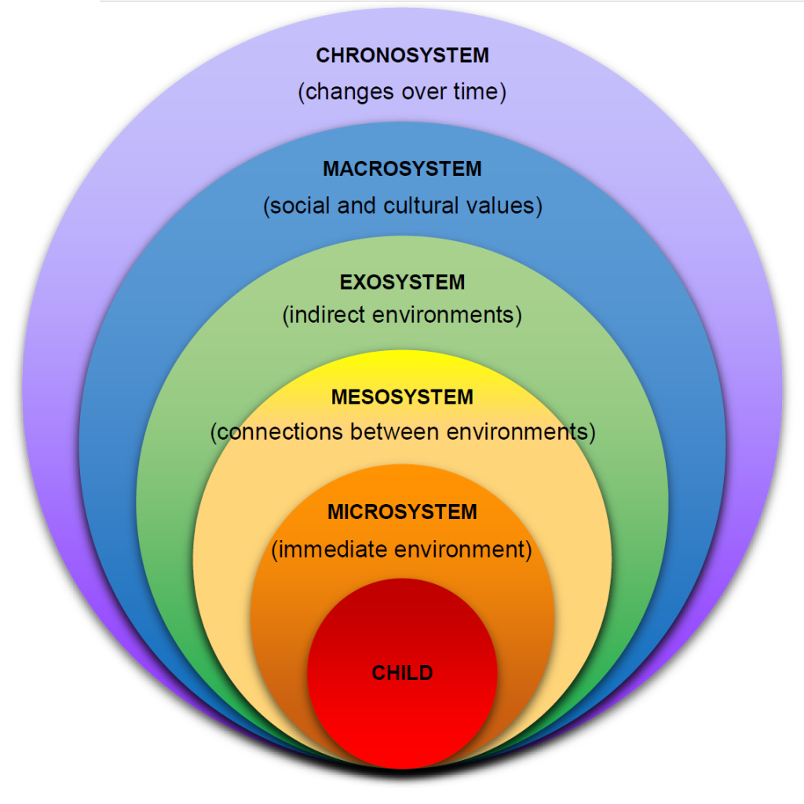
Brofenbrenner’s model***
A developmental theory that describes how nested social and cultural contexts shape every person’s development
Baumrind’s 4 Parenting Styles

strategies for encouraging peer cooperation
Provide space, enough resources for each student
Avoid highly competitive activities, evaluations
Do not reinforce aggressive behavior
Comfort victim, ignore aggressor; use reasonable punishment
Teach directly about positive social behaviors
Incorporate lessons with morals, social ethics
Provide ways to learn tolerance and cooperation
Erikson’s stages

theory of mind
Understanding that other people are people too, with minds, thoughts, feelings, perceptions
Begins to develop by age 2–3
Kohlberg’s stages of moral reasoning
•Moral reasoning: Thinking process involved in judging right and wrong
•Kohlberg’s theory of moral development, based on children’s reasoning in response to moral dilemmas:
oPreconventional: Judgment based on person’s own needs (i.e., not getting in trouble)
oConventional: Takes into account laws and society’s expectations (i.e., not being perceived poorly by others)
oPostconventional: Abstract judgments and principles of justice (i.e., guided by an internal moral compass)
factors that relate to students cheating
•Modeling may relate to a child's decision to cheat
•Academic cheating based on goals, abilities, and costs
oFocused on performance goals
oFeel low self-efficacy for task
oAct impulsively
•Methods for preventing cheating: Avoid high-pressure situations; prepare students for assessments; focus on learning, not grades; enforce cheating policies; and monitor testing
person-first v identity-first language
Person-first reference: Emphasis on individual before the disability
-“Student with disability” not “disabled student”
Identity-first reference: Terms like “autistic” or “deaf” to describe a person
-Preferred by some people with disabilities
fluid and crystallized intelligence

Gardner’s multiple intelligences
Howard Gardner: Multiple intelligences (MI)
Eight separate abilities: Logical-mathematical, linguistic, musical, spatial, bodily-kinesthetic, interpersonal, intrapersonal, naturalist
Individual may be high in one or several intelligences
Values of intelligences vary with cultures and eras of history

Sternberg’s Triarchic theory of intelligence
Three parts:
Analytic intelligence: Analyze, judge, compare/contrast to deal with relatively familiar problems
Creative intelligence: Use insight (deal with novel situations) and automaticity (process quickly, automatically)
Practical intelligence: Adapt to environment to succeed in practical matters (career choice, social skills)

Individuals with Disabilities Act (IDEA)***
Requires states to provide free, appropriate public education (F A P E) for all students with disabilities
Note: To qualify for IDEA services, a child must have a disability and need specialized education to make progress in school
Defining disability: List of I D E A’s 13 categories
Most students have “specific learning disabilities"
Least restrictive environment (L R E): Educate each child with peers in general education classroom to greatest extent possible
Mainstreaming: Include in regular classes as convenient
Integration: Fit child into existing class structures
Inclusion: Integrate all students into regular classes
Individualized Education Plan (I E P): Written statement about services to be provided to student; created by I E P team and revised annually

Section 504 of the Rehabilitation Act***
Section 504—part of Vocational Rehabilitation Act of 1973
Prevents discrimination against people with disabilities in any program funded with federal money
Covers students with medical/health conditions: Diabetes, drug addiction, severe allergies, communicable diseases, temporary disabilities
Covers students with attention deficit hyperactivity disorder (ADHD)
504 Accommodation plans ("504 plans") developed by individual schools
Differences between an IEP and a 504 Plan:
IEP = specialized education services; modifications to the curriculum
504 plan = academic accommodations to increase access to the general education curriculum
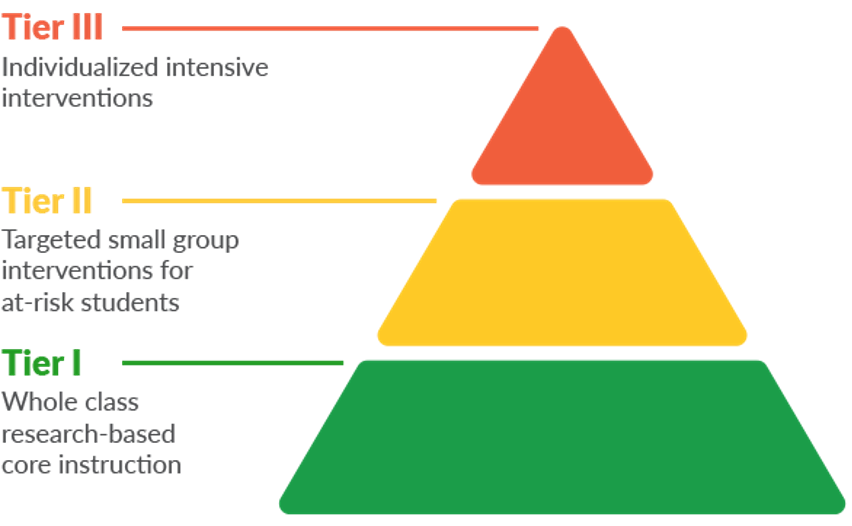
Multi-Tiered Systems of Support (MTSS) / Response to Intervention (RTI)
Multi-Tiered Systems of Support (MTSS): Framework for providing support to students that is targeted to their needs
Response to Intervention (R T I): A form of MTSS that focuses on systematically assessing and providing appropriate instruction/support for students with learning challenges
Used to determine who needs more intensive learning support
oProgress monitoring is essential!
Learning disabilities
•Disorder in one or more basic psychological processes involved in understanding or using spoken or written language
•Students may have average intelligence and typical instruction but struggle with mastering specific academic tasks
•Includes dyslexia, dysgraphia, dyscalculia
intellectual disabilities
•Significantly below-average intellectual functioning plus deficits in adaptive skills (communication, self-care, social)
•Typically considered when IQ is below 70 AND when there are deficits in daily living skills
ADHD
•Inattention, impulsivity, and/or hyperactivity
•May impact organization, focus, and self-control
•These students typically receive special education services under the classification of Other Health Impairment
Autism Spectrum Disorder
•Developmental disability affecting verbal/nonverbal communication, social interaction, and restricted interests and repetitive behaviors
•Can often include sensory processing differences, rigidity, and difficulty with changes in routine
Emotional or behavioral disorder
•Sometimes referred to as Emotional Disturbance (ED)
•Persistent issues with learning, interpersonal relationships, mood, fears/anxiety, or behaviors that interfere with learning and are not better explained by other factors
Students with trauma
Strategies for supporting student with a trauma background:
Prioritize relationships with and between students
Provide academic as well as social and emotional supports
Practice cultural humility and responsiveness
Work to ally with parents
Continually engage in learning and reflection
The Rosenthal Effect
also known as the Pygmalion effect, is a psychological phenomenon where higher expectations lead to increased performance and lower expectations lead to decreased performance
Differentiated instruction (definition/purpose)
•Adapting teaching to the abilities and needs of each learner
oMatch content, process, and product based on student differences in readiness, interests, learning needs
oAdapt teaching to students’ ability, prior knowledge, challenges
oDesigned differentiation: Design different levels of support/scaffolding
oInteractional differentiation: Adaptations on the fly during teaching
Universal Design for Learning (UDL) Guidelines
•Universal design: Considering the needs of all users in the design of new tools, learning programs, or websites
•Universal design for learning (UDL): Strategies and structures to make learning accessible to as many students as possible in inclusive settings
oProvide multiple ways to engage learning process, to represent learning materials, for students to act/express understanding
Pull together: Motivation (the “why” of learning), representations (“what” of learning), and expressions of learning (“how” of learning)
Similarities/Differences between main careers in educational psych
1 School Counselors
•Provide academic advising, scheduling, and college/career readiness support
•Deliver classroom guidance lessons on topics such as study skills, conflict resolution, and career exploration
•Offer short-term counseling for personal, social, and emotional concerns
•Identify at-risk students and connect them with appropriate resources
•Collaborate with teachers and families to promote student success
•Advocate for equitable access to opportunities and resources for all students
2 School Social Workers
•Address barriers to learning related to family, home, and community issues
•Provide counseling and case management for students and families with social-emotional needs
•Connect families with community resources (mental health, housing, food security, medical care, etc.)
•Advocate for students experiencing poverty, abuse, neglect, or trauma
•Support attendance interventions and truancy prevention
•Serve as liaisons between school, home, and outside agencies
•Lead or support crisis intervention and prevention efforts
3 School Psychologists
•Conduct psychological and psychoeducational assessments to identify learning, behavioral, and emotional needs
•Attend IEP/504 meetings to share evaluation findings and recommendations
•Develop and implement behavior intervention plans and academic supports
•Consult with teachers, parents, and administrators to improve learning environments
•Monitor progress and evaluate effectiveness of interventions
•(Occasionally) provide individual and group counseling to support social-emotional and behavioral health
Purposes of assessment
differences between school counselor/social worker/psychologist

similarities between school counselor/social worker/psychologist

steps of the evaluation process
Referral & Intake
Receive request for evaluation from parent, teacher, or multidisciplinary team
Review relevant student records and prior assessments
Meet with members of the multidisciplinary team to gather background info on referral question
Planning & Consent
Develop an evaluation plan tailored to student needs
Ensure that proper written consent is obtained
Clarify any necessary procedures or timelines
Assessment & Data Collection
Administer standardized tests (cognitive, academic, social-emotional, and behavioral as appropriate)
Conduct observations in classroom and/or other settings
Collect additional information from teachers, parents, and other professionals (interview and/or rating scales)
Scoring & Interpretation
Assessments scored and compared to normative data
Consider multiple sources of information to identify patterns of strengths and weaknesses
Write up psychoeducational report
Eligibility Determination Meeting
Present findings to the multidisciplinary team (teachers, parents, specialists)
Discuss whether the student meets criteria for special education services
Recommend interventions, accommodations, or supports based on the evaluation results
Follow-Up, Reporting, Re-Evaluation
Support teachers and families in implementing recommendations
Monitor student progress and adjust support plans as needed
Re-evaluate student as recommended to determine progress and supports needed