exam 1: Above Ground Stems + Leaves
 Call Kai
 Learn
 Practice Test
 Spaced Repetition
 Match
 Flashcards
 Knowt Play
1/102

There's no tags or description
Looks like no tags are added yet.
103 Terms
Stem Tuber
A modified stem used to store food underground (ex. Potato)
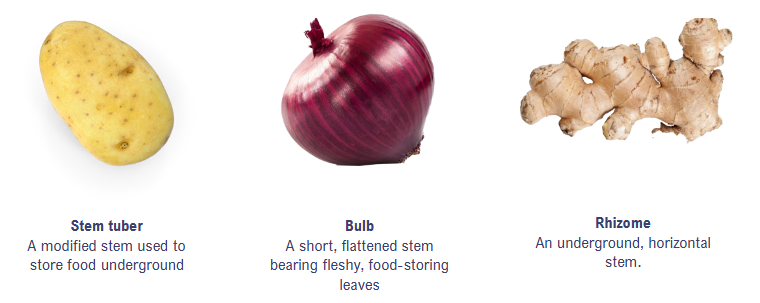
Bulb
A short, flattened stem bearing fleshy, food-storing leaves. (ex. Onion)
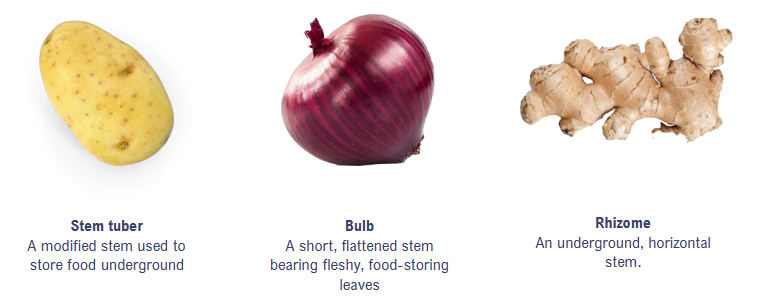
Rhizome
An underground, horizontal stem (ex. Ginger)

Shoot System
This system consists of stems, leaves, and reproductive organ. Mostly found above ground... although modified
stems (e.g. potatoes) and leaves (e.g. onions) grow underground.
this system originates in the plume of the embryo

where does the shoot system originate in the embryo?
the plume

Stem Function - Support
Upholds leaves, flowers, and buds. Sometimes can help leaves orient towards Sun (tropisms)
Stem Function - Conduction
Moves water and minerals from roots to leaves, and products of photosynthesis from leaves to the rest of the plant
Stem Function - Photosynthesis
Green stems are photosynthetic - sometimes the only photosynthetic organ (e.g. cacti)
for some they can get 100% of photosynthesis from stems, others can get 0% photosynthesis from stems
Food Storage
Modified stems can serve as food storage (mainly starches)
Stems - Morphology
Plant stems are characterized by the presence of nodes spaced at regular intervals. The internode region of the stem elongates early in its development to ensure separation of leaves.
Nodes
Points of attachment of leaves in stems
spaced out regularly and separated by internodes
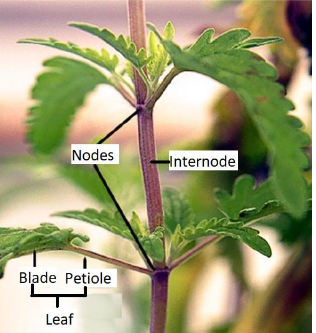
Internode
Area between nodes in a stem
elongates early in maturation to ensure good separation of leaves

Axillary Bud
A embryonic shoot that has the potential to form a lateral shoot, or branch. gives rise to axillary shoot
The bud appears in the angle formed between a leaf and a stem (axil)
useful for pruning
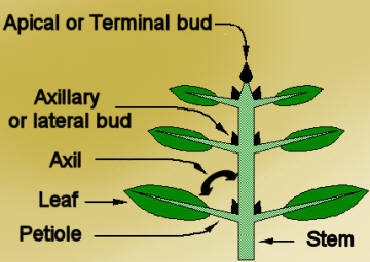
axil
the angle or upper point of attachment where a leaf, branch, or flower stalk meets the main stem of a plant.
where the axillary bud is found

Axillary Shoot
a lateral branch or flower cluster that grows from an axillary bud, which is located in the leaf axil
this type of shoot forms more slowly but with greater genetic uniformity
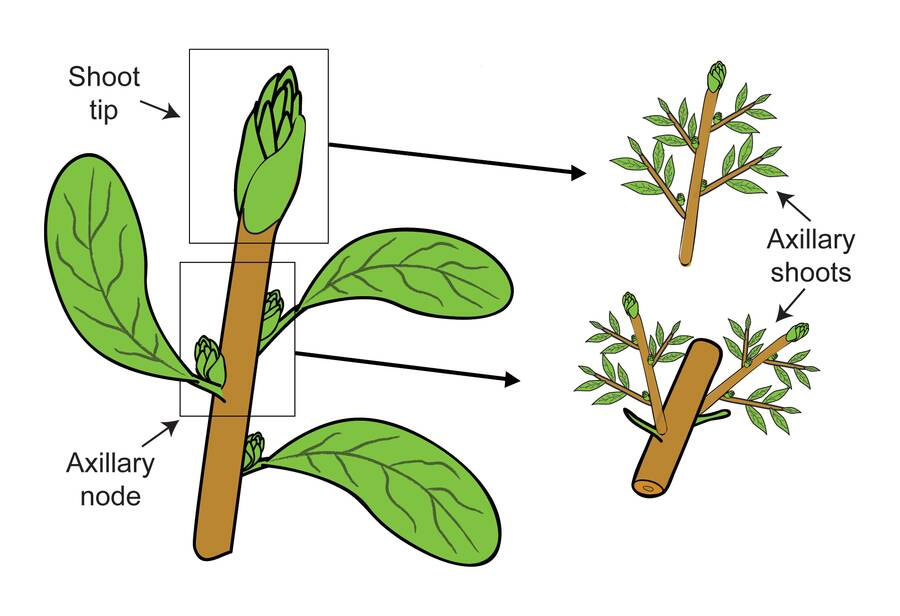
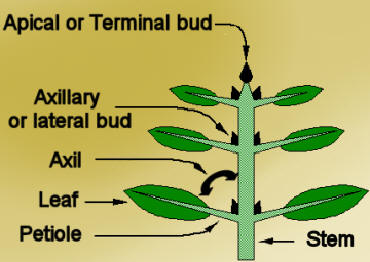
what is the diff btwn an apical bud and axillary bud
The Apical bud sits at the tip of a plant stem to drive upward height, while the Axillary bud rests on the side where leaves meet the stem to create branches or flowers
what r the 3 types of Primary Meristematic Tissue produced by the apical meristem?
Protoderm
epidermis
Ground meristem
ground tissue (photosynthetic, storage, support)
Procambium
gives rise to vascular tissue (transport)

Protoderm
gives rise to epidermis
type of primary meristem
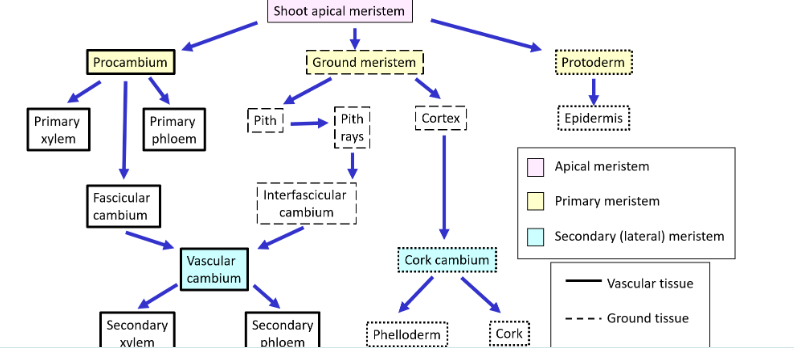
Ground Meristem
Gives rise to ground tissue (photosynthetic, storage, support) → pith, pith rays, cortex, interfascicular cambium
type of primary meristem

Procambium
Gives rise to vascular tissue (transport) → primary xylem and phloem, fasicular cambium
type of primary meristem
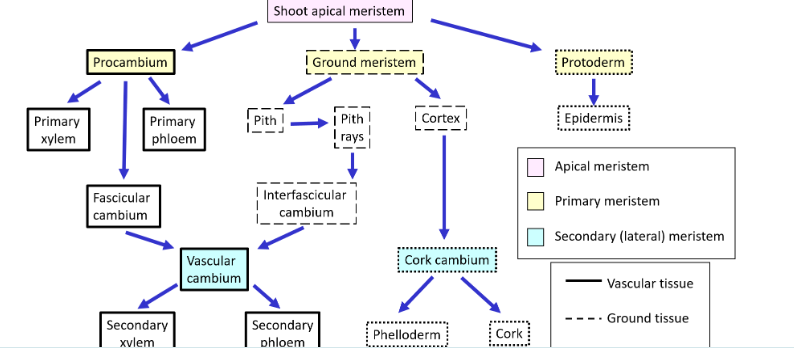
Secondary Growth
An increase in thickness or girth of the stem caused by cell division of secondary/lateral meristem
the secondary meristem contains: vascular cambium + cork cambium
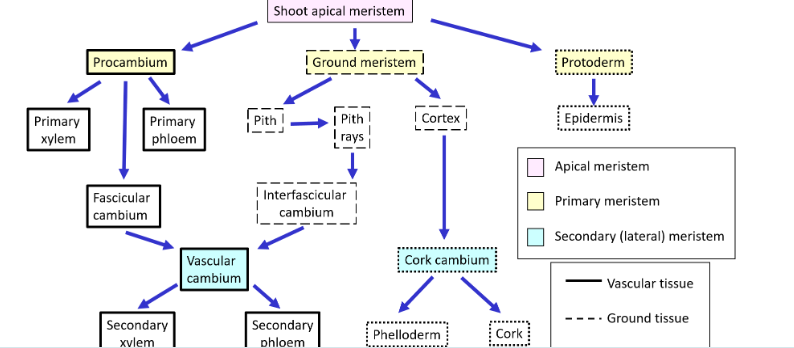
Secondary/lateral Meristem
for increase in girth/thickness of stem
This meristem consists of:
vascular cambium
secondary phloem (outside)
secondary xylem (inside)
cork cambium
produces periderm tissue (phelloderm + cork)
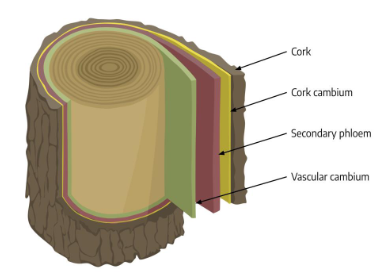
Vascular Cambium
This divides into secondary xylem (inside) and secondary phloem (outside)
part of the secondary meristem
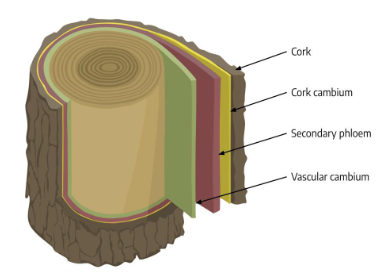
Cork Cambium/Phellogen
Produces periderm tissue
part of the secondary meristem
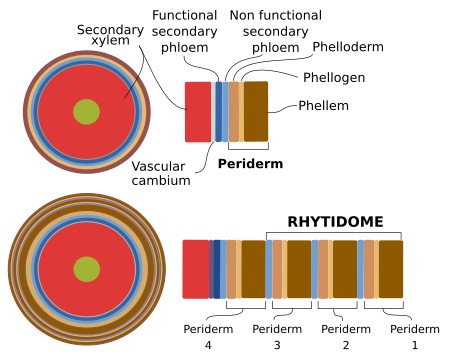
periderm tissue includes: phelloderm + cork/phellem

Secondary Growth - Periderm
Replaces the epidermis in shoots at the end of the first year of growth. It is mostly not permeable due to waxy suberin
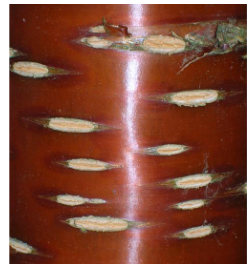
gas exchange happens via lenticels
new layers of periderm r produced inside the older layers (rhytidome)

Lenticels
Elevated regions with large intercellular space where gas exchange happens in the periderm
Rhytidome
Old layers of periderm that die and are pushed out of the bark , cracking and producing typical texture of bark
cuz new layers of periderm r produced inside the older layers
what makes periderms walls impermeable
waxy suberin embedded in phellem (cork) cells
what gives rise to the periderm
phellogen/cork cambium will divide to produce new cells on both sides → phellem/cork cells + phelloderm

what is periderm composed of
its a secondary tissue made by cork cambium that is composed of:
phellem (cork)
dead at maturity with waxy suberin embedded in cell walls
phellogen or cork cambium
The middle meristem layer of actively dividing cells that creates the other two layers.
phelloderm
parenchyma-like cells btwn the cork cambium and cortex

Secondary Growth - Bark
Consists of all tissue external to the vascular cambium. protects the plant against physical damage and prevents water loss
older layers of the secondary phloem r lost (get crushed) which is why the brk remains relatively thick
consists of:
inner bark
outer bark

Inner Bark
Includes the secondary phloem, the cortex, and the phelloderm (inner part of periderm)
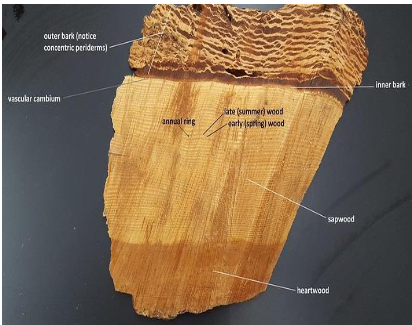
Outer Bark
The cork cambium and everything outside (periderm, cork, etc).
remember that older layers or periderm (rhytidome) die and get pushed out → crack and give typical texture of bark

whats the diff btwn bark vs wood?
the dividing line between wood and bark is a single microscopic ring of stem cells called the vascular cambium.
Everything created to the inside of this ring becomes wood
everything created to or pushed to the outside becomes bark.

Wood
Consists of the original pith, primary xylem and secondary xylem
vascular cambium divides it in this way → secondary phloem (outside) and secondary xylem (inside)

how does the Vascular Cambium dictate Wood formation?
the vascular cambium divides in 2 directions:
secondary phloem (outside)
secondary xylem (inside).
older (dead) layers of secondary xylem r retained → adding new layers of wood.
as new layers of xylem r created, the pith tissue at the center might be destroyed
the secondary xylem is part of what?
secondary xylem is part of wood cuz its on innerside of vascular cambium.
secondary phloem is part of inner bark
Heartwood
The oldest (inner most) layers of secondary xylem which NO longer conduct water!
darker in color, strongest
Tylosesvessel elements prevent water flow

Tylosesvessel
Elements that prevent water flow in heartwood!

Sapwood
Water-conducting xylem in the periphery of heartwood.
lighter in color than heartwood

winter twigs
Dormant stems of winter deciduous plants that are modified to facilitate overwintering.
has a terminal bud (w/ apical meristem) protected by bud scales
lateral buds at each node
leaf scars below lateral buds that form where leaves fall off → contain circular markings that make bundle scars

Terminal Bud in winter twigs
Contains apical meristem and is protected by bud scales
when it resumes growth, scales fall off → leaving a series of ring-shaped scars

bud scales
cover the terminal bud in winter twigs for protection
when bud resumes growth, scales fall off → leaving a series of ring-shaped scars

Lateral Buds
Similar in structure to the terminal bud, but form at each node.
AKA axillary bud
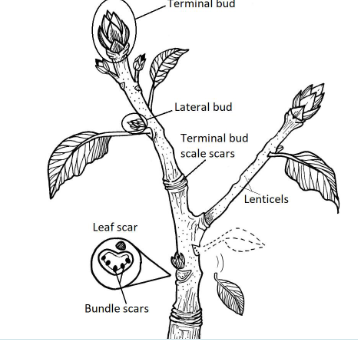
Leaf Scars
Form where leaves fall off below lateral buds - they contain circular markings called bundle scars
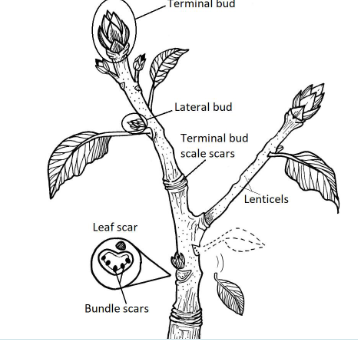
bundle scars
circular markings in leaf scars from where leaves fell off
below lateral/axillary buds

what r the 2 types of branching from lateral/axial buds?
monopodial
buds DO NOT degrade, all shoots continue to grow
sympodial
terminal bud degrades, and lateral buds closest to apex become the new terminal shoot
u can force one type into the other

Monopodial Branching
Buds do NOT degrade, and all shoots continue to grow
branching happens off main stem (ex: tree)

Sympodial Branching
Terminal buds degrade, and lateral buds closest to the apex become the new terminal shoot
bush, shrub
horizontal growth

what r some diff growth forms in plants produced by thickening and branching?
vines
trees
shrubs
herbs (no secondary xylem)
rosette (circular, flat)
erect (up, vertical)
mat (ground cover, horizontal)
Vines
Climbing woody and herbaceous plants
Trees
Woody plants with one main long-lived trunk
Shrubs
Woody plants with multiple main long-lived trunks/stems

Herbs
Herbaceous plants (no secondary xylem)
can be:
rosette (circular, flat)
erect (up, vertical)
mat (ground cover, horizontal)

leaves
they r specialized organd for performing photosynthesis
arise from the shoot apical meristem through leaf primordia
most leaves have determinate growth
usually easy to distinguish, but modified stems + leaflets can appear as whole leaves
true leaves subtend an axillary bud at their base and are lateral (NEVER in the apex)
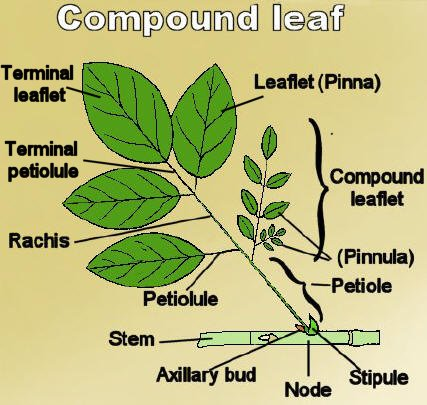
leaflet
a single, distinct segment or blade division of a compound leaf.
Unlike a regular individual leaf, a leaflet does not attach directly to the main plant stem and never has an axillary bud at its base. Instead, multiple leaflets attach to a shared central stalk (called a rachis or petiole), and the axillary bud is only found where that main stalk finally meets the stem.
not a true leaf!

true leaf
Grow from an axillary bud at their base and are lateral. (not in apex aka top pt of growing stem)
whereas a leaflet is just a smaller segment of that leaf and never has its own bud.
Leaf Primordia
The place where leaves arise from the shoot apical meristem
a leaf in its absolute earliest, baby stage of develooment. it starts as a tiny, knobby bump or bulge on the side of the shoot apical meristem (the main growing tip at the very top of a plant stem).

Blade/lamina
Flat, usually widest, part of leaf

Petiole
Stem-like part of the leaf, connecting the blade to the stem
petiolate leaves
sessile leaves

Petiolate Leaves
Leaves containing visible petiole (usually attached to margin)
peltate leaves → special type of petiolate leave where petiole attaches under blade

Sessile Leaves
Leaves without visible petiole
perfoliate leaves → special type of sessile leaf where stem passes through center of blade

Midrib
Contains the main vein of the leaf

Peltate Leaves
Special type of petiolate leaves in which the petiole attaches underneath the blade (instead of margin)

Perfoliate Leaves
Special type of sessile leaves in which the stems passes through the center of the blade

Phyllotaxy
The arrangement of leaves on the stem. # and arrangement is species dependent
3 main types:
alternate → one leaf per node
Opposite → pair of opposite leaves per node
decussate (rotated 90 degrees)
distichous (in same plane)
whorled → 3+ leaves per node
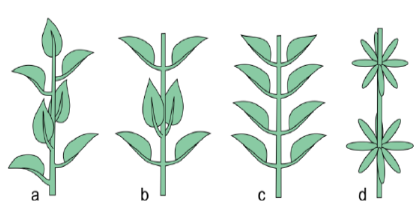
Alternate
One leaf per node

Opposite (Deccusate)
A pair of opposite leaves per node. Each pair is rotated at 90 degrees
gets less sunlight

Opposite (Distichous)
A pair of opposite leaves per node. All pairs in the same plane
gets more sunlight
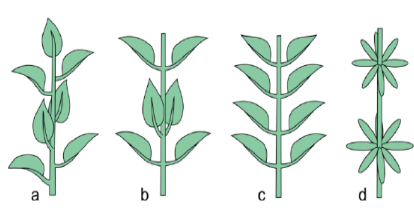
Whorled
Three or more leaves per node

Simple Leaf
Blade of leaf is undivided

Compound Leaf
Blade is completely divided into leaflets. Notice position of axillary buds!
palmately compound
pinnately compound
doubly compound

Palmately Compound
Leaflets radiate from a single point (resembles the palm of a hand)
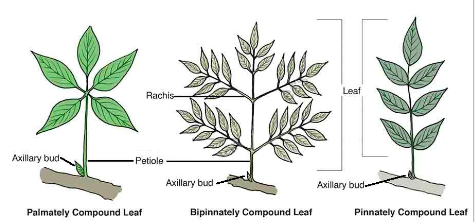
Pinnately Compound
Leaves originate from the midrib (feather-like)

Doubly Compound
Rachis (stem-like structure) originate from midrib, and then divide into leaflets.

rachis
The central axis of a pinnately compound leaf above the petiole (leaf stalk).
Acts as an extension of the midrib/stem axis to which separate smaller leaflets (pinnules) attach.
Only in pinnately compound or doubly compound leaves!!

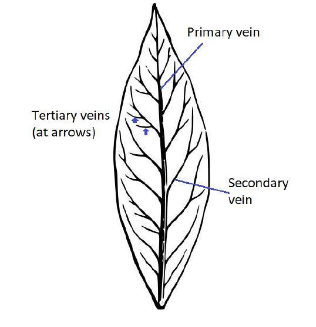
Leaf Veins
Vascular bundles coming from the stem.
Main vein (usually the midrib)
Secondary veins branch from main vein
Tertiary veins branch from secondary (etc)
what r the 3 main arrangements of leaf veins?
parallel
runs longitudinally
pinnate
branch from main vein
palmate
arise from single pt. at base of leaf
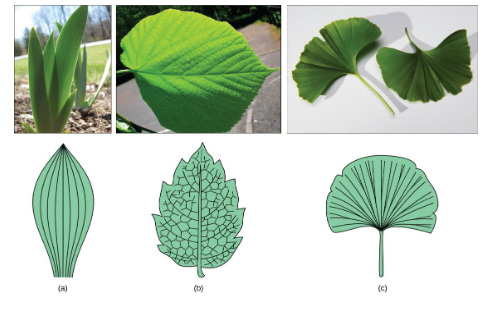
Parallel Venation
Runs longitudinally on the leaf

Pinnate Venation
Branch from main vein of the leaf
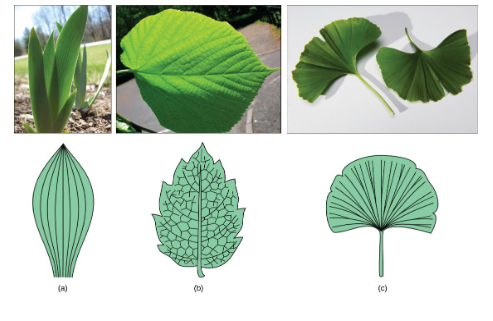
Palmate Venation
Arise from a single point at base of leaf

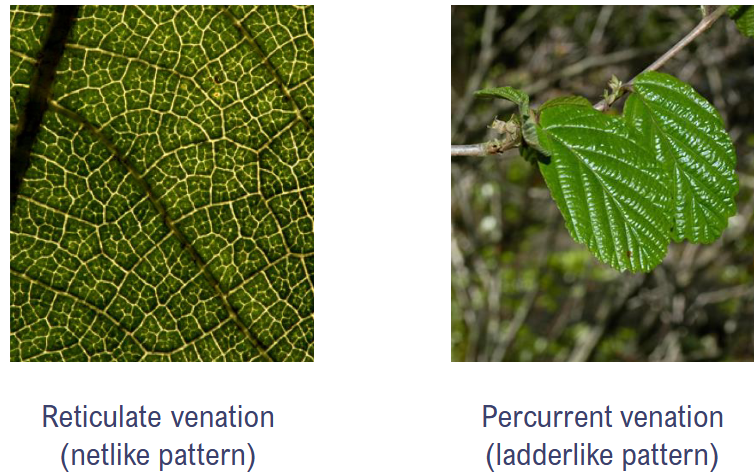
what are tertiary venation patterns in a leaf?
minor tertiary veins can branch in patterns
reticulate venation
netlike pattern
percurrent venation
ladderlike pattern
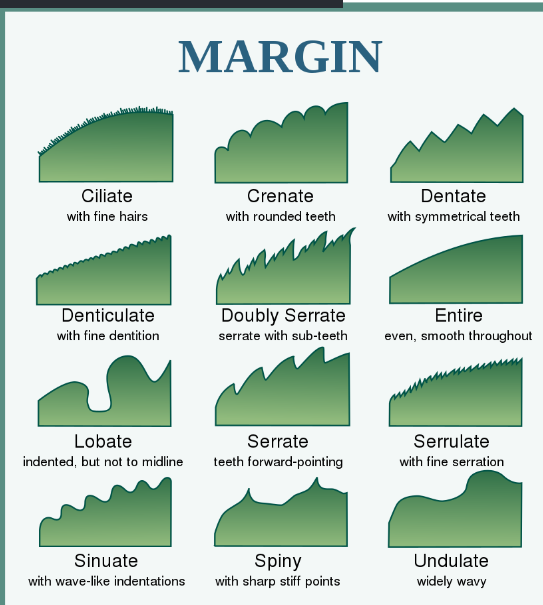
leaf margins
describes the outline of leaf or leaflet
entire → smooth
undulate → wavy
palmately lobate → lobes outline palmate venation
pinnately lobate → lobes outline pinnate venation
toothed
serrate → sharp teeth pointing forward
dentate → sharp, symmetrical
crennate → rounded teeth

Entire Margin
Smooth margin

Undulate Margin
Wavy margin

Palmately Lobate
Lobes outlining palmate venation

Pinnately Lobate
Lobes outlining Pinnate venation

Serrate Teeth
Sharp teeth pointing forward

Dentate Teeth
Sharp, symmetrical teeth
Crennate Teeth
Teeth are rounded

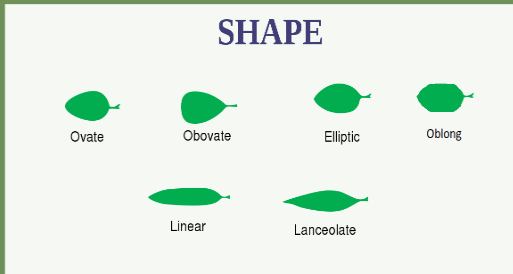
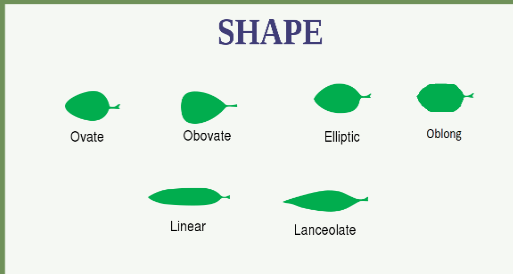
leaf shapes
ovate → widest at base
obovate→ widest at apex
eliptic → single wide middle portion
oblong → longer wide middle portion
linear → long + thin
lanceolate → intermediate btwn ovate and linear
Ovate Shape
Are widest towards the base
Obovate Shape
Are widest towards the apex
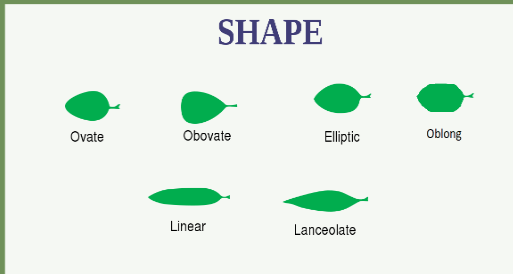
Elliptic Shape
Single wide middle portion

Oblong Shape
Longer wide middle portion

Linear Shape
Long and thin

Lanceolate Shape
Lance shaped (intermediate between ovate and linear)

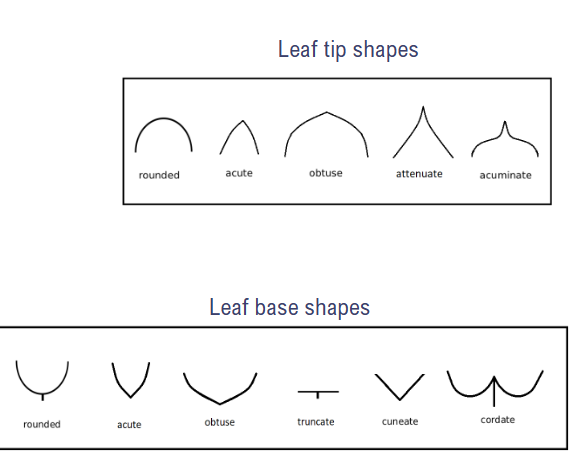
leaf tip + base shapes
rounded
acute → less than 90 degree angle
obtuse → more than 90 degree angle
attenuate → tapering to a pt
acuminate → curving inward to a pt
cuneate → wedge shaped base
cordate → upside down heart/butt shaped
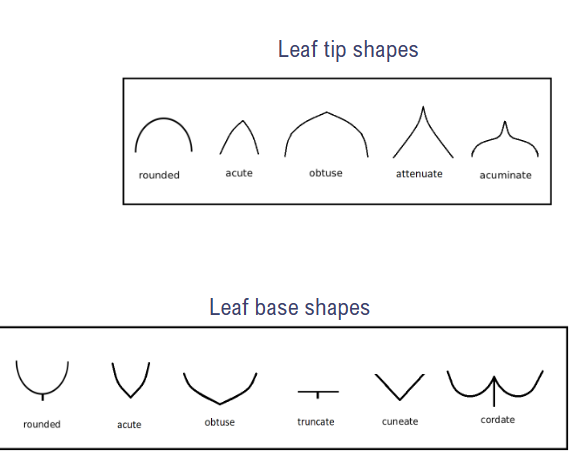
Attenuate Tip
Tapering to a point

Acuminate Tip
Curving inward to a point