Biology - Human evolution
 Call Kai
 Learn
 Practice Test
 Spaced Repetition
 Match
 Flashcards
 Knowt Play
1/52

There's no tags or description
Looks like no tags are added yet.
53 Terms
Brachiation
Movement by swinging beneth brunches with two arms
Binocular/stereoscopic
Two forward-facing eyes that give overlapping vision
Plantigrade
Walking on the whole bottom of the foot
Opposability
The ability of the thumb to touch the fingertips of the same hand
Mosaic
Combination of features
Arboreal
Living in trees
Bipedalism advantages
See further, Hands freed up, throwing things for hunting, look larger/more dominant, more efficient over long distance walking
Bipedal
Using two limbs/feet for locomation (walking/transport)
Quadrupedal
Using 4 limbs for locomotion - knuckle walking (chimps, gorillas)
Bipedalism disadvantages
S shaped spine, birth more painful - large headed babies, prone to falling and foot/leg injuries, takes time to learn to walk
what is the spinal trend?
C to S shaped
What is the pelvis trend?
Went from long and narrow to short and wide/broad (bowl shaped) - this occurred as a trade off between efficient bipedal movement and large brain size
Did the valgus angle increase or decrease?
Increase - to increase stability as the knees were bought closer together under the COG
Where did the Foramen magnum shift?
Shifted from the rear base of skull to the centre base of skull
What is the feet trends?
Big toe became aligned with other toes, short toes, big toe = provides trust, arch feet to absorb shock and more efficienct for walking long distances
arm to leg ratio
Arms went from being longer than legs to legs being relatively longer than arms
Is bipedalism more efficient than quadrupedal locomotion? Why/Why not?
Yes - freed up hands allowed us to carry out activities that gave us advantages, saving energy
What are three theories behind bipedalism?
Postural - reaching for food, balance
Provision - freed up hands
Savannah - early hominins who settled on ground became increasingly bipedal
What was the trend in the skull shape?
Flat top - rounded top, robust - gracile, sloping - flat face
What are three areas on the skull that got smaller
Brow ridges, saggital crest, Nuchal crest
Did the brain size increase or decrease?
Increase - mordern humans now have much larger brains
Trends in the jaw
Smaller jaw as diet changed due to natural selection - higher quaility food, softer, less energy required
What was the trend for teeth?
U to V shaped
Natural selection
The process by which organisms with favourable traits are selected for by environmental selection pressures, making them more likely to survive and reproduce, passing these traits onto their offspring.
Which part of the brain is for understanding speech/comprehension?
Wernickes
Which part of the brain is for production of speech?
Broccas
In the brain, what does broccas control?
The jaw, tongue, lips, and vocal cords
As selection pressures drove the increase in brain size and development, what order does fossils show these changes?
Bipedalism
Dental changes
Larger brain developments
What is the fingers trend?
They become shorter and straighter
What was the trend in the thumb?
Went from semi-opposable to fully opposable
What are the two types of grips?
Power grip
Precision grip
What is "Lucys” scientific name?
Australopithecus afarensis
What is the scientific name for the “Handy man”? and what was he the first to do?
Homo habilis - first to use tools
What is the scientific for the “Pecking man/Java Man”?
Homo erectus
What is the scientific name for the “Cave men”
Homo neanderthalensis/Neandertal
Who left Africa first?
Homo erectus
What are the two dispersal models?
Out of Africa/replacement theory
Multiregional model
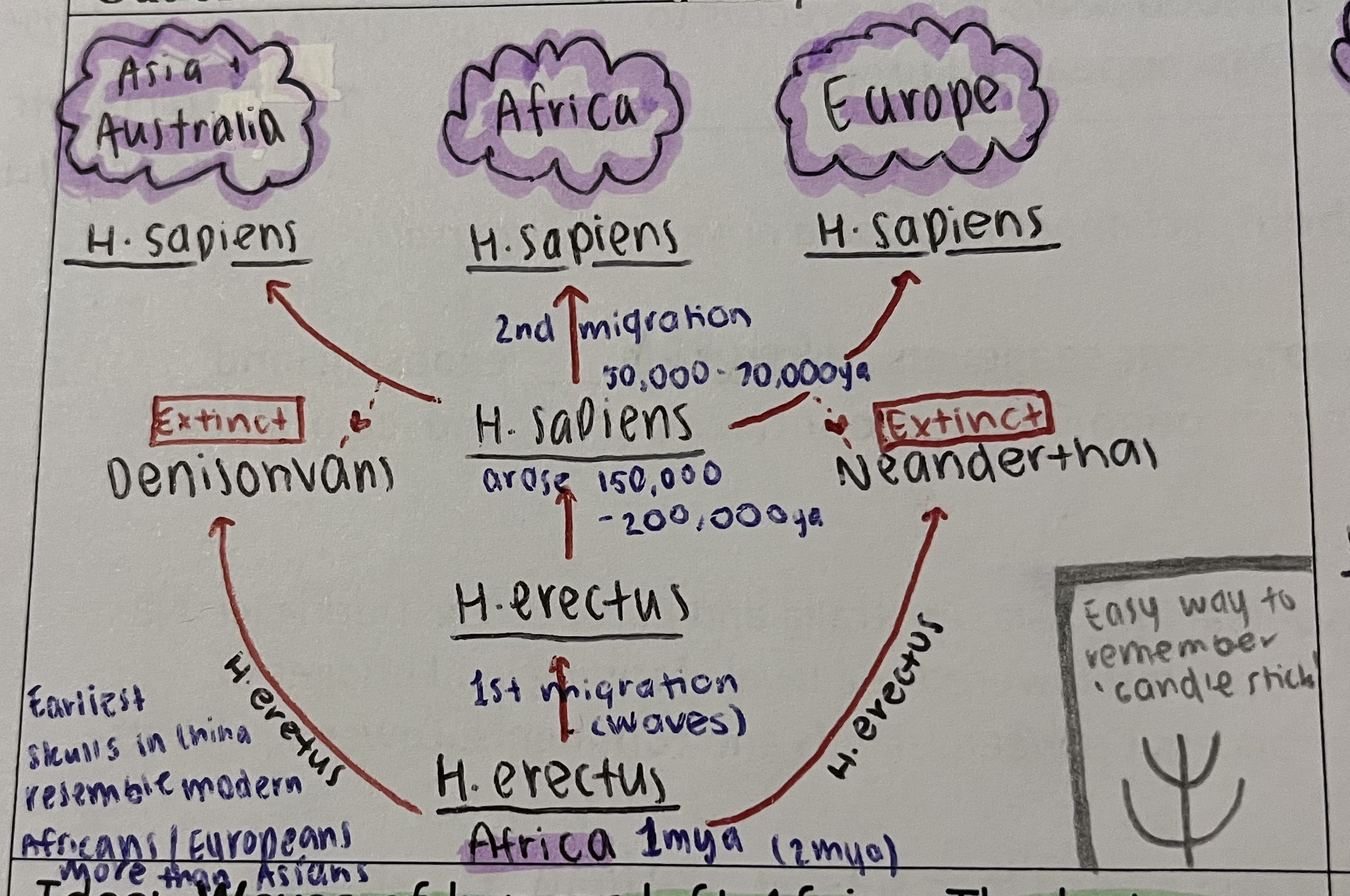
What model is this?
Out of Africa theory

What model is this?
Multiregional theory
Which theory is mainly supported by genetic evidence and why?
OOA model - mtDNA, Y chromosomes, African population has the highest genetic diversity, suggesting humans originated from Africa
Which theory is mainly supported by fossil evidence and why?
MR - transitional fossils were found in many places, showing the gradual change physically across the 3 different species (H. erectus, Neanderthal, H. sapiens
Who has Neandertal DNA today?
All non-Africans, telling us that having the same amount tells us interbreeding occurred before the population diverged
What are features all modern hominins share?
Big brain, light/gracile skeletons, evolved in Africa
What are features that demonstrate differences between individuals?
Nose shape, skin colour, hair colour, eye colour - regional differences due to mutations
Cultural evolution
The passing on of learned behaviours, beliefs, customs and ideas in a group that is passed on (non genetic basis)
Biological evolution
Biological evolution is the change in inherited characteristics of a population over generations
What is the lower palaeolithic tool first used by H. Habilis (“Handy man”)?
Oldowan tool culture
What is the lower palaeolithic tool first used by H. erectus?
Acheulian tool culture
What is the middle palaeolithic tool first used by Neanderthals?
Mousterian tool culture
What is the upper palaeolithic tool first used by H. sapiens
Upper palaeolithic tool culture
Who first used fire?
H. erectus
What was fire first used for?
Light, cooking, warmth, keeping predators away, hunting
Who first made forms of art?
H. sapiens