(ONLY L.A.) GEE L.3 Dugdale Ecology
 Call Kai
 Learn
Learn Practice Test
 Spaced Repetition
 Match
Match Flashcards
 Knowt Play
1/7

Earn XP
Description and Tags
Evolutionary arms races, cooperation and population ecology
Name | Mastery | Learn | Test | Matching | Spaced | Call with Kai | Chat |
|---|
No analytics yet
Send a link to your students to track their progress
8 Terms
Explain what an evolutionary arms race is and give 3 examples!
Antagonistic interactions between predators and prey will lead to the evolution of adaptations and counter adaptations, but they each may experience no chance in their relative success
A predator may develop improved visual activity, a prey will then undergo crypsis (the ability to hide better in environment)
A predator may learn to search for specific imagery, a prey will then develop polymorphism (having different looks)
A predator will hunt in a specific location, a prey will then to spread out.
What is cooperative behaviour and explain why males may cooperate in their courtship days.
cooperative behaviour is when two or more individuals perform an action that benefits both actor(s) and recipient(s)
actors are individuals who provide help
recipients are the individuals receiving the help
during courtship days some courtship is more effective with/requires two (or more) males. An alpha and a beta male dynamic will develop. The alpha male will be able to mate with females if courtship is successful, the alpha male and beta male may be closely related or not at all
When not closely related, the alpha male will gain direct benefit because of an increase fitness after mating with the females present at a courtship site. the beta male, normally younger in these cases, will not mate. Once the alpha male dies, females will still continue to visit the courtship site, now older, the beta male can assume the role of alpha male as he inherits the courtship site. (delayed direct benefit)
When closely related the dominant and subordinate males will work together to get the dominant male to mate with a female. the subordinate male will not mate whatsoever and has no direct benefit. The two males being closely related however, allows for the dominant male to partially pass some genes that overlap with the subordinate male due to close relatedness. This is a case of altruism since it provides no direct benefit more the subordinate male
What is population ecology and what are the three types of survivorship curves
Population ecology: The study of populations in relation to the environment including: environmental influences on density & distribution, age structure and population size.
a population is a group of individuals of a single species living in the same general area
dispersion is the pattern of spacing among individuals within the boundaries of the population
Type 1(I) curve: Low deathrates during early and middle life, increase of deathrates among older age groups. Few offspring, high parental care
Type 2 (II): Death rate is constant over the organisms life span
Type 3(III): high death rates for the young, then a slower deathrate for survivors. Many offspring but no parental care

Which type of curve is each letter
A = 3
B = 2
C = 1

Explain the exponential model of population growth
Exponential model: The population growth in an ideal, unlimited environment (J-shape)
Idealized situations help to understand the capacity a species has to increase, and the conditions that may facilitate this growth
dN/dt = rN where N = population size, t = number of generations d = delta difference and r = intrinsic rate of increase of the population
intrinsic rate of increase: the rate of reproduction is at its maximum (under the ideal conditions in the exponential model)
The J-shape is characteristic (?) of some populations introduced to a new environment
Explain the logistic models of population growth
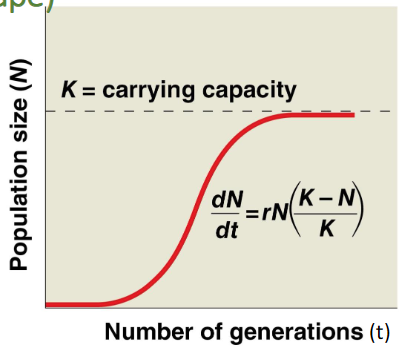
Logistic model: Exponential growth cannot be sustained for long in any population (S-shape)
Carrying capacity (K): The maximum population size the environment can support
Population growth slows as it nears carrying capacity
dN/dt = rN((K-N)/K) Where d = delta difference (?), N = population size, t = number of generations, K= carrying capacity and r = intrinsic rate of increase of the population
Some populations overshoot K before settling down to a relatively stable density
What factors affect population growth?
whether a population is a density-independent or -dependent one
A density-independent population: Birth & death rates don’t change with population density
A density-dependent population: birth rates decrease and death rates increase with population density
Changes in predation pressure can drive population fluctuations
Explain what a meta population is and what factors affect patch occupancy.
Metapopulations: groups of populations linked by immigration and emigration. (distribution is dynamic over time, there are local extinctions and recolonizations)
Occupancy of patches is affected by extinction and colonization probability
Extinction probability: Depends on patch size and habitat quality
Colonization probability: Depends on isolation or connectivity (as corridors between patches are believed to increase movement between patches), demographic state of surrounding patches.