Sedentary behaviour - Health and intervention
 Call Kai
 Learn
 Practice Test
 Spaced Repetition
 Match
 Flashcards
 Knowt Play
1/20

There's no tags or description
Looks like no tags are added yet.
21 Terms

C - cause it does not meet the low energy requirement of sedentary behaviour.
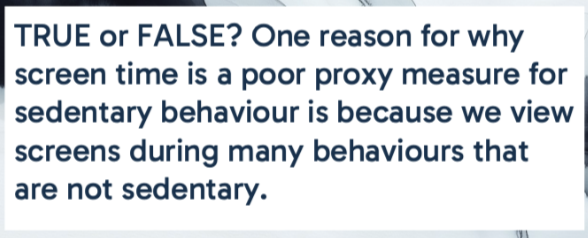
True
All-cause mortality
Risk of death from any cause.
Among physically active people, how much did sitting 10+ h/day increase all-cause mortality compared with sitting <5 h/day?
By 16%.
and among physically inactive and sedentary people mortality risk increased 46%
How did watching TV for more than 6 h/day affect mortality compared with less than 2 h/day?
It doubled the odds of mortality.

What metabolic dysfunctions does prolonged sitting cause?
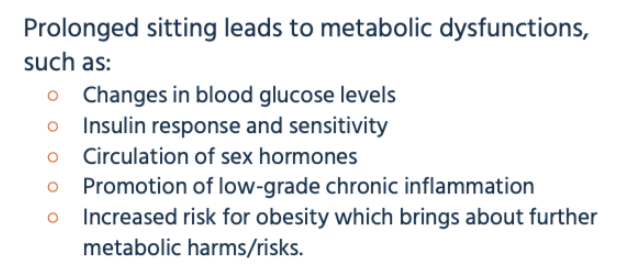
Why can't one workout cancel out a day of sitting?
Our bodies are built for frequent, regular movement. A single bout of activity isn't enough to undo the metabolic effects of prolonged sitting.
How does sitting for long periods put the body under chronic stress?
Staying stuck in a chair or bed goes against what the body is designed for. It changes our normal metabolic profile and creates a state of chronic stress, even in physically active people.
which is better: one 60-minute workout, or standing up and moving briefly every 30 minutes, if you sit all day?
Breaking up sitting regularly. The body needs frequent movement, and one bout doesn't cancel prolonged sitting. Ideally, do both.
Why might it be hard to convince young people to sit less?
The risks are distal. Problems like diabetes or CVD usually don't show up until later in life, so there's no immediate consequence to motivate change.
Hedonic wellbeing
Optimal wellbeing as the product of maximizing positive experiences and minimizing negative ones.
What's the difference between affect and life satisfaction?
Affect is a feeling, a short-term mood state. Life satisfaction is a thought, a cognitive judgment about your life overall.
How does sedentary behaviour affect life satisfaction?
Sitting more than you typically do is linked to lower life satisfaction.
Which sedentary behaviours have the strongest negative associations with wellbeing?
Social media, TV watching and commuting.
while these sedentary behaviorus have positive effect on well being: Socializing, and computer use in older adults.
the type of sitting we do matters.
Do we need to stop sitting entirely to be healthy?
No. Many sedentary behaviours are comfortable and mainly pose a risk when sitting is prolonged.
How do we reduce our sedentar behaviour?
eliminate it
replace it
break up our sb
Eliminating SB
eliminating any kind of SB from our daily lives
not realistic as many envitonemnts are built for sitting, and its not necessary bc its only a probelm when prolonged sitting occurs.
some enviotnemnts arent realstic to be standing or movign all the time.
too much standing can be bad for musculoskeletal problems
Replacing SB
Swapping sedentary behaviour for other behaviours, like exercise, sleep or NEAT (unstructured, incidental movement that isn't formal exercise, like walking to the store, carrying groceries, taking the stairs or fidgeting)
exercise is unrealsitic to do multipel bouts of a day
sleep cn be probelmattic and can disrupt sleep schdules past recommendations
NEAT can be hard to plan - but most realsitic
Breaking up SB
Taking short, frequent breaks of non-sedentary behaviour (standing, walking, stretching, exercise) during long periods of sitting.
3–5 minutes of non-sedentary behaviour every 30–45 minutes of sitting can signficantly reduce health risks from excessive SB.
most realstic
What are the 2 parts of Canada's 24-hour movement guidelines for sedentary behaviour?
Limit sedentary time to 8 hours or less a day (volume), and break up long periods of sitting as often as possible (pattern).
Stratgeies for breaking up SB

make invisible behaviour visible. - even drink more water so u have to get up and pee more or get a dog so u can walk it.