ART H 200 Exam 1 Study Guide
 Call Kai
 Learn
 Practice Test
 Spaced Repetition
 Match
 Flashcards
 Knowt Play
1/79

There's no tags or description
Looks like no tags are added yet.
80 Terms

Anonymous, Spotted Horses and Human Hands, Pech-Merle Cave. Dordogne, France. Horses 25,000-24,000 BCE; hands 15,000 BCE. Pain on limestone

Anonymouse, Bird-Headed Man with Bison, Shaft scene in Lascaux Cave. c. 15,000 BCE. Paint on limestone

Anonymous, Hero and centaur (Herakles and Nessos?), ca. 750-730 BCE, Bronze

Polykleitos, Doryphoros (Spear Bearer), ca. 450-440 BCE, Roman marble copy after a bronze original

Phidias, Athena Parthenos, Cell of Parthenom (reconstruction), 438-432 BCE, gold and ivory, 38’

Plan of the Parthenon

Iktinos and Kallikrates, Parthenon, the Temple of Athena Parthenos, 447-438 BCE

Parthenon East Pediment, Three goddesses (Hestia, Dione, and Aphrodite?), ca. 438-432 BCE)

Lapith Fighting a Centaur, metope on the Doric Frieze of the Parthenon, ca. 447-443 BCE, marble
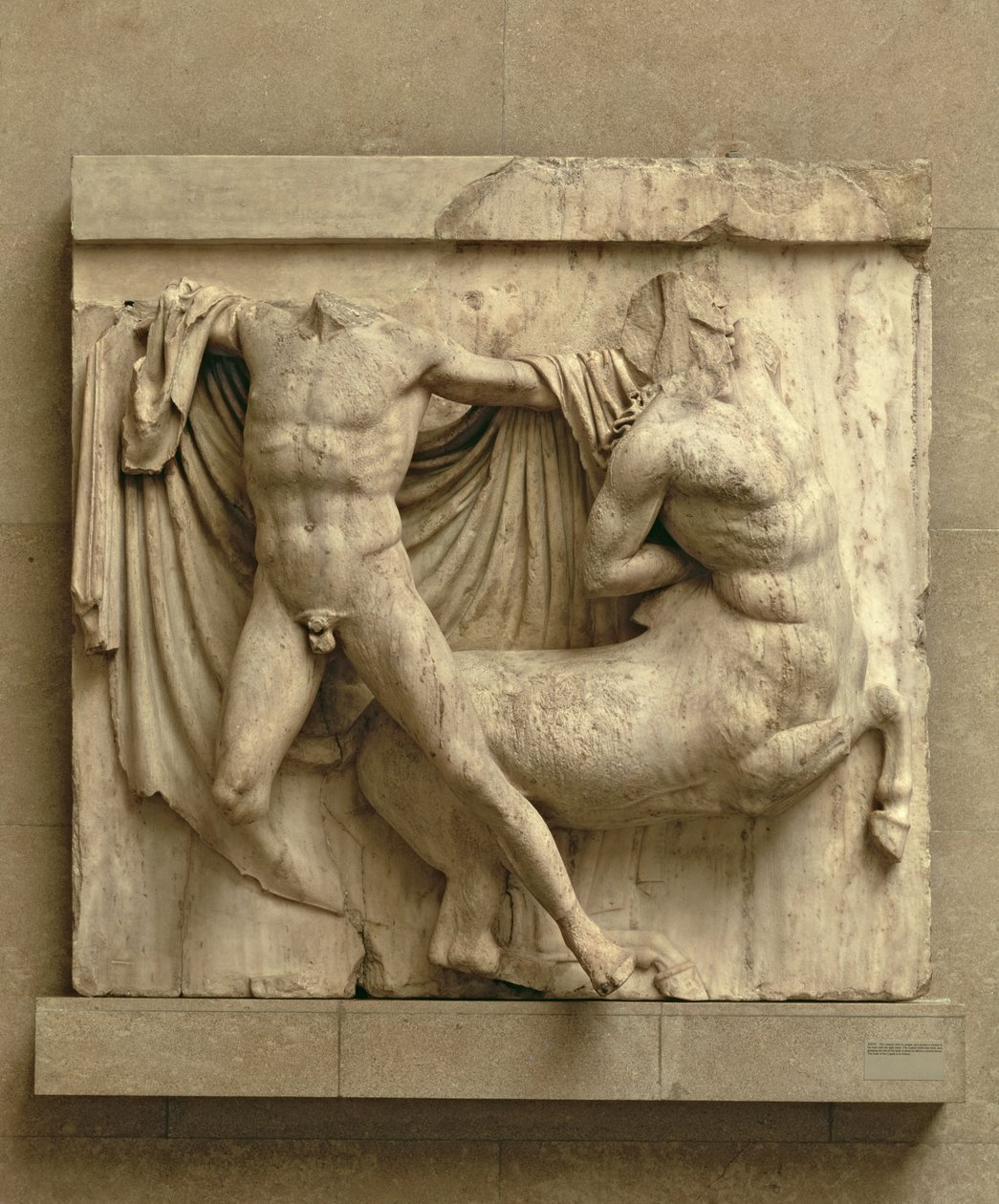
Lapith Fighting a Centaur, metope on the Doric Frieze of the Parthenon, ca. 447-443 BCE, marble

Sacrificial cattle with attendants; south frieze of the Parthenon, ca. 438-432 BCE

Parthenon east frieze; gods and acolytes (Erechtheus’s daughter with shroud?), 477-438 BCE, marble
Panathenaic festival and procession
The most important religious and civis celebration in Athens, help annually to honor the city’s patron goddess, Athena
Festival held in late summer, offering athletic games, musical performance, poetry, races…
Procession is the ritual centerpiece of the festival w a long line of horsement, charioteers, musicians, elders carrying olive branches, youth leading sacrificial animals, and maidens carrying sacred ritual baskets… also had a new woven peplos for the cult statue… ends in big ol sacrifice of oxen
Kouros and Kore
Freestanding sculptures from the archaic period serving as votive offerings for gods in sanctuaries or funerary grave markers for the dead
Frieze in low relief
long, narrow, decorative band that features slightly raised scultural carvings, often in Ionic or Corinthian orders
Metope in high relief
rectanangular architectural panel in a Doric frieze where the sculpted figures are carved deeply from the background so the project heavily and appear nearly free-standing
Classical orders of architecture

Fluted shaft
A vertical column or pilaster w/ a seris of shallow, parallel, concave grooves (flutes) cut or molded into the surface
Polykleitos’ “canon of proportions”
Established a mathmatical + numerical system of ideal human body proportions


Leonardo da Vinci, Vitruvian Man, ca. 1490, ink on paper

Leonardo da Vinci, Last Supper, 1495-97, oil and tempera on plaster

Leonardo da Vinci, Virgin, Child and Saint Anne, 1508-13, oil on panel

Raphael, Madonna of the Goldfinch, 1505-06, oil on wood

Raphael, Study for Madonna of the Goldfinch, 1505-06 pen and brown ink over preliminary indications…

Raphael, Disputa, 1508-11, fresco

Raphael, School of Athens, 1509-11, fresco

Michelangelo Buonarroti, Bacchus, 1496-97, marble

Michelangelo Buonarroti, Pieta, ca. 1500, marble
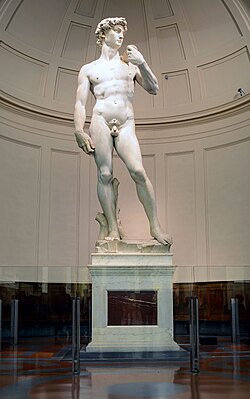
Michelangelo Buonarroti, David, 1501-1504, marble

Michelangelo Buonarroti, Bound Captive, 1513-16, marble

Michelangelo Buonarroti, Sistine Chapel Painting, Creation of Adam, 1508-12, fresco
Renaissance
“re-birth” of Classical art of culture, that is, Greece and Rome
Humanism
14th- to 17th- century intellectual and cultural movement originating in Italy that shifted the focus of art and philosophy from abstract, church-dominated medieval themes to human experience, individual potential, and classical antiquity
Neo-Platonism
Renaissance revival and artistic application of late Platonic philosophy —> connects visible, physical beauty with divine, spiritual truth, treating art as a ladder that helps the human soul ascend from the material world back to a higher, spiritual reality.
Paragone
Famous debate from Italian Renaissance where different art forms—especially painting and sculpture—competed to prove which one was superior
One-point linear perspective
Horizon line
Vanishing point
Orthogonals
One-point linear perspective = mathematical drawing method that creates an illusion of 3D depth on a flat, 2d surface
Horizon line - horizontal reference line that stretches across the picture
Vanishing point = single spot of the horizon line where parallel lines appear to meet and disappear as the move deeper into the distance
Orthogonals = the diagonal lines drawn from the edges of objects back toward the vanishing point
Sfumato
Italian Renaissance painting technique that softens the transitions between colors, tones and outlines so that they blend into one another without hard lines or borders
Foreshortening
art technique used to draw, paint, or photograph an object, body, or structure so that it appears compressed, shorter, or receding dramatically into space
Chiaroscuro
art technique using strong contrasts between light and dark to give flat figures and objects a 3D illusion of volume, depth, and dramatic mood
Fresco
technique of mural painting where water-based pigments are applied directly onto freshly laid, wet lime plaster
Tempera
a permanentm fast-drying painting medium made by mixing color pigments with a pater soluble binding agent
Oil painting (glazing)
technique of applying a thin, transparent or semi-transparent layer of paint of a thoroughly dried, opaque layer of paint underneath
Angogical axis
method of interpretation that reveals the spiritual, mystical, or ultimate divine meaning of a text, object, or architectural space
Disegno
Means “drawing” or “design” —> intellectual concept, creative plan, and linear structure underlying a work of art.
Colore
16th-century Venetian painting approach that prioritized rich color, light effects, and direct pain application over hard lines or preliminary sketches
Pope Julius II
one of greatest and most influential patrons of the High Renaissance, using grand architectural and fine art commissions to project political power, revive classical antiquity, and secure his historical legacy
Trompe l’oeil
“fool the eye” —> technique that uses realistic imagery and perspective to create a 3D optical illusion on a flat, 2D surface
Mannerism
European art movement that emerged in Italy ~1520 and lasted until ~1600 before transitioning into Baroque period —> figures feature stretched limbs, small heads, elongated necks… self-conscious style…
‘Poesie’
enigmatic pastoral themes inspired by literary revival of pastoral poetry
Figura serpentinata
describes a twisting, spiral pose used in Mannerist painting and sculpture —> human body twists around a central vertical axis
Nonfinito
“not finished” —> aesthetic or artistic technique where a work of art is intentionally left rough, unpolished, or incomplete

Raphael, Portrait of Baldassare Castiglione, ca. 1514, oil on canvas

Robert Campin, The Merode Alterpiece (Triptych of The Annunciation), 1425-28, oil on wood panel

Jan van Eyck, Madonna and Child in a Church, ca. 1425, oil on panel
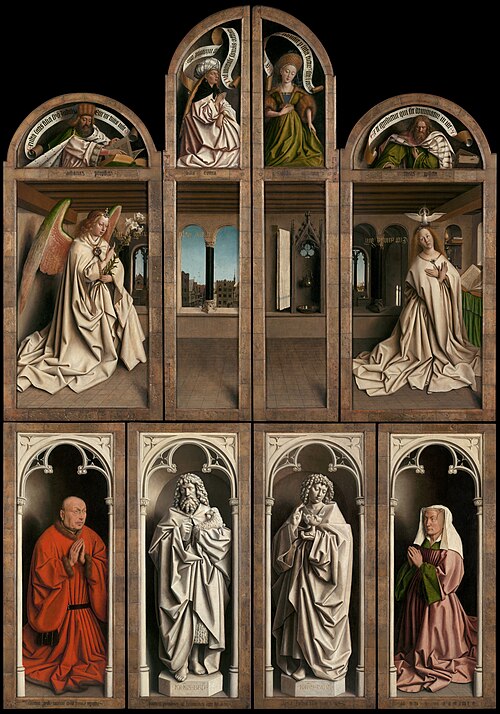
Jan van Eyck, Ghent Altarpiece, (closed), finished 1432, oil on panel

Jan van Eyck, Ghent Altarpiece, (opened), finished 1432, oil on panel

Jan van Eyck, Double Portrait, Giovanni Arnolfini & wife (Giovanna Cenami?), 1434, oil on panel

Hieronumus Bosch, Garden of Earthly Delights, ca. 1505-15, oil on wood

Pieter Breugel the Elder, Large Alpine Landscape, 1555, engraving

Pieter Bruegel the Elder, Netherlandish. Proverbs, 1559, oil on wood panel

Pieter Breugel the Elder, Christ Carrying the Cross, 1564, oil on wood panel

Pieter Breugel the Elder, The Harvesters, 1565, oil on wood panel

Pieter Aertsen, The Meat Stall, 1551, oil on panel

Pieter Aertsen, “Vanitas Still Life” (Christ in the House of Mary and Martha), 1552, oil on panel

Pieter Aertsen, Christ in the House of Mary and Martha, 1553, oil on panel
Northern Renaissance
a cultural, intellectual, and artistic movement in Europe north of the Alps
The Reformation
major 16th-century religious and political movement in W. Europe that challenged the authority of the Pope and the Roman Catholic Church, leading to the birth of Protestantism and the divisian of Western Christianity
Indulgences
a remission before God of the temporal punishment due for sins whose guilt has already been forgiven
Erasmus and his Praise of Folly
Praise of Folly by Desiderius Erasmus is a foundational satirical text that heavily influenced 16th-century visual culture, printmaking, and iconography
Chambers of rhetoric
15th-to-16th-century dramatic. and literary societies in Low Countries
The Polyglot Bible
an edition of the Bible that features the scriptural text translated into multiple languages arranged side-by-side in parallel column or on facing pages
Christopher Plantin
a pioneering French-Flemish Renaissance printer, publisher, and bookbinder whose work revolutionized the visual standards of the print medium
Hieronymous Cock
An influential Flemish Renaissance painter, etcher, and the most prominent print publisher in Northern Europe during the 16th century
Hendrik Nichlaes and the “Family of Love” (Familia Caritatis)
a 16th-century radical spiritualist and mystical sect founded around 1540 by German-born merchant and visionary Hendrik Niclaes
The Duke of Alva and the Spanish Inquisition
A brutal Spanish general sent by King Philip II in 1567 to crush political and religious dissent in the Netherlands
Genre painting
A style of art that depicts scenes from everyday life, featuring ordinary people engaged in common activities like working, eating, or relaxing at home
“Inverted still life”
A genre of painting—pioneered in 16th-century N Europe by artists like Pieter Aertsen—where traditional religious or historical subject matter is pushed into the distant background, while large, detailed everyday objects like food, meat, or market produce dominate the foreground
Vanitas
refers to a genre of still-life painting that flourished primarily in the Netherlands during the 16th and 17th centuries
Repoussior
an artistic and compositional technique where an object, figure, or shadow is placed in the extreme foreground—usually at the left or right edge of a frame—to “push back” the rest of the scene and create a strong sense of spatial depth
Moralizing subject matter
art, literature, media, or discourse that is explicitly designed to teach a moral lesson, pass ethical judgement, or reform human behavior