Ancient Societies test 2
 Call Kai
 Learn
Learn Practice Test
 Spaced Repetition
 Match
Match Flashcards
 Knowt Play
1/42

There's no tags or description
Looks like no tags are added yet.
Name | Mastery | Learn | Test | Matching | Spaced | Call with Kai | Chat |
|---|
No analytics yet
Send a link to your students to track their progress
43 Terms
Starr Carr
England (9000-8500 BC), Important Mesolithic Site. Wooden Platforms on a lake, ceremonial center, sedentism
Lepenski Vir
Chez Republic (9500-6000 BC). Early sedentary settlement after the Paleolithic. Danu River village settlement. Trapezoidal house shape. Fishing
Epipaleolithic
End of the Paleolithic to the Mesolithic. 10 kya
Kebaran
Levant culture in Modern Israel 18-15 KYA. Large Stone bowls, Sickle Blades, Harvesting Grasses.
Natufian
Known for semi-permanent stone settlements, burials, storage areas, sickle blades, mortars, and pestles. Natufians intensively harvested wild grains but lived before full agriculture, showing that sedentary village life began before plant and animal domestication.
Catalhoyuk
Neolithic village in Turkey (7500-6000 BC), where there are many closely spaced houses; evidence of building and rebuilding successive stages of houses in place over long periods; large numbers of burials in the floors of some houses; and evidence of acquisition and accumulation of large amounts of obsidian (valuable raw material for making stone tools) from nearby volcanic mountains.

Jericho
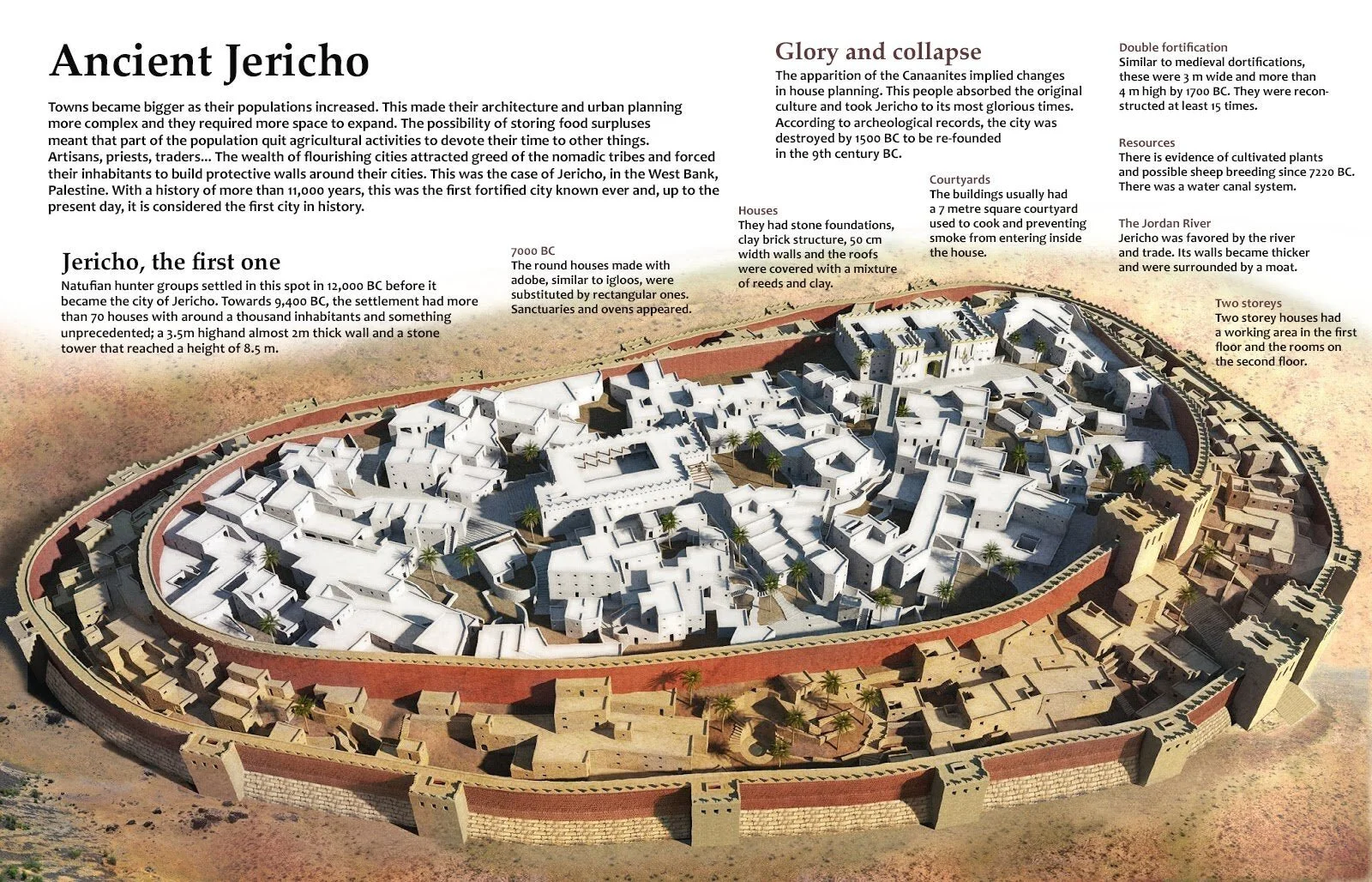
Neolithic site in Israel, dating 12-11 KYA, with evidence of a Natufian encampment, covered by a Neolithic village enclosed by a massive stone wall and tower, which may have been related to defense, land claims or storage of resources, or water management.
Ain Ghazal
Megasite in Jordan (7500-5000 BC). Hearths, fireplaces, large clay vessels. Limestone Statues depicting Humans. Public Structures. Plaster floor with walls; burials underneath.
Ali Kosh
Ecotonal Location in Iran (9000-6000 BC). Wheat, Barley, and rye. Sheep +Rhye. pathways. Courtyards and lanes between rectangular houses.
Jarmo
Iraq, 7000-5000 BC. Mud houses, multiple rooms, and courtyards. Clay pottery.
Cayonu
Turkey (7200-6600), long occupation with secondary burials. Apsidal structures, “skull” building, stone slabs as altars.
Göbekli Tepe
Neolithic temples, with carved stone slabs (monoliths) depicting wild animals, and dating from 9500 to 8000 BC. Kites aiding in hunting

Nevali Cori
Turkey (8500-8000 BC), stone foundations, carved Monoliths, and votive figurines.

Nabta Playa
Egypt (6000 BC). domesticated wheat and barley, and living in small sedentary villages with rows of pithouses. Structures, pottery, wells, stone circles (like one reconstructed version shown here), large hearths (for cooking large amounts of food), and evidence for ritual activity focused on cattle symbolism.
Linearbandkermik Culture
Neolithic Culture (6000-4000 BC), first settlement across Europe. Pottery with linear and curve design. Thatch and Wattel +Daub. Catte. Settled along river valleys.
Cucuteni-Trypillia
Ukraine, 4200-3600 BC. Important Megasites that predate Stonehenge. Include: Singerei, Nebeliulsa (circular, many brunt structures)
Merimde Beni Salama
Nile River Valley. Oval House, extensive Irrigation. Long periods of occupation beggininng 3900 BC
Abu Hureyra
Syria 13-10 KYA (PPNB). Epipaleolithic hunter-gatherer community. Large amounts of dwellings before the Younger Dryas.
Nahal Oren
Israel; Epipaleolithic PPNA, PPNB. Residential + Storage Structures. GOATS and Wheat
Netiv Hagdud
Jordan (9500-7500 BC). Southern Levant. Neolithic Site: mud-brick circular buildings + storage. Obsidian Tools (evidence of Trade + Exchange)
Younger Dryas
(11,000-10,000 BC, or roughly 13-12 KYA) predates the domestication of cereals in the Levant, and it may have been a major factor in the transition from broad-spectrum hunting and gathering by Natufians to plant cultivation and animal husbandry by Neolithic communities.
Avebury
A massive Neolithic henge and ceremonial complex in southern England, constructed mainly around 2850–2200 BCE. It contains a large earthen bank and deep internal ditch surrounding the world’s largest prehistoric stone circle and two smaller stone circles. Its monumental construction and connecting avenues suggest large-scale cooperation, ritual gatherings, processions, and a shared regional identity.
Stonehenge
A Neolithic ceremonial monument in southern England built in several stages beginning around 3000 BCE. It began as an earthen bank and ditch, followed by timber post circles, Welsh bluestones, and later the larger sarsen stones and lintels transported from near Avebury. Its monumental construction and astronomical alignments suggest ritual gatherings, ancestor ceremonies, and cooperation among distant communities.
Guilá Naquitz
cave site in the Valley of Oaxaca in Mexico has produced evidence of rock art (like the panels seen in this image) and episodic occupations by hunters and gatherers, as well as evidence of domesticated maize (before 6000 BC), and gourds and squashes (approximately 8000 BC).
Jomon Culture
Sedentary settlements in Japan with evidence of and emphasis on fishing and foraging (less so on farming), and elaborately decorated pottery (12500-300 BC).
Yangshao Culture
Neolithic sites in China built on terraces above agricultural fields in surrounding floodplains, where people cultivated millet and other crops, associated with naturalistic art styles and culinary practices that presage those of later Chinese civilization (5200-3000 BC). Yelllow River Basin
Adena
Ohio Valley; Earthen burial mounds. Settlements where people practiced hunting and gathering and cultivated grasses and squashes native to eastern North America (500 - 1 BC).
Mississippian
Sites with large earthen platform mounds and plazas, such as Cahokia (Illinois) and Moundville (Alabama), surrounded by residential neighborhoods, log stockades, and agricultural fields (AD 900-1600).
Hopewell
Sites in the Ohio Valley and elsewhere in eastern North America, with earthen embankments and burial mounds, and valuable materials like mica cutouts, copper plates, carved stone pipes, and obsidian and chert tools emplaced in mounds and mortuary structures (AD 1-400).
Hohokam
Sites in Arizona with ballcourts; irrigation canals; evidence of cultivation of maize, beans, cucurbits, and cotton; and eventually platform mounds (AD 500-1450).
Hohokam
Sites in Arizona with ballcourts; irrigation canals; evidence of cultivation of maize, beans, cucurbits, and cotton; and eventually platform mounds (AD 500-1450).
Jomon
Sedentary settlements in Japan with evidence of and emphasis on fishing and foraging (less so on farming), and elaborately decorated pottery (12500-300 BC).
Mesa Verde
Cliff dwellings and other settlements occupied after droughts led Ancestral Pueblo groups to abandoned pueblos in Chaco Canyon and to move northward towards southwestern Colorado (AD 1130).
Cerro Juanaquena
Early farming village in northwstern Mexico with stone terraces and evidence for cultivation of maize and harvesting of native grasses (1150 BC).
Chaco Canyon
Stone masonry pueblos in New Mexico associated with roads, ceremonial structures known as kivas, and fields of maize, beans, and squash (AD 490-1130).

Poverty Point
Monumental earthworks in northern Louisiana, with evidence for trade networks spanning much of eastern North America, supported by foraging and fishing in the Mississippi River Valley (1700-1200 BC).
Huaca Prieta
Located in coastal Peru, this site provides evidence for early human settlement in South America, and later evidence for cultivating beans, squashes, and cotton, and fishing and foraging in maritime environments (13700-2500 BC).
Casas Grandes
Located in northern Mexico, this site has at least 1600 puebloan rooms as well as plazas, ballcourts, earth ovens, and evidence for trade in painted pottery, turquoise, marine shell, copper bells, tropical macaws, and a form of stone known as serpentine (AD 1250-1450).
Lapita Culture
An ancestral Polynesian culture that spread across Pacific islands around 1600–500 BC. Known for dentate-stamped pottery, advanced seafaring, long-distance trade, and transporting domesticated plants and animals to newly settled islands.
Longshon Site, China
It and other Neolithic villages are enclosed by earthen fortifications, surrounded by irrigation infrastructure and field systems for wet rice cultivation, forming the basis for the development of Chinese civilization.
Iraq ed Dubb
Jordan, PPNA. Stone foundations and roofs made of bark. Large number of buildings