oct 23rd Nitrogen Metabolism
 Call Kai
 Learn
 Practice Test
 Spaced Repetition
 Match
 Flashcards
 Knowt Play
1/24

There's no tags or description
Looks like no tags are added yet.
25 Terms
How does amino acid nitrogen leave the body?

Nitrogen from amino acids is first moved onto glutamate through a process called transamination. In the liver, glutamate releases its amino group as ammonium (NH₄⁺) primarily through oxidative deamination catalyzed by the mitochondrial enzyme glutamate dehydrogenase. The urea cycle (also known as the ornithine cycle) converts excess nitrogen into water-soluble urea in liver cells, after which the kidneys eliminate it in the urine.
Why must excess amino nitrogen be eliminated?

Amino acids come from protein in food and from the body's own proteins, which are constantly broken down and rebuilt. The body can store glucose (as glycogen) and fat, but it has no store for amino acids. Amino acid carbon can be metabolized for energy or used to make glucose or ketone bodies. Their nitrogen cannot be used for energy and must be removed safely. Urea is far less toxic than ammonia, dissolves readily in water, and travels through the blood to the kidneys for excretion
Why must excess nitrogen from amino acids be eliminated, mainly as urea?
A. Amino acid nitrogen is the body's main fuel during fasting
B. The body has no store for amino acids, and their nitrogen cannot be used for energy
C. Urea is the storage form of amino acids in the liver
D. Urea is converted back into glucose during fasting
B
What does transamination do?

In transamination, an aminotransferase (also called a transaminase) moves the α-amino group from an amino acid to an α-keto acid. The usual acceptor is α-ketoglutarate, which becomes glutamate:
Amino acid + α-ketoglutarate α-keto acid + glutamate
The reaction can run in either direction. Because most amino acids transfer their amino group to α-ketoglutarate, glutamate becomes the collecting point, or hub, for amino nitrogen. Aminotransferases need pyridoxal phosphate (PLP), the active form of vitamin B6, to carry the amino group.
Case 1: Isoniazid interferes with vitamin B6 metabolism and can reduce the availability of pyridoxal phosphate (PLP), the active coenzyme form of vitamin B6 required by aminotransferases and many other enzymes.
Why are ALT and AST measured as liver tests?
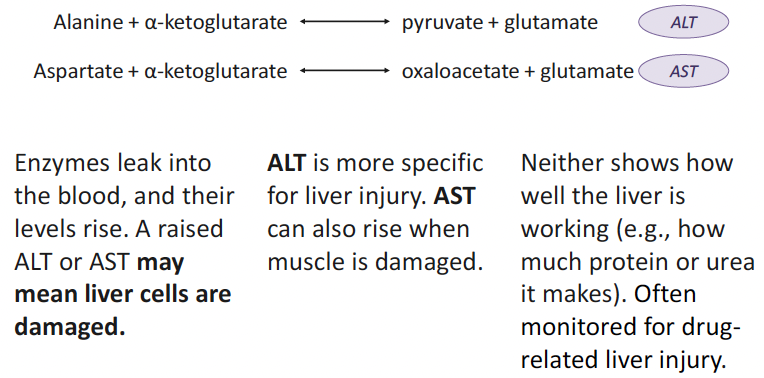
Two aminotransferases appear on almost every set of blood tests:
Alanine + α-ketoglutarate ←> pyruvate + glutamate (alanine aminotransferase, ALT)
Aspartate + α-ketoglutarate ←> oxaloacetate + glutamate (aspartate aminotransferase, AST)
When cells are damaged, the enzymes leak into the blood, and their levels rise. A raised ALT or AST may therefore mean liver cells are damaged. ALT is more specific for liver injury than AST as AST can also rise when muscle is damaged. Neither test shows how well the liver is working, for example how much protein or urea it makes. Many drugs can damage the liver, so ALT and AST are the main tests used to watch for drugrelated liver injury.
Case 1: Why pyridoxine, and does it protect his liver?

Case 1. Isoniazid interferes with vitamin B6 metabolism and can reduce the availability of pyridoxal phosphate (PLP), the active coenzyme form of vitamin B6 required by aminotransferases and many other enzymes. Pyridoxine, a form of vitamin B6 given as a supplement, helps prevent isoniazid-associated peripheral neuropathy, especially in patients at increased risk, such as those with diabetes. Separately, isoniazid can injure liver cells, causing ALT to rise in the blood. These are two different effects: pyridoxine helps prevent neuropathy but does not prevent liver injury. An elevated ALT requires clinical assessment but does not automatically mean isoniazid must be stopped.
A patient's AST is raised but ALT is normal. Which explanation fits best?
A. AST is found only in liver cells
B. ALT is found only in muscle
C. AST rises only when the kidneys fail
D. AST can also rise when muscle is damaged
D
How does oxidative deamination differ?

In liver mitochondria, glutamate dehydrogenase removes the nitrogen from glutamate as free NH₄⁺. Because the reaction is an oxidation, it is called oxidative deamination. It also gives back α-ketoglutarate, which can collect more amino groups:
Glutamate + NAD(P)⁺ + H₂O <→ α-ketoglutarate + NH₄⁺ + NAD(P)H + H⁺
Transamination only moves an amino group and releases no ammonia. Oxidative deamination releases free NH₄⁺, which can go straight into the urea cycle.
Which reaction releases free NH₄⁺ that can go straight into the urea cycle?
A. Transamination by ALT
B. Transamination by AST
C. Oxidative deamination by glutamate dehydrogenase
D. Glutamine synthesis by glutamine synthetase
C
How do glutamine and alanine carry nitrogen to the liver?

Because free ammonia is toxic, tissues send their nitrogen to the liver in safe forms. Glutamine is the main carrier. In the brain and other tissues, glutamine synthetase adds NH₄⁺ to glutamate (using ATP) to make glutamine. In the liver, glutaminase splits glutamine back into glutamate and NH₄⁺, and the NH₄⁺ is made into urea.
Muscle also uses alanine. It collects nitrogen on glutamate, then uses ALT to pass it to pyruvate, making alanine. In the liver, ALT moves the nitrogen back to glutamate, and the pyruvate is used to make glucose. This is the glucose–alanine cycle: muscle sends alanine to the liver, and the liver returns glucose to muscle (Figure 1).
Figure 1. How nitrogen travels from muscle and other tissues to the liver, where it becomes urea, and then to the kidneys. Simplified.
In the glucose–alanine cycle, what does the liver return to muscle?
A. Glucose
B. Alanine
C. Urea
D. Glutamine
A
How does the urea cycle turn NH₄⁺ into urea?

The urea cycle runs in liver cells. It starts inside the mitochondria and finishes in the cytosol. Each urea molecule carries two nitrogen atoms: one from free NH₄⁺ and one from aspartate. Making one urea uses three ATP.
Carbamoyl phosphate synthetase I (CPS I) joins NH₄⁺ to bicarbonate to make carbamoyl phosphate. This is the step that controls the cycle. Ornithine transcarbamylase (OTC) then joins carbamoyl phosphate to ornithine, making citrulline, which moves out to the cytosol. There, citrulline picks up the second nitrogen from aspartate, and the next reactions make arginine. Arginase splits arginine into urea, which goes into the blood, and ornithine, which goes back into the mitochondrion for the next turn. The carbon skeleton from aspartate eventually becomes fumarate, which connects the urea cycle to the TCA cycle.
The urea cycle. Blue and orange mark the two sources of nitrogen; green labels beside CPS I mark its activators; red marks the step affected in OTC deficiency. The other enzyme names are shown for reference only.
What switches on CPS I? and how do drugs affect it?

CPS I needs N-acetylglutamate (NAG) to work. NAG is made by N-acetylglutamate synthase (NAGS) in liver mitochondria. Pharmacy perspective: Carglumic acid acts like NAG and activates CPS I. It is used when the body cannot make enough NAG, as in NAGS deficiency.
Pharmacy perspective: Valproate can cause high blood ammonia even when liver tests and the valproate level are normal. Several mechanisms may contribute, including reduced NAG production. If a patient taking valproate becomes unusually drowsy, starts vomiting or becomes confused, high blood ammonia may be the cause, and a blood ammonia level should be checked.
A patient cannot make enough N-acetylglutamate (NAG). Which drug acts like NAG to activate CPS I?
A. Lactulose
B. Rifaximin
C. Carglumic acid
D. Phenylbutyrate
C
What does blood urea nitrogen (BUN) tell us?

Blood urea nitrogen (BUN) measures the nitrogen in blood urea. Because the liver makes urea and the kidneys remove it, BUN depends on both organs: it rises when the kidneys remove less urea, and it can be low in severe liver failure because little urea is made. BUN also rises after bleeding into the gut, because digested blood is a protein load.
Which BUN pattern fits severe liver failure?
A. High, because the kidneys remove less urea
B. Low, because little urea is made
C. High, because ammonia is converted to urea faster
D. Unchanged, because BUN depends only on the kidneys
B
Why does high blood ammonia harm the brain?
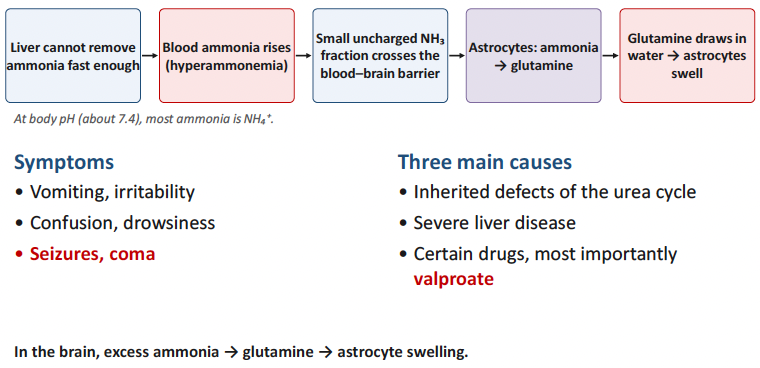
When the liver cannot remove ammonia fast enough, blood ammonia rises. This is called hyperammonemia. At body pH (about 7.4), most ammonia is present as ammonium (NH₄⁺), but a small amount is uncharged ammonia (NH₃), which can cross the blood–brain barrier. In the brain, support cells called astrocytes turn the extra ammonia into glutamine. Glutamine builds up, draws in water, and makes the astrocytes swell. Symptoms range from vomiting and irritability to confusion, drowsiness, seizures and coma. The three main causes are inherited defects of the urea cycle, severe liver disease, and certain drugs, most importantly valproate.
A patient taking valproate becomes unusually drowsy and starts vomiting. Liver tests and the valproate level are normal. What should be checked?
A. Blood ammonia
B. BUN only
C. ALT only
D. Nothing — normal liver tests rule out a drug effect
A
Case 2: Why after feeding, and how does treatment work?

Case 2. In OTC deficiency, the OTC enzyme works poorly or not at all, so little citrulline is made (Figure 2). The urea cycle cannot keep up, and ammonia builds up. Before birth, the mother's liver clears the baby's ammonia through the placenta, so the baby seems well at birth. Once feeding starts, protein from milk, plus the newborn's own protein breakdown, brings in more nitrogen than the weak cycle can handle.
Treatment has two aims. The first is to reduce the nitrogen load during the acute crisis. Dietary protein is temporarily limited, while glucose and fat provide energy to reduce the breakdown of the body's own proteins. The second is to give nitrogen another way out of the body. Drugs called nitrogen scavengers provide this alternative route. Phenylbutyrate is one example. The body converts it to phenylacetate. Phenylacetate combines with glutamine, and the product is excreted in urine. Each molecule carries nitrogen out of the body without passing through the urea cycle. In severe cases, dialysis removes ammonia from the blood directly.
How does a nitrogen scavenger such as phenylbutyrate help a newborn with OTC deficiency?
A. It restores OTC activity
B. It activates CPS I
C. It traps NH₄⁺ in the colon
D. Its product with glutamine carries nitrogen out in the urine, bypassing the urea cycle
D
How do lactulose and rifaximin lower ammonia?

In cirrhosis, the liver is badly damaged and cannot clear ammonia well. Ammonia made by bacteria in the colon therefore builds up in the blood and reaches the brain, causing confusion known as hepatic encephalopathy.
Because much of the ammonia comes from the gut, treatment aims to reduce its production and absorption. Lactulose is a nonabsorbable sugar that bacteria in the colon break down into acids, lowering the local pH. This favors the conversion of ammonia (NH₃) to ammonium (NH₄⁺), which is charged and less readily absorbed into the blood. Lactulose also acts as a laxative, helping remove ammonium in the stool. Rifaximin is an antibiotic that reduces ammonia-producing bacterial activity in the gut. Lactulose is the first-line treatment for hepatic encephalopathy. Rifaximin may be added in selected acute episodes and is commonly used with lactulose to reduce the risk of recurrence.
Unlike in a urea-cycle crisis, protein is not restricted in cirrhosis. Cutting protein makes muscle loss worse, and muscle helps clear ammonia by turning it into glutamine.
Case 3: Why the confusion, and what about lactulose?

Case 3. During a gastrointestinal (GI) bleed, blood enters the digestive tract, where its proteins are broken down. Gut bacteria produce additional ammonia from this nitrogen-rich material. Because the damaged liver cannot remove the extra ammonia efficiently, more reaches the brain and contributes to confusion. Constipation adds to this: stool stays longer in the colon, so bacteria have more time to make ammonia and more of it is absorbed. The pharmacist should explain that lactulose is adjusted to produce about two to three soft stools per day, helping remove ammonia from the gut without causing excessive diarrhea.
How does lactulose lower blood ammonia?
A. It kills ammonia-producing bacteria in the gut
B. Colon bacteria break it into acids; the lower pH favors NH₄⁺, which is less readily absorbed and is removed in stool
C. It activates CPS I in the liver
D. It limits dietary protein
B
What happens to the carbon skeleton?
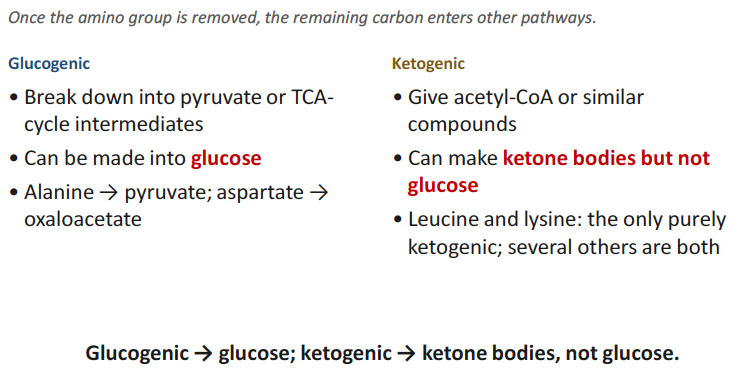
Once the amino group is removed, the remaining carbon enters other pathways; for example, alanine becomes pyruvate and aspartate becomes oxaloacetate. Glucogenic amino acids break down into pyruvate or TCA-cycle intermediates, which can be made into glucose. Ketogenic amino acids give acetyl-CoA or similar compounds, which can make ketone bodies but not glucose. Leucine and lysine are the only amino acids that are purely ketogenic; several others are both.
An amino acid whose carbon skeleton breaks down only to acetyl-CoA can be used to make:
A. Glucose only
B. Both glucose and ketone bodies
C. Ketone bodies, but not glucose
D. Urea
C