Physics
 Call Kai
 Learn
Learn Practice Test
 Spaced Repetition
 Match
Match Flashcards
 Knowt Play
1/20

Earn XP
Description and Tags
21 Terms
Free Body Diagram
A diagram that shows all of the external forces acting on a single object.
Example: These diagrams are used to solve force problems.

Period (T)
The time it takes a wave to complete one cycle
Example: The units of period are seconds
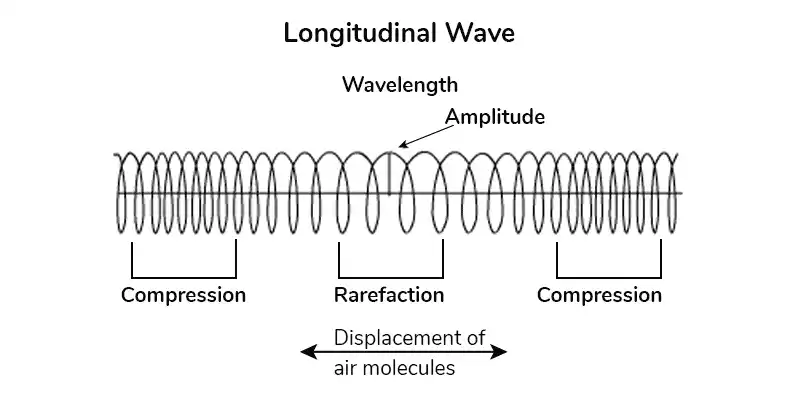
Longitudinal Waves
Oscillation are parallel to the direction of wave propagation
An example is sound wave

Power
The rate at which work is done or energy is transferred
P = W/t, and the units are Watts
Flow Rate (Q)
The volume of fluid that is moving per unit time
Has units: m3/s

Tranverse Waves
Oscillations are perpendicular to the direction of wave propagation
An example is light waves
Radiation
Heat transfer using electromagnetic waves
Can occur with a vacuum or transparent solids, liquids, and gases.
Ohm’s Law
V = IR
This equation relates voltage, current, and resistance within a circuit
Frequency (f)
The number of waves cycles completed per second
The units are Hertz
1/s
Wave Cycle
The interval required to return to the same point in a wave
The same point is based on position or motion and is accomplished in 1 period of the wave
Scalars
Physical quantities that have only magnitude
No direction included
Kinetic Energy
Energy due to motion of an object
KE = ½ mv²
Units are joules
Ammeter
It’s a device used to measure current
The device is connected in series with the portion of the circuit where current needs to be determined.
Ammeter have a low resistance
Viscous Flow
Fluids that have some resistance to fluid flow
Include honey and blood, but not water.
Acceleration-Time Graph
Describes the acceleration of an object over a particular time interval
If an object is traveling at a constant velocity, the acceleration graph would be a flat line at zero
Vibrational Motion
Object is vibrating back and forth
This movement can produce kinetic energy
Watts (W)
Equivalent to joules/second
Kg.m²/s³
Describes Power
Work
W is positive when work is done on the system
W is negative when work is done by the system
This term involves a change in volume
Buoyant Force
The buoyant force is the net upward force resulting from the difference in pressure above and below an object in a fluid
The buoyant force is directly proportional to the object’s density, the volume displaced by the object
FB =p fluidVsub g
Thermodynamic System
Includes a system, which is what we are interested in, and the surroundings, which includes everything else.
This separation into system and surroundings is a helpful tool for analyzing thermodynamics systems
Wave
A disturbance that transfer energy through matter or space
waves consist of oscillations of a physical medium or field and do not transfer matter.