I&I B7/8
 Call Kai
 Learn
 Practice Test
 Spaced Repetition
 Match
 Flashcards
 Knowt Play
1/29

Earn XP
Description and Tags
HIV, Arboviruses I & II, Ebola
30 Terms
Describe the structure of the HIV genome
2x single stranded (+)ssRNA encoding 9 genes that have overlapping sequences
What structural features does HIV have? (4)
Nucleocapsid
Capsid
Matrix
Envelope
What proteins does HIV have a) on its surface envelope and b) inside?
a) gp120, gp41
b) Reverse Transcriptase, Integrase, Protease
HIV transmission routes
Sexual contact
Intravenous drug use
Blood transfusions
Mother to child transmission
HIV infection life cycle (10 steps)
CD207 on DCs binds to gp120 on HIV
DCs migrate to draining Lymph nodes
Binding of HIV gp120 to cell surface protein CD4
conformational change in gp120
Binding of HIV gp41 to a cellular co-receptor (CXCR4 or CCR5)
Formation of six-helix bundle
Fusion of virus envelope & plasma membrane
Release of NC into cytoplasm
HIV integration and replication in host genome
budding and release
What functions does reverse transcriptase (in HIV) have? (3)
RNA dep DNA pol activity
RNase H activity: cleaves RNA from RNA:DNA hybrids.
DNA dep DNA pol activity
Process of reverse transcription of the HIV genome (8)
-ve DNA synthesis is initiated using cellular tRNA annealed to the 18-base sequence Primer Binding Site
RNA strand of the RNA:DNA duplex is degraded by RNase H of RT.
First strand transfer: newly formed DNA —R sequences→ 3′ end of the viral genome
-ve DNA synthesis + RNase H digestion of all template RNA except polypurine tract (PPT)
PPT is used as a primer for second strand DNA synthesis.
RNase H removes the tRNA and the PPT RNA.
Second strand transfer: annealing of the newly formed PBS DNA (second strand) to the PBS DNA from the first strand.
Completion of second strand synthesis → linear DNA duplex with LTRs at both ends
Integration of HIV DNA (5 steps)
Linear HIV DNA enters nucleus
HIV integrase: Circularisation of linear DNA
“ : Cleavage of terminal dinucleotides
“ : Single-stranded nick & end-joining to host DNA
“ : Ligation into host DNA
What is a well known example of a) host protein that is a target for a certain b) HIV protein and c) what is the outcome?
a) APOBEC3G
b) Vif
c) poly-ubiquitination of APOBEC3G→ protease
What kind of protein is APOBEC3G?
cytidine deaminase: C→U in the ss DNA substrate
TRUE OR FALSE: HIV can establish reservoirs in latently infected cells with an integrated viral genome
TRUE
HIV reservoirs can exist in…(4)
Central nervous system
Gastrointestinal tract
Genital tract
Lymph node
Describe the genome of ebola (+ gene products)
Negative-stranded RNA linear genome encodes for 7 proteins:
NP: Nucleoprotein
VP30: Minor nucleoprotein
VP35: Polymerase complex protein
VP40: Matrix
GP + sGP: envelope glycoprotein, secretory glycoprotein
L: RNA dep RNA Pol
VP24: Inhibits STAT1 nuclear transport
How is ebola transmitted?
broken skin or unprotected mucous membranes
Contact with infected animals
Direct contact with body fluids
Hand-to-eye contact
potentially Inhalation of aerosol particle
Sexual transmission
ebola target cells (6)
Monocytes
Macrophages
Dendritic cells
Hepatocytes
Endothelial cells
Epithelial cells.
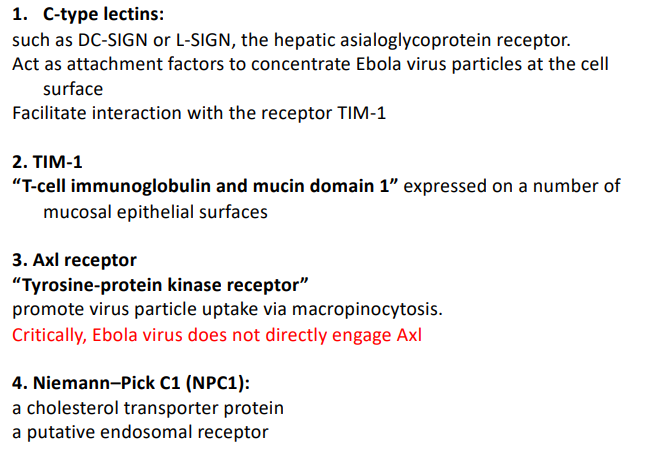
Ebola infection life cycle (11 steps)
GP binds to TIM-1
Receptor mediated endocytosis
Cathepsins L and B perform sequential proteolytic cleavage on GP1 inside endosome
GP1 binds to NPC1
Exposure of GP2
Fusion of virus membrane with the endosome
Release of nucleocapsid
Genome replication
mRNA translation using host ribosome
assembly of nucleocapsid and association with matrix and envelope proteins
cytopathic release by budding
How can ebola evade IFN action? (3)
VP35 protein: suppresses the activation of PKR by ISGs (no translation→ apoptosis), suppresses the activation of RIG-I /induction of downstream IFN genes.
VP24: blocks STAT1 activation of ISRE
How can ebola evade antibody action?
deploy sGP to decoy Ab responses
The GP gene of ebola codes for … proteins which are produced by…
The GP gene of ebola codes for 3 proteins which are produced by editing of transcript
How can ebola improve its cellular uptake? (2)
attached antibodies mediate attachment to host cell FcR
C1q component of the complement system binds to antibody associated with ebola
What causes symptoms of haemorrhagic fever in ebola? (2)
hepatocytes infected; the liver produces coagulation factors
endothelial cells infected; cytopathic effect and damage to the endothelial barrier → loss of vascular integrity
TRUE OR FALSE: All arthropod borne (arbo-) viruses are RNA genome
TRUE
How are arboviruses transmitted between arthropod and mammal/bird host?
through blood transfer
What are the hosts of Ross River virus?
host and vector generalist—many many!
Describe the structure of Ross River Virus
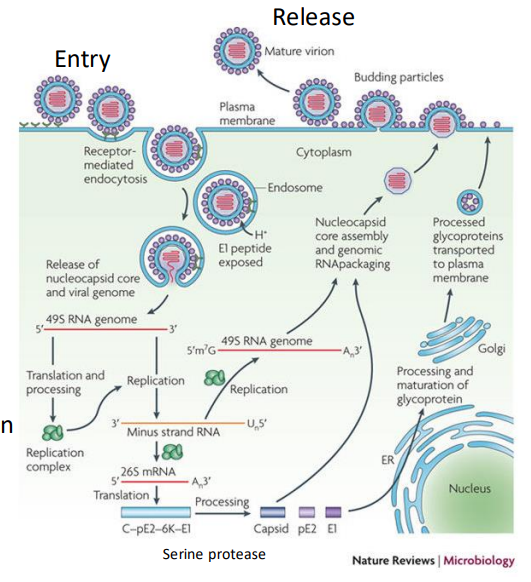
icosahedral nucleocapsid with envelope embedded with E1 and E2 glycoprotein
RRV symptoms
flu like, but can cause chronic arthralgia
What produces Type 1 interferons upon stimulation with alphaviruses?
TLR 3 & 7