3.1.3 Bonding
 Call Kai
 Learn
 Practice Test
 Spaced Repetition
 Match
 Flashcards
 Knowt Play
1/49

There's no tags or description
Looks like no tags are added yet.
50 Terms
Is a change of state a physical or chemical change, and is it reversible or irreversible?
physical change
reversible
(does not change the chemical properties or chemical makeup of the substances involved)
What are the changes of state?

What is the difference between evaporation and boiling?
evaporation occurs only at the surface and takes place at temperatures below the boiling point
boiling occurs at a specific temperature (boiling point)
Relationship between temperature and energy during state changes

Ionic bonding
between a metal (cations) and non metals (anions)
electrons are transferred from the metal to the non metal to achieve full outer shells. this creates charged particles called ions
oppositely charged ions are arranged in a lattice with strong electrostatic forces of attraction between oppositely charged ions acting in all directions
covalent bonding
between two non-metals
(pairs of) electrons are shared to achieve a full outer shells
a covalent bond is a shared pair of electrons
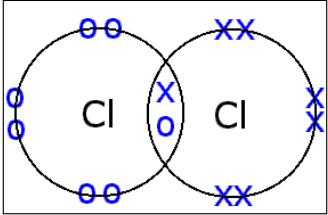
dative covalent bonding/ coordinate bonding
both of the electrons in the shared pair are supplied from a single atom
the atom with a lone pair donates a pair of electrons to an electron deficient atom
represented by an arrow from the atom providing the lone pair to the atom that is deficient

Metallic bonding
lattice of positively charged ions surrounded by a ‘sea’ of delocalised electrons
strong electrostatic force of attraction between positive metal ions and the sea of delocalised electrons

Factors that affect the strength of metallic bonding
Number of protons/ strength of nuclear attraction
→ the more protons, the stronger the bondNumber of delocalised electrons per atom
→ the more delocalised electrons, the stronger the bondSize of ion
→ the smaller the ion, the stronger the bond
What are the main types of crystal structure?
ionic
metallic
simple molecular
macromolecular
Properties of ionic structures
high melting and boiling point
→ strong electrostatic forces of attraction require a lot of energy to overcomecan conduct electricity when molten or in solution
→ ions are free to move and carry charge
Example of ionic structure
Sodium chloride

Properties of metallic structures
high melting/boiling point
→ strong electrostatic forces of attraction between positive ions and sea of delocalised electronscan conduct electricity when solid or molten/dissolved in solution
→ delocalised electrons are free to move and carry charge through the structuremalleable
→ layers of positive ions are able to slide over each other
Examples of metallic structures (on the spec)
magnesium
sodium

Properties of simple molecular structure
low melting/boiling point
→ weak intermolecular forces between molecules, need little energy to overcomecannot conduct electricity
Examples of small molecules (on the spec)
iodine
ice
Properties of macromolecular/ giant covalent structure
high melting/boiling point
→ strong covalent bonds need lots of energy to breakDiamond and sand: cannot conduct electricity
graphite: can conduct electricity as there are delocalised electrons between layers
Examples of macromolecular structures
diamond
graphite
What is a charge cloud/orbital?
area where you have a large chance of finding an electron
each orbital holds 2 electrons (a pair)
Pairs of electrons/charge clouds _____ each other
repel
How do pairs of electrons in the outer shell of atoms arrange themselves and why?
as far apart as possible to minimise repulsion
Electron pair repulsion theory
electron pairs repel each other
lone pairs cause more repulsion than bonding pairs because they are closer to the nucleus
electron pairs arrange themselves as far apart as possible to minimise repulsion
Repulsion increases in this order
bond pair- bond pair repulsion < bond pair - lone pair repulsion < lone pair - lone pair repulsion
Three ways to show bonds in a diagram
stick (both atoms and the bond are in the same plane)
dashed (bond is going away from viewer/ into the paper)
wedge (bond coming towards viewer/ out of the paper)

Names of shapes with no bonding pairs
linear
trigonal planar
tetrahedral
trigonal bipyramidal
octahedral
2 bonding pairs, no lone pairs =
linear
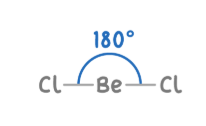
Linear shape + example
BeCl2
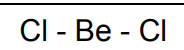
Linear bond angle
180o
3 bonding pairs, no lone pairs =
trigonal planar
trigonal planar shape + example
BF3
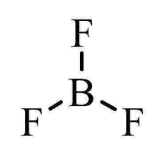
trigonal planar bond angle
120o

4 bonding pairs, no lone pairs =
tetrahedral
tetrahedral shape + exaple
CH4
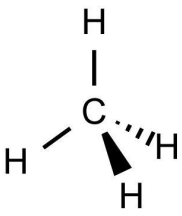
tetrahedral bond angle
109.5o

5 bonding pairs, no lone pairs =
trigonal bipyramidal
trigonal bipyramidal shape + example
PCl5

trigonal bipyramidal bond angle
90o
120o

6 bonding pairs, no lone pairs =
octahedral
octahedral shape + example
SF6

octahedral bond angle
90o

How does the presence of lone pairs affect bond angles and why?
lone pairs reduce bond angles by 2.5o
because lone pair repulsion is stronger and therefore pushes the bonding pairs together
in the example, each molecule has 4 total pairs, but different bond angles

How to determine the number of bonding and lone pairs
bonding pairs: how many atoms are bonded to the central atom
lone pairs: subtract the total number of electrons in bonding pairs (multiply b.p by two) and subtract from the number of outer e- (group number) of the central atom. then divide by two for the number of pairs
if there is a + charge, add one to the number of outer electrons
if there is a - charge, subtract one from the number of outer electrons
2 bonding pairs, one lone pair =
(give the name, shape, bond angle)
bent
120 - 2.5 = 117.5o

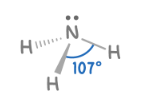
3 bonding pairs, one lone pair (name, shape, angle)
trigonal pyramidal
109.5 - 2.5 = 107o
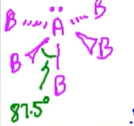
4 bonding pairs, one lone pair = (name, shape, angle)
seesaw
90 - 2.5 = approx 87.5o
120 - 2.5 = approx 117.5o

5 bonding pairs, one lone pair = (shape, bond angle, name)
square pyramid
90 - 2.5 = 87.5o
2 bonding pairs, 2 lone pairs = (name, shape, bond angle)
bent
e.g. water
109.5 - 2.5 - 2.5 = 104.5o

3 bonding pairs, 2 lone pairs = (name, shape, bond angle)
t-shape
90 - 2.5 = approx 87.5
(we do not do 90 - 2.5 - 2.5 because the repulsion is from above AND below which somewhat cancels each other out)

4 bonding pairs, 2 lone pairs = (name, shape, bond angle)
square planar
90o
(bond angle does not change due to the equal repulsion from opposite sides cancelling each other out- they are pushing by the same amount so bond angle does not decrease)
