Avian Bio: Organ Systems and Physiology
 Call Kai
 Learn
 Practice Test
 Spaced Repetition
 Match
 Flashcards
 Knowt Play
1/35

There's no tags or description
Looks like no tags are added yet.
36 Terms
Nares
Nostrils
Cere
fleshy skin/keratin around nostrils
Specializations: tubenoses
group of seabirds that have tubular nostrils on top of the bill. Associated with salt glands that help seabirds remove excess salt from their bodies. (ex. albetrosses)
Specializations: baffles
Structures that guide or redirect airflow, helping regulate the movement of air. (ex. falcons)

Trachea
Black line. Main respiratory tube.

Syrinx
unique to birds. Sound producing organ located at the split between trachea and bronchi.
Lungs
Dont inflate. Trachea → Bronchi → 2 Bronchi → Parabronchi

Parabronchi
Fundamental sire of gas exchange, these are the traditional “lungs”

Anterior air sacs
Interclavicular (red line) and cranial thoracic (green line). They are located in the front.

Posterior air sacs
Abdominal (teal line) and caudal thoracic (purple line). They are located in the back.
Unidirectional lung ventilation
Happens by movement of the rib cage by uncinate (small, hook-shaped projections on the ribs of birds) processes. Air flows through the lungs one way. Mixing oxygen and carbon to blood so they always encounter a fresh oxygen supply.
Tongue
Important for accessing and manipulating food, has few tastebuds.

Alimentary canal: Crop
red line. Extension of the esophagus for food storage.
Alimentary canal: Stomach, Proventriculus
Glandular portion of stomach that produces enzyme for digestion.
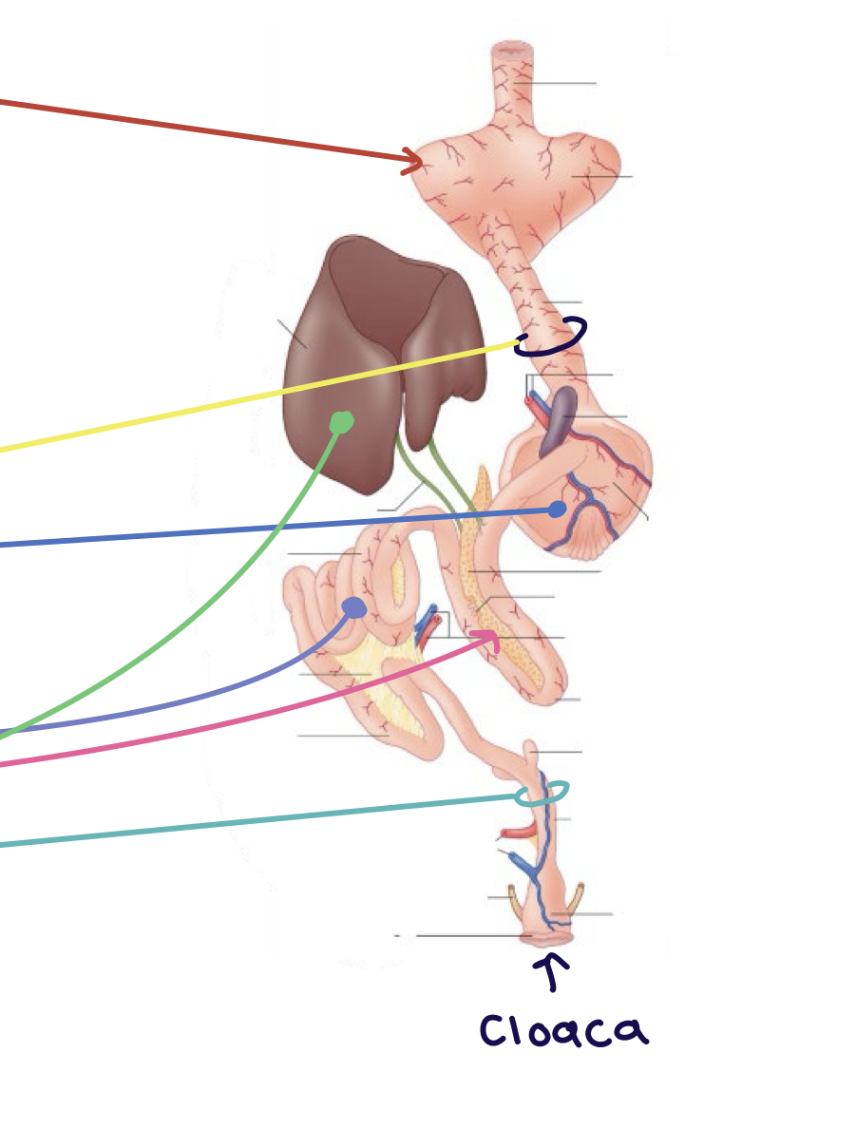
Alimentary canal: Stomach, Gizzard
yellow line. Muscular portion of stomach. Site of mechanical digestion - blue line (breaking down hard foods, seeds).
Alimentary canal: Small intestine- duodenum, jejunum, ileum
purple line
Alimentary canal: Pancreas
pink line
Alimentary canal: Liver
green line
Alimentary canal: Large intestine
blue line
Urogenital system
Uro: urinary system. Genital: reproductive system
Gonads: gender
females = ZW (determine sex of baby). males = ZZ
Gonads: organs
Females- single (left) functional ovary
Males- testes; cloacal phallus (very rare, ostriches and ducks) in some.
Cloaca
Common site of output of digestive + urinary system
Brain size
brain size varies with body size. Larger size = larger brain.
Hippocampus
Perception and memory space. Well developed on caching species (jays and crows)
Bill tip organ
Clusters of mechanoreceptors (sensory receptors that detect physical forces) along bill. Best developed in kiwis, shorebirds, and parrots.
Nictitating membrane
3rd eyelid for added protection
Rods
monochromatic
Cones
4 types: red, green, blue, and Ultra Violet light

Central fovea
monocular vision

Temporal fovea
Binocular vision

Fovea
area of highly concentrated cones
Motion parallax
Stereoptical effects through head-bobbing. Closer objects appear to move faster
Hearing: Barn owls
They have asymmetrical ear positions that help triangulate the location of sound (prey)
Olfaction
Sense of smell that is well developed in tubenose seabirds (finding prey and their own nesting burrows), vultures (carrion), and kiwis (foraging).
Metabolic waste
Uric acid: Produced in liver. Water conserving but requires more energy to produce.