ACER 10/9 Lecture #13: MO Theory Part 2 (Part 1)
 Call Kai
 Learn
 Practice Test
 Spaced Repetition
 Match
 Flashcards
 Knowt Play
1/8

There's no tags or description
Looks like no tags are added yet.
9 Terms
Why do heteronuclear diatomic molecules with atoms in different periods have nonbonding orbitals?
They have different numbers of valence shells so one atom will have atomic orbitals that can’t be paired with orbitals.
For MO Diagrams of heteronuclear diatomic ions (e.g. CN-), a negative charge is typically placed on which atom? What about a positive charge?
Negative charge on the more electronegative atom
Positive charge on the less electronegative atom
What is the principal axis? What does this mean for bonds?
The z-axis. Sigma σ bonds are always aligned on the z-axis.
Describe Skeletal Structures (double/triple bonds, angles)
Double bonds are represented by two lines, triple bonds are represented by three lines
Angles must match VSEPR shapes
How does the MO theory compare to Lewis theory when representing a conjugated (delocalized) π system?
A system of connected p-orbitals over adjacent molecules, which allows π bonds to delocalize over multiple atoms.
The MO theory easily represents it compared to the Lewis theory which requires multiple resonance structure to show this.
Why do we focus on the π system? What are frontier orbitals?
We focus on π orbitals because they dictate the majority of bonding and properties of atoms. Specifically, we focus on the frontier orbitals, the HOMO and LUMO, because in a bond the HOMO of one atom overlaps with the LUMO of another.
What are conjugated polyenes?
Why do we focus on these for π systems?
Even more specifically, why do we focus on even-numbered polyenes?
They are carbon chains that are completely unsaturated with double bonds, meaning the carbon-carbon bonds alternate between single and double (this alternation is what makes them conjugated).
They offer the simplest model to demonstrate electron delocalization and node patterns in organic molecules.
Even-numbered polyenes have an even number of carbon atoms so half of their molecular orbitals are always bonding and the other half is always antibonding.
Draw the π system of 1,3-butadiene, including the p-orbitals in the molecular structure and the molecular orbitals.
Identify the HOMO and LUMO.
Then draw how the p-orbitals combine for each MO and the mirrored particle in a box representation. Determine the number of nodes in each MO.
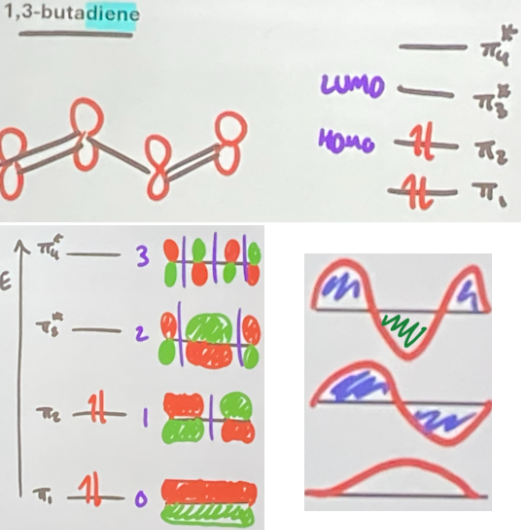
Why does the π system diagram representation of nodes mirror the wavefunction and probability density diagrams of particle in a box model?
Conjugated polyenes are very well modeled by the particle in a box model.
The particle in a box model and the π system diagram both give the same number of nodes for each energy level/orbital.