ch 14 & 15 cell mol
 Call Kai
 Learn
 Practice Test
 Spaced Repetition
 Match
 Flashcards
 Knowt Play
1/52

There's no tags or description
Looks like no tags are added yet.
53 Terms
Which of the following correctly matches the cellular location with the production of ATP by oxidative phosphorylation in that cell type?
A. chloroplasts—plants
B. cell wall—photosynthetic algae
C. plasma membrane—bacteria
D. mitochondria—archaea
plasma membrane—bacteria
Individuals with inherited diseases causing mitochondrial dysfunction typically experience which of the following symptoms?
A. bone deformities
B. light sensitivity
C. sterilit
D. heart problems
heart problems
In a sperm cell, where are the mitochondria located?
A. They are located in a tubular network that are just inside the plasma membrane
B. The mitochondria surround the nucleus of the cell
C. Mitochondria are randomly scattered around in the cytoplasm of the cell
D. The mitochondria form elongated tubes that wrap around the flagellar core
The mitochondria form elongated tubes that wrap around the flagellar core
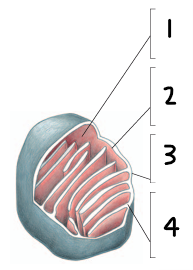
Shown is the structure of a mitochondrion with different compartments labeled. Which of the numbers represents the most permeable membrane of the mitochondrion?
A. 1
B. 4
C. 3
D. 2
3
Glycolysis alone captures approximately what percentage of the free energy available in a molecule of glucose?
A. 20%
B. 99%
C. 50%
D. 10%
10%
The citric acid cycle produces which activated carriers that transfer high-energy electrons to the electron-transport chain?
A. NADP and FAD
B. NAD+ and FAD
C. NADH and FADH2
D. NADPH and NADH
NADH and FADH2
How do the high-energy electrons of activated carries contribute to forming the high-energy phosphate bonds of ATP?
A. They are transferred directly to ADP to form ATP
B. They are used by the electron-transport chain to make a proton gradient
C. They are pumped across the membrane to form an electron gradient
D. They are passed to ATP synthase to power ATP synthesis
They are used by the electron-transport chain to make a proton gradient
Which of the following is a mobile electron carrier in the electron-transport chain?
A. ubiquinone
B. cytochrome c reductase complex
C. NADH dehydrogenase complex
D. cytochrome c oxidase complex
ubiquinone
Which of the following has the lowest electron affinity?
A. cytochrome c reductase complex
B. NADH dehydrogenase complex
C. cytochomr c oxidase complex
D. oxygen
NADH dehydrogenase complex
Protons are pumped across the mitochondrial inner membrbane to accumulate in the
A. cytosol
B. intermembrane space
C. electron-transport chain
D. mitochondrial matrix
intermembrane space
The pH of the mitochondrial matrix is _________, which is ________ than that of the intermembrane space.
A. 7.9; higher
B. 7.2; lower
C. 7.9; lower
D. 7.2; higher
7.9; higher
The proton flow through the transmembrane H+ carrier of ATP synthase results in
A. moving ADP and Pi across the membrane into the enzyme active site
B. bending of the carrier and stalk to produce mechanical force
C. mechanical rotation that is converted into the chemical-bond energy of ATP
D. binding of the proton to ADP to enhance formation of the phosphate bond
mechanical rotation that is converted into the chemical-bond energy of ATP
How is pyruvate imported into the mitochondrial matrix for use in the citric acid cycle?
A. sodium gradient-driven antiport
B. ATP-driven pyruvate pump
C. diffusion through porin complexes in the membrane
D. proton gradient-driven symport
proton gradient-driven symport
The low redox potential of NADH means that it has a
A. very stable bond
B. tendency to give up electrons
C. low free energy
D. high electron affinity
tendency to give up electrons
The number of ATP molecules that could be synthesized from the energy released by the transfer of two electrons from NADH to molecular oxygen is
A. 2.5
B. 1.5
C. 3
D. 4
2.5
The cytochrome complexes contain heme prosthetic groups, which have a higher redox potential than the iron-sulfur centers found in other electron-transport chain complexes like NADH dehydrogenase. Where in the electron-transport chain would the cytochrome complexes thus be located relative to iron-sulfure complexes?
A. earlier in the chain
B. at the same point of the chain
C. later in the chain
D. it cannot be determined
later in the chain
Cytochrome c oxidase catalyzes the reaction that reduces molecular oxygen (two oxygen atoms) to two water molecules. The electrons are added sequentially, and during the process cytochrome c oxidase must bind the oxygen tightly in the active site. Why?
A. If the oxygen escapes, it will bubble out as a gas and escape quickly
B. The escaped oxygen will form carbon monoxide and kill the cell
C. Superoxide radicals are formed as an intermediate, and are dangerous to the cell
D. Oxygen will bind to the electron-transport chain and reverse the pumping of protons
Superoxide radicals are formed as an intermediate, and are dangerous to the cell

Shown is the mechanism believed to be used for pumping protons by cytochrome c oxidase across the inner mitochondrial membrane. One of the steps shown is unidirectional because it is driven by the energy of electron transport. Why must this step be performed only in one direction?
A. The inner membrane would become porous to all molecules
B. The protons could be also captured from the intermembrane space and released back into the matrix
C. The H+ affinity in the two conformations would reverse
D. The complex would stay stuck in the closed (center conformation)
The protons could be also captured from the intermembrane space and released back into the matrix
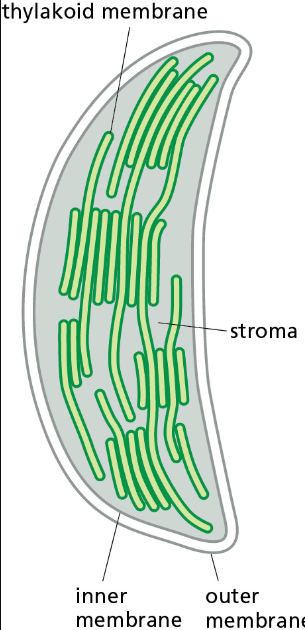
Shown is a chloroplast with labeled structures. The photosynthetic machinery is found in which of the compartments shown?
A. inner membrane
B. outer membrane
C. stroma
D. thylakoid membrane
thylakoid membrane
In oxidative phosphorylation in mitochondria, high-energy electrons are transferred to the electron-transport chain from activated carriers like NADH. Stage 1 of photosynthesis also uses an electron-transport chain to pump protons and make ATP. In this case, where do the high-energy electrons come from?
A. ADP
B. NADPH
C. chlorophyll
D. FADH2
chlorophyllStage
Stage two of photosynthesis (or the light-dependent reactions) uses which input molecules to produce organic food molecules?
A. ATP, NADPH, CO2
B. amino acids, sugars, fatty acids
C. H2O, light, chlorophyll
D. O2, NADH, ADP
ATP, NADPH, CO2
Chlorophyll appears green because it
A. absorbs blue light
B. absorbs red light
C. reflects UV light
D. reflects green light
reflects green light
The first living things on Earth probably generates ATP by what mechanism?
A. carbon fixation
B. photosynthesis
C. fermentation
D. oxidative phosphorylation
fermentation
What role does the signal-recognition particle (SRP) play in protein sorting to the ER?
A. It degrades incorrectly folded proteins in the ER lumen
B. It binds the ribosome and ER signal sequence, halting synthesis until docking with the ER membrane
C. It cleaves the signal sequence after translocation
D. It transports the vesicles to the Golgi apparatus
E. It folds proteins after their entry into the ER lumen
It binds the ribosome and ER signal sequence, halting synthesis until docking with the ER membrane
Which feature supports the theory that mitochondria originated from an engulfed bacterial ancestor?
A. transport of proteins exclusively via vesicles
B. lack of protein translocation mechanisms
C. direct continuity with the ER membrane
D. possession of their own genomes similar to bacterial genomes and double membranes
E. similar pH environment to the cytosol
possession of their own genomes similar to bacterial genomes and double membranes
Which statement best describes the nuclear pore complex?
A. A large structure composed of multiple proteins forming a gate that selectively transports in and out of the nucleus
B. A single protein that forms a continuous channel across the nuclear envelope
C. The site where nuclear envelope membranes merge with the ER
D. An organelle that produces ribosomes in the cytosol
E. A vesicle that transports proteins from the nucleus to the ER
A large structure composed of multiple proteins forming a gate that selectively transports in and out of the nucleus
Which components are involved in the formation of a clathrin-coated vesicle at the plasma membrane?
A. Rab proteins, SNAREs, and lysosomal enzymes
B. Clathrin molecules, adaptins that select cargo, and dynamin that pinches off the vesicle
C. Signal-recognition particle and export receptors
D. Golgi enzymes and ER chaperones
E. Mitochondrial translocases and peroxisomal receptors
Clathrin molecules, adaptins that select cargo, and dynamin that pinches off the vesicle
How does the nuclear import receptor release its cargo inside the nucleus?
A. Cargo diffuses spontaneously from receptor inside the nucleus
B. Hydrolysis of ATP provides energy to eject cargo
C. The receptor leaves the cargo at the cytosolic fibrils
D. The receptor is cleaved by proteases to release cargo
E. Ran-GTP binds the import receptor, causing release of the cargo protein in the nucleus
Ran-GTP binds the import receptor, causing release of the cargo protein in the nucleus
Which organelle functions as the main site of intracellular degradation and digestion?
A. endoplasmic reticulum, which synthesizes lipids
B. endosomes, which store and recycle proteins
C. lysosomes, which contain hydrolytic enzymes active at acidic pH
D. peroxisomes, which oxidize toxic molecules
E. golgi apparatus, which modifies glycoproteins
lysosomes, which contain hydrolytic enzymes active at acidic pH
What is receptor-mediated endocytosis?
A. nonselective ingestion of fluid molecules by pinocytosis
B. engulfing of large particles by pseudopods
C. secretion of proteins from secretory vesicles
D. the selective uptake of specific macromolecules bound to cell surface receptors via clathrin-coated vesicles
E. fusion of transport vesicles with the plasma membrane
the selective uptake of specific macromolecules bound to cell surface receptors via clathrin-coated vesicles
What is the ultimate fate of most proteins synthesized in the ER and destined for secretion?
A. transported via the golgi apparatus in vesicles to the plasma membrane for exocytosis
B. directed to mitochondria for folding
C. degraded in endosomes immediately
D. stored in the cytosol as aggregates
E. transported into the nucleus through pores
transported via the golgi apparatus in vesicles to the plasma membrane for exocytosis
What is unique about mitochondria and chloroplasts compared to other membrane-enclosed organelles?
A. their membranes are permeable to all small molecules
B. they originated from invagination of the plasma membrane
C. they transport proteins primarily by vesicular mechanisms
D. they have their own small genomes and evolved from engulfed bacteria
E. they are connected to the ER by membrane continuities
they have their own small genomes and evolved from engulfed bacteria
How is the topology (membrane-spanning arrangement) of a single-pass transmembrane protein determined in the ER?
A. proteins are integrated only after complete synthesis
B. signal peptides remain permanently bound to the membrane surface
C. an N-terminal signal initiates, and a hydrophobic stop-transfer sequences halts transfer, anchoring the protein in the membrane
D. all proteins fully translocate into the lumen before membrane insertion
E. hydrophilic sequences initiate membrane anchoring
an N-terminal signal initiates, and a hydrophobic stop-transfer sequences halts transfer, anchoring the protein in the membrane
What is the primary strategy used by eukaryotic cells to segregate incompatible chemical reactions?
A. aggregating enzymes into complexes in the cytosol
B. increasing the cell’s surface-to-volume ratio
C. mixing cellular contents in a test tube
D. confining different metabolic processes within membrane-enclosed compartments
E. degrading proteins by proteolytic enzymes
confining different metabolic processes within membrane-enclosed compartments
How is cellular cholesterol internalized by most animal cells?
A. direct synthesis within lysosomes
B. transport through nuclear pores
C. diffusion across the plasma membrane
D. phagocytosis of cholesterol aggregates
E. via receptor-mediated endocytosis of LDL-bound LDL receptors in clathrin-coated vesicles
via receptor-mediated endocytosis of LDL-bound LDL receptors in clathrin-coated vesicles
What happens to receptors after releasing their cargo in endosomes?
A. receptors are recycled through mitochondria
B. receptors are secreted outside the cell
C. all receptors remain in the endosomal membrane indefinitely
D. some receptors return to the plasma membrane, others are degraded, and some are transported to different membrane domains
E. all receptors are immediately degraded in lysosomes
some receptors return to the plasma membrane, others are degraded, and some are transported to different membrane domains
What is the function of the ER retention signal?
A. a signal that directs proteins for secretion
B. a C-terminal sequence that prevents proteins meant to stay in the ER from escaping
C. a motif for nuclear localization
D. a docking site for transport vesicles
E. a sequence tagging proteins for degradation
a C-terminal sequence that prevents proteins meant to stay in the ER from escaping
Which structure connects the nuclear envelope to the endoplasmic reticulum (ER)?
A. mitochondria attach the nuclear envelope to the ER
B. nuclear pores link the nuclear envelope to ribosomes
C. lysosomes bridge the nuclear envelope and the ER
D. the outer nuclear membrane is continuous with the ER membrane
E. the inner nuclear membrane connects to the golgi apparatus
the outer nuclear membrane is continuous with the ER membrane
Why can’t mitochondria perform photosynthesis, despite having similar chemiosmotic mechanisms?
A. they do not generate proton gradients
B. they lack ATP synthase
C. their membranes are impermeable
D. mitochondria lack chlorophyll and the photosystems necessary to capture light energy
E. they cannot pump protons
mitochondria lack chlorophyll and the photosystems necessary to capture light energy
What is the primary role of the cytochrome c oxidase complex in the mitochondrial electron-transport chain?
A. to carry electrons from ubiquinone to cytochrome c
B. to oxidize NADH to NAD+
C. to transfer electrons to oxygen, producing water and pumping protons
D. to transport ADP into the mitochondrial matrix
E. to generate ATP directly
to transfer electrons to oxygen, producing water and pumping protons
Which mechanism prevents release of reactive oxygen species during water splitting in PS II?
A. use of cytochrome c oxidase
B. bypass of electron transfer
C. retention of reaction intermediates by the manganes-containing enzymes until four electrons are extracted
D. immediate release of hydrogen peroxide
E. recycling of oxygen as substrate
retention of reaction intermediates by the manganes-containing enzymes until four electrons are extracted
What is suggested by the presence of chemiosmotic coupling in organisms like Methanococcus?
A. that chemiosmosis evolved recently
B. that proton gradients are unique to eukaryotes
C. that chemiosmotic ATP generation is an ancident and conserved energy mechanism
D. that Methanococcus uses fermentation only
E. that archaea do not perform oxidative phosphorylation
that chemiosmotic ATP generation is an ancident and conserved energy mechanism
In photosynthesis, what molecule acts as the terminal electron acceptor to become NADPH?
A. NADP+, reduced by electrons transferred from PS I
B. ferredoxin alone
C. ATP synthase
D. oxygen from water splitting
E. plastoquinone
NADP+, reduced by electrons transferred from PS I
What fundamental process allows mitochondria and chloroplasts to generate ATP efficiently?
A. simple electron transfer without membrane involvement
B. ATP production via fermentation of sugars
C. direct substrate-level phosphorylation within the cytosol
D. membrane-based chemiosmotic coupling using electrochemical proton gradients
E. passive diffusion of ADP and Pi across membranes
membrane-based chemiosmotic coupling using electrochemical proton gradients
What evolutionary event gave rise to mitochondria and chloroplasts in eukaryotic cells?
A. De novo synthesis from nuclear genes
B. invagination of the plasma membrane
C. fusion of organelles in ancient cells
D. endosymbiosis of ancestral bacteria by early eukaryotic cells
E. spontaneous generation from cytosolic components
endosymbiosis of ancestral bacteria by early eukaryotic cells
What provides reducing equivalents for photosynthetic carbon fixation in chloroplasts?
A. CO2 itself
B. NADPH generated by PS I electron transfer
C. chlorophyll excited electrons
D. ATP generated by mitochondria
E. oxygen from water splitting
NADPH generated by PS I electron transfer
Why is rubisco considered inefficient but abundant in plant chloroplasts?
A. because it consumes ATP without generating sugars
B. because it does not participate in photosynthesis
C. because it has slow catalytic rate so plants produce large amounts to maintain carbon fixation
D. because it degrades rapidly in sunlight
E. because it binds oxygen instead of carbon dioxide
because it has slow catalytic rate so plants produce large amounts to maintain carbon fixation
How do mitochondrial and chloroplast ATP synthase enzymes demonstrate their shared evolutionary origin?
A. they differ entirely in structure but perform the same function
B. one uses sodium gradients instead of protons
C. chloroplast ATP synthase uses light directly
D. they have similar structures and functions, producing ATP using proton gradients
E. mitochondrial ATP synthase is unrelated to proton movement
they have similar structures and functions, producing ATP using proton gradients
Why are iron-sulfur centers critical in mitochondrial electron transport?
A. they pump across membranes
B. they bind and transfer electrons tightly as part of respiratory complexes
C. they bind oxygen gas
D. they synthesize NADH
E. they store ATP molecules
they bind and transfer electrons tightly as part of respiratory complexes
How does dinitrophenol (DNP) affect mitochondrial ATP synthesis?
A. it uncouples electron transport from ATP synthesis by carrying protons across membranes
B. it blocks electron transfer to oxygen
C. it enhances proton pumping efficiency
D. it inhibits ATP synthase activity
E. it increases NADH production
it uncouples electron transport from ATP synthesis by carrying protons across membranes
Which two molecules produced in the light reactions of photosynthesis drive carbon fixation in the chloroplast stroma?
A. carbon dioxide and water
B. ATP and NADPH generated by the thylakoid electron-transport chain
C. chlorophyll and plastoquinone
D. ADP and NADP+
E. glucose and oxygen
ATP and NADPH generated by the thylakoid electron-transport chain
What feature of PS II allows it to supply electrons for photosynthesis?
A. a chlorophyll molecule that directly splits water
B. a plastocyanin transport protein
C. a NADPH oxidase enzyme
D. a manganese-containing water-splitting enzyme that extracts electrons from water
E. a cytochrome c oxidase to reduce oxygen
a manganese-containing water-splitting enzyme that extracts electrons from water
What feature of mitochondria is analgous to the chloroplast stroma?
A. the cytosol adjacent to mitochondria
B. the mitochondrial outer membrane
C. the chloroplast thylakoid membrane
D. the mitochondrial intermembrane space
E. the mitochondrial matrix, which contains enzymes for the citric acid cycle
the mitochondrial matrix, which contains enzymes for the citric acid cycle