622 11/9 L Staphylococcus Intro
 Call Kai
 Learn
 Practice Test
 Spaced Repetition
 Match
 Flashcards
 Knowt Play
1/87

There's no tags or description
Looks like no tags are added yet.
88 Terms
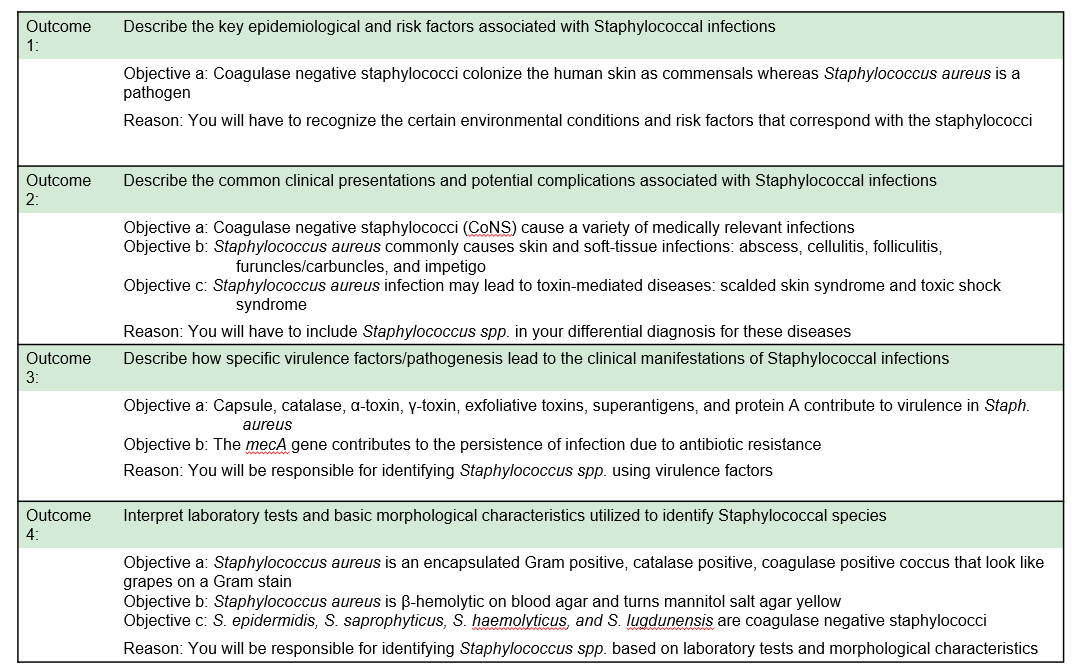
Objective and Outcomes
Gram + Cocci Flow Chart

Staphylococci
cocci in clusters, gram +, catalase positive, grow on most lab media, can grow in high salt (>7.5%)
non-motile, non-spore forming, facultative anaerobes

Mannitol Salt Agar
used to differentiate mannitol-fermenting s aureus from the non-mannitol fermentation

Staphylococci General Epidemiology
ubiquitous, in that all humans have coagulase-negative staphylococci colonizing their skin (s epidermidis), oropharynx, GI, ang urogenital tracts (s saprophyticus)
we can all have coagulase-positive s aureus colonies
Where do coagulase-positive S aureus colonies form?
most skin-folds (transient)
umbilical stump and the perineal area of neonates
anterior nasopharynx in older children and adults (short term or chronically/carriers in adults)
Nosocomial Staphylococci Epidemoiology
survive on dry fomites
transmission is direct contact of fomites
Community-Acquired Staphylococci Epidemiology
outbreaks of MRSA (skin and pneumonia)
Risk Factors of Staphylococcus
transplant patients (low immune response and open surgery)
catheterized patients (biofilm)
prosthetic joints (open surgery and biofilm)
burn patients (localized immunocomprimised)
neonates
immunocompromized
influenza infection in elderly
CoNS
coagulase-negative staphylococci
CoNS Epidemiology
opportunistic pathogens (often commensals as part of normal flora), often nosocomial, form biofilms
General CoNS Infections
bacteremia
infections in patients with medical devices
prosthetic joints, vascular grafts and prostheses, hemodialysis catheter, pacemaker, scalp electrodes
native valve endocarditis
UTIs
endophthalmitis, post-op wound infections, osteomyelitis
Bactermia
general CoNS infection, most common nosocomial bloodstream infections
in neonates, patients wit leukemia and lymphoma, and bone marrow transplant recipients
Infections in Patients with Medical Devices
general CoNS infection, intravascular catheters, csf shunts, peritoneal dialysis catheter, prosthetic valves
4 Coagulase Negative Staphylococci
s epidermidis
s saprophyticus
s haemolyticis
s lugdunensis
S Epidermitis Clinical Disease
bacteremia (nonsocomial)
implanted device infections (especially prosthetic joints)
subacute endocarditis (most frequent of CoNS)
septicemia
IVs
S Saprophyticus Clinical Disease
UTIs
rare complication of acute pyelonephritis and endocarditis
S Haemolyticus Clinical Disease
implanted device infections
S Lugadunesis Clinical Disease
endocarditis similar to s aureus
perineum (high colonization)
5 CoNS Common Virulence Factors
MSCRAMM adhesion molecules
biofilms
elastase (degrate elastin and elastin-like proteins)
lantibiotics (antibacterials that ait in colonization)
lipases (degrade fats)
MSCRAMM Adhesion Molecules
CoNS common virulence factor, microbial surface components recognizing host matrix molecules
initial attachment to fibrinogen, collagen, fibronectin
aid in formation of biofilms by CoNS
Biofilms
major CoNS common virulence factor, protection from immune response and antibiotics
polysaccharide intercellular adhesion factor
2 S Epidermidis Virulence Factors
delta toxin (small peptide that acts like a detergent to disrupt host cell membranes)
epidermin (small catatonic antibacterial peptide that aids in creating niche on skin)
3 S saprophyticis Virulence Factors
urease
adhesion proteion (UafA) that attaches to urinary tract epithelium
ion transport systems (osmotolerance)
2 S haemolyticus Virulence Factors
delta-like toxin
highest antibiotic resistance of CoNS
S lugduensis Virulence Factor
adhesion molecules that binds von Willebrand factor (glycoprotein involved in clotting), aids in binding heart valve
CoNS Lab Diagnostics Overview

CoNS Gram Stain
all gram + cocci

Catalase Test for CoNS
all 4 CoNS are catalse positive (will have bubbling)
Coagulase Test
coagulase enzyme interacts with coagulase-reacting factor in serum and subsequently converts soluble fibrinogen to insoluble fibrin, which causes clumping
during infection, fibin may surround bacterium and protect from phagocytes

Process of Coagulase Test
serum added to sample tubes
each inoculated with pure bacteria sample
invert tube to evaluate consistency (clumping) of serum
CoNS Coagulase Test
all CoNS are cogulase negative
CoNS Bacteria Sensitive (S) to Novobiocin
s epidermidis
s haemolyticus
s lugdunensis
CoNS Bacteria Resistant (R) to Novobiocin
s saprophyticus
CoNS Bacteria with Gamma (no) Hemolysis
s epidermidis
s saphrophyticus
CoNS Bacteria that are +/- for Hemolysis
s haemolyticus
s lugdunensis
S epidermidis Summary

Highlights of S epidermidis
ubiquitous commensal microorganism of skin, patients at risk are often hospital acquired (nosocomial)
biofilm formation is main virulence factor
clinical disease comes from implanted device infections (device-assocaited)
can cause subacute endocarditis
susceptible to novobiocin
S epidermidis Lab Diagnositcs
catalase +
cogulase -
suscpetible to novobiocin
gamma hemolytic
S saprophyticus Summary

Highlights of S saprophyticus
main virulence factors are biofilm formation and urease
main clinical disease is UTIs
idetifying lab diagnostic is resistance to novobiocin
S saprophyticus Lab Diagnositcs
catalase +
cogulase -
resistant to novobiocin
gamma hemolytic
S haemolyticus Summary

Highlights of S haemolyticus
highest antibiotic resistance of CoNS
main virulence factor is biofilm formation
clinical disease caused in implanted device infections
S lugdunensis Lab Diagnositcs
catase +
cogulase -
sensitive to novobiocin
PYR +
Orn +
S lugdunensis Summary

Highlights of S lugdunensis
main virulence factors include biofilm formation and adhesion molecules
clinical disease is endocarditis similarly to s aureus
S haemolyticus Lab Diagnostics
catalase +
cogulase -
sensitive to novobiocin
ornithine decarboxylase (Orn) -
What is the leading cause of pathogen-associated morbidity and mortality int he US?
staphylococcus aureus
Locations that S aureus Colonizes
moist skin-folds (transient)
umbilical stump and the perineal area of neonates
anterior nasopharynx in older children and adults
2 Epidemologies of S aureus
hospital-associated
community-acquired
Hosptial-Associated (HA-MRSA)
epidemology of s aureus, infection >48 hrs and within 1 year following hospitalization
commonly transmitted to patients by contaminated hands of healthcare workers
resistant to many antibiotics, vancomycin and linezolid are reserved for treatment
Community-Acquired (CA-MRSA)
epidemology of s aureus, in the absence of healthcare exposure, commonly transmitted by direct contact with a colonized or infected individual or fomites
resistance is typically limited to penicillins, methicilllin, erythromycin, and sometimes clindamycin
strain USA 300 is most common
S aureus Patient Risk Factors
hospitalized patients (surgery)
long-term care facilities
catheterized patients
immunocompromised
crowded living spaces
athletes
injection drug use
diabetics, hemodialysis patients
7 Clinical Disease of S aureus
folliculitis
cellulitis
furuncle
carbuncle
abscess formation
scaled skin syndrome/ritter’s disease
toxic shock syndrome
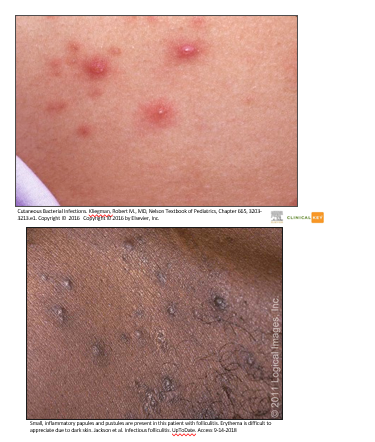
Folliculitis (from S aureus)
superficial staphylococcal folliculitis, cuteanous abscesses in and around hair follicles
infectious - can be manifestation of CA-MRSA
Folliculitis Clinical Presentation
follicle is raised and reddened
papule (discrete elevation of the skin < 1 cm diameter)
pustule
if on base of eyelid, called a stye
Folliculitis Prevention
shower/wash hands regularly
use antibacterial soap
Cellulitis (from S aureus)
a rapidly spreading infection of the dermis and subcutaneous fat layer with poorly defined borders

Furuncle (from S aureus)
many hair follicles involved, boil, large and painful raised nodules
purulent material extends through the dermis into the subcutaneous tissue and a small abcess forms
pus drains spontaneously after surgical incision

Carbuncle (from S aureus)
carbunculosis, cluster of furuncles, deeper subcutaneous tissue involved
multiple sinus tracts visible

Abcess Formation (from S aureus)

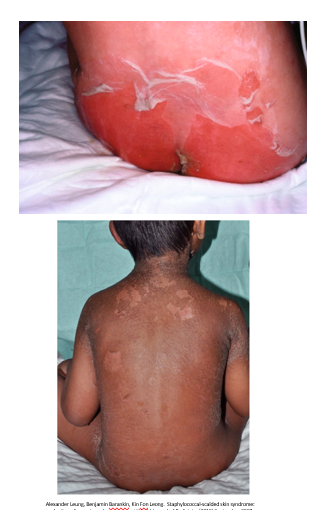
Scalded Skin Syndrome/Ritter’s Disease (from S aureus)
characterized by skin tenderness, large bullae, and desquamination of epithelium (skin detachment)
blisters contain fluid with no bacteria as symptoms are due to exfoliative toxins A and B
more often a disease of infants and children
Scalded Skin Syndrome/Ritter’s Disease Image
Toxic Shock Syndrome (from S aureus)
high fever, rash, and shock
can be menstruation-related
caused by superantigen TSST
Superantigen TSST (Toxic Shock Syndrome Toxin)
responsible for symptoms of toxic shock from s aureus such as fever, hypotension (shock) and rash/pupara
Clinical Presentation of Toxic Shock Syndrome
desquamination of palms and soles
macular erythematous rash
purpura fulminans

2 Other S aureus Diseases
staphylococcal food poisoning (aka staphylcoccal enteritis)
major cause of prosthetic joint infection/failures and septic arthritis
6 S aureus Virulence Factors
structural virulence
adherence
enzmyes
toxins
immune evasion
antibiotic resistance
S aureus Virulence Factors Diagram

S aureus: Structural Virulence Factors
capsule
slime layer
protein A
peptidoglycan and teichoic acid
Protein A as S aureus Structural Virulence Factor
normally, antibodies bind to pathogens using the V region to help them clear the infection
protein A grabs antibodies by the opposite end, the Fc region
this stops the antibodies from doing their job
S aureus: 7 Enzymatic Virulence Factors
coagulase
catalase
hyaluronidase
staphylokinase/fibrinolysin
lipase (hydrolizes lipids, dissemination in subcutaneous tissue)
DNase (hydrolyzes DNA, dissemination and escape
beta-lactamase
Coagulase
s aureus enzymatic virulence factor, converts soluble fibrinogen to insoluble fibrin, fibrin surrounds bacterium and may protect from phagocytosis
Catalase
s aureus enzymatic virulence factor, involved in the antioxidant defense response
Hyaluronidase
s aureus enzymatic virulence factor, hydrolyzes hyalurinci acid in connective tissue, allows dissemintation of microbe though tissues
Staphylokinase/Fibrinolysin
s aureus enzymatic virulence factor, dissolves fibrin clots, dissemination and immune escape
Beta-Lactamase
s aureus enzymatic virulence factor, hydrolyzes bond in beta lacatm ring, rendering class of antibiotics inactive
S aureus: Toxic Virulence Factors
cytotoxins
exfoliative toxins
enterotoxins (food poisoning)
toxic shock syndrome toxin
superantigens
Cytotoxins
toxic virulence factor of s aureus, a-hemolysin is responsible for beta-hemolysis to form pores in host cells, also y-toxin
Exfoliative Toxins
toxic virulence factor of s aureus, contribute to scalded skin syndrome
exotoxin mediated destruction of keratinocyte attachments in stratum granulosum
S aureus: Antibiotic Resistance Virulence Factor
b-lactamase leaves the b-lactam ring, present in >90% of clinical isolates
methicillin-resistant s aureus
Methicillin-Resistant S aureus (MRSA)
mecA gene allows resistance to methicillin antibiotics (such as penecillin)
encodes and alternative penecillin binding protein 2a (PBP2a), PBP2a is a transpeptidase with low affinity for b-lactams meaning it keeps working in the presence of those antibiotic
PBP2a works by cross-linking of peptide side chains in peptidoglycan during cell wall synthesis
Lab Diagnosis of S aureus Chart

Lab Diagnostics of S aureus
gram + cocci
catalase +
cogulase +
novobiocin sensitive
yellow on mannitol salt agar
beta hemolysis (clearing due to alpha-hemolysin)
What special lab test is used for detection of S aureus?
nucleic amplification test (NAT) for MRSA, test for the presence of mecA gene
S aureus Summary

S aureus Clinical Diseases Summary
