OCHEM 1 (Exam 4) - Addition Reactions of Alkenes
 Call Kai
 Learn
 Practice Test
 Spaced Repetition
 Match
 Flashcards
 Knowt Play
1/16

There's no tags or description
Looks like no tags are added yet.
17 Terms
Reagents: H₂ with Pd/Pt/Ni
Markovnikov/anti-Markovnikov: Neither, so no carbocation or H-shift/methyl shift, as well as no rearrangements.
More substituted carbon: H added.
Less substituted carbon: H added.
Stereochemistry: SYN addition (wedge and wedge or dash and dash)

Reagents: HCl or HBr or HI.
Markovnikov/anti-Markovnikov: Markovnikov.
Carbocation: Yes. Forms a carbocation intermediate.
Possible rearrangements: Yes. A shift can form a more stable carbocation.
H-shift/methyl shift: Yes. Possible 1,2-hydride shift or 1,2-methyl shift.
More substituted carbon: X (Cl or Br or I) attaches.
Less substituted carbon: H attaches.
Stereochemistry: Not stereospecific.

Reagents: HBr and ROOR (peroxide) often with heat or light.
Markovnikov/anti-Markovnikov: Anti-Markovnikov.
Carbocation: No. Uses a radical chain mechanism. Also no shifts or rearrangements
More substituted carbon: H attaches.
Less substituted carbon: Br attaches.
Stereochemistry: Not stereospecific.

Reagents: H₂O and acid catalyst such as H₂SO₄ or H₃O⁺.
Solvent: Water.
Markovnikov/anti-Markovnikov: Markovnikov.
Carbocation: Yes. Forms a carbocation intermediate.
Possible rearrangements: Yes. A shift can form a more stable carbocation.
H-shift/methyl shift: Yes. Possible 1,2-hydride shift or 1,2-methyl shift.
More substituted carbon: OH attaches.
Less substituted carbon: H attaches.
Stereochemistry: Not stereospecific.

Oxymercuration-Demercuration
Reagents: Step 1: Hg(OAc)₂ and H₂O. Step 2: NaBH₄
Markovnikov/anti-Markovnikov: Markovnikov BUT no carbocation.
Carbocation: No free carbocation, so no shift. Forms a bridged mercurinium ion instead.
More substituted carbon: OH attaches.
Less substituted carbon: H attaches.
Stereochemistry: ANTI (one wedge and one dash)
Possible rearrangements: None because there is no free carbocation.

Alkoxymercuration
Reagents: Step 1: Hg(OAc)₂ and ROH (methanol or ethanol). Step 2: NaBH₄
Markovnikov/anti-Markovnikov: Markovnikov BUT no carbocation
Carbocation: No free carbocation. Forms a bridged mercurinium ion.
H-shift/methyl shift: No.
More substituted carbon: OR attaches (OCH3 or OEt)
Less substituted carbon: H attaches.
Stereochemistry: ANTI (one wedge and one dash)
Possible rearrangements: None because there is no free carbocation.

Hydroboration
Reagents: Step 1: BH₃, THF. Step 2: NaOH, H₂O₂, or H₂O.
Markovnikov/anti-Markovnikov: Anti-Markovnikov. So, no carbocation and no shifts or rearrangements.
More substituted carbon: H attaches.
Less substituted carbon: OH attaches.
Stereochemistry: SYN addition (both wedge/wedge or dash/dash).

Halogenation
Reagents: Br₂ or Cl₂.
Solvent: Commonly inert CCl₄ or CH₂Cl₂ (solvent doesn’t react)
Markovnikov/anti-Markovnikov: Neither, so no carbocation/shifts or rearrangements
Forms a bridged halonium ion.
More substituted carbon: X attaches (Br or Cl)
Less substituted carbon: X attaches (Br or Cl)
Stereochemistry: ANTI addition (halogens added to opposite faces - one wedge and one dash)

Halohydrin
Reagents: Br₂ or Cl₂ with H₂O.
Solvent: Water (polar protic solvent reacts)
Markovnikov/anti-Markovnikov: Markovnikov BUT no carbocation
Carbocation: No free carbocation. Forms a bridged halonium ion instead.
H-shift/methyl shift: No.
Possible rearrangements: None.
More substituted carbon: OH attaches.
Less substituted carbon: X (Br or Cl) attaches.
Stereochemistry: ANTI addition (one wedge and one dash)

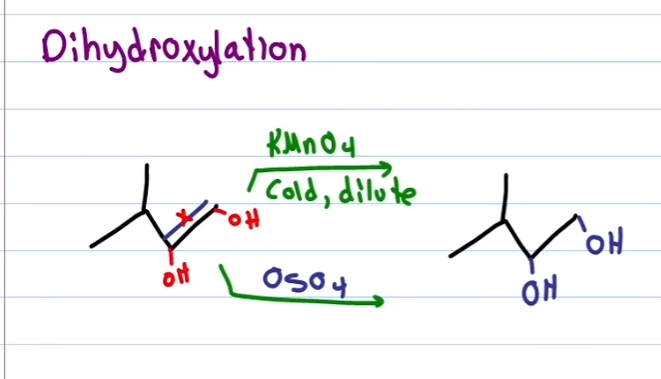
Dihydroxylation (Syn) - 2 Types
Option 1: Reagents: strong oxidizing agent like KMnO₄ under weak conditions (cold, dilute)
Option 2: OsO₄ often followed by NaHSO₃/H₂O.
Markovnikov/anti-Markovnikov: Neither. So, no carbocation, shifts or rearrangements.
More substituted carbon: OH attaches.
Less substituted carbon: OH attaches.
Stereochemistry: SYN addition (both OH groups wedge/wedge or dash/dash)
Dihydroxylation (Anti)
Reagents: Step 1: Peracid, like mCPBA, Step 2: H₃O⁺.
Markovnikov/anti-Markovnikov: Neither, so no carbocation, shifts, or rearrangements
More substituted carbon: OH attaches.
Less substituted carbon: OH attaches.
Stereochemistry: ANTI addition (OH groups end up on opposite faces; one wedge and one dash).

Reagents: Peracid (meaning extra oxygen), like RCO3H or mCPBA
Markovnikov/anti-Markovnikov: Neither, so no carbocation, shifts, or rearrangements. Forms a triangular ring.
More substituted carbon: Oxygen forms a bridge to this carbon.
Less substituted carbon: Oxygen forms a bridge to this carbon.
Stereochemistry: Syn addition (same side)
Product: Epoxide (three-membered ring containing oxygen).

Cyclopropanation (Simmons-Smith)
Reagents: CH₂I₂ and Zn(Cu).
From the 2 halogens, none of them stay on the product. Forms a triangular ring.
Markovnikov/anti-Markovnikov: Neither, so no carbocation, shifts, or rearrangements.
More substituted carbon: CH₂ group forms a bond to this carbon. (add H)
Less substituted carbon: CH₂ group forms a bond to this carbon. (add H)
Stereochemistry: Syn addition

Cyclopropanation (Carbene)
Reagents: Carbene (:CR₂) such as :CCl₂. :CCl₂ can be generated from CHCl₃ and strong base, like NaOH or H2O.
From the 3 halogens, 2 of them stay on the product. Forms a triangular ring.
Solvent: Commonly a nonaqueous solvent.
Markovnikov/anti-Markovnikov: Neither, so no carbocation, shifts, or rearrangements.
More substituted carbon: Carbene carbon forms a bond to this carbon. (add Cl)
Less substituted carbon: Carbene carbon forms a bond to this carbon. (add Cl)
Stereochemistry: Syn addition

Ozonolysis (Reductive)
Reagents: Step 1: O₃, Step 2: (CH3)2S or DMS, or Zn/H₂O.
Markovnikov/anti-Markovnikov: Neither. This is cleavage and NOT addition. Also, no carbocations, shifts, or rearrangements.
More substituted carbon: If it has no H it becomes a ketone. If it has H it becomes an aldehyde. (H)
Less substituted carbon: Same rule. (O)
Stereochemistry: Not applicable because the C=C bond is broken.
Product: Aldehydes and/or ketones. Terminal CH₂ can produce formaldehyde.

Ozonolysis (Oxidative)
Reagents: Step 1: O₃, Step 2: Hydrogen Peroxide - H₂O₂.
Markovnikov/anti-Markovnikov: Neither. This is cleavage and NOT addition. Also, no carbocations, shifts, or rearrangements.
More substituted carbon: If it has no H it becomes a ketone. If it has H it becomes a carboxylic acid. (OH)
Less substituted carbon: Same rule. Product depends on whether that carbon has an H. (O)
Stereochemistry: Not applicable because the C=C bond is broken.
Product: Carboxylic acids and/or ketones. Terminal CH₂ can be further oxidized to CO₂.

Reagents: Hot and concentrated KMnO₄.
Primary carbons become a carboxylic acid or keytone?
Markovnikov/anti-Markovnikov: Neither. This is cleavage and NOT addition. Also, no carbocations, shifts, or rearrangements.
More substituted carbon:
If it has at least one H, becomes a carboxylic acid (COOH).
If it has no H, becomes a ketone (C=O).
Less substituted carbon: Follow the same rule:
At least one H → carboxylic acid (COOH).
No H → ketone (C=O).
Terminal CH₂ → CO₂.
Stereochemistry: Not applicable because the C=C bond is broken.
Product: Carboxylic acids and/or ketones. Terminal CH₂ is strongly oxidized to CO₂.
