4.5 Economic Growth
 Call Kai
 Learn
 Practice Test
 Spaced Repetition
 Match
 Flashcards
 Knowt Play
1/33

There's no tags or description
Looks like no tags are added yet.
34 Terms
Economic growth
Increase in the level of national output which is the annual percentage change in GDP
Gross domestic product
Measures value of goods and services produced within a country for a period of time usually one year (total output in a country).
Ways to measure economic growth
Output method
Income method
Expenditure method
Output method
Measures GDP by adding up all the output produced by all the industries in the country, Makes sure that output is not counted twice so economists must include the value added by each firm and at each stage of production
Value added
Difference between sales revenue received and cost of raw material used
Income method
Includes all incomes which have been earned in producing the country’s output. Transfer payments are not included because there is no correspondence to output of goods and services.
Expenditure method
Adding up all expenditures on the country finished output which is calculated by adding up consumer expenditure (C), investment expenditure (I), government expenditure (G), export earnings (X) minus import expenditure (M), making the formula GDP = C+I+G+(X-M)
Consumer expenditure
Total spending on goods and services by individuals or households in the economy
Investment expenditures
Capital Expenditure of firms which is used for further production and expands the economy’s productive capacity.
Government Expenditure
Total consumption and investment expenditures of the government.
Export earnings
Measures monetary value of all exports sold to foreign buyers
Import expenditures
Measures monetary value of all payments made for all imports.
Circular flow of income
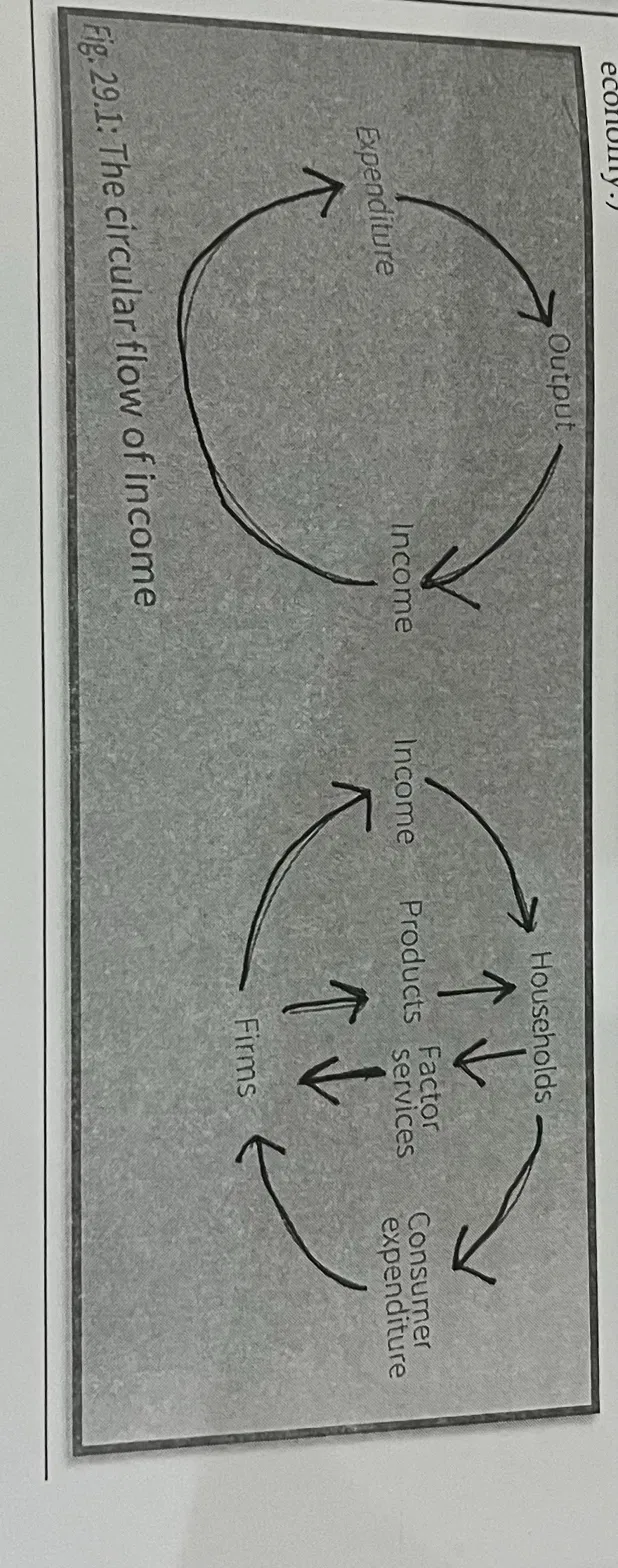
Nominal GDP
Total output produced by a country not adjusted for inflation. GDP at current prices
Real GDP
Total output of a country adjusted for inflation
How to calculate real GDP
Nominal GDP x CPI of previous year / CPI of current year
CPI
consumer price index
Real GDP per head
Real GDP divided by total population of a country
Why is real GDP difficult to measure
Existence of informal economy which has unrecorded economic activity, Can be referred to grey, hidden or shadow economy such as illegal drugs dealing, work done by immigrants who do not have permission to work in the country or businesses who want to avoid government intervention.
Non marketed goods and services such as products which are not bought or sold such as subsistence farming, family members who produce their food for their own use or people who provide services for themselves by cleaning their own house or repairing their own car and are not accounted in GDP.
How to increase economic growth in short term
Increase in any component in GDP.
For example an increase in consumer consumption due to increase confidence or a cut in income tax will increase demand causing it to shift outward causing the firm to increase, output. This will cause movement from within the PPC to towards the PPC.
Long term economic growth causes
Increase in quality or quantity of factors of production
Investment expenditures as it will invest in capital resources increasing quantity of capital causing economic growth
Foreign Direct investment
Investment done by foreign multinational companies to an overseas market
Advantages of economic growth
Economic growth leads to increased employment as the demand for labour will increase as it is derived demand which will increase income so increasing standard of living as people have real income so can spend it on necessities such as housing and food, reducing absolute poverty.
Increase government tax revenue which the government can spend on tax revenue like health care and education
Higher exports will increase exports so increasing international competitiveness so the country can improve its current account of the balance of payments
Disadvantages of Economic Growth
Economic growth has an opportunity cost which is reallocating resources from making consumer goods to capital goods if the economy is working in full capacity reducing living standard and reduce consumer goods in short term as they are already at max capacity
Can cause external costs like congestion, air pollution, environmental damage.
Depletion of resources damaging wellbeing of people and their quality of life in the long term.
Increase stress on the workers as it will increase the number of working hours decreasing their leisure time
Can cause demand pull inflation as if income increase, spending increase, demand increase, prices increase.
Increase demand for imported raw materials and capital goods increasing imports expenditure and worsening balance of payments.
Sustainable economic growth
Economic growth that does not endanger the country’s ability yo grow in the future
How will conserving resources affect the government
Avoids rapid depletion of resources as it takes into consideration the future generations but it will reduce output reducing economic growth and increasing unemployment leading to lower standards of living
Exploiting resources
In the short term it will increase the economic growth and employment but will lead to rapid depletion of resources due to scarcity and does not take into account future generations
Recession
GDP declines over a period of 6 months or more or two successive quarters.
Period of negative output and less being produced than that in the previous period
Causes in recession
Decrease in aggregate demand or aggregate supply
Effects of recession
Lower output
Cyclical unemployment likely
Lower standards of living
Lower investment
Negative demand side shocks
Lower confidence in the economy led to lower consumer and investment expenditure
Government decrease expenditure
Net exports fall due to rise in exchange rate
Negative supply side shock
Rise in cost of production causing businesses to produce less
Actions by the government to increase economic growth in a country
Expansionary Fiscal Policy through its policies of government spending and taxes
Lowering taxes on businesses or foreign investment to decrease cost and increase production
Increase expenditure on health care and education so increasing quality of labour so increasing their skills and productivity
Expansionary monetary policy
Encourage technological advances through financial support increasing the productivity of capital so able to produce more products in less time
Promote free trade and no trade restrictions like tariffs to encourage foreign investment and to decrease the price of imported raw materials and capital goods will be cheaper so reducing cost of production
Reduce exchange rate to increase the demand on exports and reduce the demand on imports so increasing GDP
Supply side policies
Limitations of using government policies to correct a recession
Households and firms may not spend more as they lack confidence in the economy so might save instead of spending
As income will increase, spending will increase and demand will increase so the general price level will also increase causing demand pull inflation
People may demand more imported products rather than local produced one so reducing total demand and reducing firms incentive to produce more