BIOE 370 General Ecology: Exam 2
 Call Kai
 Learn
 Practice Test
 Spaced Repetition
 Match
 Flashcards
 Knowt Play
1/197

There's no tags or description
Looks like no tags are added yet.
198 Terms
What causes population size to change?
births, immigration, death, emigration (BIDE)
What is the equation for population growth?
new population size = old population size + Births + Immigration - Deaths - Emigration
What factors of BIDE do closed populations exclude?
immigration and emigration

Suppose in each year, each individual in the population produces two offspring and then dies. Starting with two individuals at t = 0, calculate the size of the population over the next four years. How much does the population increase each year?
doubles every year
What kind of population growth is it if a population doubles every year?
geometric population growth
What is the equation for geometric population growth?
Nt = N0 × λt
Nt: population size at a given time (future pop.)
N0: initial population size at time = 0
λ: population growth rate (e.g. if the pop. doubles every year, λ = 2)
What is geometric population growth?
when a population changes in size by a fixed proportion (lambda) each time interval
What is the equation for lambda (λ)?
λ = (Nt+1) / Nt
How does the population size change if λ = 1?
the population stays the same size
How does the population size change if lambda is greater than one (λ > 1)?
the population increases
How does the population size change if lambda is less than one (λ < 1)?
the population declines
What does geometric growth assume?
reproduction occurs in discrete intervals
Why is geometric growth considered a discrete model?
populations reproduce at specific, distinct time intervals rather than continuously every second
What is the equation for exponential growth?
dN/dt = rN
r = per capita rate of increase
N = population size
What is the equation for r?
r = birth rate - death rate
What does exponential growth assume?
populations reproduce continuously and generations overlap
Does only r or N change in the exponential growth model?
only N changes
How does the population change if r is greater than zero (r > 0)?
the population grows
How does the population change if r is less than zero (r < 0)?
the population declines
How does the population change if r = 0?
the population is stable
Are r and λ descriptions of multiplicative or additive growth?
multiplicative - multiplies by a constant factor, causing the value to scale and grow faster over time (exponential growth)
You plant some sword ferns in the understory of a wet forest where there aren’t any ferns currently. They do really well! You count the number of ferns each year. Which set of counts seems realistic?
3, 6, 12, 24, 48
Why don’t populations expand indefinitely?
They run out of resources.
Other species consume their resources.
Predation and other disturbances happen.
What does exponential growth assume in terms of density?
per capita rates do not change with density (density independent population growth)
growth rate (r) does not vary with population size (N)
What is density dependence?
a reduction in per capita growth rate (r) with increasing population size (N)
What can cause density dependence?
resource limitations (can impact birth rate or death rate)
What is carrying capacity (K)?
the maximum population size of a species that a specific environment can sustain indefinitely
where birth rate = death rate
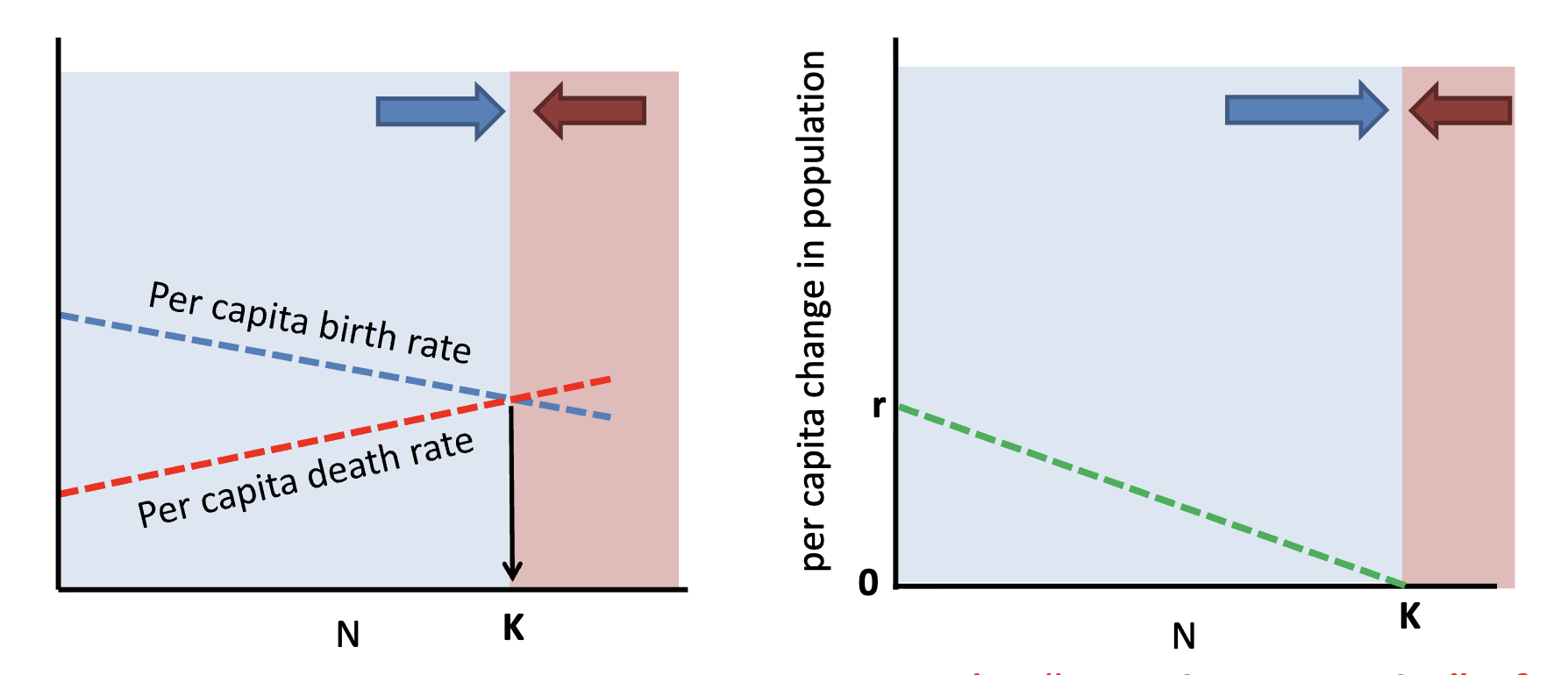
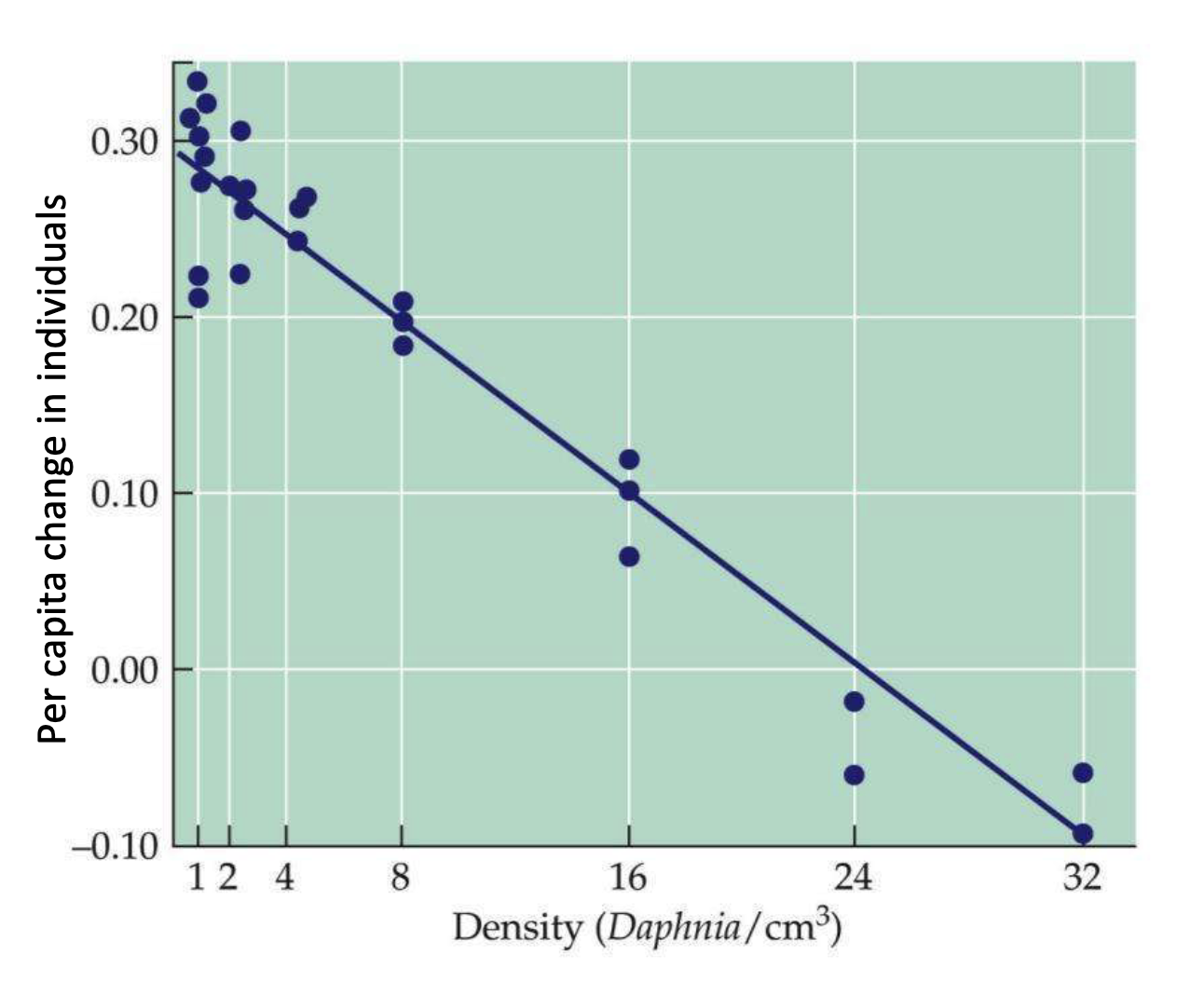
What is K for this population?
32
What is the logistic growth equation?
dN/dt = rmaxN(1 - N/K)
N = population size
K = carrying capacity
What does dN/dt represent in the logistic growth equation?
the number of individuals added to the population each time increment
What does rmax represent in the logistic growth equation?
the highest possible growth rate per individual in a population when resources (such as food, space, and water) are completely unlimited
birth rate - death rate (when N is very small)
Why can you think of the term inside the parentheses of the logistic growth equation as a brake?
the closer the population gets to K, the more the population growth rate (dN/dt) is reduced
What is the difference between exponential growth and logistic growth?
per capita rates have density dependence in logistic growth
populations level off at carrying capacity instead of increasing indefinitely
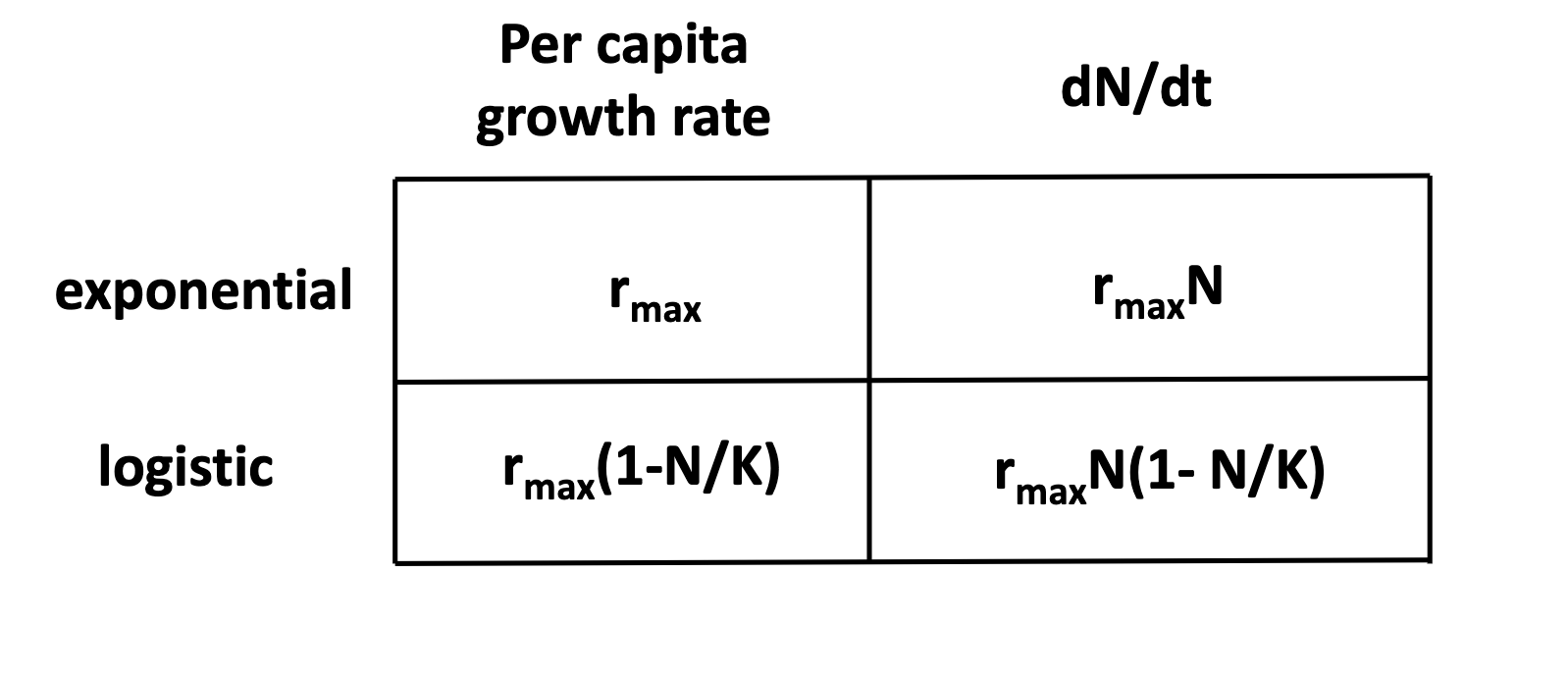
What type of curve does logistic growth make?
sigmoidal (S-shaped) curve

What type of growth occurs when N (population size) is small?
growth is nearly exponential

What type of growth occurs as N (population size) approaches K?
growth rate decreases because resources (food, water, space, etc.) run short
What is the growth rate at carrying capacity?
zero → population size does not change
When does the growth rate (dN/dt) peak?
when N = K/2 (population size is half of carrying capacity)
Which of the following is true?
None of the above
Why is K considered a theoretical equilibrium?
natural populations fluctuate around carrying capacity due to environmental variation
population size is frequently/usually not at K
What is arithmetic growth?
population changes by a fixed amount
opposite of geometric growth
ex: 20, 30, 40, 50, 60
What does connectivity in a population allow for?
allows organisms to find food and mates
dispersal
maintain gene flow
recolonize areas after local extinction
migrate
respond to environmental change
What does connectivity depend on?
depends on the species and spatial scale
a landscape may be well connected for one species but poorly connected for another
What is structural connectivity?
the physical geometry and spatial arrangement of habitat patches (independent of species behavior)
What is functional connectivity?
how organisms actually move through the landscape
Does a physical connection between patches mean that organisms can or will use it?
not necessarily
What is an example of fragmented connectivity on global vs. regional scales?
global: bird migratory paths becoming fragmented
regional: highways blocking wildlife corridors
What does Graph Theory represent for connectivity?
habitat patches or protected areas as nodes, and corridors as edges (links)

What binary distinctions does Graph Theory assume?
patch vs. non-patch
corridor vs. non-corridor
Does Graph Theory generally describe structural or functional connectivity?
structural
What does resistance mapping represent for connectivity?
how difficult different parts of the landscape are for an organism to move through
What does Circuit Theory use for connectivity?
it uses resistance maps to assess many possible dispersal routes
Does resistance mapping generally describe structural or functional connectivity?
functional
Does Circuit Theory generally describe structural or functional connectivity?
functional
What is a metapopulation?
a set of subpopulations connected by dispersal
a “population of populations”
What dynamics do metapopulations focus on?
local extinction and colonization of habitat patches
TRUE OR FALSE: A subpopulation can go extinct while the overall metapopulation persists.
true
When does the metapopulation extinction risk increase?
if individual patches are more likely to go extinct
if there are few patches
What does dispersal allow for?
recolonization of empty patches and sustaining existing subpopulations
You’re in charge of conserving sea urchins in a tropical archipelago. Each island has its own sub-population, but larvae can disperse between them. Should you strive to:
Promote dispersal amongst islands
How can isolation effect genetic diversity in a population?
reduce genetic diversity
increase inbreeding
How does gene flow effect genetic diversity in a population?
increase genetic diversity
improve survival and reproductive success
What is an example of gene flow benefitting a population?
a small, isolated population of Florida panthers showed low genetic diversity and signs of inbreeding depression
introducing Texas females increased genetic diversity
individuals of mixed ancestry had higher survival
What are some ways we can conserve connectivity in species?
Connected networks of small reserves can support populations across a larger landscape (e.g., tigers in central India).
Wildlife crossings and habitat corridors can help maintain movement
through fragmented landscapes.
Why do ecological corridors differ in their importance for population persistence?
Corridors vary based on their quality, width, length, and the specific behavior of the species using them.
A corridor that works perfectly for one species might be completely unusable or dangerous for another.
What is the benefit of combining movement models with population and metapopulation models?
By merging how individuals move (behavior) with how populations grow and interact (demographics), managers can predict which land tracts are most critical to prevent local extinctions
Why must connectivity be evaluated in terms of movement?
measures whether an animal can physically move across the landscape between patches on a daily/seasonal basis to find food, mates, and shelter
Why must connectivity be evaluated in terms of gene flow?
measures whether moving individuals are successfully breeding in the new patches, which mixes the gene pool, prevents inbreeding depression, and maintains genetic diversity
Why must connectivity be evaluated in terms of population persistence?
measures whether the connected network actually keeps the metapopulation stable over time, ensuring that immigration rates are high enough to rescue declining/empty habitat patches from permanent extinction
What is competition?
an interaction that reduces fitness for all participants
reduces growth rate of both populations (-/-)
What is intraspecific competition?
occurs among individuals of the same species
already built into the logistic growth equation
What is interspecific competition?
occurs between different species
adds a term to the logistic growth equation
What is the equation for interspecific competition?
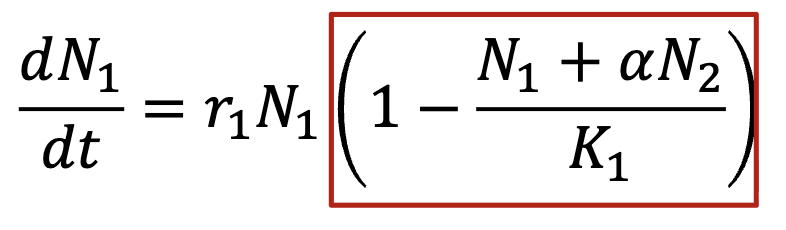
What is interference competition?
direct aggressive behavioral interactions among individuals
(ex: hyenas vs. lions)
What is exploitative competition?
indirect use of shared resources
What is apparent competition?
shared predator/pathogen makes one species appear to suppress another
(ex: hawk preys on both mice and rabbits)
What does the intraspecific growth equation show?
how changing density of species 1 affects its own growth rate

What is the Lotka-Volterra competition model?
a logistic growth model for two species
What is the Lotka-Volterra competition equation for Species 1?
dN₁/dt = r₁N₁(1 – (N₁ + αN₂)/K₁)
What is the Lotka-Volterra competition equation for Species 2?
dN₂/dt = r₂N₂(1 – (N₂ + βN₁)/K₂)
What is a competition coefficient?
measures the effects of one species on the population growth of the other
What does the competition coefficient of α (alpha) represent?
the competitive effect of species 2 on species 1
What does the competition coefficient of β (beta) represent?
the competitive effect of species 1 on species 2
What do both alpha and beta measure for competition?
the extent to which the use of resources by an individual of one species decreases the per capita growth rate of the other species
What does it mean when α = 1?
one individual of species 2 has the same effect on species 1 as one individual of species 1
(interspecific competition = intraspecific competition)
What does it mean when alpha is less than one (α < 1)?
interspecific competition < intraspecific competition
What does it mean when alpha is greater than one (α > 1)?
interspecific competition > intraspecific competition
How are alpha and beta related to the degree of niche overlap between species?
Species with a lot of niche overlap will tend to compete strongly (high competition coefficients)
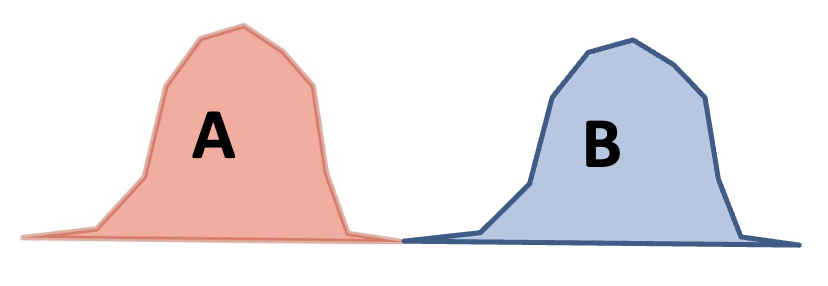
Do these species have high or low competition coefficients?
very low because there is no niche overlap

Do these species have high or low competition coefficients?
high because there is some niche overlap
In which case is alpha for species B on species A likely to be the highest?
A and B consume mostly the same resources
Say that wildebeest compete with three other ungulate species on the African savannah, and that α for Thomson’s gazelle, Grant’s gazelle, and waterbuck are 0.2, 0.22, and 0.9, respectively. Which has the highest impact on wildebeest population growth?
Intraspecific competition with other wildebeest
Why are alpha and beta considered independent of each other?
Just because species 1 affects species 2, it doesn’t follow that species 2 has any predictable effect on species 1

What is exploitation?
interactions where one organism benefits at the other’s expense (+/-)
What are the types of exploitation?
herbivory
predation
parasitism
parasitoidism
disease
What are predators?
consumers that kill and ingest many other organisms over the course of their lives
What are herbivores?
consumers that ingest live plant material but do not usually kill plants
What are parasites?
consumers that live on the tissues of their hosts but do not generally kill the host
What are parasitoids?
consumers that kill a single host in their life (usually insects whose larvae feed off another live arthropod)
What are pathogens?
organisms that induce disease in the host