Soil Fertility Exam #1
 Call Kai
 Learn
Learn Practice Test
 Spaced Repetition
 Match
Match Flashcards
 Knowt Play
1/154

There's no tags or description
Looks like no tags are added yet.
Name | Mastery | Learn | Test | Matching | Spaced | Call with Kai | Chat |
|---|
No analytics yet
Send a link to your students to track their progress
155 Terms
Define nutrient
any element or compund used for the proper growth and development of an organism
Define mineral nutrient
Any nutrient or essential element drived from soil (all except C, H, O)
Define essential element
One of the 17 elements required by plants to complete its normal life cycle
Define soil fertility
The quality of a soil that enables it to provide nutrients in adequate amounts and in proper balance for the growth of specified plants or crops.
Define soil productivity
Soil productivity is the ability of a soil to produce an adequate amount of plant growth with optimum management
Fill in the black: All _________ soils are _______, but not all ______ soils are productive
All productive soils are fertile soils, but not all fertile soils are productive.
What are some major yield limiting factors (besides nutrients) for crops? Which ones can the producer manage?
Moisture
Low Fertility
Poor Stand
Poor soil moisture
Improper crop variety
Weeds
Insects and diseases
Possible reduction
Where do plants get their nutrients?
Air and Water (Carbon, Hydrogen, Oxygen) 96% Soil: 4%
Sir Francis Bacon
In the late 1500’s he speculated that soil only supported plants and protected them from heat and cold, while water was the only “nutrient” required for growth.
Jan Baptiste van Helmont (1577-1644)
He grew a willow tree in 200 lbs of soil for five years. He added only water. The tree gained 165 lbs, while the soil lost only 2 oz. He was sure that water was the only nutrient needed for growth. Also believed he could turn mercury to gold.
Jethro Tull
In the mid 1700s ge suggested tiny soil particles are “ingested” through openings in plant roots and enter its “circulatory system”. Therefore, he suggested plowing soil to a “fine powder” so that plants could more easily injest it. He also invented the horse hoe and seed drill
Jean Senebier
In the late 1700s, he contributed to our knowledge of the influence of light on vegetation. He stated that the increase in the weight of van Hemont’s willow tree was due to the air!
Justis von Liebig (1803-1873)
Considered the father of modern soil fertility
– Stressed the value of mineral elements
– Discovered carbon in plants comes from CO2, H and O come from water
• Derived source and function of several nutrients
Liebig’s Law of Minimum
A crop can only grow as well as its most limiting essential resource allows.
Thomas & Way
1845, recognized ion exchange in soil (ammonium from manure exchanged for calcium and potassium
Fritz Harber
1918, was awarded Nobel Prize for Chemistry for synthetic nitrogen fixation (also directed the most deadly chemical warfare attacks of WWI)
Carl Boch
He was awarded the 1931 Nobel Prize for Chemistry for industrializing the Haber process
What is the Harber process?
The Haber-Bosch Process takes nitrogen from the air (N₂) and turns it into ammonia (NH₃) to make fertilizer that helps crops grow. Make the Green Revolution possible.
Norman Borlaug
He is a plant breeder, Nobel Peace Prize in 1970 for the Green Revolution
Native Americans
Widely used companion crops such as “three sisters”
Used Mound plantings to improve drainage
Utilized irrigation in arid regions
Used natural fertilization (wood ash, fish, plant materials, and animal waste)
Ancient Mesopotamia (Fertile Crescent)
Annual flooding created fertile lands along the Tigris and Euphrates Rivers
Irrigation/drainage
Oversalinization eventually destroyed crops, shifting populations north
Deforestation over-grazing followed
Large-scale ecological destruction created a “mass exodus” from the region
Early Amazonian civilizations
Dark, fertile soils in the Amazon basin names terra preta
The presence of charcoal, pottery, and bones indicated they were mainly farming
Mayan Civilization – Mexico, Central America
Developed sustainable farming practices
later used slash and burn techniques
Greeks and Romans
Used slash and burn techniques on uplands
Geometric systems to lay out crop lands
Used rotations with green manure to improve fertility
Used marl (lime, wood ashes, animals manure, and saltpeter to improve fertility
Arnon and Stout’s Deginition of an essential nutrient:
An essential nutrient is one a plant must have to complete its life cycle, cannot replace with another nutrient, and uses directly for growth and development. You could also add: substantial number of plany species
Define benefical elements:
promote plant growth in many plant species but are not absolutely necessary
for completion of the plant life cycle, or fail to meet Arnon and Stout's criteria on other grounds
Primary form of N plants take up:
Nitrate (NO₃⁻) and Ammonium (NH₄⁺)
Primary form of P plants take up:
H₂PO₄⁻ and HPO₄²⁻ (Dihydrogen phosphate and Hydrogen phosphate)
Primary form of K plants take up:
K⁺ (Potassium Ion)
How to remember the 17 essential plant nutrient elements?
C.Hopkins cafe, managed by mine cousin Mokel, who owes me a nickel. → C Hopkns CaFe, Mg B Mn CuZn MoCl, Ni
Define deficient
Concentration is low enough to cause decreased yield and visual deficiency symptoms
Define critical range
Concentration is below the level at which yield responds to added nutrients
occurs – no deficiency symptoms
Define sufficient
Concentration range in which added nutrients do not increase yield
Define excessive or toxic
Concentration is high enough to reduce plant growth or yield
What is the Steenburg Effect and what causes it?
When nutrient concentration goes down but yield goes up. This is when a plant is utilizing the nutrients in the seed to get its initial growth to help it develop a root system to develop to reach more nutrients.

What does this chart show you?
More nutrients do not always mean more yield. Plants need the right amount of nutrients for optimal growth.
NDVI
Normalized Difference Vegetation Index; requires reflectance information in
red and near-infrared wavelengths.
SPAD meter
Estimates relative chlorophyll concentration in leaf tissue; often used as an
indicator related to crop N status.
Corn stalk nitrate test
End-of-season diagnostic of N management; it does not adjust the current
season N rate.
Define growth cessation
When a plant stops growing because an essential nutrient or another necessary resource is too limited to support further growth.
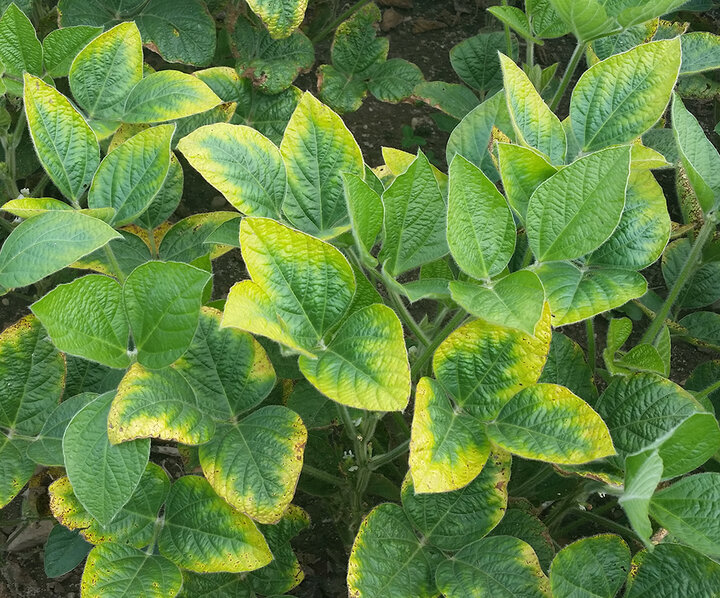
What type of deficiency is this?
nitrogen - Leaves are small and light green; lower (older) leaves lighter than upper ones; not much leaf drop; small, weak stalks

What type of nutrient deficiency is this?
Phosphorus - Dark-green foliage; lower leaves sometimes yellow between veins; purplish color on leaves or petioles.

What type of nutrient deficiency is this?
Potassium - Lower leaves may be mottled; dead areas near tips and
margins of leaves; yellowing at leaf margins continuing toward center.

What type of nutrient deficiency is this?
Calcium - Tip of the shoot dies; tips of young leaves die; corn: tips
of leaves are hooked-shaped.

What type of nutrient deficiency is this?
magnesium - Lower leaves are yellow between veins (veins remain green); leaf margins may curl up or down or leaves may pucker; leaves die in later stages.

What type of nutrient deficiency is this?
Sulfur - Tip of the shoot stays alive; light green upper leaves; leaf
veins lighter than surrounding areas
Chlorosis
uniform or interveinal yellowing or light green
Necrosis
death of leaf tips, margins, or interveinal region of leaves
Reddening
Accumulation of anthocyanins causes red or purple color on leaf margins, interveinal regions, or whole leaves
Stunting
reduced plant heights, shorter internodes and leaves may remain dark or become light green
Why might tissue testing not be feasible for correcting nutrient deficiency?
The deficiency may have already caused yield loss
The crop may not respond to the applied nutrient at the specific growth stage tested
The crop may be too large to apply nutrients
Climatic conditions may be unfavorable for fertilization
Why is it recommended to take samples from both healthy (normal) areas and unhealthy areas when taking tissue samples?
This gives you something to compare to across all nutrients
Explain generally how tissue tests for total nutrient analysis are conducted in a laboratory? Why is sample handling and selecting the proper plant part and growth stage important?
Performed on specific plant parts (Petioles, stems, leaves) in a laboratory after the tissue is dried and ground
Nutrient content determined after wet digestion with acids or dry aching in furnace
Samples should be clean and dried or refrigerated immediately after sampling
Part selected is important
What is a cell sap test and how is it conducted?
Estimates of nutrient concentration in tissues can be made in the field using cell sap extracted from the plant
Typically done on conductive tissues. Petioles are used for most vegetable crops
What factors can influence a cell sap test?
Time of day, variety, and location can affect concentrations
Critical Nutrient Concentration
CNC is part of the nutrient concentration curve where nutrient concentration changes from deficient to adequate.
Critical Nutrient Range
range above which nutrients additions are not likely to increase yields, and below which nutrient additions are likely to increase yield.
List some commonly used tissue nutrient ratios:
N:P, N:S, K:Mg, Ca+Mg:K, etc.
Equation for NDVI
NDVI = NIR-RED/ NIR+RED
List some examples of canopy senors for NDVI measurements:
Crop Circle, Greenseeker, Cropspec
Provide examples of post-mortem tissue tests and limitations of their use in managing soil fertility.
Post-mortem tissue tests are useful for diagnosing nutrient problems and improving fertilizer decisions for future crops, but they may not help correct problems in the current growing season. Examples are stalk testing, leaf tissue analysis, and grain analysis.
Describe generally how remote-sensed information is used to identify nutrient stresses?
Remote sensing uses drones, satellites, and sensors to measure reflected light from crops to identify areas of possible nutrient stress. Farmers use this information to locate problem areas and make fertilizer decisions.
List factors that affect nutrient concentrations in the soil solution:
Soil air, soil OM, rainfall, evaporation, drainage, solid minerals, surface (ion exchange), nutrient uptake.
Ion Exchange
Reversible process by which cation or anion adsorbed on the soil surface is exchanged with another cation or anion in the liquid phase
Cation Exchange
Negatively charged particles attract and hold exchangeable cations on their surfaces
Is cation exchange more important and larger then anion exchange in soils?
Yes CEC>AEC
Where does cation exchange occur?
Mineral surface, OM surfaces, root surfaces
What is a N sufficiency index and how is it calculated from chlorophyll meter readings?
SI = average reading from unknown area x100
Average meter reading for reference area
What is the primary disadvantage of post-mortem tests?
It often requires multiple years of date to accurately estimate N requirements
What two types of layers (sheets) make up the silicate clay minerals and also list the ionic forms of elements that comprise each layer.
Silica tetrahedra – 4 sided sheet
Aluminum Octahedra – 8-sided sheet
Kaolinite
1:1 clay mineral (1 octahedral sheet and 1 tetrahedra) very low CEC
Pyrophyllite
2:1 clay mineral
Mica
1:4
Vermiculite
More isomorphic = higher CEC
Montmorillonite (smectite)
More isomorphic = higher CEC
Isomorphic substitution:
Gives rise to permanent charge on surface of clay minerals
Caused by subsitution of ions with lower charge of Si+4 and/or A+3
Negative charge is distributed evenly over the clay mineral surface
What are the two major sources of pH-dependant charge in soils and what gives rise to the pH-dependent charge in them?
Soil OM = the release (dissociation) of H⁺ from carboxylic and phenolic functional groups.
Broken Edges of Clay Minerals = Charge comes from Al–OH and Si–OH groups that gain or lose H⁺.
What are the standard units used to express cation and anion exchange capacity in soils?
Expressed as meq/100 g or cmol/kg dry soil
How does organic matter affect soil CEC?
Organic matter increases CEC because its negatively charged surfaces hold and exchange positively charged nutrients (cations).
How does organic matter exchange cations and anions?
At high pH, carboxylic and phenolic groups lose H⁺, creating negative charges that hold cations. Positive sites can attract anions, especially at low pH.
What is an equivalent (eq)?
An amount of ions containing 6.02 × 10²³ positive or negative electrical charges.
What is normality (N)?
The number of equivalents of a substance per liter of solution (eq/L).
Rank common clay minerals by CEC, highest to lowest.
Vermiculite > Montmorillonite (smectite) > Mica > Kaolinite
What are the typical CEC values of clay minerals?
Vermiculite: 120–150; Montmorillonite: 80–120; Mica: 20–40; Kaolinite: 1–10 meq/100 g.
What is the CEC of organic matter?
Approximately 100–300 meq/100 g, making it a major contributor to soil CEC.
Rank soil types by typical CEC, lowest to highest.
Light sands < dark sands/light loams < dark loams < clayey soils < organic soils.
What are typical CEC values for different soil textures?
Light sands: 3–5; dark sands/light loams: 10–20; dark loams: 15–25; clayey soils: 20–50; organic soils: 50–100 meq/100 g.
How do you estimate soil CEC from clay minerals and organic matter?
Multiply each component's fraction of the soil by its CEC, then add all the contributions.
What is the lyotropic series?
The order in which cations are held by soil exchange surfaces, based on adsorption strength.
What is the lyotropic series for common soil cations?
Al³⁺ > H⁺ > Ca²⁺ > Mg²⁺ > K⁺ = NH₄⁺ > Na⁺. Strongest adsorption is on the left.
What is base saturation?
The percentage of total soil CEC occupied by the basic cations Ca²⁺, Mg²⁺, K⁺, and Na⁺.
How does base saturation relate to soil pH?
As soil pH increases, base saturation generally increases. Low-pH soils generally have lower base saturation.
What is soil buffer capacity?
The soil's ability to maintain or resupply nutrient concentrations in the soil solution as nutrients are added or removed.
What are quantity and intensity?
Quantity (Q) is the amount of nutrient held on soil surfaces. Intensity (I) is its concentration in the soil solution.
What is the buffer capacity formula?
Buffer capacity = ΔQ / ΔI (change in quantity divided by change in intensity).
How are CEC and buffer capacity related?
Soils with higher CEC generally have greater nutrient buffer capacity because they can hold and release more exchangeable nutrients.
Which soil generally has greater buffer capacity: sandy or clayey?
Clayey soil, because it typically has more exchange sites and can maintain nutrient concentrations more effectively.
What causes root CEC?
Mainly carboxyl (COOH) groups on root surfaces, responsible for about 70–90% of root CEC.
Which has higher root CEC: broadleaf plants or grasses?
Broadleaf plants generally have higher root CEC and preferentially adsorb divalent (+2) cations. Grasses more readily adsorb monovalent (+1) cations.
What are typical Wisconsin P and K buffer capacities for medium-fine textured soils?
P = 18 lb P₂O₅/acre per 1 ppm; K = 6–7 lb K₂O/acre per 1 ppm, depending on soil group.