Unit 6 - Cell Respiration and Metabolism
 Call Kai
 Learn
 Practice Test
 Spaced Repetition
 Match
 Flashcards
 Knowt Play
1/55

Earn XP
Description and Tags
Vocabulary practice flashcards covering cell respiration, glycolysis, the lactic acid pathway, glycogen metabolism, aerobic respiration, the Krebs cycle, electron transport, oxidative phosphorylation, and the metabolism of lipids and proteins from Chapter 5 of Human Physiology.
56 Terms
Metabolism
The complete set of chemical reactions in the body that involve energy transformations, divided into catabolism and anabolism.
ATP is made primarily from
glucose, lipid, and proteins
What is regenerated in ETC?
NAD + FAD to shuttle more electrons from Krebs cycle to ETC
Equation for catabolism of glucose. What is this known as and what does it produce?
C6H12O6 + O2 → 6 CO2 + 6 H2O + ATP. cellular respiration (although first part is anaerobic) yields about 38 ATP
Catabolism
The metabolic breakdown of complex organic molecules into simpler compounds, which releases energy (exergonic) and serves as the primary energy source for making ATP.
Anabolism
The phase of metabolism that synthesizes larger molecules from simpler precursors, requiring energy input (endergonic) and producing the body's energy-storage compounds.
Glycolysis and O2 requirement
The anaerobic metabolic pathway occurring in the cytoplasm that oxidizes one molecule of glucose into 2 molecules of pyruvic acid, and produces a net yield of 2ATP and 2NADH, doesn’t require O2
Glucose combines with what to yield its product
glucose + 2NAD + 2 ADP + 2Pi → 2 pyruvic acid + 2 NADH + 2 ATP
Glucose is ___ atom and becomes what?
6 Carbon atom, split in ½ to become two 3 Carbon atoms
What is the main function of the Krebs cycle?
Extract electrons
Glucose Trapping (Phosphorylation)
The initial priming reaction of glycolysis in which ATP activates glucose by adding a phosphate group to 6 C atom form glucose 6-phosphate, trapping glucose inside the cell.
Glycogenolysis clips ____ out of glycogen as glucose _______ if cells need ____
glucose, 6-phosphate, need glucose
In glycolysis, after adding the 2nd phosphate what happens to glucose?
split into 3 carbon molecules and each of the 2 molecules goes through electron extraction (NAD → NADH), 2 NADH + 4 ATP in energy releasing but gain 2 ATP
Lactic Acid Pathway
An anaerobic metabolic pathway in which NADH is oxidized to NAD+ while pyruvic acid is reduced to lactic acid by lactate dehydrogenase (LDH), avoiding end-product inhibition with a net gain of 2ATP.
RBCs don’t have ____ they only use which pathway?
mitochondria, LA
Where does the LA pathway and when?
skeletal and heart muscle when O2 supply falls below critical level during heavy exercise or vascular blockage
What is regenerated in LA fermentation and what does this allow?
2 NAD+s at the end and can go back to glyolysis
Why must pyruvate be converted to LA in absence of O2?
Because pyruvate would accumulate in the cell and inhibit glucose → end-product inhibition meaning NO ATP would be generated
Proteins in ETC
accepts electrons and is reduced + oxidized when gives electrons to next protein (exergonic)
If you run out of NAD+ what happens and what can you do?
no glycolysis, give electrons from NADH back
Increasing the activity level does what?
run out of O2 so go through LA → increases pH → decreases muscle contraction → fatigue, microtear → soreness (not due to LA)
Alcohol Fermentation
An anaerobic pathway in which NADH is oxidized to NAD+ while converting pyruvate into CO2 and ethanol through two decarboxylation events.
In a lab setting, what does the accumulation of CO2 signify in test tubes?
glycolysis is taking place
Glycogenesis
The production of glycogen from glucose molecules, primarily occurring in skeletal muscles and the liver to store carbohydrate without causing osmotic cell swelling.
Glycogenolysis
The hydrolysis or brkdown of glycogen that yields glucose 6-phosphate for glycolysis, or free glucose in the liver that can be secreted into the blood.
Glucose-6-Phosphatase
An enzyme present only in the liver that removes the phosphate group from glucose 6-phosphate, enabling the liver to release free glucose into the bloodstream.

Cori Cycle. What can this also happen with?
LA produced by contracting skeletal muscles travels through → blood → liver, where it is converted back through pyruvic acid → glucose + glycogen and then to glucose via gluconeogenesis. Can also happen with amino acids and glycerol
Gluconeogenesis
The production of glucose from noncarbohydrate molecules, including LA and amino acids, primarily in the liver.
When does aerobic respiration begin?
Pyruvic acid formed by glycolysis enters the mitochondria

How is Acetyl CoA formed + its purpose, what happens to CO2?
pyruvic acid loses CO2 + coenzyme A (a carrier of acetic acid) = Acetyl CoA . energy in acetyl CoA extracted during aerobic respiration in mitochondria and CO2 goes to lungs
Krebs Cycle (Citric Acid Cycle). Why is it a cycle?
mitochondrial pathway that begins when acetyl CoA (C2) + oxaloacetic acid (C4) to form citric acid (C6). It’s a cycle because citric acid moves through series of rxns to produce oxaloacetic acid again
Important events of Krebs cycle. How many times do these occur for each acetic acid and glucose molecule?
1. ____ produced, which donates ____ to form _____
2. ___ molecules of ___ are ____ to ____
3. ____ molecule of ____ is _____ to _____
acetic acid = once, glucose mol = twice
one GTP donates phosphate group to ADP forms ATP
3 NAD reduced to NADH
1 FAD reduced to FADH2
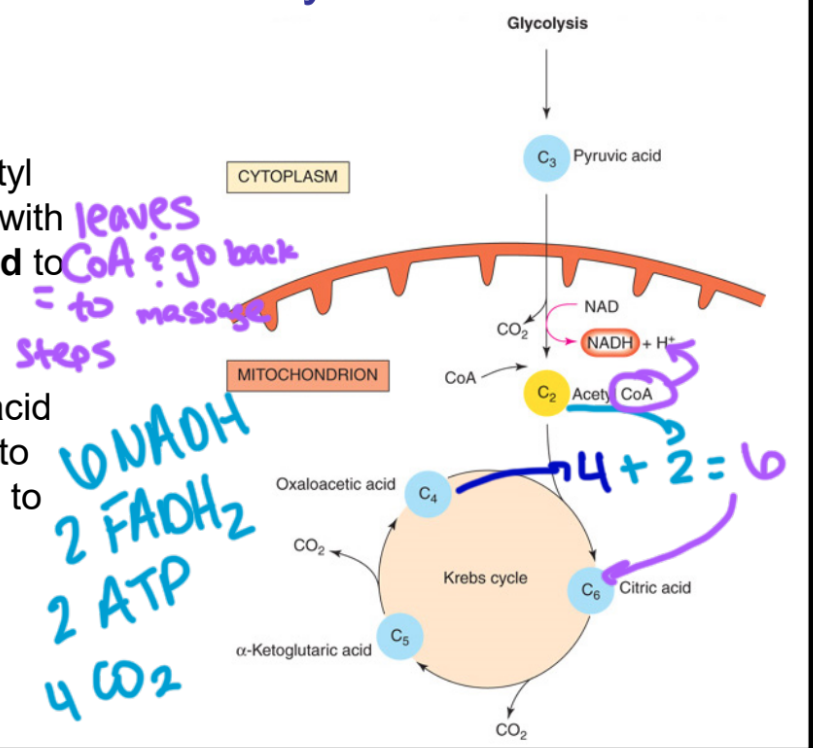
What’s the first intermediate of the Krebs cycle?
citric acid
How many oxidation-reduction rxns in Krebs cycle, how many NADHs per Acetyl CoA, what is regenerated?
4 rxns, 3 NADHs, NADH + FADH2 regenerated
Products of the Krebs cycle per glucose. How many and which molecules come from a different process?
6 NADH, 2 FADH2, 2 ATP, 4 CO2. 2 NADH + 2 ATP from glycolysis
Electron Transport Chain (ETC). What are the 3 proteins involved and what carries electrons to ETC?
A linked series of electron-carrier proteins FMN, coenzyme Q, and cytochromes. located on the cristae of the mitochondria where Krebs cycle NADH and FADH2 carry electrons shuttled through ETC
Substrate-Level (direct) Phosphorylation
The direct transfer of a phosphate group to ADP when chemical bonds are broken, generating 2ATP in glycolysis and 2ATP (via GTP) per glucose in the Krebs cycle.
Oxidative Phosphorylation and how many ATPs
The exergonic process in mitochondria in which energy extracted during electron in Krebs drives the phosphorylation of ADP to produce ATP. 30-32 ATPs made this way

Chemiosmotic Theory
energy released by the ETC pumps protons (H+) into the mitochondrial outer chamber + creates high H+ concentration + H+s diffuse down concentration and charge gradient through ATP synthase and back into inner chamber driving ATP synthesis
Final Electron Acceptor
Oxygen (O2), which accepts electrons at the end of the ETC and combines with 4H+s according to the reaction O2+4e−+4H+→2H2O.
Net production of ATP
34 ETC, 2 from glycolysis, 2 from direct phosphorylation in Krebs = 38 total ATPs per gluose
Lipogenesis
The formation of triglycerides (fat) from fatty acids and glycerol, primarily occurring in adipose tissue and liver
Lipolysis
hydrolysis of triglycerides into free fatty acids and glycerol by lipase, primarily occurring in adipose tissue
Too much energy?
can’t store ATP for later when more food energy than needed it taken into the body so glucose is converted into glycogen and fat

lipid metabolism. glucose doesn’t complete what process so what happens to Acetyl CoA
ATP levels rise after energy-rich meal, inhibiting ATP production and glucose doesn’t complete. glc doesn’t complete glycolysis to form pyruvate and acetyl CoA already formed joined to produce variety of lipids including cholesterol, ketone bodies, fatty acids
Beta-Oxidation
enzymes remove acetic acid molecules from fatty acid chains to form acetyl CoA molecules, yielding energy directly and via the Krebs cycle and ETC.
For every 2 carbons on FA chain, how many Acetyl CoA formed? 16 C FA → ___ Acetyl CoA. How many NADH, FADH2, ATP does each acetyl CoA have so how many ATP + electron transport would this be in a 16 C FA.
1 Acetyl CoA, 16 C FA → 8 Acetyl CoA. 1 Acetyl CoA = 10 ATP + 1 NADH + 1 FADH2. 16 C FA → 80 ATP + 28 electron transport = 108 ATP
Ketone Bodies
when the rate of lipolysis exceeds the rate of FA utilization (as in dieting, starvation, diabetes) concentration of FA in blood increases. liver cells convert FA into acetyl CoA + then ketone bodies that are water-soluble and circulate in blood
Ketogenesis
formation of ketone bodies, which are four-carbon-long organic acids, from fatty acids during periods such as starvation, dieting, or diabetes in the liver
What happens if more AA than needed are consumed?
Excess used for energy or converted into carbs/fat
Essential Amino Acids
Our bodies can make 12 of the 20 AA from other molecules. The eight amino acids in adults (nine in children) that the human body cannot synthesize from other molecules and that must therefore be supplied by the diet.
Transamination
amine group (NH2) from an amino acid added to a keto acid (such as pyruvate or a Krebs cycle intermediate) to form a new amino acid, requiring vitamin B6 as a coenzyme + obtained from other amino acids
Example of transamination
amine from glutamic acid added to oxaloacetic acid (Krebs cycle intermediate) forming aspartic acid
Oxidative Deamination
if more AA than needed, stripping the amine group from an excess amino acid, converting the nitrogen into urea excreted in urine while leaving pyruvate or another Krebs cycle intermediate can be used to make energy / converted to glucose or fat
Importance of different molecules in blood w respect to energy requirements of different organs. brain, skeletal muscles (resting), liver, heart
brain - glucose, skeletal muscles (resting), liver, heart - FA
Catabolism of what produces ATP
glucose