Personality disorders
 Call Kai
 Learn
 Practice Test
 Spaced Repetition
 Match
 Flashcards
 Knowt Play
1/24

There's no tags or description
Looks like no tags are added yet.
25 Terms
List the Criteria for Personality Disorder (3)
Dev. And Course
Prognosis
Common in males? females?
General Criteria for a Personality Disorder:
Pattern of experience/behavior that deviates from expectations of individual’s culture
Manifested by at least two:
Cognition
Affectivity
Interpersonal functioning
Impulse control
Pattern =
inflexible and pervasive
Stable/Long Duration; Traced back to adolescence/early adulthood
significant distress or impairment
Pattern must be present for at least a yr
(antisocial personality disorder is not diagnosed before the age of 18)
Development and Course
Prognosis:
Some improve w/ Age (borderline, antisocial);
Others Don’t (obsessive-compulsive, schizotypal)
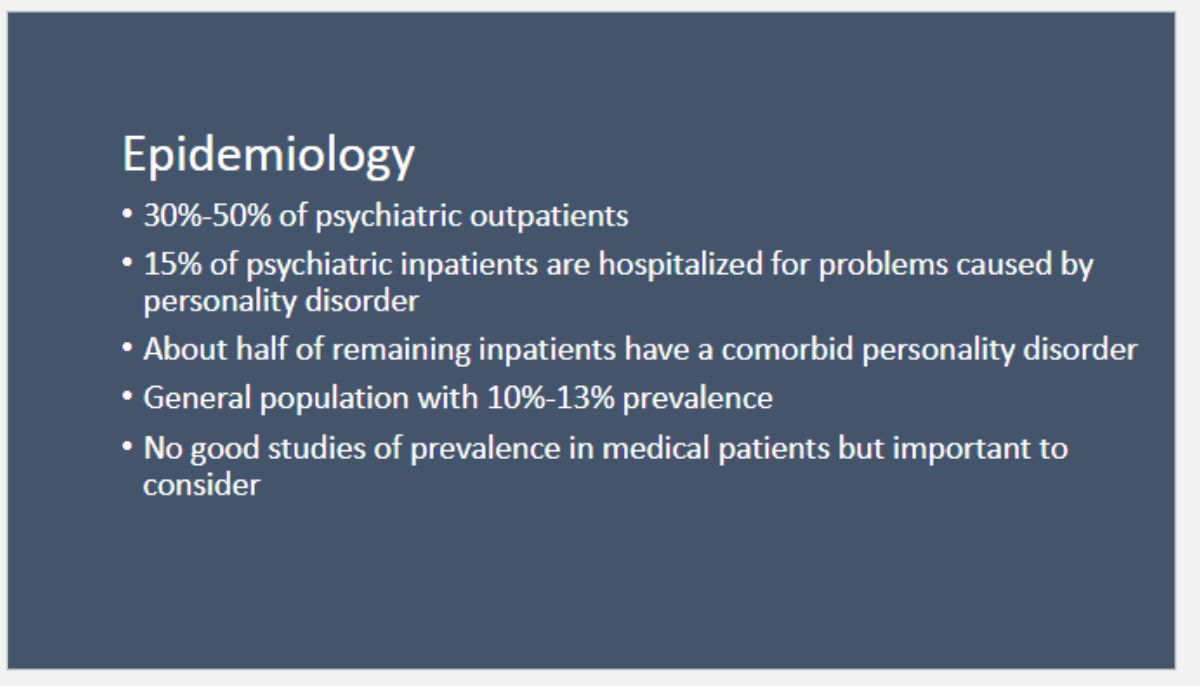
Diagnosed more in males:
Antisocial
Diagnosed more in females:
Borderline
Histrionic
Dependent

List the Basic Principles For Managing a Patient With a Personality Disorder (6)
Basic Principles For Managing a Patient With a Personality Disorder
Identify and honor patient’s strengths:
Where did best functioning occur
Identify prior medication response
Identify prior treatment factors precipitating prior patient response
Provide structure
Offer details of the structure and function of treatment
Define goals and boundaries
Reassess patient situation
Recognize own limitations
Get help when needed
Take care of your own stress management
List the Personality Clusters and associated personality disorders
Personality Clusters
Cluster A
Paranoid
Schizoid
Schizotypal
Cluster B
Antisocial
Borderline
Histrionic
Narcissistic
Cluster C
Avoidant
Dependent
Obsessive-Compulsive
Describe Paranoid Personality Disorder
Dx Criteria (7)
Prevalence
More common in? (3)
Associated w/
Symptoms during childhood (5)
Consequences (2)
Mental Status:
Affect:
Mood:
Thought process:
Thought content:
Primary defense mechanism
Tx:
Difficulty? Sln?
Methods
Dx Criteria:
Pervasive distrust and suspiciousness; as indicated by 4:
Suspects (w/o basis) that others are plotting on him
Preoccupied w/ unjustified doubts of loyalty of friends/associates
reluctant to confide in others (fears info be used against them)
Interpret neutral stimuli as hidden demeaning or threatening
Persistently bears grudges
Perceives unapparent attacks on character + quick to react w/ anger or couterattack
Recurrent suspicions on loyalty of partners
Prevalence
2.3 to 4.4%
More commonly in
Males
Women in research studies
Prisons and inpatient psychiatric units
May be more common if related to people w/ schizophrenia (association is weak)
During childhood:
Solitariness
Limited peer relationships
Social anxiety
Underachievement
Peculiar thoughts and language
Consequences:
Difficult to get along with
May be argumentative/hostile aloofness
Mental status
Affect:
may be normal of labile
Mood:
May be angry
Thought process:
Rigid, concrete understanding.
Thought content:
Suspicious. Perceived victimization.
Primary defense mechanism
PROJECTION
Tx:
Difficulty:
Engaging and Compliance
Mistrust -> avoidance
Soln:
Maintain respectful, straightforward and non-intrusive style
Avoid being overly warm or excessively interested
CBT
Coping skills
develop trust and empathy
Antipsychotic medication
only if they develop psychotic symptoms
What is the difference between Paranoid personality disorder and Delusion Disorder (3)

Describe Schizoid Personality Disorder
Dx criteria (7)
Pt Characteristics (2)
How does Pt Interpret Illness and Sln:
Tx
Difficulty
Methods
Schizoid Personality Disorder
Dx Criteria:
persistent pattern or detachment from social relationships + restricted emotional expression range in interpersonal settings + 4:
Doesn’t Want/Like close relationships (including family)
Lacks close friends/confidants (other than first degree relatives)
Prefers solitary activities
LIttle interest in having sex
Takes pleasure in few activities
Indifferent to praise/criticism of others
Shows emotional coldness, detachment, or flattened affectivity
Begins by early adulthood,
Pt Characteristics:
Often oversensitive, fragile and lacking resilience
Aloofness = protective
How does Pt Interpret Illness and Sln:
Illness = frightening intrusion
Disrupt equilibrium of solace/satisfaction w/in oneself
Sln:
Make few demands for personal involvement with others
Do not permit complete withdrawal
Ensure patient knows the routines of procedures, meals and medication administration
Treatment
Difficulty:
Rarely seek treatment, as don’t see the value
May be brought by family or others
May come for treatment of anxiety or depression
May only tolerate supportive type therapy aimed at crisis resolution
CBT
Help understand usefulness/importance of interpersonal relationships
Slowly encourage social involvement
Group therapy
social skills
No Meds indicated
Describe Schizotypal Personality Disorder
Dx Criteria (8)
Mental status features
Cognitive and perceptual distortions:
Thought process
Behavior:
Speech
Affect
Mood
Appearance
Treatment
Dx Criteria:
Pervasive pattern of: acute discomfort/reduced capacity for relationships + cog/perceptual distortions + eccentric Behavior; as indicated by 5:
Ideas of reference
Odd beliefs or magical thinking -> influences behavior
inconsistent with subcultural norms
Odd, eccentric or peculiar Behavior/appearance
Odd thinking and speech
Unusual perceptual experiences
including bodily illusions
Suspiciousness or Inappropriate or paranoid ideation
Lack or close friends/confidants (other then first-degree relatives)
Excessive social anxiety
Does not diminish w/ exposure
Associated w/ Paranoid fears (not negative judgement)
Beginning by early adulthood
Mental status features
Cognitive and perceptual distortions:
ideas of reference:
bodily illusions
unusual telepathic and clairvoyant experiences
Thought process
linear or rambling
Behavior: eccentric
talk to themselves in public
gesture for no apparent reason
dress in a peculiar or unkempt fashion
Speech
odd and idiosyncratic
unusually circumstantial
Metaphorical
vague
Affect
constricted or inappropriate
Mood
normal or anxious
Appearance
disheveled or eccentric
Schizotypal PD Treatment
When present to the ER, usually severe social crisis
Supportive psychotherapy
Calm, predictable, non-judgmental
Can be vulnerable to sensory overload from the hospital
Interpersonal
Focused on reducing interpersonal conflict or improving SES
No psychotropic medications indicated unless other psychiatric disorder present

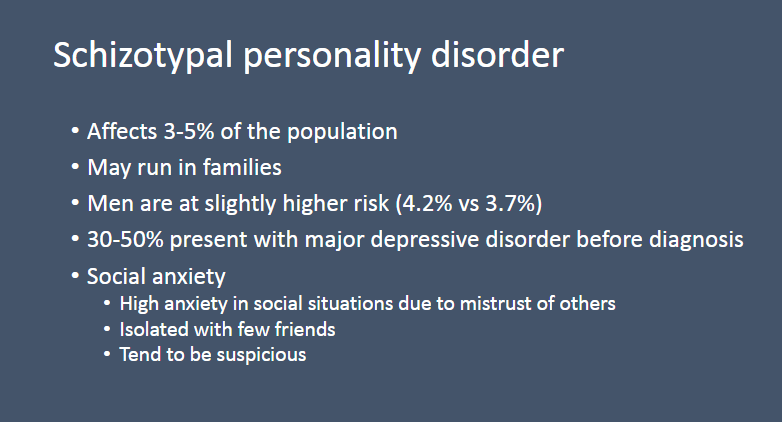
What is the difference between Schizotypal PD and Schizophrenia (4/3)
Describe Antisocial Personality Disorder
Dx Criteria (7)
Epi
Tx
Dx Criteria:
Pervasive disregard/violation of others rights; as indicated by 3:
Fails to conform to Law (Social Norms)
Repeatedly performing unlawful acts
Deceitfulness
Impulsivity or failure to plan ahead
Irritability/aggressiveness
repeated physical fights or assaults
Consistent irresponsibility
Reckless disregard for safety (self/others)
Lack of remorse
Indifferent or rationalizing
Evidence of Conduct Disorder with onset before 15 years
Individual is at least age 18 years.
Epidemiology
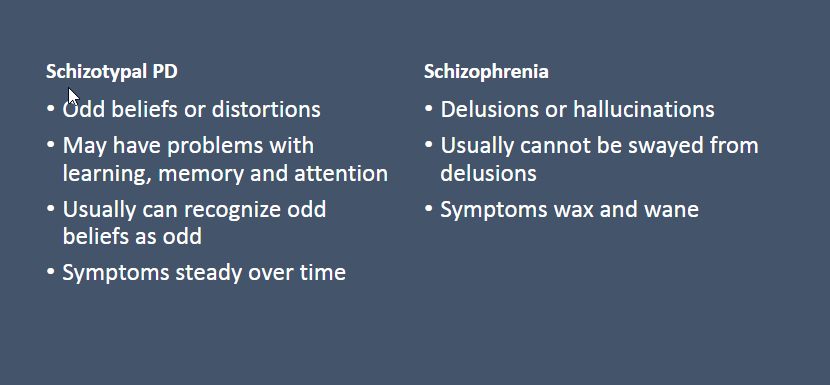
2 to 4% of men, 0.5 to 1% of women
Symptoms tend to lessen with age
Tend to die early
suicide, accidents, homicides, and diseases associated with substance abuse
Tx:
Difficulty:
Rarely seek treatment
Little evidence for successful treatment
Setting:
confined settings such as prison or military
Depressive or introspective concerns may surface
Confrontation by peers may lead to change in behavior
Behavior therapy
Group therapy
Some may be able to form a therapeutic alliance
Mood stabilizing drugs and antidepressants for specific symptoms
Avoid addictive substances
Some may have ADHD, treat carefully
Cognitive-behavior therapy for motivated
Focus on changing sociopathic thinking
Change is not likely to be rapid
Describe Borderline Personality Disorder
Dx Criteria (9)
Tx
Management guidelines
Dx Criteria:
pervasive pattern or instability in relationships, self image, affects + marked impulsivity; as indicated by 5:
Frantic efforts to avoid abandonment (real/imagined)
Relationships alternate between extremes of idealization and devaluation
Identity disturbance (unstable self-image; sense of self)
Impulsivity in at least two areas -> potentially damaging
Recurrent Suicidal behaviors, gestures, threats or self-mutilating behavior
Affective instability b/c mood reactivity
Anger Issues
Chronic feelings of emptiness
Transient, stress-related paranoid ideation or severe dissociative symptoms
Begins by early adulthood
Tx
Difficulty:
High utilizers of psychiatric and emergency services
Extremely difficult to treat – long - term
Intense psychotherapy
Relationship > Insight
Frequent idealization and devaluation “splitting”
Can be helpful to have different provider for medication than therapy to diffuse the transference, but this can lead to splitting
Pharmacological management aimed at specific problems
Mood instability and impulsivity
Perceptual disturbances
Low dose antipsychotics and SSRI’s
Avoid benzodiazepines
Cognitive-behavioral interventions and group
Dialectical behavior therapy (DBT)
Managing Borderline Patients in Medical Settings
Develop a strong therapeutic alliance
Avoid labeling behaviors manipulative
See them as a lack of skills to get needs met
Have firm boundaries and realistic expectations
Coordinate care and refer
Team-based approaches often work best
Describe Histrionic Personality Disorder
Dx Criteria (8)
Clinical Features
Mental Status
Appearance
Behavior
Speech
Thought process
Mood
Judgment
Insight
Tx
Dx Criteria:
Pervasive pattern of excessive emotionality and attention-seeking; as indicated by 4:
Uncomfortable when not center of attention
Interaction w/ others = inappropriately sexually or provocative
Uses physical appearance to draw attention to self
Rapidly shifting and shallow expression of emotions
Self-dramatization, theatricality, and exaggerated expression of emotion
Speech style = impressionistic + lacking in detail
Suggestible
Considers relationships to be more intimate than they actually are
Beginning by early adulthood
Clinical Features:
Underlying insecurity about their value
Often present with complaints:
Depression
Somatic symptoms of unclear origin
History of disappointing romantic relationships
Medical symptoms and illness evoke a threat to self-image
Mental status
Appearance
Provocative or attention-seeking
Behavior
Disinhibited
May be hypersexual gestures
Speech
Often loud and dramatic
Thought process
Usually linear
Mood
May shift rapidly
Judgment
Poor
Insight
Thoughts and behaviors are ego-syntonic
Treatment
Difficulty:
May be treatment resistant
Idealization and eroticism brought into therapy
Material for exploration
Therapists need to be aware of countertransferential gratification
Individual psychodynamic psychotherapy or CBT
Develop new interpersonal skills
Focus on reducing conflict
Aim at helping increase awareness:
How self-esteem is tied to ability to attract attention
How shallow relationships reflect unconscious fears of real commitments
Caregivers should be supportive and allow for affective ventilation
Psychotropic medication generally ineffective unless other psychiatric condition
Describe Narcissistic Personality Disorder
Dx criteria (9)
Clinical Features
Tx
Dx Criteria:
Pervasive pattern of: grandiosity, need for admiration, and lack of empathy; as indicated by 5:
Grandiose sense of self-importance
Preoccupied with fantasies
unlimited success, power, brilliance, beauty or ideal love
Believes he/she = special and only understood/associated w/ other special/high status peeps
Requires excessive admiration
Has sense of entitlement
interpersonally exploitive
Lacks empathy
Envious or believes others are
Arrogant/haughty behaviors/attitudes
beginning by early adulthood
Clinical Features:
Fragile self-esteem
Anger when people don’t appease them
Belittle achievements of others
May be feeling weak, unattractive or unsuccessful
May become depressed -> seeking help
Often distant in relationships, try to appear self-sufficient
May withdraw to avoid appearing vulnerable
Very Needy
Overly hostile or expect special treatment
born of the terror of abandonment
Unaware of deep dependency underlying actions
Illness threatens their fears of being vulnerable and unimportant
Tx
CBT
Difficulty forming trusting relationship with therapist
Possibly dialectical behavior therapy
Group therapy or couples therapy
Psychotropic medications usually not indicated unless other mental disorder present
How to deal with “Entitled Demanders”

Describe Avoidant Personality Disorder
Dx criteria (6)
Clinical Features
Tx
Dx Criteria:
Persistent pattern of social inhibition, feelings of inadequacy, and hypersensitivity to criticism, disapproval or rejection
Unwilling to form relationship UNLESS certain of being liked
Restraint w/ int. Relationship b/c fearing shamed/ridiculed
Preoccupied w/ being criticized or rejected
Feelings of inadequacy = inhibiting new interpersonal situations
Views self as socially inept, personally unappealing, or inferior
Reluctant to take personal risks or engage in new activities b/c they may prove embarrassing
Clinical Features:
Strongly desire relationships
but fears ridiculed, criticized, rejected or humiliated
Treatment of Avoidant Personality
Psychotherapy with supportive techniques and sensitivity
protective defenses
Assertiveness and social skills training
Cognitive techniques
challenge beliefs
Systematic desensitization
Group therapy
Meds:
SRI’s for anx.
Anxiolytics (short term; low dose)
Difference between Avoidant and Schizoid PD?

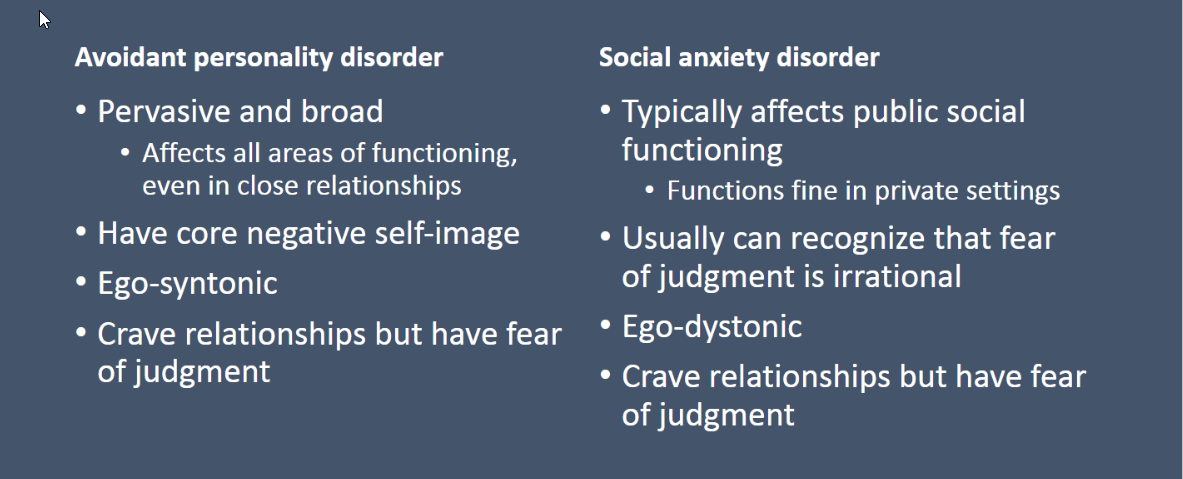
Difference between Avoidant and Social anxiety disorder (4)
Describe Dependent Personality Disorder
Dx Criteria (8)
Clinical Features
Dependent Personality Patients
Mental status
Appearance
Speech
Mood
Thought content
Thought process
Judgment
Insight
Tx
Dx Criteria:
Persistent/excessive need to be taken care of -> submissive/clinging behaviors + fear of separation; as indicated by 5:
Difficulty making decisions w/o excessive advice/reassurance
Needs others to assume responsibility for major areas in own life
Difficulty expressing disagreement w/ others b/c fear of loss of support/approval
Difficulty initiating projects or doing things independently
(lack of self confidence)
Goes to excessive lengths to obtain nurturance/support from others
Urgently needs new relationship when previous ends
Uncomfortable or helpless when alone
Fear of unable to care for oneself
Preoccupied with fears of being left to take care of oneself
beginning by early adulthood
Clinical Features:
View others as stronger/more capable
Low self-esteem + self-doubt -> avoid positions of responsibility
Tolerate mistreatment and abuse in relationships
Dependent Personality Patients
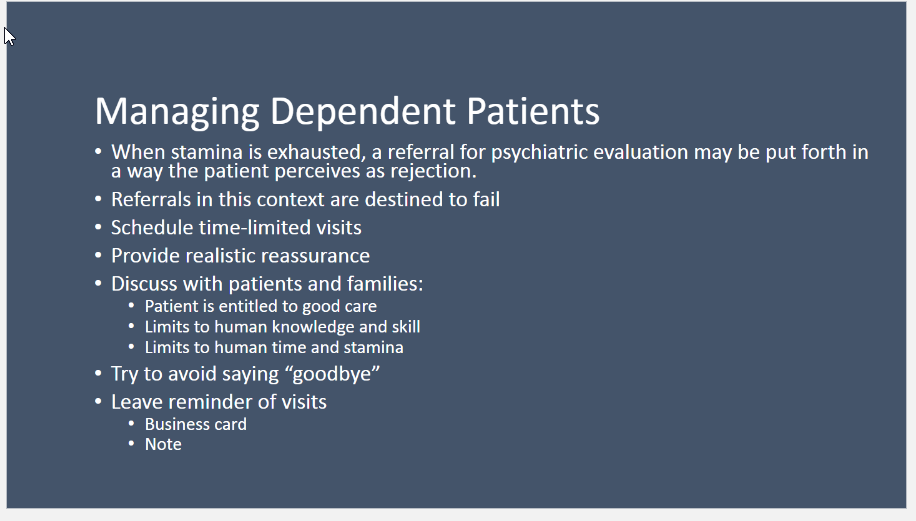
May be mildly or severely ill
Have self perception of bottomless needs and are unable to reassure themselves
Seek reassurance from medical staff
Perceive caregivers as inexhaustible
Use flattery and unconscious seduction
Early signs of dependence:
Extreme gratitude
Feeling of specialness by caregiver
Mental status
Appearance
generally normal
Speech
may talk less due to shyness
Mood
normal to anxious
Thought content
fear of losing relationship
Thought process
usually linear
Judgment
inhibited by approval seeking
Insight
usually poor
Tx
Difficulty:
Often present with depression or anxiety related to loss of a dependent relationship
Psychotherapy
Increase self-esteem, assertiveness and independent functioning
Group and cognitive-behavioral therapies
Couple and family therapy may be helpful
Medication may be helpful if co-occurring conditions

Describe Long-Suffering, Self-Sacrificing Patient or Family Member
Characteristic
Response
Long-Suffering, Self-Sacrificing Patient or Family Member
Characteristics:
History of repeated suffering, rather from repeated illnesses, disappointments, or other adversities and failures
Inclined to disregard own comfort and be of service to other people
Tendency to display suffering in exhibitionistic way despite overt humility
Striving for love, care and acceptance, but feels too guilty and anxious to accept without self-sacrifice and suffering
Response:
Express appreciation of the difficulties of illness as they are experienced by the patient
Describe Obsessive-Compulsive Personality Disorder
Dx Criteria (8)
Tx
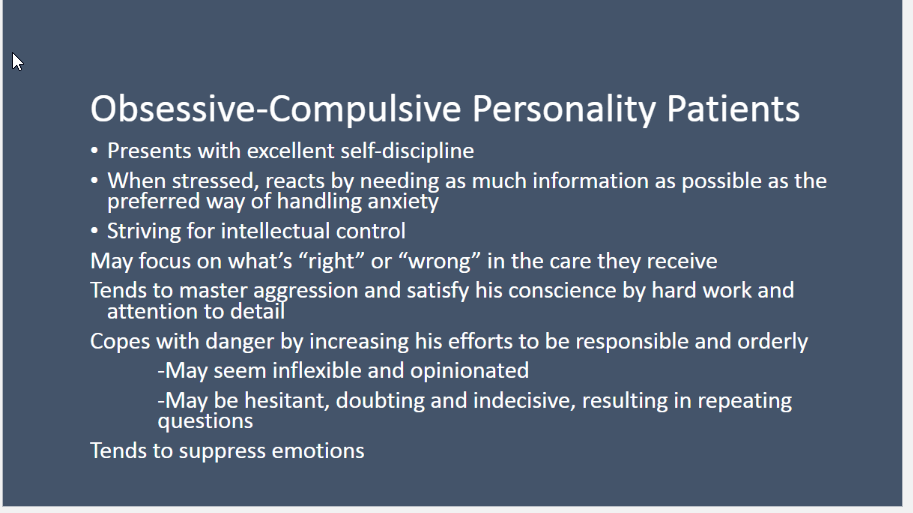
Dx Criteria:
Pervasive pattern of preoccupation of: orderliness, perfectionism, and mental/interpersonal control @ expense of: flexibility, openness and efficiency; as indicated by 4:
Preoccupied w/ rules, details, lists, order, organization, or schedules
Has perfectionism -> interferes w/ task completion
Reluctant to delegate tasks or to work with others
Unless they submit to doing his/her way
Devoted to work and productivity -> exclusion of friendship/leisure activities
Overconscientious, scrupulous, and inflexible about matters of morality, ethics, or values
Shows rigidity and stubbornness
Unable to discard worn-out or worthless objects
Money = hoarded for future catastrophes
Begins by early adulthood
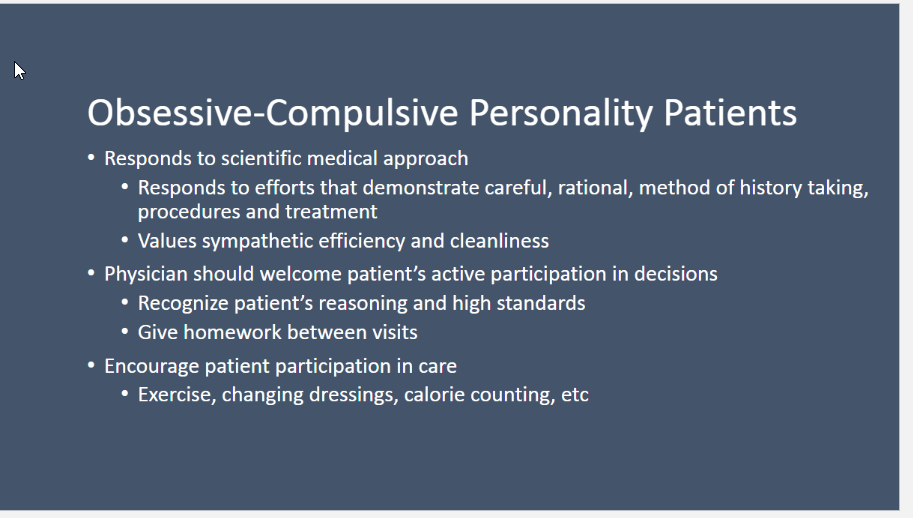
Treatment
Difficulty:
Excessive intellectualization
Difficulty expressing emotion
Therapists must be active
Avoid being drawn into interesting but affectless discussions
Focus on feelings that are being avoided
Power struggles offer opportunities to address the excessive need for control
Cognitive techniques to diminish need for control and perfection
Dynamically oriented groups that focus on feelings
Dif between OCPD and OCD (4)
