W9: Childhood disorders
 Call Kai
 Learn
 Practice Test
 Spaced Repetition
 Match
 Flashcards
 Knowt Play
1/24

There's no tags or description
Looks like no tags are added yet.
25 Terms
What did Kim-Cohen et al. (2003) find about when adult mental disorders first appear?
About ½ of 26 y/o adults had first been diagnosed at ages 11-15, and about ¾ by age 18; Most adult disorders started out as a childhood disorder
What are the 2 broad dimensions of child psychopathology?
Externalising/undercontrolled: problems directed outward (e.g. aggression, defiance)
Internalising/overcontrolled: problems directed inward (e.g. anxiety, sadness, withdrawal)
What are the 2 main groups of externalising disorders (DSM-5)?
Oppositional defiant disorder (ODD)
Conduct disorder (CD)
What are the 2 main groups of internalising disorders (DSM-5)?
Anxiety disorders
Depressive disorders
What is another group of disorders covered?
Neurodevelopmental disorders
e.g. ADHD, autism spectrum disorder, communication disorders
What is the comorbidity rate for childhood disorders
They overlap substantially
e.g. Leo show symptoms of hitting, defiant, oppositional, impulsive, overly active → features of ODD and ADHD
What are 5 psychological assessment methods used with children?
Clinical interviews (diagnostic interview)
Psychological tests (self-report)
Behavioural observations (including ABC analysis)
Specialised testing (IQ, ASD etc)
Third-party information
What are the 4 criterias for a comprehensive child assessment??
Knowledge from multiple settings (home, school, peers)
Multi-reporter (parents, teachers, child)
Multi-method
Relevant developmental information
For younger children, what types of measures are especially important?
Observation and rater measures (self-report measures are unreliable)
What do rater-based measures determine what is abnormal?
Rely on normative cut-offs like T-scores
How do we interpret a T-score?
A standard score with M = 50, SD = 10
How do we interpret scores of 65+ or 70+?
Means that the symptoms are rare in the normative sample
What are the DSM-5-TR criteria for conduct disorder (CD)?
A repetitive, persistent pattern of behaviour: at least 3 of 15 criteria in the past year, from 4 categories:
Aggression to people and animals
Destruction of property
Deceitfulness or theft
Serious violation of rules (running away, truancy <13y/o)
What are the DSM-5-TR criteria for oppositional defiant disorder (ODD)?
A pattern of angry/irritable mood, argumentative/defiant behaviour or vindictiveness (grudge) with at least 4 symptoms for 6+ months (not only with a sibling)
What disorder did Kim-Cohen et al. (2003) identify as a ‘priority prevention target’ and why?
Conduct disorder, because it is a common early precursor for adult mental illness
e.g. adults who have anxiety, SAD highly likely have had CD as a child
What are the worldwide prevalence rates for ODD, CD and ADHD?
ODD > ADHD > CD
What 4 conditions do these estimates depend on?
Setting
Ethnic group
Age (adolescence > childhood)
Gender (boys > girls)
What is the typical developmental course of conduct problems?
3 y/o: temper tantrums, non-compliance
8 y/o: arguing, defiance, aggression, bullying
Towards 17y/o: property destruction, lying, theft, truancy
What are the DSM-5-TR criteria for antisocial personality disorder (APD)?
A pervasive disregard for and violation of others’ rights since age 15
At least 3 of 7 of these symptoms
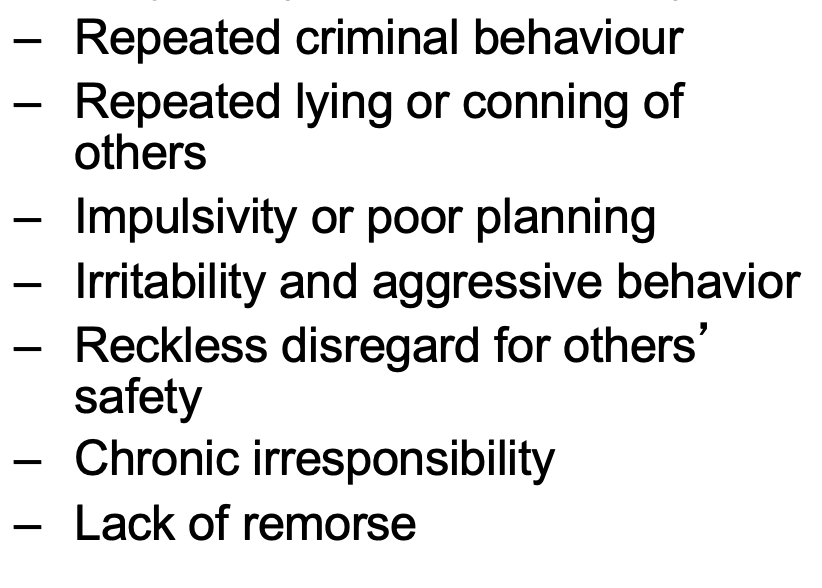
What is the age requirement for APD and how does it link to CD?
They must be at least 18 y/o, with evidence of CD before 15 y/o
What is the precedence of the 3 disorders?
ODD > CD > APD
What are the 2 groups of risk factors for conduct problems?
Dispositional (child)
Contextual (environmental)

What is a significant contextual risk factor?
Dysfunctional parenting practices
What does Patterson’s coercion theory explain?
How conduct problems are caused and maintained

How does this example showcase this theory?
Everyday family interactions train the child in escalating, coercive behaviour through negative reinforcement (the mum gives in to the child/removes the demand to stop watching ipad, which encourages them to repeat this behaviour)