Derivative Rules — Formula Cards
 Call Kai
 Learn
 Practice Test
 Spaced Repetition
 Match
 Flashcards
 Knowt Play
1/20

Earn XP
Description and Tags
21 formula cards: all six trig derivatives, all six inverse trig derivatives, exponential and logarithmic derivatives, product, quotient and chain rules. Each answer has a readable formula image. u = inside expression; u′ = its derivative.
21 Terms
When do I use the product rule?
(fg)' = fg' + gf'. Two variable expressions multiply. Example: (x sin x)' = x cos x + sin x.

When do I use the quotient rule?
(f/g)' = (g f' - f g')/g^2. Bottom times derivative of top MINUS top times derivative of bottom; over bottom squared. g must be nonzero.

What is the chain rule?
[f(g(x))]' = f'(g(x)) g'(x). Differentiate outside, keep inside, multiply by inside derivative; work inward once per layer.

Derivative of sin(u)?
cos(u) u'. Example: sin(3x) becomes 3 cos(3x).

Derivative of cos(u)?
-sin(u) u'. Example: cos(x^2) becomes -2x sin(x^2).

Derivative of tan(u)?
sec^2(u) u'. Example: tan(5x) becomes 5 sec^2(5x).

Derivative of cot(u)?
-csc^2(u) u'. Remember the negative.

Derivative of sec(u)?
sec(u) tan(u) u'. Secant pairs with tangent.

Derivative of csc(u)?
-csc(u) cot(u) u'. Cosecant pairs with cotangent, with a minus.

Derivative of e^u?
e^u u'. Keep the full exponent, multiply by exponent derivative. Example: e^(3x^2) becomes 6x e^(3x^2).

Derivative of a^u?
a^u ln(a) u', with constant a>0. Example: 2^(3x) becomes 3 ln(2) 2^(3x).

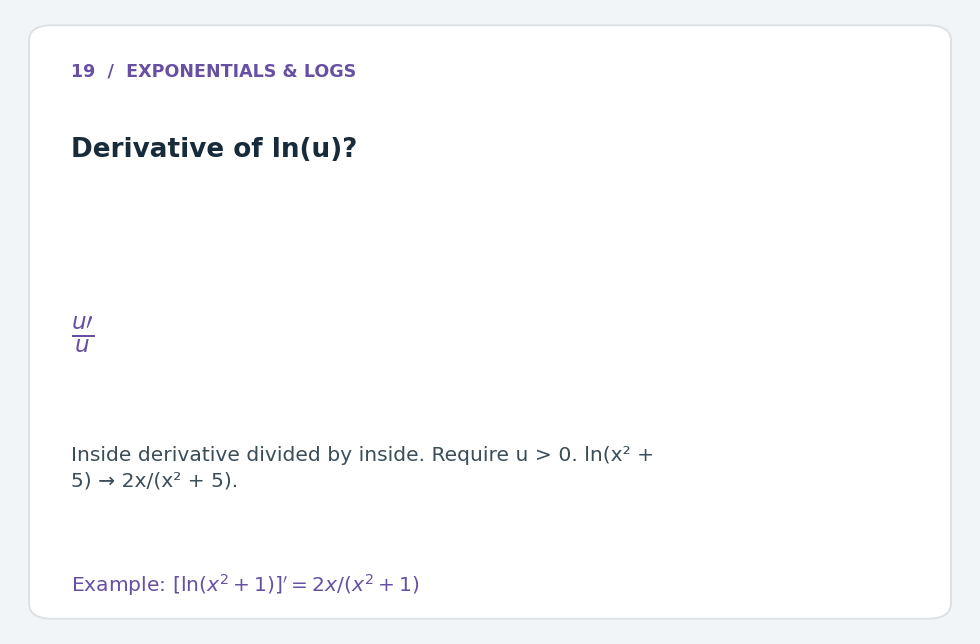
Derivative of ln(u)?
u'/u, for u>0. Inside derivative divided by inside. Example: ln(x^2+5) becomes 2x/(x^2+5).
Derivative of log_a(u)?
u'/(u ln(a)); u>0, a>0, a!=1. ln(base) is in the denominator.

Derivative of common log(u)?
For base 10: u'/(u ln(10)). Example: log(3x) becomes 1/(x ln(10)), x>0. Check intended base when notation is ambiguous.

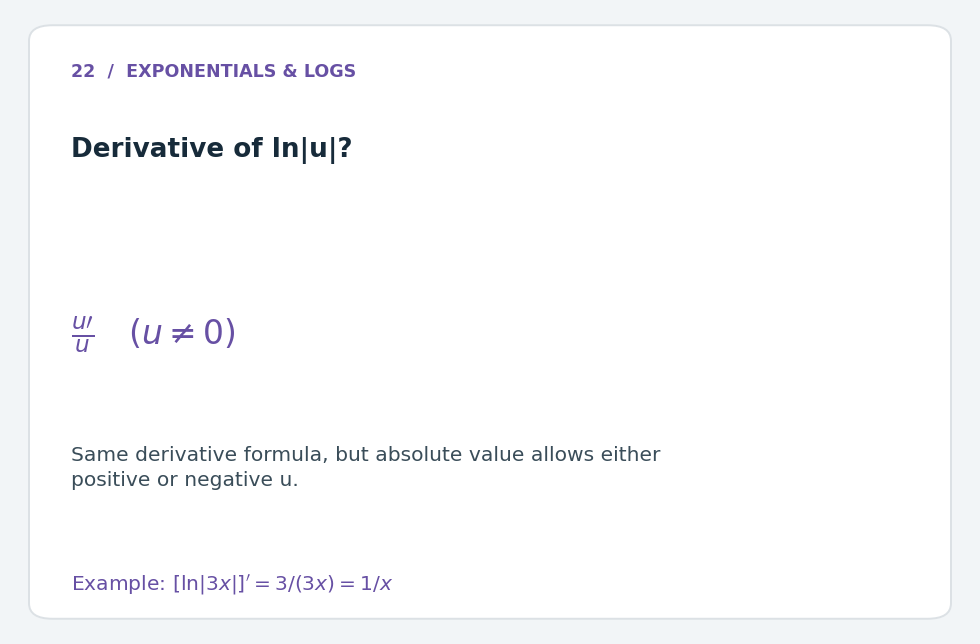
Derivative of ln|u|?
u'/u for u!=0. Absolute value allows either positive or negative inside.
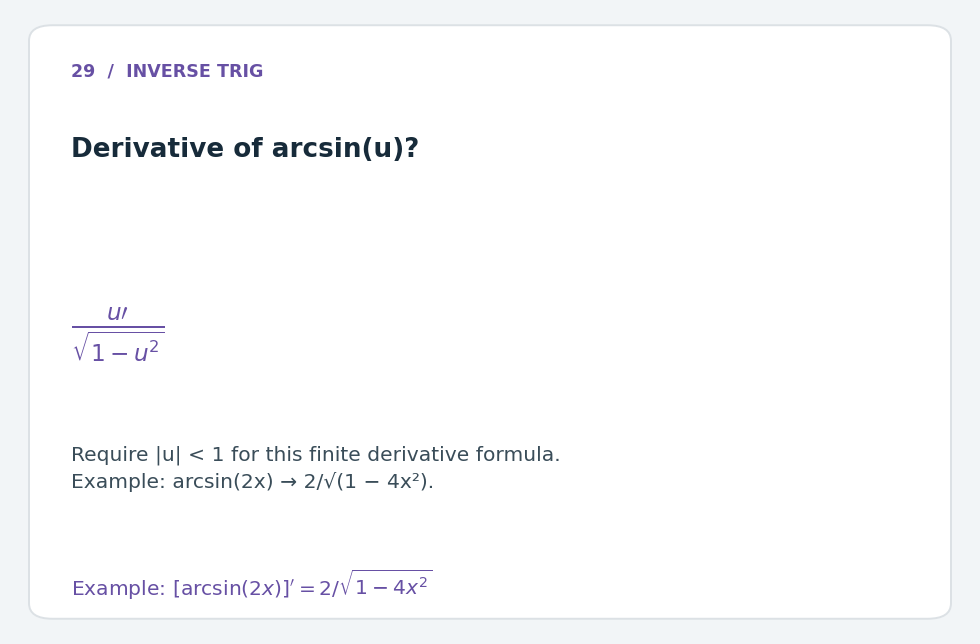
Derivative of arcsin(u)?
u'/sqrt(1-u^2), for |u|<1. Example: arcsin(2x) becomes 2/sqrt(1-4x^2).
Derivative of arccos(u)?
-u'/sqrt(1-u^2), for |u|<1. Same denominator as arcsin, but negative.

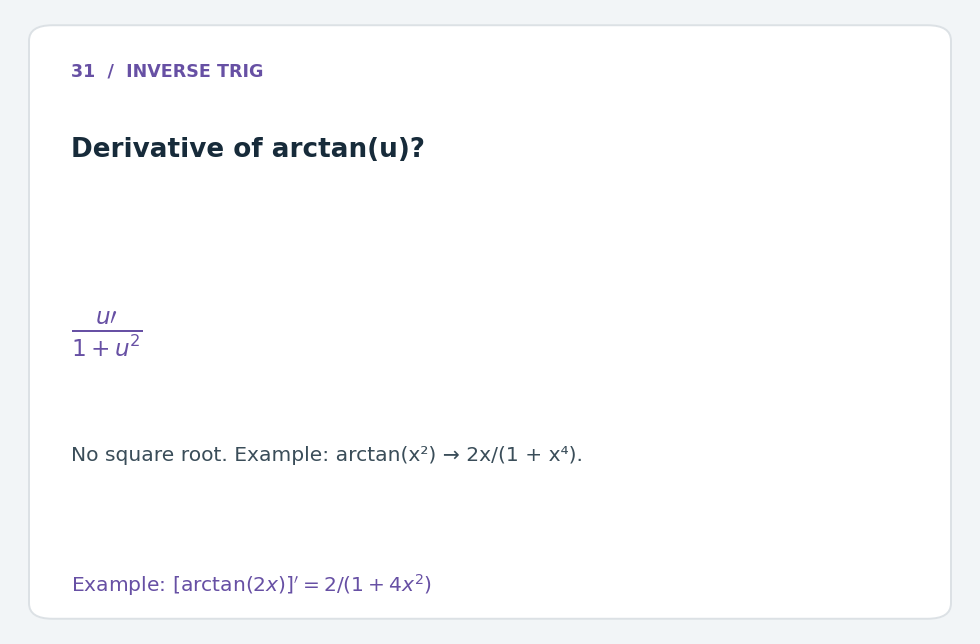
Derivative of arctan(u)?
u'/(1+u^2). No square root. Example: arctan(x^2) becomes 2x/(1+x^4).
Derivative of arccot(u)?
-u'/(1+u^2), using the decreasing arccot convention in your notes.

Derivative of arcsec(u)?
u'/(|u| sqrt(u^2-1)), for |u|>1. Keep the absolute value.

Derivative of arccsc(u)?
-u'/(|u| sqrt(u^2-1)), for |u|>1. Same denominator as arcsec, but negative.
