Mammalian and avian blood
 Call Kai
 Learn
Learn Practice Test
 Spaced Repetition
 Match
Match Flashcards
 Knowt Play
1/24

There's no tags or description
Looks like no tags are added yet.
Name | Mastery | Learn | Test | Matching | Spaced | Call with Kai | Chat |
|---|
No analytics yet
Send a link to your students to track their progress
25 Terms
hematopoietic tissue
tissue forming blood
hematopoiesis
is the process of blood formation that occur in the trabeculae of the flat bones and the long bones
liver, spleen, thymus, lymph nodes, yolk sac, bone marrow
HEMATOPOIETIC ORGANS:
Liver
primary site of blood cell production during fetal development (hepatic phase)
spleen
prinarily functions to filter blood, remove old red blood cells, and store platelets
a site for lymphocyte production and maturation, especially during fetal development
thymus
key organ for the maturationof T-lymphocytes, which are crucial for the immune system.
bone marrow
The spongy tissue inside bones, like the vertebrae, pelvis,and sternum,
is the main site for theproduction of all types of blood cells(red blood cells, white blood cells, andplatelets) after birth.
mammal erythrocyte
small, anucleate cells
adapted to transport oxygen and carbon dioxide
acidophilic
acquire an orange to red color with romanovsky stain
central pallor
results from the erythtrocyte’s biconcave shape is best defined in the erythrocyte of the dog, but may be seen in other domestic animals
avian red blood cells
elliptical when mature
oval or circular in immature
nuclei and mitochondria are present
repltile RBC is smaller
neutrophils
prominent cytoplasmic granules with lysozome containing enzyme released as inflammatory reaction
cells are multilobed nuclei
last in the circulation for 12 hours must be replaces in the bone marrow
considered as the first line of defense
band neutrophils
immature neutrophils that circulate
cresent shaped nucleus
not yet lobulated
also has cytoplasmic granules
heterophils
segmented nuclei that are partly obscure by the large nucleus
eosinophils
they have bright red cytoplasmic granules
respond to allergic reaction, fungal, and parasitic
basophils
they have a dark purple cytoplasmic inclusions
the least numerous in WBC
they protect the body from infection
basophilia
autoimmunity diseases or leukemia
basophils
largest cells of the WBC
they have the ability to detect cancer cells in early stages
in high counts they can denote an autoimmune diseases and in love counts they detect allergy reaction
they function by the release of the enzyme known as histamine and heparine
canine
identify what animal has this type of basophil

feline
identify what animal has this type of basophil
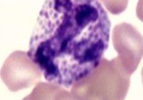
equine
identify what animal has this type of basophil

bovine
identify what animal has this type of basophil

bovine and equine
animals that has no central pallor and no rouleaux formation

rouleaux formation
is the formation of RBC in stack of coins
commonly seen in healthy horses and in some cat
not seen in dog and cattle
porcine erythrocyte
are the sharp pointed ends and exhibit poikilocytosis

dog
biconcave with central pallor