Biochemistry 410 Final
 Call Kai
 Learn
 Practice Test
 Spaced Repetition
 Match
 Flashcards
 Knowt Play
1/59

There's no tags or description
Looks like no tags are added yet.
60 Terms
A prosthetic group in hemoglobin.
Heme
Subcellular compartment found in animal cells, but not plant cells.
Lysosome
These bind to hydrophobic regions of an unfolded protein to prevent misfolding.
Hsp-70 family
An amino acid commonly found in ß-turns.
Proline
This amino acid has a methyl group as a sidechain.
Alanine
Amino acid capable of forming disulfide bonds.
Cysteine
Secondary protein structure stabilized by oppositely charged amino acids 3-4 apart in the primary structure.
a-helix
This amino acid is required in your diet.
Valine
A fibrous protein comprised of 2 right-handed alpha helices, wound in a left-handed coil.
a-keratin
This type of solution would cause water to enter a cell, thus causing it to swell.
Hypotonic
Which of the following best describes a mature (non-growing) living organism?
A closed system at steady state.
A closed system at equilibrium.
An open system at steady state.
An open system at equilibrium.
None of the above.
An open system at steady state.
Which of the following buffers would be effective at pH 6.5? You may find the information on the last page helpful.
Acetic
BICINE
CHES
MOPS
MOPS
Which of the following allosteric modifiers of hemoglobin will result in an INCREASE in the affinity for oxygen?
2,3-bisphosphoglycerate
CO2
Oxygen
Protons
Oxygen
Which of the following amino acids would cause the least structural/functional change in a protein if replaced by a Lys?
His
Glu
Val
Thr
His
What is the predominant net charge of the amino acid D at pH 2?
-2
-1
0
+1
+2
0
Which of the following functional groups contains Sulfur?
Amino
Ester
Methyl
Thioester
Thioester
The pl (isoelectric point) of an amino acid describes the pH at which the amino acid is the most effective buffer.
false
Hemoglobin has a higher affinity for carbon monoxide than oxygen.
true
Motifs are examples of quaternary protein structure.
false
The binding of oxygen to one subunit of hemoglobin increases the likelihood of oxygen binding to the other subunits.
true
Acetic acid would be an effective buffer at physiological pH. You may find the information on the last page helpful.
false
Peptide bonds are formed by condensation reactions, where the components of water are removed and water is produced.
true
All anaerobic organisms have evolved to survive without oxygen, but only the obligate anaerobes will die when exposed to oxygen.
true
Amino acids can switch between the D and L stereoisomeric forms because the two are easily converted.
false
Intrinsically disordered proteins lack a stable tertiary structure, resulting in structural flexibility.
true
A weak acid is a more effective buffer than a strong acid because it has the potential to both donate and accept protons.
true
This group of enzymes adds phosphate groups to substrates or other enzymes.
Kinases
Binding of CO2 and H+ to hemoglobin stabilizes the _________ conformation state.
T (tense)
A protein is only functional when it is in its most stable, or ______ conformation.
native
What is the net charge of free Lys at pH 8.0? You may find the information on the last page helpful.
+1
A type of enzymatic catalysis that involves a proton donor or acceptor (or both).
acid-base
What is the molar concentration of a citrate buffer prepared by mixing 250 ml of 0.4 M citric acid and 150 ml of 0.4 M of sodium citrate?
0.4 M
In situations of low oxygen, like high altitude, the body produces _______, which decreases hemoglobin's affinity for oxygen, resulting in more oxygen being delivered to the tissues.
2,3 BPG (or BPG, or 2,3 bisphosphoglycerate)
A protein that undergoes ____________ has a loss of 3-dimensional structure that causes a loss of function.
denaturation
pH of a solution that contains 4.32 x 10⁻⁵ M protons.
4.36
Enzymes change the ____ by which a reaction occurs, but they do NOT affect the equilibrium of a reaction.
rate
You need to prepare 500 ml of 0.1 M citrate buffer with a pH of 4.0. You have stock solutions available of 0.1 M dihydrogen citrate (H2C6HsO7) and 0.1 M hydrogen citrate (HCsHsO72-). How much in ml of each do you need to make the buffer? What would be the expected change in pH if you added 10 ml of 1 M NaOH to the previous buffer?

What is the predominant net charge of the following oligopeptide at pH 11.0? You may find the information on the last page helpful.
Tyr-Lys-Phe-Pro-Cys-Asp

Describe the different states of hemoglobin, how and where it transitions from one to the other, and why it is important.
Hemoglobin has two states: the R (relaxed) state where hemoglobin binds O2 with higher affinity and the T (tense) state where it binds O2 with lower affinity.
In peripheral tissues, O2 conc. is lower and CO2 and H+ conc. is higher than in the lungs. Hemoglobin will bind CO2 and become protonated. This will favor the T-state, causing hemoglobin to release O2 (transition from R to T state). In the lungs, O2 conc. is higher and CO2 and H+ conc. is lower. This will cause hemoglobin to release H+ and CO2, no longer stabilizing the T-state, and instead transitioning to the R-state. Binding O2 will also cause hemoglobin to change from T to R-state, where affinity for O2 is higher. If Hb was always in the R-state, it would not deliver/release O2 in the tissues. If always in T-state, it would not saturate w/O2 in the lungs.

Which amino acid is shown here? Please give the full name, the 3-letter name, and the one-letter name.
Threonine, Thr, T
Draw and name one sulfur-containing amino acid at pH 7.0.
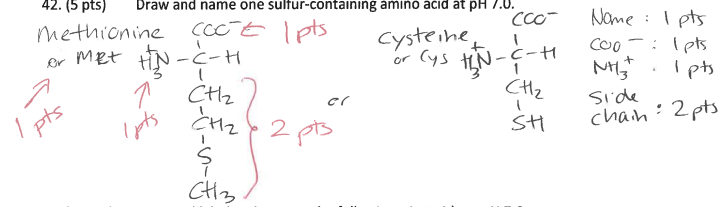
Draw and label with names the following tripeptide at pH 7.0.
D-E-Y

Dr. Krause is from which of the following Nordic countries?
Sweden, the home of Pippi Longstocking, Abba, and Greta Thunberg.
Norway, the home of Edvard Munch, A-ha, and Jens Stoltenberg.
Finland, home of Kimi Räikkönen, Jean Sibelius, and awesome Northern Lights.
Denmark, the home of Hans Christian Anderson, Niels Bohr and Søren Kierkegaard.
Denmark, the home of Hans Christian Anderson, Niels Bohr and Søren Kierkegaard.
Suppose you prepared a phosphate buffer by combining 450 mL 1.2 M sodium phosphate monobasic (NaH2PO4; weak acid) and 550 mL 1 M sodium phosphate dibasic (Na2HPO4; conjugate base). The relevant pKa is 6.82. What is the concentration and pH in the phosphate buffer you prepared? Round your answers to the nearest hundredth. What would be the expected change in pH if you added 5 mL of 12 M NaOH to the previous buffer?

It is known the dissociation constant, Kd, is 2.3 x 10⁻⁹ M for the relationship between glucagon and its receptor. What percent of the receptor is bound when [glucagon] = 2.3 x 10⁻⁹ M?

What is the net charge of the following oligopeptide at pH = 8.0? Be sure to include the relevant ionizable groups, pKas, specific group molecular formula, and charge for each relevant amino acid in addition to the overall charge to receive full credit. You may find the information on the last page helpful.
Tyr-Met-His-Ser-Asn-Trp-Ala

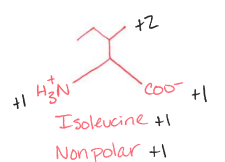
Draw and name the free amino acid Ile at pH 7.0. Which group does this amino acid belong to?
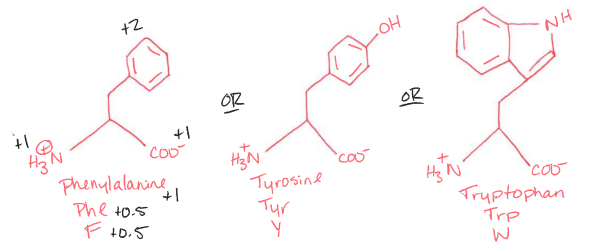
Draw and name an aromatic amino acid at pH 7.0. Please also give the 3-letter and 1-letter abbreviation.
Draw and label with names the following tripeptide at pH 7.0:
F-L-R


Identify the following functional groups indicated below:
A. Carboxyl
B. Carbonyl (Ketone) or Amido
C. disulfide
D. phenyl or benzene
Proteins that contain permanently associated chemical components are called ___________________.
Conjugated proteins
Prosthetic groups
Bound proteins
None of the above
Conjugated proteins
The pH at which a buffer is 50% weak acid and 50% conjugate base.
pKa
7
Kd
14
pKa