PP #2 - History of Diagnostic Medical Sonography
 Call Kai
 Learn
Learn Practice Test
 Spaced Repetition
 Match
Match Flashcards
 Knowt Play
1/119

There's no tags or description
Looks like no tags are added yet.
Name | Mastery | Learn | Test | Matching | Spaced | Call with Kai | Chat |
|---|
No analytics yet
Send a link to your students to track their progress
120 Terms
What is sound?
Sound is a form of energy produced by a vibrating source that causes molecules in a medium to move back and forth, creating sound waves.
Needs a medium (solid, liquid, or gas)
Cannot travel through a vacuum
Who are the early pioneers?
Aristotle and Pythagoras, Da Vinci, Galileo, Newton, Boyle, Fresnel, Joule, Doppler, Jacques & Pierre Curie, Langevin
What did Aristotle and Pythagoras study?
The movement of sound through air or ‘SONOMETER’
What does SONOMETER refer to
demonstrates the relationship between pitch and frequency
What did Leonardo da Vinci identify about sound reflection?
The angle of reflection = angle of incidence.

What did Galileo demonstrate?
Frequency determines pitch.
What is Sir Isaac Newton credited with?
The theory of velocity.
What did Robert Boyle recognize about sound?
Sound must travel through a medium.

What is Augustin Fresnel known for?
The theory of wave diffraction.

What did James Joule describe?
The ferromagnetic effect
Unit of measurement for energy

What did Christian Johann Doppler discover?
Discovered that the pitch of the sound wave will vary if the source of the sound is moving

How is the Doppler Effect used in ultrasound?
Moving blood cells cause a change in the frequency of the sound waves, allowing us to evaluate blood flow.

What are some examples of the Doppler Effect outside ultrasound?
Radar detectors, burglar alarms, motion detectors, and meteorology.
What are Jacques and Pierre Curie known for?
The piezoelectric effect.

What is the piezoelectric effect?
Certain materials can generate an electric charge and change shape when mechanical pressure is applied.
Why is the piezoelectric effect important in ultrasound?
It is the basis for ultrasound transducer frequencies.
What did Paul Langevin study?
Sound frequency and intensity in water using submerged objects.
What device did Langevin use?
A hydrophone.
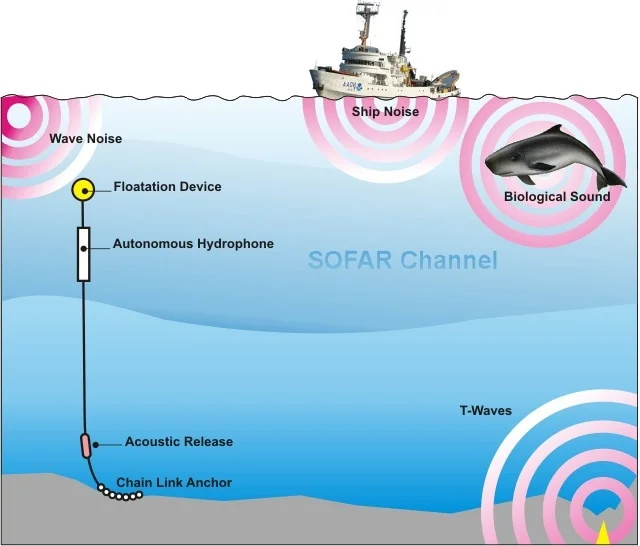
What technology did Langevin's work help lead to?
SONAR, which was later used in WWII.
What did Langevin observe about high-intensity sound?
It could have harmful effects, such as killing small fish and heating his assistant's hand.
What does SONAR stand for?
Sound Navigation and Ranging.
How does SONAR work?
Sound is sent through water → bounces off an object → returns as an echo → analyzed to identify/locate the object.

What was SONAR originally used for?
Defense purposes, especially to detect submerged objects.
Who are the medical pioneers in Diagnostics?
Dr. Karl Dussik, George Ludwig, Julian Wild, John Reid, Dr. Douglas Howry, Joseph Holmes, Ian Donald, Tom Brown, Carl Hertz, Inge Edler, Arvo Oksala, Gilbert Baum, Nathaniel Bronson, Dr. Samuel Maslak
Who was Dr. Karl Dussik?
First to apply ultrasound for medical purposes in the 1940s; used 2 transducers across the head to image the brain. Images were called hyperphonograms.
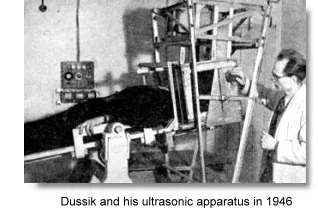
What did Karl Dussik discover ultrasound could detect?
Brain tumors and lesions.
Who was George Ludwig?
Used pulse-echo (A-mode) ultrasound to diagnose gallstones and foreign bodies in animal tissue.
What did Julian Wild discover?
Cancerous tissue had a different thickness than normal tissue and he developed the first rectal transducer for bowel imaging.
Who was John Reid?
An engineer who worked with Wild to develop the first B-mode transducer for breast imaging and the first U.S. echocardiography system.
What was the “Water Tip”?
A development associated with Wild and Reid for ultrasound imaging.
Who were Douglas Howry and Joseph Holmes?
Pioneers who developed methods for producing cross-sectional ultrasound images.
What did Douglas Howry develop?
The first cross-sectional ultrasound picture using water immersion.
What did Joseph Holmes contribute?
Discovered that moving the transducer along two paths created a more complete anatomical image; called the system a somagram.
What was the B-52 Gun Turret Tank used for?
A mechanical transducer moved around a water tank while the patient was held still to create ultrasound images.
Why was the gun turret system replaced?
It wasn't practical for sick patients, leading to the development of the pan scanner.
What was the pan scanner?
A water-filled pan where the patient sat next to it while the transducer moved through the water.

Who is known as the “father of obstetric ultrasound”?
Ian Donald.
What did Ian Donald contribute to ultrasound?
Perfected ultrasound measurements to estimate fetal age, weight, and growth.
Who worked with Ian Donald to develop the first B-mode handheld fetal scanner?
Tom Brown, an engineer.
What was Ian Donald and Tom Brown's scanner called?
The Diasonograph.
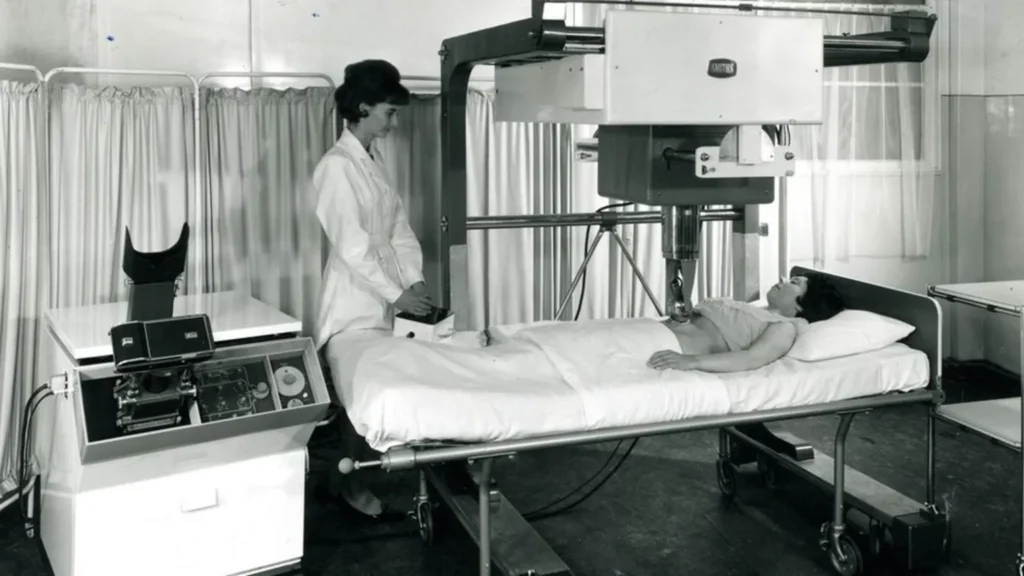
What did Carl Hertz and Inge Edler develop? What was their device called
Used an old SONAR device to create the first moving images of the heart. The Reflectoscope.
Who is considered the “father of echocardiography”?
Inge Edler.
Who were the pioneers of ophthalmic ultrasound in the 1950s?
Arvo Oksala and Gilbert Baum.
What frequencies did Oksala and Baum first use for ophthalmic ultrasound?
10–15 MHz, which produced higher-resolution images.
Who combined ultrasound with surgical forceps to remove a foreign body from the eye?
Nathaniel Bronson.
Who is considered the “father of modern ultrasound”?
Dr. Samuel Maslak.
What did Samuel Maslak contribute to ultrasound?
He combined computer technology with diagnostic ultrasound, creating software for black-and-white and color images.
Who are the “current” gurus in ultrasound?
Carrie Chapman, Joan Baker, Marveen Craig, Eugene Strandness
Who was Carrie Chapman?
The 1st female president of AIUM and founder of ASUTS, which focused on training sonographers.
What is ASUTS?
American Society of Ultrasound Technical Specialists — focused on training sonographers.
Who was Joan Baker?
One of the 6 founders of ASUTS, the 1st president of SDMS, and initiated the term “sonographer.”
Who was Marveen Craig?
Began as an assistant to Dr. Joseph Holmes
developed many clinical and didactic ultrasound programs
She also wrote textbooks and journal articles for sonographer education.
Who was Eugene Strandness?
Devoted his career to non-invasive measurements of the peripheral vascular system and assigned waveform patterns to specific disease processes.
What is the progression of the Modern-day ultrasound machine?
(in order: past to current)
static scanner
computerized real-time scanner
Massive improvement in transducers, image quality, computer technology
Huge improvements in ergonomic design
What does General ultrasound evaluate?
Abdominal organs and small parts such as the thyroid, scrotum, prostate, and breast.
What does musculoskeletal ultrasound evaluate?
Joints, tendons, ligaments, and muscles for superficial soft-tissue pathology.
What does pediatric ultrasound evaluate?
Pediatric abdomen, small parts, pelvis, neonatal hips, infant spine, and neonatal brain, plus other pediatric procedures.
What does gynecologic ultrasound evaluate?
The non-pregnant uterus and pelvis.
What does obstetric ultrasound evaluate?
The pregnant uterus and fetus throughout different stages of pregnancy
What is fetal echocardiography?
An advanced, detailed evaluation of the fetal heart.
What types of uncomfortable exams might a general sonographer perform?
Transvaginal, testicular/scrotal, and prostate exams.
What does it mean for a sonographer to put on a “mask”?
They can recognize pathology but do not give the patient their results.
What does vascular ultrasound evaluate?
The arterial and venous systems of the arms and legs, intracranial/extracranial vessels, and abdominal vasculature.
What is Transcranial Doppler (TCD)?
An advanced study of blood flow through the brain.
What modality is commonly used for DVT studies?
Doppler ultrasound.
By the mid-1990s, what became standard on ultrasound units?
Doppler
What can TCD be used as a non-invasive alternative to?
CTA (CT angiography).
What does PVR stand for?
Pulsed Volume Recording.
What does TCD stand for?
Transcranial Doppler.
What does echocardiography study?
The anatomy and blood flow of the heart.
What does pediatric echocardiography evaluate?
The hearts of newborns, infants, and children up to age 17.
What does TEE stand for?
Transesophageal Echocardiography.
Who might prefer Cardiac ultrasound?
Someone who likes to focus deeply on one thing and know what they'll be scanning throughout the day.
Who might prefer Vascular ultrasound?
Someone who likes knowing a lot about a few things but wants variety in where and what they scan.
Who might prefer General ultrasound?
Someone who doesn't like repetition, enjoys switching gears, and likes not knowing exactly what they'll scan next.
What was ultrasound imaging like before the late 1960s?
Static — still-frame, black-and-white images.
What did analog scan converters allow in 1969?
Shades of gray, giving a more accurate depiction of soft tissue and more accurate caliper placement.
What did digital scan converters allow in 1975?
More shades of gray — 64 shades
What did real-time imaging allow?
Recording moving structures, like a movie or video.
What area of medicine was most affected by real-time imaging?
OB/GYN.
What did real-time ultrasound allow doctors to see in OB?
Early pregnancy anatomy and fetal heart rate (FHR).
What is Biophysical Profile (BPP) for?
to assess fetal well-being.
Is therapeutic ultrasound used for diagnostic purposes?
No.
What is therapeutic ultrasound used for?
Uses high-energy, focused sound waves to increase blood flow and aid healing.
How does therapeutic ultrasound help soft-tissue injuries?
Heating the tissue can help speed recovery.
Where is therapeutic ultrasound commonly used?
Sports medicine and physical therapy.
What does 3D ultrasound use to add dimensions to an image?
Volume rendering.
Where was 3D ultrasound first applied?
OB, but it is now used in multiple modalities and biopsies.
What is 4D ultrasound?
Real-time 3D imaging.
What is a compact ultrasound system?
A highly portable ultrasound system, usually weighing less than 10 lbs.
Where can compact ultrasound systems be used?
Battlefields, developing/third-world countries, space programs, ERs, and hospital floors.
What is point-of-care ultrasound?
Using portable ultrasound at the patient's location for quick diagnostic information.
How small can some compact ultrasound systems be?
Some are about the size of a smartphone.
What does FAST stand for?
Focused Assessment by Sonography for Trauma.
What is FAST used for?
Quickly assessing trauma patients for internal bleeding.
When is FAST performed?
During the trauma protocol in the emergency department to help determine the next step.
What is interventional ultrasound used for?
Image guidance for fluid collections and biopsies.
How can cardiac ultrasound be used interventionally?
During cardiac surgery and for fluid collections around the heart and biopsies.
What is tumor ablation?
Using ultrasound guidance to position a cryotherapy or radiofrequency probe inside a tumor.
How is ultrasound used before and after tumor therapy?
To evaluate the tumor's size and position.