Art History Midterm
 Call Kai
 Learn
 Practice Test
 Spaced Repetition
 Match
 Flashcards
 Knowt Play
1/48

Earn XP
Description and Tags
ARTHC 201 - from Prehistoric to A
49 Terms
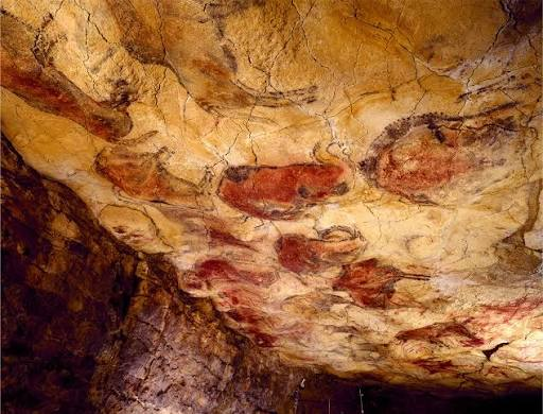
Wall of Bison, Altamira Caves, Spain (13,000-11,000 BC)
Prehistoric: Paleolithic
“The Sorcerer,” Cave of the Three Brothers (13,000 BC) Sketch by Henri Breuil
Next to “The Sorcerer,” contemporary photo
Prehistoric: Paleolithic


According to Henri Brielle this drawing indicated a deeper understanding of creatures and humans in a spiritual or religious realm
Henri drew a “copy” of this cave painting, yet the original turned out to be much different
Controversial, maybe he saw things that have eroded with time, mistook the three-dimensional space as part of the experience and drawing
The Hunting Scene, Lascaux Cave (17,000-13,000 BC)
Prehistoric: Paleolithic

Found in France, people risked their lives to make these painting
Not simply depictions of animals
-> rare hunting scene, fight or battle, potential indication of bird masks or clothing
-> human and animal narrative is very rare
Venus of Willendorf, Austria (28,000-25,000 BC) (4.4”)
Prehistoric: Paleolithic

Named later, no indication that they actually depicted goddesses
anatomical exaggeration, embellishments of female characteristics
limestone figurine
Potentially fertility charms, women as the bringers of life
“Decorated Ochre”, Blombos Cave, South Africa, 75000 BC
Prehistoric: Paleolithic

Found Ochre (crayon) in a prehistoric cave that had been caved in 77 000 years ago
Oldest work of art (known)
Ancient Mesopotamia (the land between the rivers) Ca. 3500-539 BC
Visual Elements:
setting, recognizable people involved in a scene
Hierarchy of scale = most important thing is the biggest
relief carving, depth of carving can vary from low to deep
sculptures have big eyes and clasped hands
Ancient Mesopotamia (the land between the rivers) Ca. 3500-539 BC
Civilization:
Complex social organization which exhibits most or all of these characteristics:
- agriculture
- permanent architecture
- social stratification
- specialization of labor
- written language
Merge together:
Move from hunter and gatherers to farmers = increase in population
Not everyone has to hunt for food, different types of labor exist now with people in charge, structure and social stratifications
Ancient Mesopotamia (the land between the rivers) Ca. 3500-539 BC
Writing:
Wedge shapes pressed into clay tablets
Cuneiform = NOT a language, just a writing form
Learn about religion, inventory, rulers
Sumerian Art, ca. 3500-2332 BC
Beginning on writing, accounting system to keep inventory and track of goods
Semi-independent city states
Share language, religion and culture
Ziggurat
The White Temple Ziggurat, Uruk, 3200-3000 BCE (Sumerian)


Building of white temples made of mud bricks, eroded by water over time
Ziggurat as the platform, the temple as a separate structure on top
Walk around the temple platform, similar to circling around mekkah in islam
Interior had a sacred fire, libation = pouring something into the fire for ritual purpose
Potentially had no ceiling structure due to found worshipper statues
Statuettes of Worshippers from Square Temple at Eshnunna (2700 BCE) (Sumerian)

Range of different size statues, big eyes, looking up
Cup or vessel in their hands, similar robe or dress, same
posture
-> Belief in literal sky gods, ceiling would obstruct
- statues could be bought in place of oneself attending temple service, name would be written on them, size depended on what one could afford
Female Head (Inanna?), Uruk (3200-3000BC) (Sumerian)

Assumed goddess on Inanna
Attached to something, potentially a life-sized sculpture in a temple
the rest of the body might have disintegrated since it was built out of mud rock, the most important part (head) made out of rock
Carved out of life sized rock, expensive
Potentially inlaid gold hair and eyebrows
Interactive piece originally, glowing from fire, not just white
Standard of Ur (War), from the Royal Cemetery (2600 BCE) (Sumerian)

One side shows a peaceful, the other a war-centered image
Box that wouldn’t open
No idea what it is
Presumed depiction of kind or general, hierarchy of scale, wagons
Left to right, top row meets in the centre
Found in a (royal maybe) cemetery, causing it to be well preserved
Head of Akkadian Ruler, Nineveh, (2250-2200 BC) (Akkadian)

inlaid eyes
Beard as important, symbolic as masculine power
Symbolic attack against a political leader, potentially attacked and conquered by an enemy leader = gauged out eyes and damage on the sculpted figure to symbolize a change of allegiance
Bronze = Lost Wax Casting
- lighter and cheaper
- this process is still similar to how we make bronze statues today
Akkadian Art, ca. 2332-2150 BC
Empire, dominating and imperial power
Ruled by Sargon of Akkad (r. 2332–2279 BCE)
introduced a new concept of royal power based on unswerving loyalty to the ruler
United instead of multiple independent city-states
-> not genetically related to Sumerians, but use cuneiform (Sumerian used as religious language, Akkadian is preserved as political language)
-> not the same group of people as Sumerians, but belief in similar gods and deities
Victory Stele of Naram-Sin (c. 2254-2215 BCE) (Akkadian) 6’7”

Stele = carved stone, political context
Depicting military victory, fought by Naram Sin
Hierarchy of scale, sight lines point to him
- in the composition, he is higher than everybody, different clothes, individuality, horn helmet as symbol of power
Victory over another tribe explained in cunei type on the back
Relief carving
Stars as symbol of gods, interest in the universe and the night sky
= the closer he gets to the sky, the more godlike he is
Later writing added, saying that “We conquered Naram Sin”
Cylinder Seal of Hunting Scene with Modern Impression (c. 2250-2150 BCE) (Akkadian)
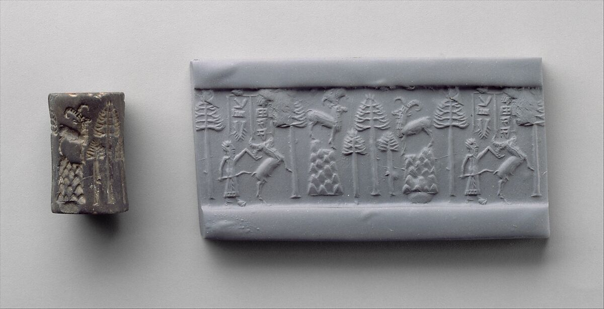
Testifies to the person who sealed an object
Not used by regular people, but kings and priests to prove their legitimacy
Made of stone, to preserve longevity of seal
Neo-Sumerian and Babylonian Art, ca. 2150-1600 BC
Akkadians are conquered by the Sumerians
Sumerians want to redefine what it means to be Sumerian in light of being conquered before
Seated Statue of Gudea (c. 2100 BCE) (Neo-Sumerian) 17”

Often found in temples
Gudea, a Sumerian ruler, remakes temples and places his statues inside
Depicted as wise, grounded, stability, kind
Big eyes to show his devotion to gods, humility
drastically different display of a leader than the ones before
Gudea can be considered a peaceful leader, enacted trade deals, however depiction through statues should not be seen as documentation of a leader
Stele of Hammurabi (c. 1780 BCE) (Babylonian) 7’4”


carved stone, relief at the top
Depicts Hammurabi receiving the law from the gods
- helmet, seated on throne, larger than Hammurabi
God holds a coil of rope and a stick
- symbolic power = build something new and powerful
- tools for building stuff = build a nation through laws
- way to measure (stick) = law, standards by which to live
Hammurabi = oldest known law code and consequences written down
Specific way of ordering society
Covered in writing
The Ishtar Gate (569 BCE) (Babylonian) 15 meters high

ishtar is a goddess in Babylon
Ritual passage, religious entrance
Interior wall made of wood, exterior is glazed pottery to mimic jewelry
Blue to mimic jade
Depiction of some real-life animals as well as fictional creatures
Ashurnasirpal II Hunting Lions (c. 883-559 BCE) (Assyrian)
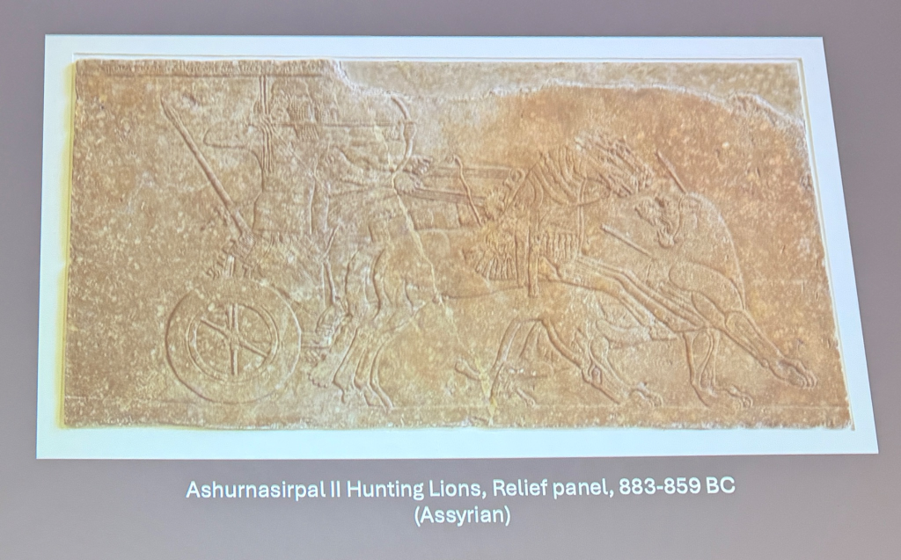
Decorative, schematic and linear depiction of the lion
Hunting animals was not just for food or population control = religious
King expressing dominance over the natural world, ritual display of the king's power
Soldiers and servants would catch a lion, a king would ride out into the courtyard of the citadel and kill the lion for ritual purpose
Relief with Benevolent Spirit (Winged Geni), Palace of Ashurnasirpall II (c. 883-859 BCE) (Assyrian)

Protective creature, guardian, placed by entrances
Body of an ox, fast as an eagle, head of a human
Four legs can be seen from the front or the side, 5 legs in a ¾ view
Really high relief carving
Ancient Egypt (3100-332 BC)
Visual Elements
Hierarchy of scale = Pharaoh is seen as a God
Static = powerful, more dynamic = lower class
Storytelling, guide for the afterlife
Statues as physical tethers to earth
Ancient Egypt
Themes
Permanent monumental architecture
religious/ funerary art
unified kingdoms (cycle of perpetual flourishing and then downfall)
Written language, organization (Egyptian hieroglyphics)
agriculturally based society
The Nile as a source of life
Judgment of Hunefer, from an illustrated Book of the Dead (c. 1290-1275 BCE) (Egyptian)

Book of the dead contains rituals, spells and religious writing, helps the deceased on their way in the after life
Left in tombs or carved into tombs throughout Ancient Egypt
Book evolves, abridgements of texts from hundreds of years ago, incredibly complicated
Hunifer, the dead, led through the underworld by Anubis
His heart is weighted against a feather, if lighter he is able to progress and live with the gods, if not he gets eaten
Palette of King Narmer (c. 3000-2900 BCE) (Egyptian)

Hierarchy of scale shows King Narmer
His bashing someone's head in with a club = Narmer is physically strong and could kill you
Wealthy wore black makeup, kept infections and bugs away
Ritual object or palette for mixing eye makeup, maybe for statues
Wears the crown of both upper and lower Egypt, shows himself as the ruler of a unified land
Unknown if he is an actual person, whether he went by various names
Mastaba (Egyptian)
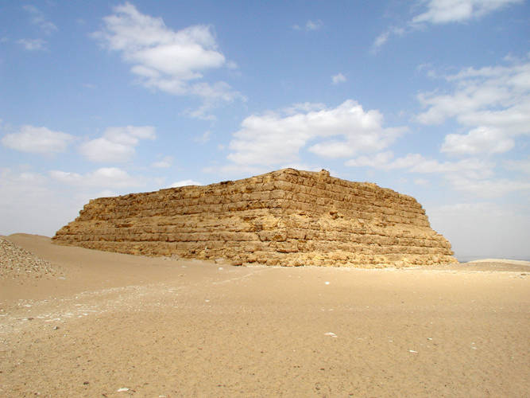
Trapezoid platform containing chapel, offering table, statues, leads down into a shaft, grave
Earliest version of tombs and pyramids in ancient Egypt
Ka = life force, ancient version of a spirit, continues to live after death
- still needs a physical tie in this realm to exist, if not the ka is cut loose and floats around in the universe
- mummies become a physical form that the ka can be tied to
- if king, statues can be built as “insurance” for a mummy, that could be stolen or destroyed
Seated Statue of Khafre, from Giza (2520-2494 BCE) (Egyptian)
Funerary, physical tethers for the ka
Never just a document of a person or their likeness, present the ideas associated with a pharaoh
Kahfre, here is not the point - the embodied power of the pharaoh, with this ensure their life
Headdress, fake beard, pleaded skirt = iconography of a pharaoh
Throne as symbol of his rule
Stiff posture
- Symbolic = eternal stillness, permanent nature
- Made of heavy stone for preservation, pose is confined to the material
- represents class, active bodies seen as lower class, servants are movable

Seated Scribe from Saqqara (2500 BCE) (Egyptian)
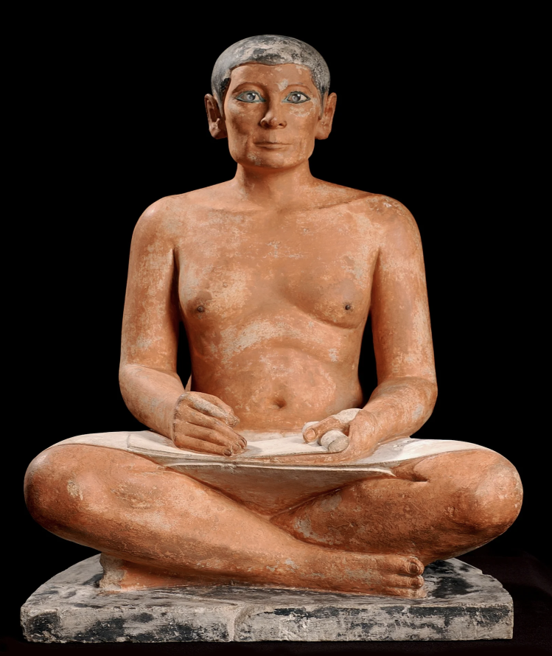
Scribe for the pharaoh in the afterlife
Pharaohs can be mortal and immortal at the same time, versions of the afterworld differ
- afterlife a better version of this one, servants and animals in tombs to help him in the afterlife
- mummies, statues or warriors in the tombs
Depiction of a person's likeness, movement and human body = attributed to lower class people
Middle Kingdom (Ancient Egypt)
Old Kingdom (flourishing of the Ancient World)
2686-2181 BC
1st Intermediate Period (almost falls apart)
2686-2055 BC
Middle Kingdom (unification under one ruler, flourishing of Egypt once again but different)
2055-1650 BC
Kneeling Statue of Hatshepsut, (1473-1458 BCE) (Egyptian)
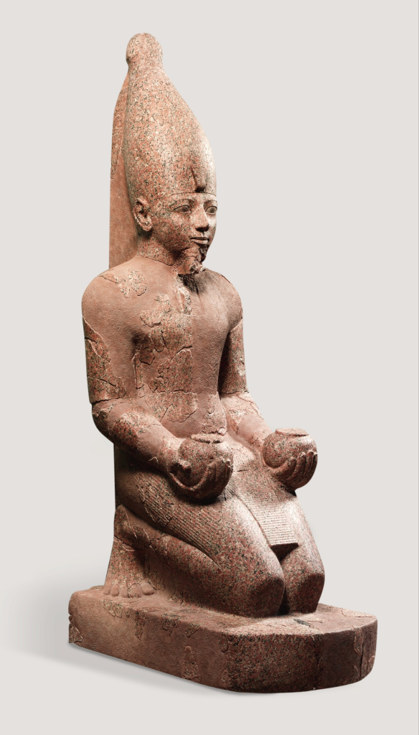
A WOMAN, one of few to rule Ancient Egypt
Daughter of a pharaoh, marries her brother, a pharaoh and becomes the regent, a queen in two different ways, in place for the heir
Goes out to battle, treaties, good ruler = makes herself a pharaoh
- no one can second guess her power,
= Depictions are not of a woman but of a pharaoh, usually a male position
Wears the fake beard in court, but doesn’t pretend to be a man or not be woman but a pharaoh
Colossal Statues of Ramses, Temple of Ramses, Abu Simbel, (1290-1224 BCE) (Egyptian)

65 feet tall statues, seated and static
This temple was moved in the 20th century by the United Nations
Initially completely covered in sand
When the sun rises on summer solstice, the sun covers all the statues, except for one which is a god of the underworld
Egyptians often play with light and the time of day to change and represent the gods
The Amarna Period
Religious Revolution
Akhenaten's father dies, becomes pharaoh and gradually makes changes
Declares that multiple gods don’t exist: only one does = Atin, the god of the sun disc (male and female, androgenous)
He is the son of Aton, moves the capital of Egypt
Cuts off the power of priests, aristocracy = only authority belongs to him and his family
The Amarna Style
Elongated faces, pearshaped bodies,
Not just him that was stylized, everyone, even babies
Strategic choice, not his actual depiction = shows Akhenaten's immense change and separation from the kings of the past
Akhenaten with Nefertiti and their children Amarna Style (1353-1335 BCE) (Egyptian-Amarna Style)

Akhenaton from temple of Aton, Amarna Style, (1353-1335 BCE) (Egyptian-Amarna Style)

Bronze Age Aegean Art and Architecture
Mycenaean = mainland Greece, classical Greece and Rome
Cycladic = The Cyclades (multiple islands)
Minoan = Crete
Cycladic Society
Islands are rich in metal and marble, figure out to use material
Travel allows them to export and trade metal with others
No written language left behind, no major towns or settlements
cemeteries and graves give insight into their lives:
- society with economic diversity
- different amount and quality of things buried in graves
Female Figure, Cycladic, 4500-4000 BCE, 8,5” high

Figures wrapped around abdomen
- meaning unknown but common presentation
Cycladic Figurine, (Cycladic)
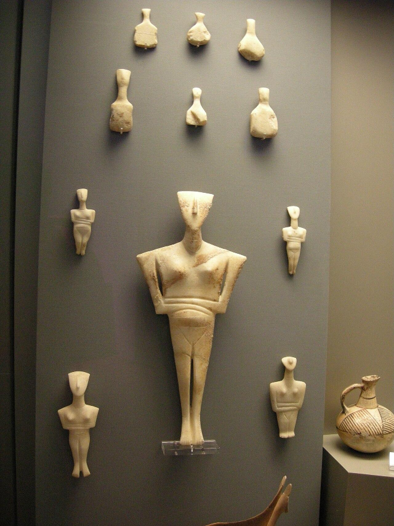
Found in graves but also in nonburial context
- used before being buried
Craved out of marble
Varying sizes
Human figures = most are women
Variety of styles, different emphasis
- facial features, wedge shaped head
Minoan Civilization
Arthur Evans (1851-1941) association with the excavation on the island of Crete
Not a systematic science yet, blow things up, guess what something was and altered objects, restored them
Themes:
ocean, water
women are shown on murals, with makeup and topless, situations of power
Left behind two types of writing:
- Linear A, ancient Minoan
- Jasper Seal, with Minoan Hieroglyphics
= not able to read these languages, not related to Greek
Frying Pan, (Cycladic)

Rare, only a few dozens found
Not used, very good condition
Oceanic decorations, fish, boats, water and waves
Potentially mirrors
Bull Leaping Fresco at Knossos, Crete (1400 BCE) (Minoan)
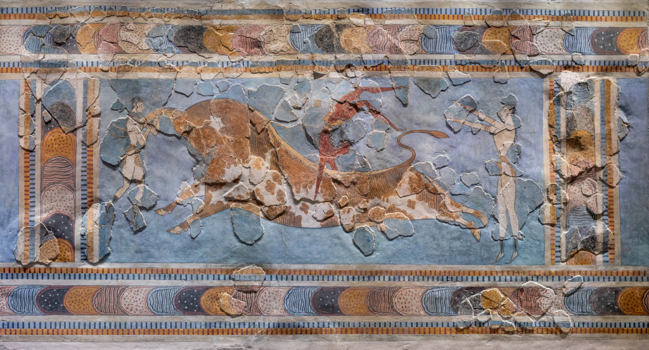
Bull murals
Skin color does not relate to race but gender: women are pale, men have dark skin
Depicts bull vaulting, dangerous
Fresco: plaster and pigment mixed, can last a long time
(often depiction of women on these murals)
Landscape with Swallows (Spring Fresco), Thera (1650 BCE) (Minoan)

Interior room painted as mountains, sparrows
Primary colors
One of the oldest pure landscape depictions not mixed with other subject matter
The Harvester’s Vase, (1500-1400 BCE) (Minoan)


Found at a burial site
Relief on top of pottery
Depictions of workers, singing, facial features
Work songs, man inhales deeply
No sense of a god, regular people doing regular work (genre art, ahead of its time)
Snake Goddesses or Priestesses, Crete (1500 BCE) (Minoan)
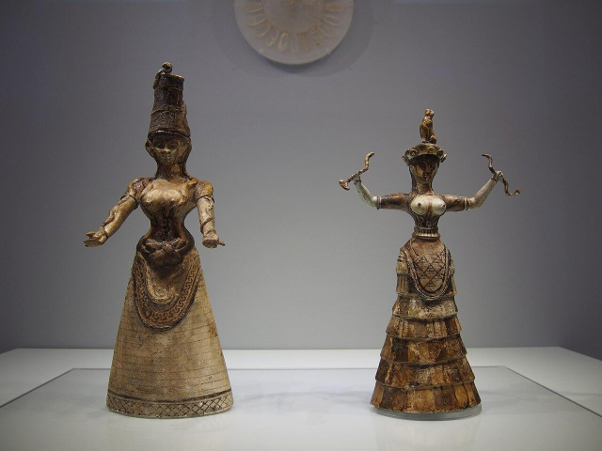
Interaction with dangerous animals as sign of power
breasts are open
Mycenaean Civilization
1750-1050 BCE
Mainland Greece
Most powerful
Heinrich Schliemann (1822-1890)
Not archaeologists like Evans
Claims the Ilyad and The Odyssey, the war at Troy is true
Discovers the city of Troy, evidence of warfare
Inspires Evans to go to Crete
Gold Death Mask (Mask of Agamemnon), 16th century BCE

Schliemann claims it to be Agamemnon, but unknown
less skilled than in Ancient Egypt. broad shapes instead of definition