audiology concept check and homework
 Call Kai
 Learn
Learn Practice Test
 Spaced Repetition
 Match
Match Flashcards
 Knowt Play
1/40

There's no tags or description
Looks like no tags are added yet.
Name | Mastery | Learn | Test | Matching | Spaced | Call with Kai | Chat |
|---|
No analytics yet
Send a link to your students to track their progress
41 Terms
A sensorineural hearing loss is characterized by:
Option A
normal air conduction and abnormal bone conduction.
Option B
normal air conduction and normal bone conduction.
Option C
abnormal air conduction and normal bone conduction.
Option D
abnormal air conduction and equally abnormal bone conduction
d
The purpose of a hearing screening is merely to identify those individuals who need further testing.
True
False
true
It is equally accurate to describe the degree of hearing loss by either dB or percentages; it is merely a matter of preference.
True
False
false
A response of 25 dB HL at even one frequency constitutes a failure.
True
False
true
For each tone generated, there are two critical components to be considered when marking an audiogram. They are:
Option A
Hertz and pitch.
Option B
intensity and loudness.
Option C
frequency and intensity.
Option D
frequency and Hertz.
c
The pure tone average (PTA) is the average of hearing threshold levels from:
Option A
1000 Hz, 2000 Hz, and 3000 Hz.
Option B
250 Hz, 500 Hz, and 1000 Hz.
Option C
500 Hz, 1000 Hz, and 2000 Hz.
Option D
2000 Hz, 3000 Hz, and 4000 Hz.
c
Otoscopy allows the examiner to view the:
Option A
stapes.
Option B
oval window.
Option C
external ear canal.
Option D
pinna.
c
When an acceptably quiet test environment cannot be found, it is acceptable to raise the intensity to counteract the background noise.
True
False
false
Abnormalities that can be visually observed can signify the presence of other internal abnormalities.
True
False
true
During air conduction measurement of the auditory pathway, sound is delivered through:
Option A
outer and inner ears.
Option B
outer, middle, and inner ears and then to the auditory nerve up to the brain.
Option C
middle and inner ears.
Option D
outer and middle ears.
b
A __________ procedure is one that requires the client to actively participate in the task.
Option A
behavioral
Option B
nonbehavioral
Option C
behavioral and subjective
Option D
subjective
c
Otoscopy should be performed before air conduction testing.
True
False
true
In bone conduction testing, the signal effectively bypasses the:
Option A
inner ear and auditory nerve.
Option B
All of these are correct.
Option C
middle and inner ears.
Option D
outer and middle ears.
d
A key difference between diagnostic and screening procedures is that the diagnostic test is typically accomplished using a pass/fail paradigm.
True
False
false
Air conduction audiometry provides information regarding the degree of hearing loss whereas bone conduction audiometry provides information pertaining to the type of hearing loss.
True
False
true
An SLP does not need to be concerned with hearing status if the patient already has a hearing aid and had a hearing evaluation done by an audiologist.
True
False
false
The best way to gather information about a client's history is to:
Option A
mail a form home to the family prior to the evaluation.
Option B
ask key questions in multiple ways to ensure understanding.
Option C
have clients sign a waiver to ensure information is not withheld.
Option D
use a premade case history questionnaire, available in a variety of languages.
b
The downward pointing arrow on an audiogram's bone conduction symbols indicates:
Option A
an air-bone gap for those frequencies.
Option B
bone conduction responses could not be obtained at those frequencies.
Option C
None of these is correct.
Option D
the examiner made an error during testing.
b
A mixed hearing loss is characterized by:
Option A
abnormal air and bone conduction responses, with a significant air-bone gap.
Option B
abnormal air conduction and equally abnormal bone conduction.
Option C
normal air conduction and normal bone conduction.
Option D
normal air conduction and abnormal bone conduction
a
A conductive hearing loss is characterized by:
Option A
normal air conduction and abnormal bone conduction.
Option B
normal air conduction and normal bone conduction.
Option C
abnormal air conduction and equally abnormal bone conduction.
Option D
abnormal air conduction and normal bone conduction.
d
According to the class lecture, select ALL of the frequencies that are tested in a pure tone hearing screening.
Option A
250 Hz
Option B
500 Hz
Option C
1000 Hz
Option D
2000 Hz
Option E
4000 Hz
Option F
8000 Hz
c, d, e
The intensity level for pure tone screenings is:
Option A
10 dB
Option B
20 dB
Option C
30 dB
Option D
50 dB
b
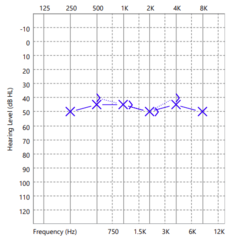
sensorineural
what type of hearing loss is shown?

moderate
what is the degree of hearing loss?

flat
what is the configuration of the audiogram?

47 dB
what is the PTA3?
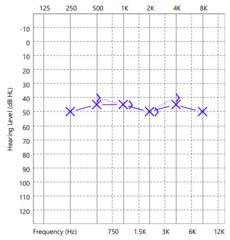
45 dB
what is the PTA2?
conductive
what type of hearing loss is shown?

mild to moderatley severe
what is the degree of hearing loss?

sloping
what is the configuration of the audiogram?

48 dB
what is the PTA3?
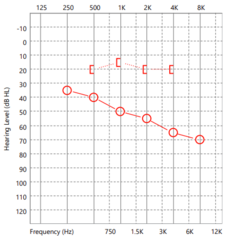
45 dB
what is the PTA2?

mixed
what type of hearing loss is shown?

moderately severe to mild
what is the degree of hearing loss?
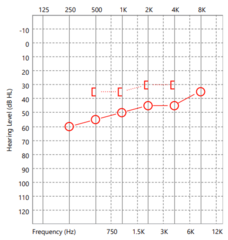
rising
what is the configuration of the audiogram?

50 dB
What is the PTA3?

48 dB
What is the PTA2?

describe the hearing lossbilateral, sloping, mild to severe, sensorineural hearing loss
describe the hearing loss
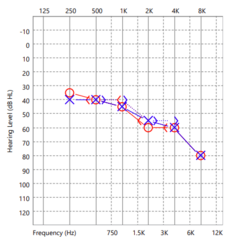
describe the hearing lossbilateral, sloping, mild to moderately severe, conductive hearing loss
describe the hearing loss

bilateral, sloping, moderate to severe, mixed hearing loss
describe the hearing loss

bilateral, sloping, moderately severe to profound, mixed hearing loss
describe the hearing loss
